From asking a general translation question to finding a place to order food, we can handle almost anything by typing a phrase or prompt. But if the context is unclear or the information is poor or inaccurate, it can lead to confusion and challenging situations. It will be hard to trust the application and use it for complex projects.
If an agentic AI system can’t keep the previous conversation in memory, it will keep looking for relevant data and information. Relying solely on text prompts without input validation and safeguards can enable malicious activity, vulnerabilities, and prompt injection attacks.
Sometimes the commands that are embedded may create persistent issues. In this blog, we cover the most popular prompt engineering techniques for AI systems to ensure consistent responses.
Why Prompt Engineering Requires More Than Writing a Prompt?
Writing a prompt is a skill; it requires an understanding of context, situation, problem, and potential goals. A good prompt comes after multiple changes and iterations because if you write something that violates tool policies, it may not generate responses.
Also, some tools have limits on what they can generate. Sometimes the tools can be biased when we're trying to compare something.
Even if the tools are written correctly, if they don't know the two things are the same, the data is outdated, or people aren't using their own skills and intelligence, that becomes challenging.
Best Prompt Engineering Techniques for Different Use-Cases
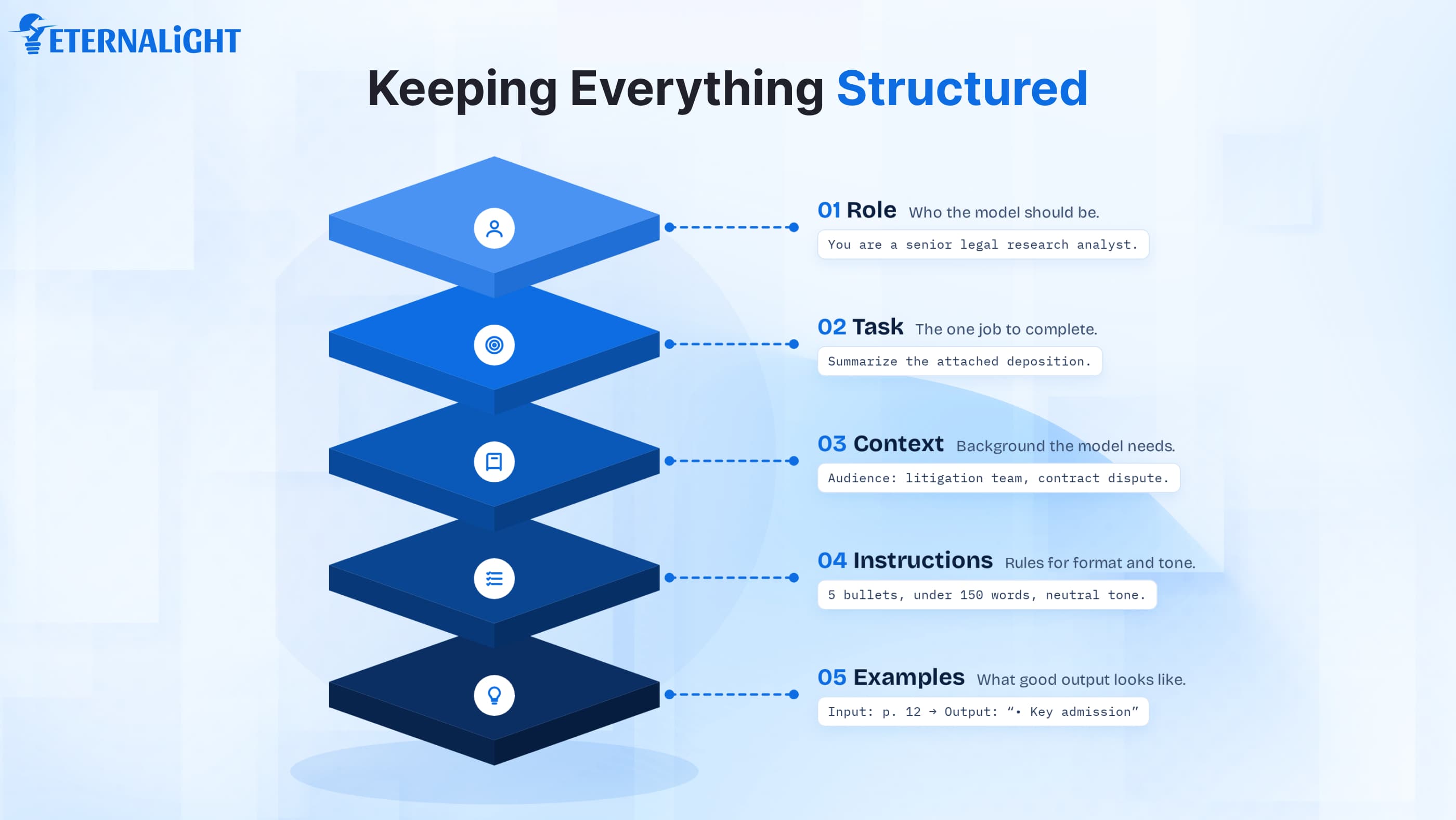
Keeping Everything Structured
When we want to generate output for a complex scenario, we usually break down the prompt by giving the role, task, scenario, things to do, and relevant examples, using simple words to help the tool understand what the user wants and apply restrictions, delimiters, and separate parts of what it should not do.
Domain-specific Content

That is also something we prefer in the real world: my marketing team is preparing a new website strategy and is using AI tools.
Explain what type of industry domain it is. At what stage are they now?
Is it the initial phase, like a new website, or is it an existing site?
How can they improve visibility, connectivity, and ranking across their network on the web? What techniques can they use?
They also asked for tools that can suggest website improvements. They asked what actions the marketing team should take to attract the audience and drive purchases.
If the team embeds RAG in that process, it becomes feasible and reliable by providing relevant responses.
Prompt Compression

Sometimes, to make it highly reliable and accurate, we try to put everything into one prompt, but it becomes too long for a single window.
We try to include enough information by explaining all scenarios in detail, whether the details you’ve given are important or not. Sometimes we use phrases and words that aren’t very relatable; instead of adding value, they create confusion.
It's better to optimize the content length first without losing the real information, then use tools to compress your instructions/prompt. Even when multiple APIs or third-party integrations are included, a short, well-typed prompt with valuable information can save time, token count, etc.
Adaptive Prompting
User queries can be vague and short. If the example you’ve given doesn’t help the AI agent system understand what’s happening in your industry, It can refine its understanding by learning from frequently asked queries, API calls, and behavior.
Active Prompting
Instead of rigidly structuring questions and answers, train your system to handle complex situations by asking multiple questions and keeping the user in sync to avoid hallucinations and inaccuracies. At the end of every response, ask the user what they want to do next and which direction they want to go, and give them options.
Multitype Data Inputs

Sometimes we can’t explain something in text; it can exceed the word limit, so it's better to use images, code snippets, audio, video, or other prompt pics to convey the relevant information.
Chain-of-thought
Do you need assistance or guidance to perform a task and want to instruct an AI model to solve the question exactly to get you out of a puzzled situation?
That technique is leveraged with many tools to deliver consistent, conflict-free responses
Tree of thought
Sometimes, when we have so many ideas and directions for a project, each with trade-offs and entry points, it gets harder to decide. Enable AI tools to adapt this technique to identify the problem, support moves toward the feasible choice, and debug hurdles.
Zero Shot
If a task is clear, straightforward, and well described, we call it zero-shot, which AI models use.
Few-shot
If the task is a bit complex and you want to give out a situation or real-world scenario to achieve your goal, that's called few-shot.
Security Measures
While writing prompts for GenAI applications or other LLM tools, data should be reliable, robust, and free from intruders. If the data is poor, compromised, or easily accessible, it can expose sensitive information.
Because this has happened in the real world- hackers have stolen information, and OpenAI and Claude have acknowledged that these tools affect privacy- it's worth exploring ways to adapt AI data security strategies.
Consider rate limiting, agentic AI compliance and governance strategies, input constraints, and clear disclaimers requiring human review before proceeding with any trade, tax, or financial health action.
Configure test cases, update tools wisely, and write the prompt without exposing personal data such as financial details, credentials, or other sensitive information.
Maintain Quality Through Testing
Tools can catch errors at any time or rely on generic logic and known facts, but let the tool try its own approach in different, unconventional scenarios. Whatever prompt you’re given, it must make sense by automating load testing, regression testing, and functional behavioral patterns.
Why use AI tools?
Definitely to save time and effort. What if the AI agent-based application takes a call independently, implementing its AI reasoning capabilities?
These are a few prompt engineering best practices to try in the real world.
How Do We Manage Prompt Engineering?
We at Eternalight avoid the guesswork and give clarity in a controlled, AI-driven environment. For that, we do prompt engineering like the following:
We keep a set of prompts in different versions to test whether the tool generates the same responses or handles the same test case differently.
Can we schedule prompts based on latency to avoid congestion and generate output faster while applying the constraints?
Observe changes in the initial phase by logging in from different accounts to evaluate whether the AI tool generates proper responses.
We create different versions of the AI tool to track behavior patterns and prompt responses to improve user satisfaction.
Final Words
A prompt is not just a set of words that express your thoughts; it's a skill that involves context, setting boundaries, aligning expectations, and choosing the best prompt-engineering technique for the project's requirements.
You need a clear mindset to write better prompts with multimodal inputs and instructions, apply security measures, and run A/B testing, behavioral testing, and load testing to navigate real-life scenarios.

Ayushi Shrivastava
Senior Content Writer
Ayushi is a Content Strategist at Eternalight Infotech with 4 years of experience in transforming complex ideas into clear, engaging, and SEO optimized narratives. She specializes in crafting impactful content strategies that enhance brand visibility and drive meaningful engagement across digital platforms.
Related Blogs
- AI & ML10 Mins
AI Doesn't Forget. It Loses Context: How Context Graphs Can Help
Learn how context graphs help AI agents connect information, retain context, and make better decisions with AI memory tools and retrieval systems.
- AI & ML10 Mins
How to Test Generative AI Applications: A Practical Guide to Reliable AI Systems
Learn how to test generative AI applications for accuracy, hallucinations, performance, security, RAG workflows, and reliability.
- AI & ML10 Mins
AI Data Security Strategies: 8 Ways to Protect Data in AI Systems
Explore 8 AI data security strategies to protect sensitive data across prompts, AI models, RAG systems, APIs, access controls, storage, and outputs.