It's become common to take our phones out of our pockets whenever we are stuck in a situation or need to make a plan and give them a prompt. Some AI tools have restrictions: they can convert text to voice or text to image, or they can only read it aloud for you.
For ideation and planning, you need to take help from different tools.
How efficient and convenient would it be if you could make the best decision by using one tool that can research, read, ideate, generate responses in text, voice, and video, compare, and solve your problem at the same time?
AI has evolved; now there's no need to rely on multiple models to analyze, process, and handle operations autonomously.
With the emergence of multimodal AI tools, you just need to provide prompt definitions of your situation and problem, and these multimodal systems will generate the required information by understanding different types of context and content.
This blog focuses on understanding what multimodal AI is.
How does it work?
And why is it in the spotlight, making businesses adopt it and implement next-gen product engineering?
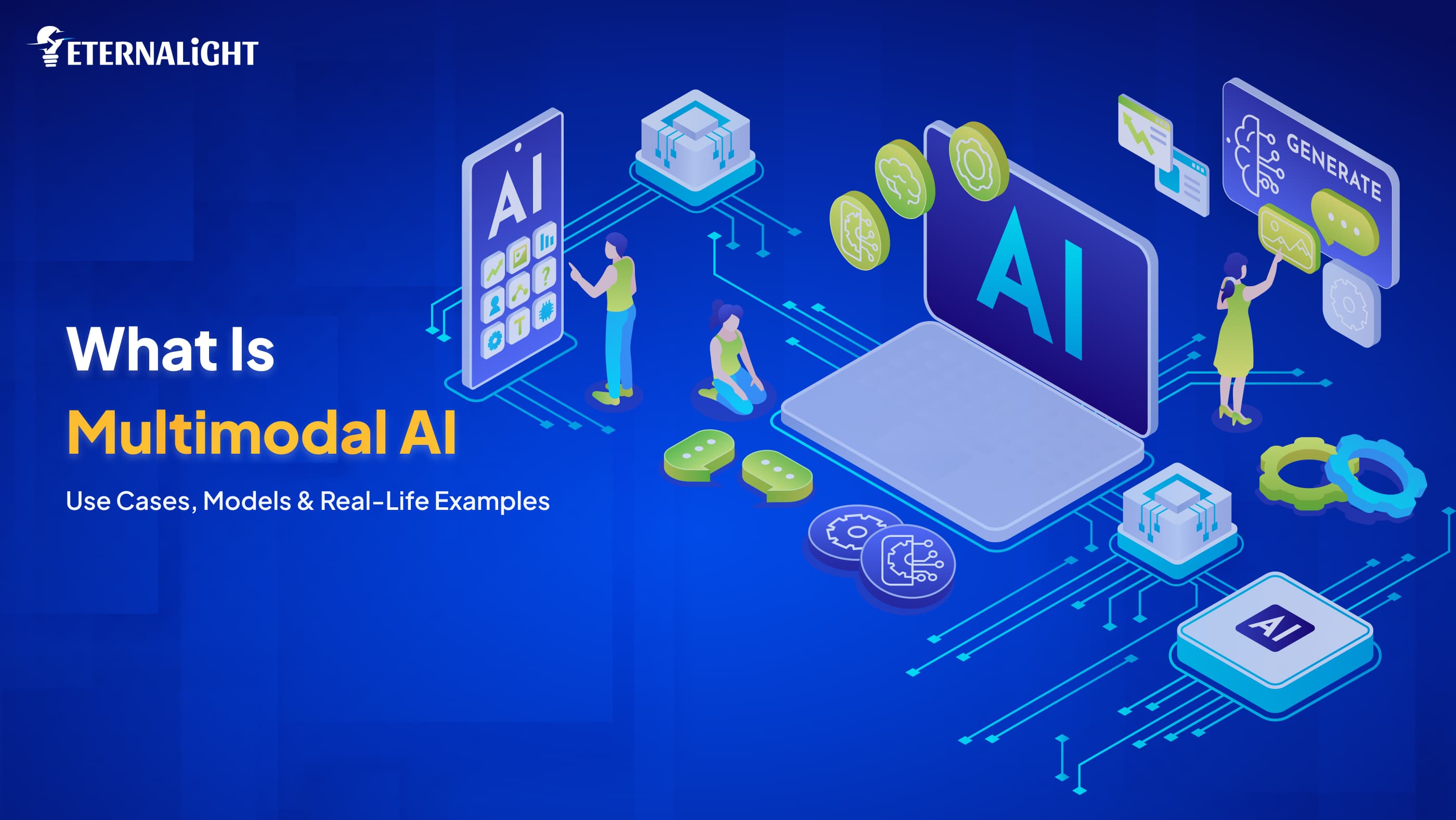
What is Multimodal AI?
Multimodal AI: the term itself defines its context to some extent, as there are different types of AI models. Its capabilities are not limited to generating text, images, audio, or video separately. Multimodal AI can combine different types of inputs and produce a richer output by understanding the context between them. You’ll see the difference in outputs between unimodal and multimodal AI systems.
How Do Multimodal AI Models Work?
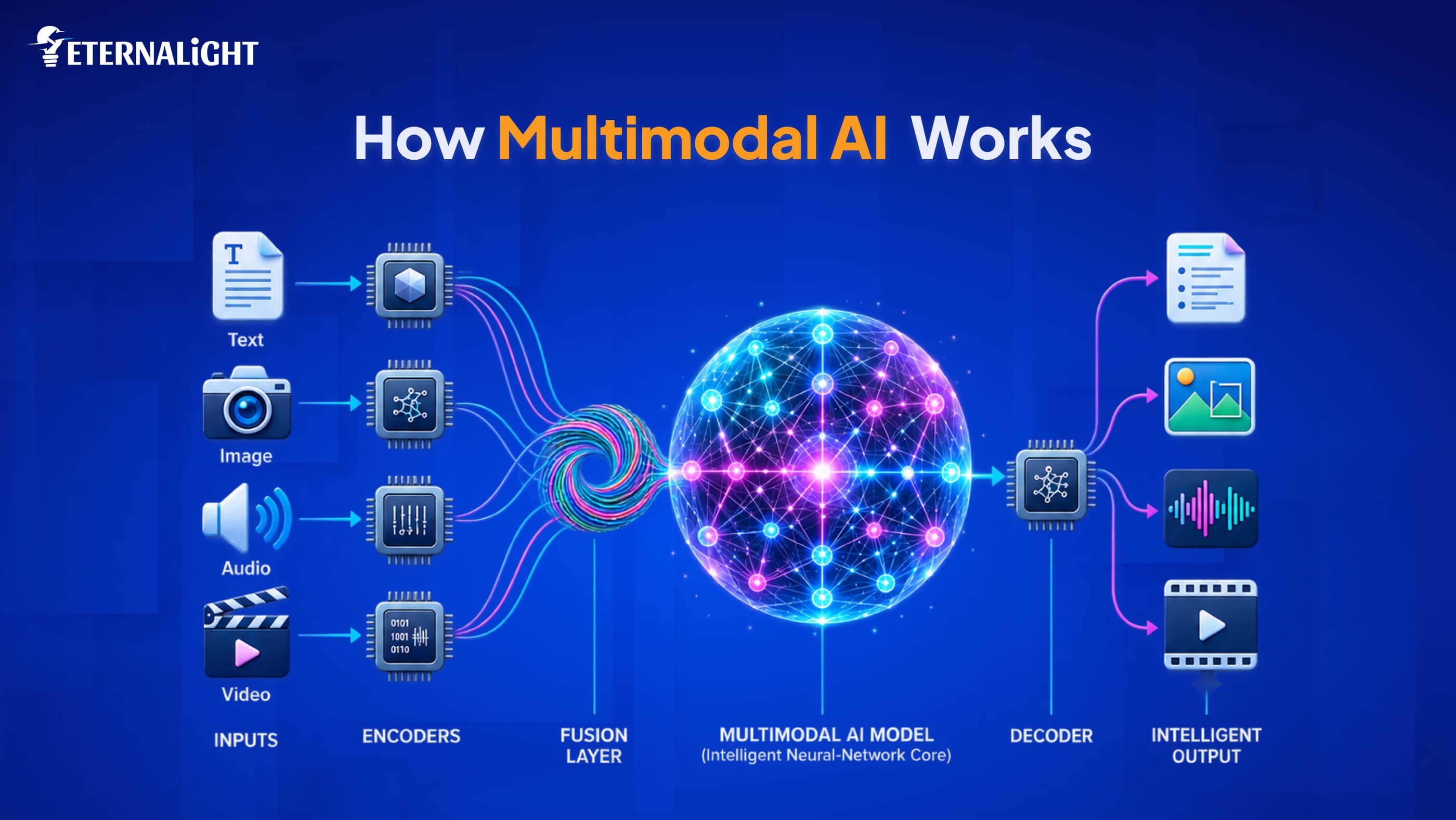
As humans, we have 5 to 6 senses to understand our surroundings and respond accordingly. Similarly, multimodal AI models combine different AI models to perceive multi-format information such as text, images, videos, and audio. They collect, analyze, and process the data to generate output without human intervention.
Modern AI systems such as ChatGPT, Gemini, and Claude can work with multiple input types, depending on the model and interface. This reflects the broader shift from text-focused AI toward multimodal systems that can understand and connect information across formats such as text, images, audio, and video.
Across healthcare, ecommerce, retail, and other domains, businesses have AI, IoT, ML, and data analytics-enabled devices that collect enormous amounts of data. Multimodal AI has immense potential to make the process more efficient and interactive with its multiagent capabilities.
Not all founders and users can write code snippets or identify objects; these models let them interact through gestures, images, or voice to interpret information.
We all have different requirements at the moment, and each has a different path toward working with AI models in their respective domain, so use cases come in different forms.
At a high level, a simplified multimodal AI pipeline can be understood through four stages: data inputs, encoders, fusion, and output generation. The exact architecture varies across models.
Encoders
As we know, systems can't read and process the same type of data; they only receive it as binary, specific code languages, vectors, or embeddings. Data can be text, audio, or multimedia video; each type uses different encoders.
Image Encoders
Since an image is a combination of pixels, an encoder converts it into a vector by capturing the image's object properties.
Text Encoders
Turning useful raw text into embeddings using transformer models in numerical formats, which can align with the model for further processing and fit with different modalities.
Audio Encoders
Identify the patterns, tone, pitch, and rhythm from raw audio files to machine-readable vectors. These encoders can also understand the context.
Fusion
After receiving the embeddings, developers use this fusion technique to simplify different data types or modalities. Each phase uses different strategies.
Early Fusion: Combine all modalities first, then process each modality.
Intermediate Fusion: Compress the data modalities to arrange them without consuming much space, and then process them
Late Fusion: Separately process the modalities and then, in the final stage, combine the outputs
Hybrid Fusion: Combination of different approaches with respect to multiple stages to get rich outputs
Decoders
The decoder, or output-generation stage, uses the combined representation to produce the required response, such as text, an image, an action, or another machine-readable output.
Here, three frameworks work together to produce the required outputs, understanding the context and content received from different modalities in vector form.
Multimodal AI Benefits: Why Businesses Are Adopting It
When multimodal models come together, combining the capabilities of different modalities, they not only accelerate efficiency but also solve complex situations and perform versatile tasks.
From medical to retail to e-commerce to software development, these multimodals can analyze, diagnose, and process information using their problem-solving skills.
Multimodal models can assess different modalities and input data formats by recognizing patterns and behaviors, responding like humans, and understanding context and situation.
You can rely on multimodal outputs because they reduce the mistakes of uniform models that understand only one or two modalities; multimodals are comparatively more accurate.
Whether it's graphic design, content creation, or another domain, multimodal AI agents capture data from different sources and provide relevant suggestions, unlocking new avenues for innovation.
Because multimodal AI agents can gather context and input through AR/VR, voice, and virtual assistants, they can deliver a personalized, intuitive, interactive experience in rich form.
Multimodal AI Challenges
We are impressed by the versatile capabilities of multimodal AI tools because they have reduced dependence on different agentic AI and AI assistant tools. However, integrating multimodal AI in real-world applications is quite difficult. Listing down the challenges here:
Time
It takes time to train models to get accurate outputs, especially when extracting from a massive amount of data.
Conversion
Whether it's a voice recording, text, video recording, or audio, each has different intensity, tone, and pitch, which are difficult to simulate or fuse into a desirable format for wide-scale representation.
Privacy/ Ethical Risks
AI tools store user inputs and can use them in future sessions to generate responses. No matter how well you command these tools to wipe the data, it's hard to trust them. If they’re not trained well to apply required federal rules and security standards, they can expose sensitive information.
Multimodal Translation(Language/ Format)
Data received in many formats can come from different regions and languages; understanding these inputs and capturing their semantic information for further representation is difficult.
Bias and Fairness
These multimodal tools can be biased sometimes based on gender, role, domain, or religion. The data shouldn’t harm anyone’s sentiments, financial values, or societal reputation.
Time, situation, and formats should align well; otherwise, AI systems may throw unnecessary blockers.
Multimodal AI Use Cases
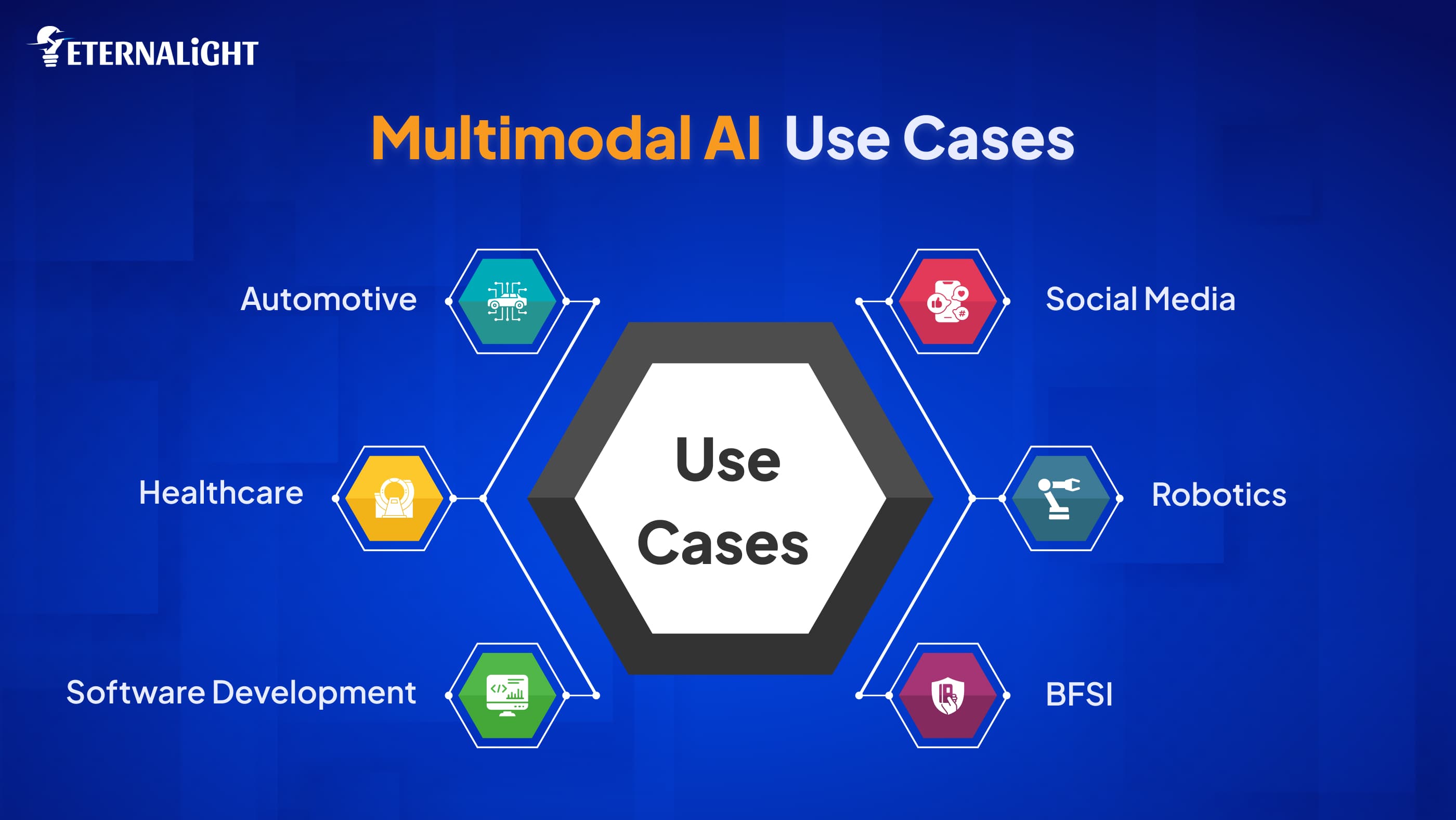
Each innovation is like two sides of a coin; one is considered auspicious and advantageous, while the other involves risks. Likewise, multimodal AI agents exist. Despite this, here we discuss multimodal AI use cases that are relevant and visible in the real world.
In the Automobile Industry: Self-driving and automated cars are being launched that can efficiently interpret gestures, leveraging sensors to capture instructions and surroundings without losing control.
In Healthcare: Scanning patient reports, injuries, and medical history was possible before multimodal AI, but now we use separate tools; multimodal models can do it all at once and generate final reports.
AI-powered Development: Optimizing the outputs of uniform chatbots and voice assistants for more accurate and rapid responses.
Social Media: It can understand different modalities and use them as needed, extracting key information to improve content performance and visibility.
Robotics: Robots are machines; they can't understand context and behavior or deliver responses without multi-agentic capabilities.
BFSI: Discover inefficiencies, anomalies, and unauthorized access; enforce strict access attempts by blending an additional layer of authorization and authentication.
Top Multimodal AI Model Examples Trending Now in the Industry
GPT-5
GPT-5 is an upgraded version of GPT launched by OpenAI, enhancing reasoning and analysis capabilities. It's a multimodal model that syncs the conversation and understands user intent for spatial, video-visual-based parameters, product manuals, user guides, screenshots, etc. It generates responses in vectors, photos, graphs, and diagrams, and can address reading ambiguity and errors in less time.
Claude
Launched by Anthropic, combining the capabilities of Claude Sonnet 5 & Opus 4.8. It’s similar to Gemini Pro for long documentation analysis and time-consuming transcripts, with better document parsing to research and understand visual representations, diagrams, and papers; best applicable in latency-sensitive applications.
Llama 4
As big tech giants have launched multimodal AI tools, how could Meta stop itself? They also want to take the lead, so they launched Llama by leveraging active parameters in two versions, Scout and Maverick, for larger context on text-based models with self-hosting, an open-weight license, and native multimodality.
Gemini Robotics 1.5
It's a collaborative tool for organizations to execute real-time instructions, combining reasoning and motion for general tasks. It enables better control and unique instances of visual understanding and perception, traversing the boundaries without wasting time on training.
Gemini 3 Pro
It's a flagship multimodal model launched by Google, built on exceptional reasoning and upgrading the experience of Gemini 2.5 Pro with better visualization, longer context, and text windows. It combines log parsing, planner AI, an encoder, and a reasoning engine to prepare the outputs by refactoring proper code analysis and tool orchestration.
The Future of Multimodal AI
Multimodal AI is just another benchmark that AI has touched. But it has defined and enhanced simulation capabilities in one modality. If we integrate it with AI systems that improve their accessibility to understand and act on input, multimodal AI can understand things better in any format, as humans can by default.
Now, AI systems can not only scan and discover the issues but also analyze all modalities, be it voice, text, or image, and also what’s missing and what action needs to be performed next autonomously, without jumping to another system.
It's the combination of perception, reasoning, and acting in AI systems across multiple domains. It's not simply integrating additional tools; it's transforming the experience, unlocking new opportunities to complete tasks on time, and aligning every data format and modality. Developers need to rethink real-world scenarios: how to provide the right information and how users interact with software.
Conclusion
Now, AI tools not only answer predefined questions or queries from a single input but can also understand different modalities, analyze and process them, and provide relevant output in the required format through proper translation.
So far, startups and enterprises have adopted AI tools to manage business workflows, but they rely on different tools. Now the real challenge is discovering solutions and performing tasks efficiently through smart multimodal AI execution. It's time to connect the different modalities and move forward in a real-world system.

Ayushi Shrivastava
Senior Content Writer
Ayushi is a Content Strategist at Eternalight Infotech with 4 years of experience in transforming complex ideas into clear, engaging, and SEO optimized narratives. She specializes in crafting impactful content strategies that enhance brand visibility and drive meaningful engagement across digital platforms.
Related Blogs
 Software Development9 Mins
Why Choose Python for Fintech App Development?
Learn how Python helps fintech businesses build scalable, data-driven applications with powerful support for analytics, AI, APIs, and automation.
- Software Development8 Mins
Is It Time to Build Off the Self vs Custom Software for Your Business?
When should you build custom software? Learn the key signs, costs, limitations, and factors to consider before choosing custom software for your business.
- Software Development11 Mins
Website Security Checklist: What to Check Before It's Too Late
Worried about website security? Use this practical website security checklist to spot common risks and protect your website, data, and users.