New software apps, tools, and integrations attract everyone’s attention, but only for a moment. People aren't sure about the use case or whether it can solve their existing business problem.
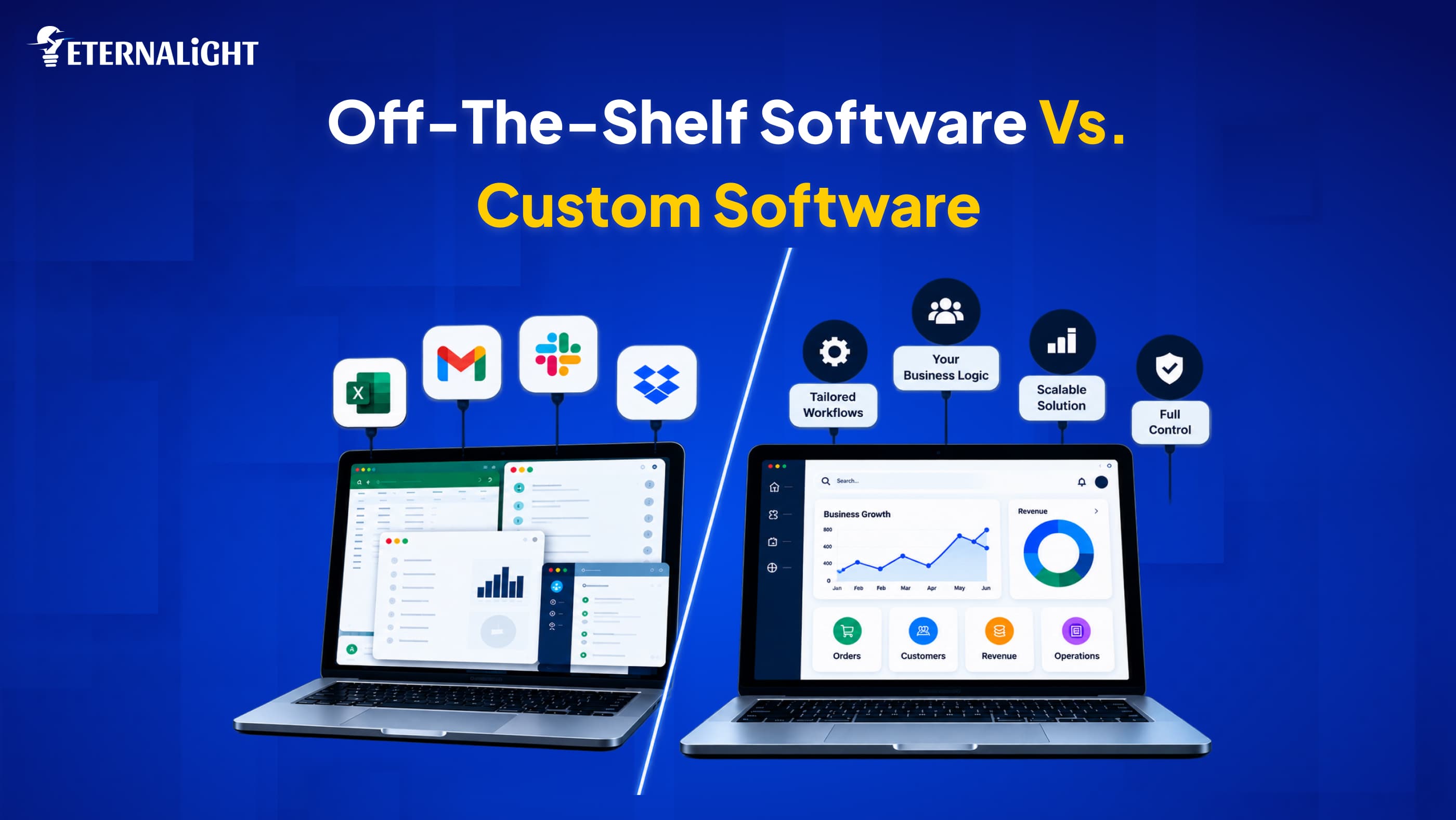
The software development team keeps switching and buying software subscriptions. But soon it becomes a liability. Most founders get confused about whether they should buy or build custom software.
Not all software can support every business operation and workflow. They also come with heavy subscription charges, and a business wouldn’t want to spend much on tools that aren't useful. For every feature, they'll pay at some point; they’ll ask whether they are using a tool to automate their workflow or adjust it.
If the founder decides to build custom software from scratch, aligning it with their business expectations will help them decide which functionalities to customize. Yes, it will definitely need some extra time and effort. For that, they can either outsource to software development companies or set up an in-house team.
When Should You Build Custom Software?
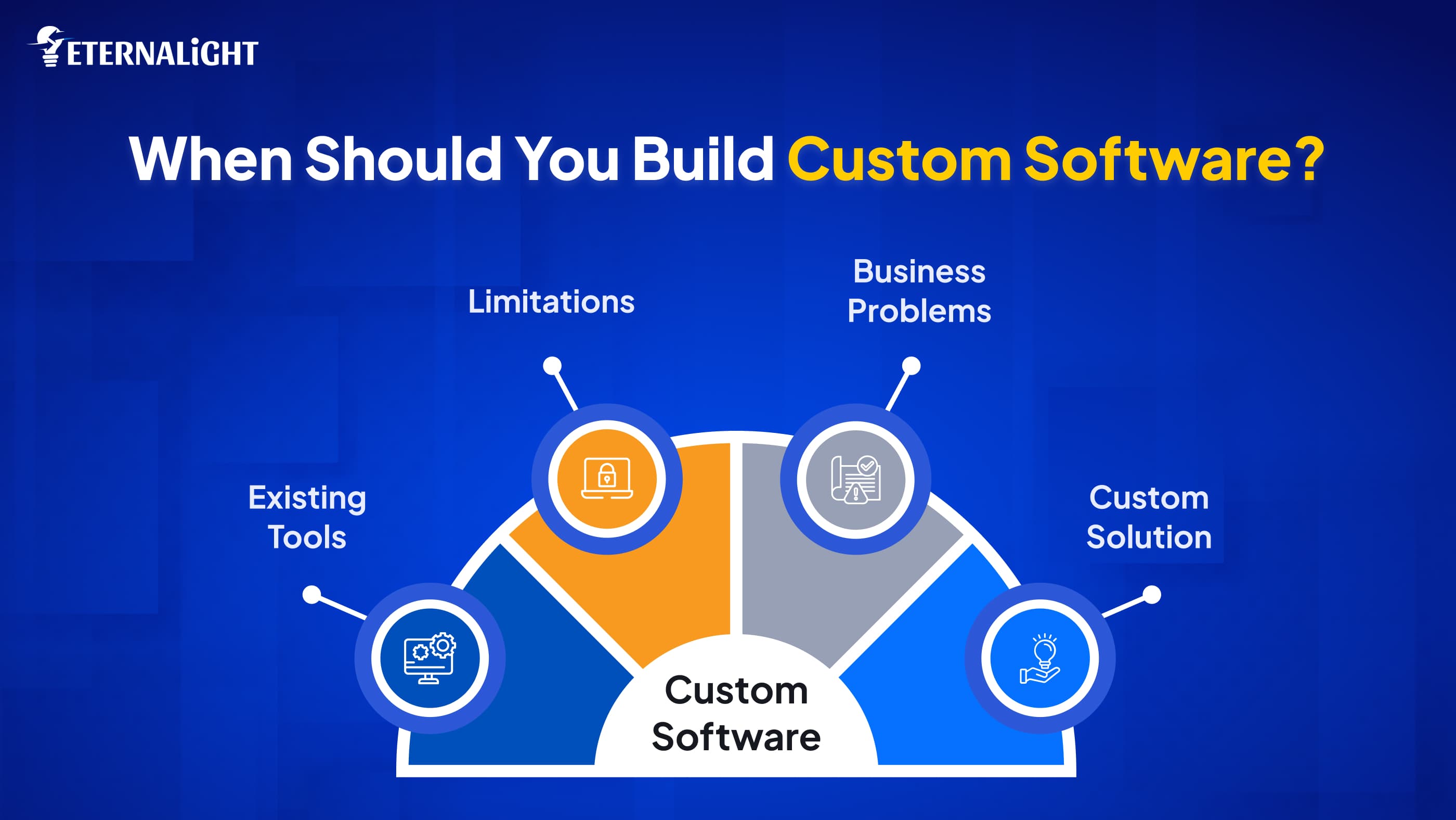
Have you faced any major drawbacks or operational issues because of an inefficient purchased tool or software?
Do you feel it’s a roadblock to your business growth, or is it eating up your budget? To avoid major pain, a founder should decide at the right time so they can stand firm in their domain.
1. Existing Software Forces You Into Workarounds
In an organization, employees handle different responsibilities, even within the same department and position. Whether it's managing spreadsheets, tackling manual record entries, or using AI-driven spreadsheets. If the team isn’t satisfied with the tools and doesn’t want to work around them, it causes friction. If they can't perform because of tool limitations, the legacy software needs to be ditched and rebuilt from scratch, suitable for the whole group with comprehensive accessibility.
2. Your Business Process is Too Unique for Off-the-Shelf Tools
The way your customers interact with your products and services is quite different than your competitors. Off-the-shelf software fits many users, but you know the rules you want for approvals, how to manage reports, and how to control orders and delivery. You may need to adjust costs or handle other exceptions. If the existing software can’t support the customization needed to match your workflow, running the business becomes harder.
3. Your Existing Tools Don't Integrate Well Enough
Technology and tools never become outdated; market dynamics evolve, and to reach global business, companies look for new approaches. They step out of their comfort zone and adopt cloud and AI-driven integrations, but sometimes that's still not enough. In those moments, companies like Eternalight step up and build custom software with AI agent capabilities.
Employees exhausted by switching between multiple tools to handle different processes get relief with centralized software that speeds up workflows and reduces manual burden.
4. Your Software Needs to Scale With the Business
When a founder starts as a bootstrapped company, they don't think they'll shut down so soon. With each successful project delivery and client validation, their enthusiasm doubles. They start thinking about setting up offices across regions.
Now, managing the business with free tools is harder: they need to do competitor analysis and track daily and weekly reports; at that point, the team needs additional features without permission restrictions.
If the tool becomes a limitation, it becomes a weakness. A tool or software should help to outperform competitors, not become a liability.
5. Security or Compliance Requires More Control
Healthcare, BFSI, and other businesses handle enormous amounts of user data. If they can’t maintain privacy and a smooth user experience while meeting industry requirements, it can disrupt daily operations by triggering complaints and security violations.
That's why they turn to custom software development companies for role-based access, rate limiting, and efficient integrations for data management, syncing workflows, and communication. Custom software doesn’t solve problems unless it has a scalable architecture, well-tested functionality, and strong security and performance.
6. Software Is Becoming Part of Your Competitive Advantage
Custom software is not just an integration to extend functionality. It improves efficiency and helps you win in a competitive space by adding an extra layer of control. A business owner hesitates to buy or build software because of pricing, customer experience, irrelevant workflows, or complex maintenance; instead, they want a standard product to automate regular tasks and support workflows.
7. The Long-Term Cost of the Workarounds Is Higher Than Building
Have you ever checked a detailed subscription invoice, or forgotten it after paying?
When we choose a tool, it comes with different plans and categories, along with accessibility and user-access limits.
Some tools don’t allow simultaneous logins; if two users need access, one has to wait. Small changes can make a difference.
If an essential feature or integration isn't connected well, we need engineering resources to fix the bottleneck.
Consequently, the process gets delayed. Vendor lock-in can be great from a security perspective if only one person manages the tool, but it creates organizational dependency.
When You Should NOT Build Custom Software
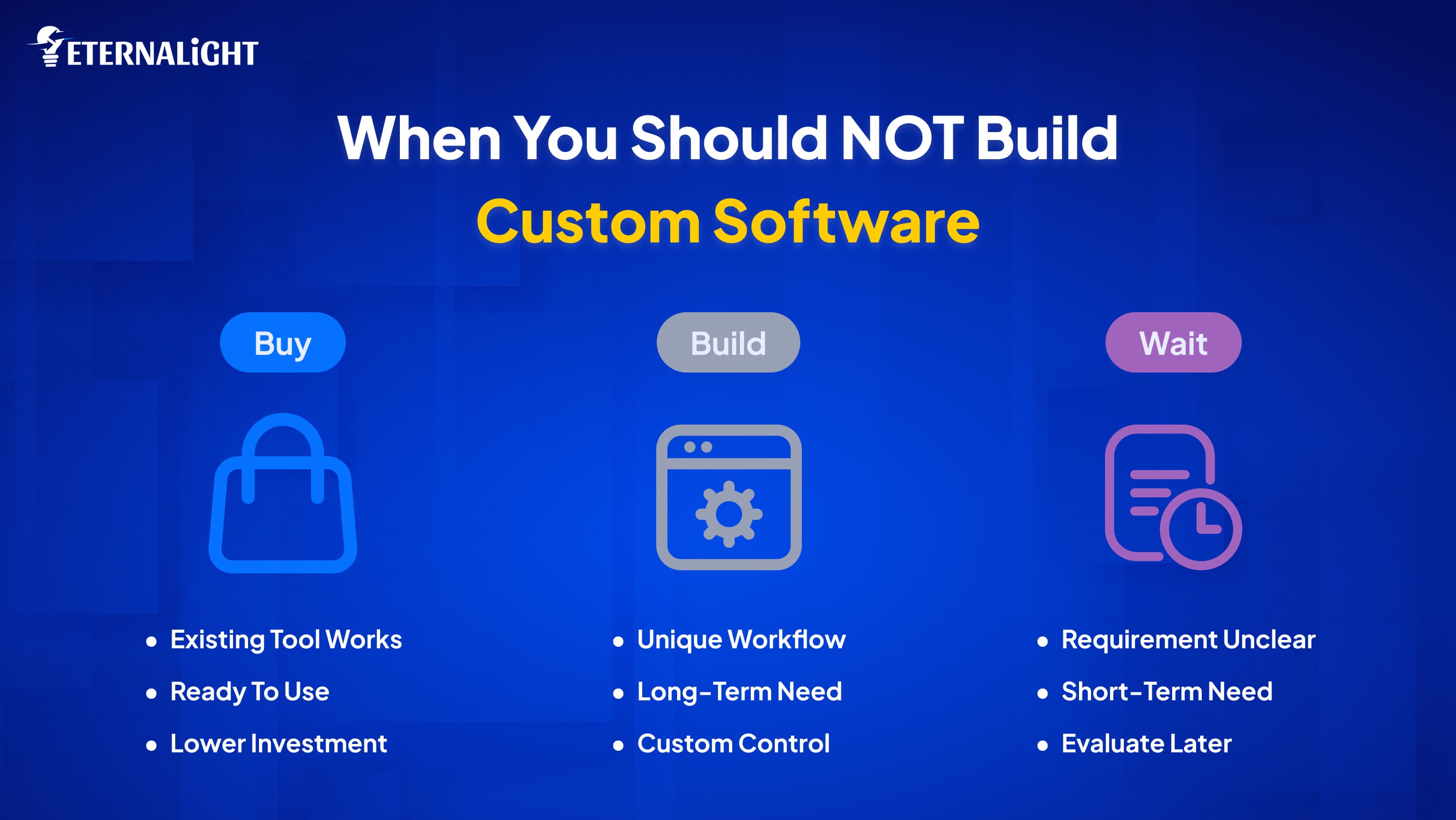
Building any MVP or highly advanced software is a big task. Even the biggest MNCs and enterprise-level companies think twice before investing in custom software development. If you are thinking of building one after getting frustrated with so many tools and their limited accessibility. Ask yourself a few things.
An Existing Tool Already Solves the Problem
Have you explored the cloud-driven, AI-driven tools available for free on the market?
Your Requirements are Still Unclear
Do you know your core business requirements and frequent tasks you do regularly? Do they change over time? Are you still discovering what to do and what to ignore?
You Need a Solution Immediately
Do you think you can manage the process for a few months, then it's better not to waste hours on a completely new software project?
The Process isn't Important Enough to Justify the Investment
If your business is facing a financial burden, it's better not to spend it on another build; save it for essential resources and operational work.
A Simple Way to Decide if Custom Software Is Right for You
Do you have a specific niche and business operations that made you pause on off-the-shelf software and consider building a custom solution around your business problem?
Do you want centralized control across all the data, features, functionality, reports, and updates?
Is it becoming difficult to change internal processes?
You want to scale accessibility in the future, but off-the-shelf software restricts or limits it, and if they allow that, it's expensive.
If the company is in fintech, healthcare, or any industry where data is the primary asset, custom software becomes crucial to avoid vulnerabilities.
Off-the-shelf software can look generic and offer a poor user experience; it may also lag or share organizational data, so custom software is often best to avoid a breach of trust.
What to Do Before Building Custom Software

You’re unsure whether to stick with subscription tools or build your own. To make this decision easier for you, you should consider a few things:
Identify your business requirements in advance and understand the core process that off-the-shelf tools can't support. No need to invest time and effort in building functionality that can’t add any value.
Building custom software is a crucial investment that will impact your funding. Before moving to development, calculate how much you spend on all relevant tools over a certain period to reduce your manual workflow burden. Will building custom AI software be financially practical, or will it exceed the budget?
Review the tools and integrations to confirm they are compatible with your existing system and can manage data without affecting the user experience. If you don't think these tools are a good fit and you need to build your own, go ahead.
Do you need quick support for short-term business issues that came up unexpectedly and won’t be needed later? If the requirement persists, you can hire custom software development services.
Conslusion
Building custom software can be a wise move when generic software fails to solve your business problems. But before you start development, research the essential features, data sources, development team, tools, security, and compliance requirements.
You shouldn't focus on establishing yourself as an innovator just because you're building custom software. The real purpose is to solve the business roadblocks you're facing, not to keep adjusting your processes around different tools.

Ayushi Shrivastava
Senior Content Writer
Ayushi is a Content Strategist at Eternalight Infotech with 4 years of experience in transforming complex ideas into clear, engaging, and SEO optimized narratives. She specializes in crafting impactful content strategies that enhance brand visibility and drive meaningful engagement across digital platforms.
Related Blogs
- Software Development11 Mins
Website Security Checklist: What to Check Before It's Too Late
Worried about website security? Use this practical website security checklist to spot common risks and protect your website, data, and users.
- Software Development7 Mins
From Off Track to Success: Custom Software Development Challenges to Fix Early
Custom software projects don’t always go as planned. Learn which challenges to catch early before they become costly problems for your budget, scope, and product.
- Software Development8 Mins
Product-Market Fit vs Revenue: What Should Indian Startups Chase
Product-market fit vs revenue: What should Indian startups focus on first? Explore the right metrics, customer signals, and growth priorities at each stage.