Fintech products are now capable of processing transactions, securely managing customer data, integrating different banking systems, and adopting new AI and ML product functionalities. Consequently, in rapidly evolving markets, businesses require technologies that allow them to quickly customize their products to serve their ever-changing needs.
Python has gained immense popularity in the fintech domain for allowing developers to build fintech applications quickly and for its automation and AI capabilities. Also, the availability of several add-ons and customizable building blocks has made it easier to create the required integrations.
From Python's perspective, its popularity among developers is justified. However, challenger frameworks often provide a better fit for specific cases. If teams prioritize understanding the gaps and the risks associated with each technology, making an informed choice will be easy.
Why Python Fits Modern Fintech Development
Fintech products are no longer restricted to basic banking or payment systems. Newer technologies rely on data that is constantly changing, automation tools, predictive modeling, and machine learning systems to combat fraud. These products also try to deliver personalized experiences to each individual customer. This results in the need for technologies that allow application development to be combined with data processing and workloads.
Python helps in this situation as it has numerous tools and libraries that vastly simplify backend development, data science, the skills of machine learning, and automation tools. Django and FastAPI can be used for application backends and APIs, respectively, and libraries like Pandas, NumPy, and scikit-learn can be used for financial data and for intelligent feature development.
Flexibility is also another huge advantage of using Python in Fintech. A Fintech product can use Python for its backend systems and use it to connect to third-party services like machine learning, payment APIs, banking systems, analytics, etc. This gives Python a huge advantage in most phases of the development cycle of Fintech products, from building a basic MVP to extending a complex financial system.
Where Python Adds the Most Value in Fintech Development
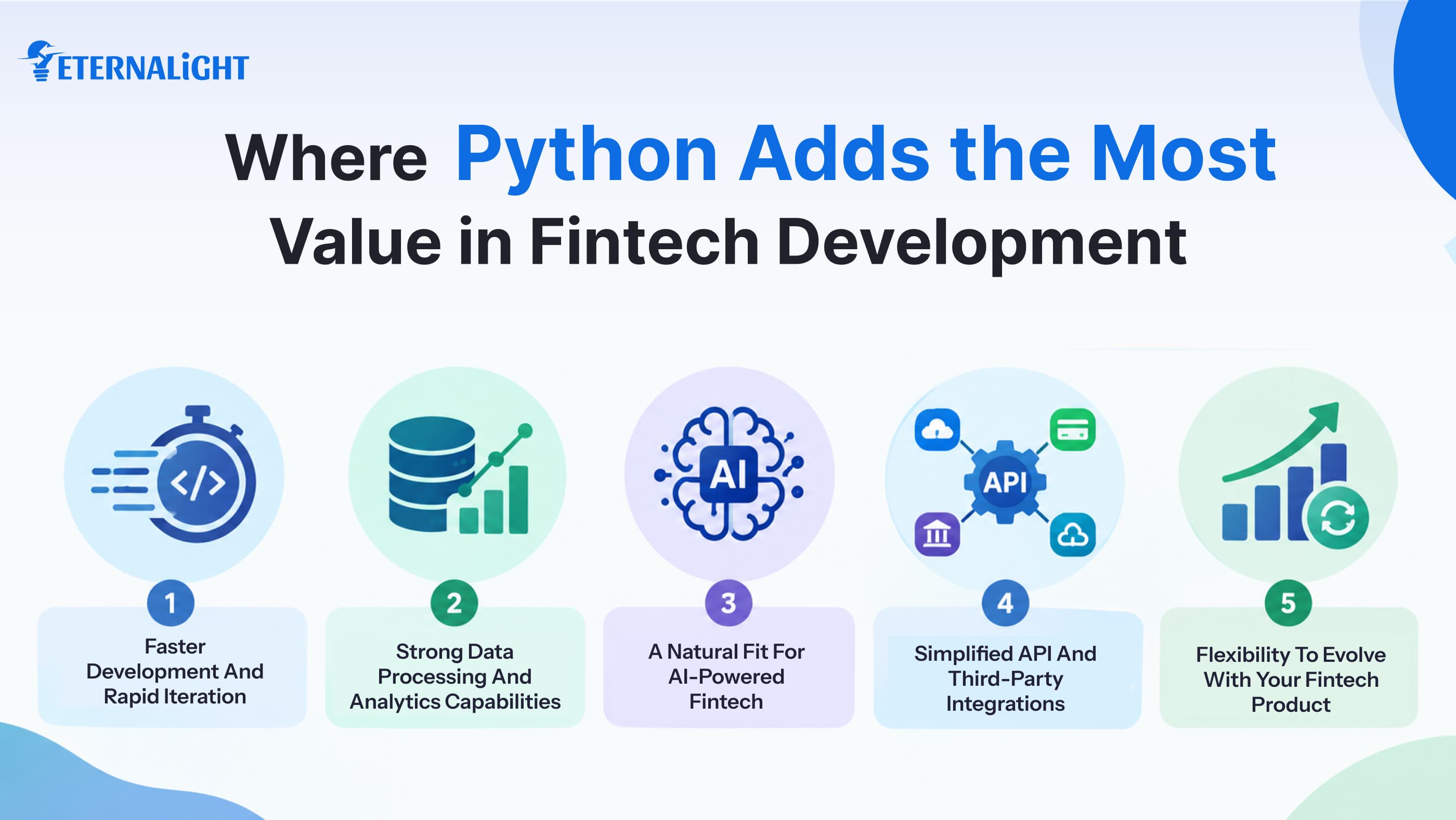
Python has a lot to offer beyond its simple syntax. With support for AI and extensions, it is flexible enough for numerous types of financial technology solutions.
Faster Development and Rapid Iteration
Fintech solutions need to be adaptable as customer needs, market conditions, and regulations are constantly changing. Features can be built more efficiently thanks to Python's concise syntax. Python frameworks and libraries mean there's less need to code features from scratch. This is especially helpful when building fintech MVPs, APIs, dashboards, and automated financial tools.
Quick development does not mean sacrificing good development practices. Developing features with security in mind means features still need testing, code reviews, validation, and compliance. Python is an amazing framework to build a foundation for features and design if your fintech solution needs them.
Strong Data Processing and Analytics Capabilities
There is a lot of variety in the data that financial applications deal with. This data may be structured or unstructured. Some common types of this data may include records of transactions, customer and vendor data, payment data, market data, credit data, and various data concerning risk.
Many financial applications rely on Python for data processing and analytics. Financial applications may use the Pandas and NumPy libraries for data analysis, manipulation, statistics, and calculations.
Financial Reporting, Analysis of Customer Behavior, and forecasting. These capabilities can support a number of product use cases. By integrating development with data processing services, teams can now build complete fintech products, with data being a part of a fully integrated system, unlike in the past.
A Natural Fit for AI-Powered Fintech
Modern financial products are employing AI and ML solutions for everything from fraud detection to credit scoring, to predicting customers’ behavior and optimizing financial product offerings and services. When all of these AI solutions come together, combine, and serve a purpose in a fintech product, then Python - and its robust ecosystem of AI and ML capabilities - is the best fit.
Development teams have many Python ML frameworks and UIs available to them to allow them to implement or integrate AI-based solutions and models to better identify abnormal transaction behaviors, underwriter credit, and financial and customer relationship behavior.
There are significantly fewer barriers to AI model deployment and integration within existing fintech and data stacks.
Simplified API and Third-Party Integrations
In general, Fintech apps do not work alone and require interaction with different third-party systems like payment gateways, banking APIs, identity verification providers, financial databases, accounting systems, notification services, etc.
Python offers a variety of frameworks and modules that enable developers to establish connections and communication between different services via APIs. That means that fintech applications can have backend services that will combine several parts of fintech solutions in one system.
For instance, a fintech application can be created in Python that would take information from a banking API, apply the business logic, save the required data in the database, and deliver the result to some other service.
Flexibility to Evolve With Your Fintech Product
Fintech app development can begin from a specific MVP and then progress as more functionality is introduced, integrated, or improved through additional analytics or AI functionality. The versatility of the Python framework makes it possible for companies to enable this progression without tying the product to a single kind of task only.
The same technological stack will enable the backend API, data processing, automation, analytics, and machine learning. Python may be applied in various architectural approaches such as modular apps, microservices, and cloud solutions.
Nevertheless, scalability is not dependent on the language but on the entire architecture, infrastructure, databases, and engineering practices. If used wisely, Python offers enough options for scaling up a fintech product.
What Can You Build With Python in Fintech?
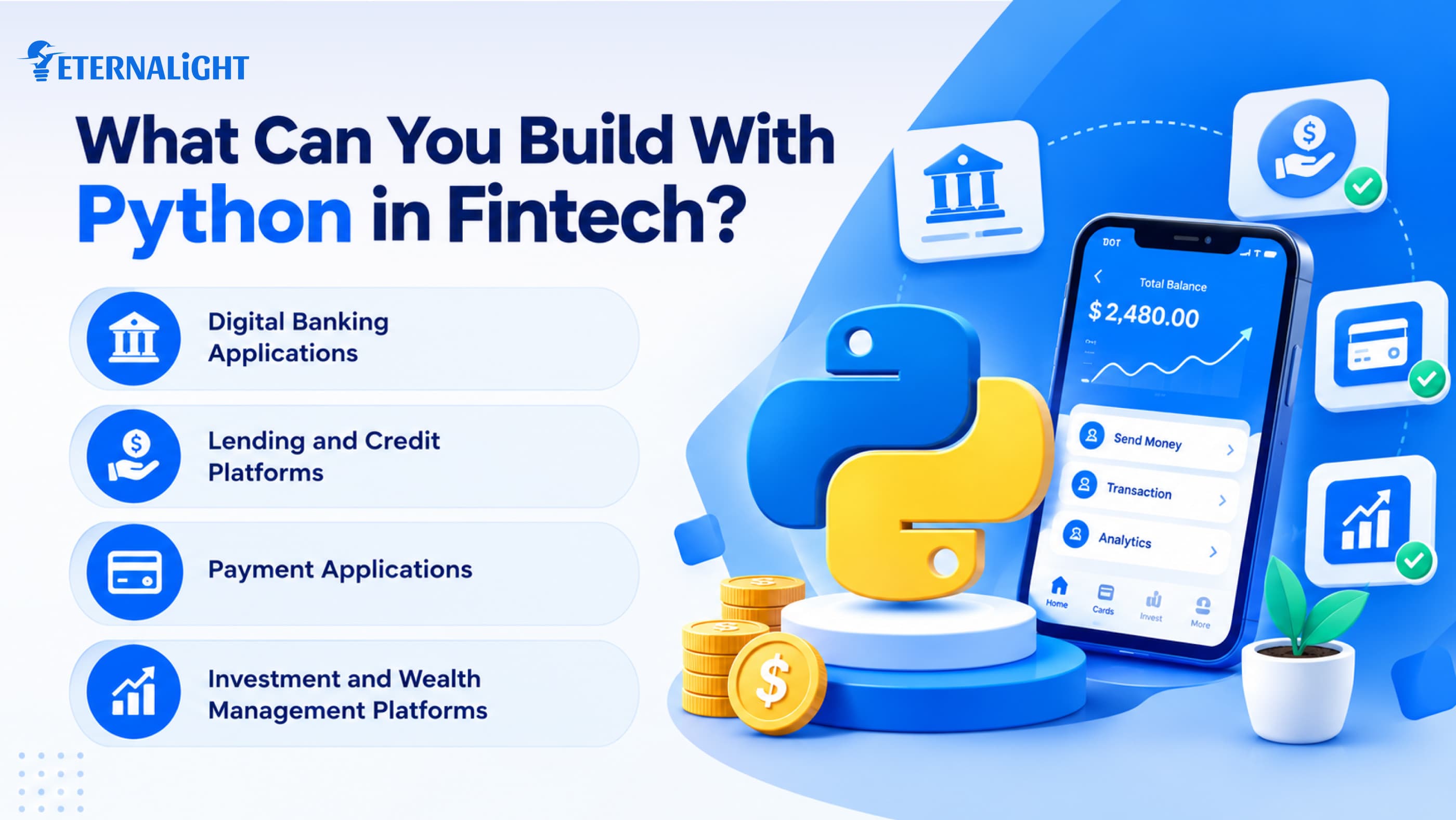
Python’s flexibility enables it to create various fintech apps. Be it banking applications, loan apps, investment applications, and more – Python can enable the creation of apps that incorporate the back-end processes and smart functionalities needed in such products.
Digital Banking Applications
Python is capable of creating back-end systems for the development of digital banking applications that will manage everything from account management to financial services. Such frameworks as Django and FastAPI can allow the creation of APIs and back-end services that enable connections between mobile or web interfaces and banking functionality.
Moreover, Python is capable of providing transaction analysis, automation, financial reporting, and more functionalities that, when coupled with the necessary security and banking functionality, can become the base for a digital banking platform.
Lending and Credit Platforms
Lending systems must handle customer data processing, check the eligibility of the customer, analyze the risk, and manage loan processes. Python is an ideal choice for this as it has data processing and machine learning capabilities.
Python can help in data analysis, score credit, identify the risks, and even automate some processes of loan assessment. It can even integrate lending applications with financial data and identity verification services.
Payment Applications
Applications for payment systems should be able to ensure proper transaction processing and integration with many payment services. Using Python, one may build a back-end API, transaction workflow, transaction tracking systems, and reconciliation.
Being integrated, these applications can connect to payment gateways and other financial services. Using Python, one may implement such functionalities as analytics and fraud detection to keep track of transactions.
Investment and Wealth Management Platforms
Investment and wealth management applications make use of various aspects such as financial information and analysis. Since Python has the capacity to handle data analytics and computations, it will be very useful in this field.
Applications in this field include portfolio analysis, financial modeling, market data processing, risk assessment, forecasting, and recommendations. As such, Python can be used in developing a technology stack for investment and wealth management applications.
When Python May Not Be the Right Choice
While Python is definitely an excellent choice for many fintech implementations, it cannot be considered the best solution for every single task within financial technologies.
For instance, those tasks that demand low latency and performance-oriented calculations will be better executed using other programming languages like C++ or Java.
Thus, a certain part of the system can be implemented using one of the mentioned languages, while another part will work in Python.
Consequently, the recommended strategy will not be to apply Python for fintech simply because of its popularity. Instead, the technology should be chosen according to performance, security, scalability, integration, and business requirements of the system.
How to Decide if Python is Right for Your Fintech App
To begin with, choosing Python for the development of the fintech application starts with the comprehension of its purpose. There might be many situations where Python will be a great choice due to the specific needs of the application.
Consider Python if your fintech application requires:
- MVP and iterative development
- Data processing and analytics
- Machine learning or AI abilities
- Fraud detection or risk analysis
- Multiple API integrations
- Automated financial workflow
- Adaptable technology stack
It is crucial to understand the requirements for performance, security architecture, regulation, number of transactions, infrastructure, and developer skills.
However, there might be cases when the best way to develop the fintech application is through a hybrid/polyglot approach, where Python will be responsible for APIs, analytics, and AI, while another programming language will be used for other parts of the system.
Conclusion
Nowadays, the adoption of Python in fintech app development companies becomes more justified due to the possibility of achieving a quick development process, advanced data-related features, machine learning and artificial intelligence implementation, and multiple integration opportunities.
Nevertheless, the selection of this programming language should be based not only on popularity but on specific product needs. Thus, performance, security, scalability, integrations, and long-term goals of the product development need to be evaluated to choose the optimal technology stack.
In order to develop a financial application, one can create the proper architecture for this task by combining Python and other programming languages and tools.

Kusum Sethiya
Software Engineer
Kusum Sethiya is a Software Engineer at Eternalight Infotech, focused on building clean and intuitive. She enjoys turning ideas into reliable applications using modern technologies like Javascript, React, Node.js , and MongoDB.
Related Blogs
- Software Development8 Mins
Is It Time to Build Off the Self vs Custom Software for Your Business?
When should you build custom software? Learn the key signs, costs, limitations, and factors to consider before choosing custom software for your business.
- Software Development11 Mins
Website Security Checklist: What to Check Before It's Too Late
Worried about website security? Use this practical website security checklist to spot common risks and protect your website, data, and users.
- Software Development7 Mins
From Off Track to Success: Custom Software Development Challenges to Fix Early
Custom software projects don’t always go as planned. Learn which challenges to catch early before they become costly problems for your budget, scope, and product.