.jpg&w=3840&q=75)
Will your current tech stack help you achieve big wins?
How often do you audit your tech stack once, twice, or in a quarter of the year?
Questioning because 50% of founders do the same thing. As projects are successful and capable of driving impact and meeting user expectations conceptually, founders don’t allocate time to auditing the tech stack.
Although startups are at the forefront, they take immediate action to shift and adopt a trend-setting tech stack based on market conditions. Change, evolution, or transformation is the key driver of success. They don’t like to miss the single block that could drive them to success.
If anyone avoids auditing their tech stack, they’re sure to fall behind and pay the price with financial and technical debt. In this blog, we discuss common mistakes, the auditing process for a tech stack, when to audit, why it matters, and more.
Tech Stack Audit: In General, What It Is
After gathering requirements, when a new idea or client project arrives, developers review their tech stack. By "tech stack," we mean all the technologies we use. It includes the tools, components, libraries, integrations, frameworks, and languages essential to shaping the idea into a vision. It affects the organization's productivity, efficiency, and service quality.
Whether it's a startup, a small organization, or a large organization, they need to review their tech stack to ensure successful launches.
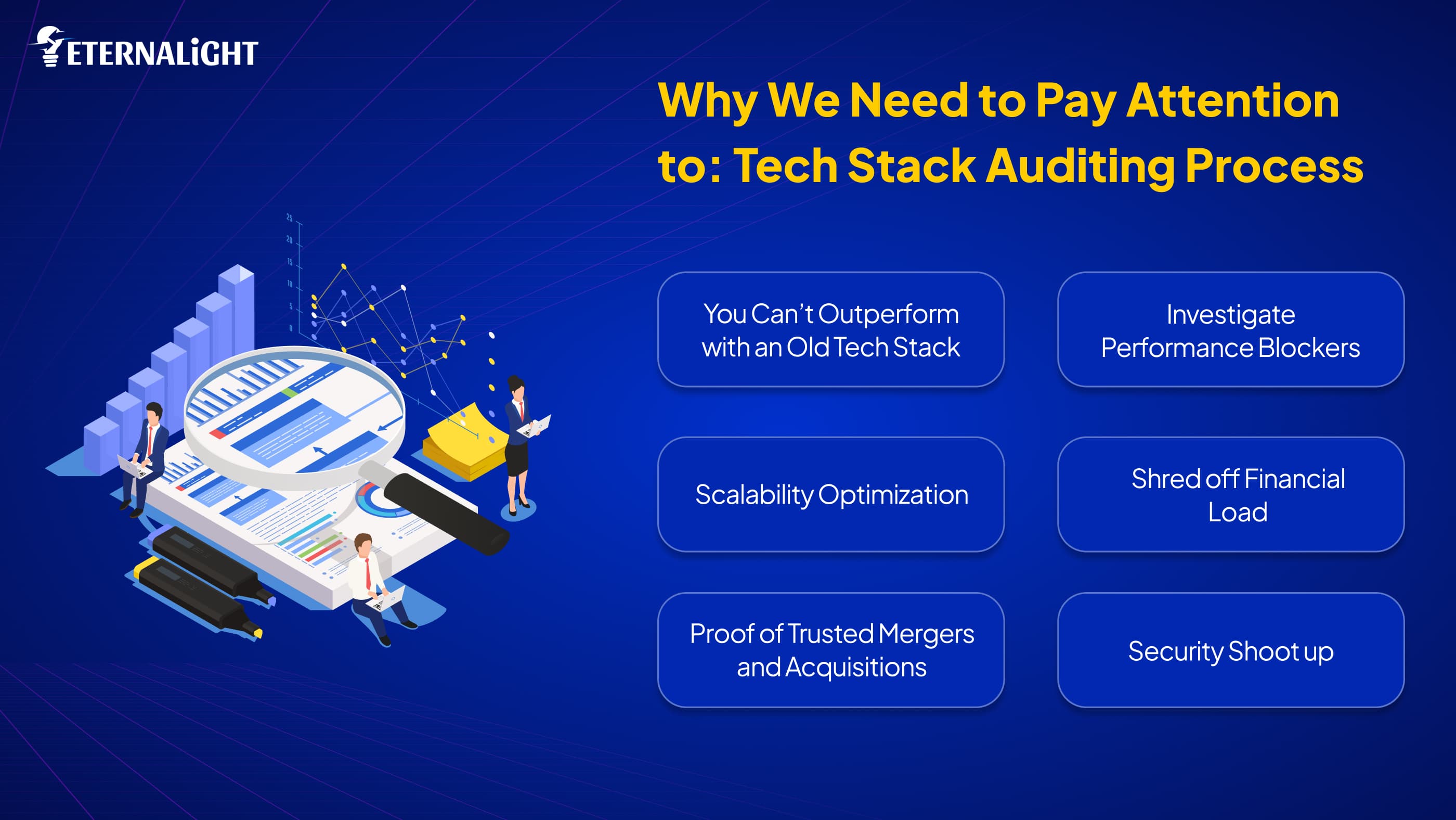
Why We Need to Pay Attention to: Tech Stack Auditing Process
If an organization can’t perform a tech stack audit quarterly or every 6 months, it must conduct a systematic evaluation annually. It provides a clear indication of whether we are future-ready, whether we should add something new, or whether we should remove something old.
Multitude of Benefits of Tech Stack Audit at a Glance
Conducting a tech stack audit is a wise move to keep business operations moving at pace. Mentioning the benefits below:
You Can’t Outperform with an Old Tech Stack
Outdated, inefficient, and incompatible tools and software cause disruption and impact the operations. To accomplish the new wins and profitable projects, it’s essential to update the techstack with advanced integrations as per evolving market demands.
Investigate Performance Blockers
Get insights into vulnerabilities, bottlenecks, and redundancies there. This enables long-term customer engagement, fueling the best user experience and profound trust.
Scalability Optimization
As market demand evolves, it is essential to reorganize the tech stack to build next-gen, modern solutions that can manage business growth and the enormous volume of data and user base without compromising performance.
Shred off Financial Load
Not all resources and tools are used frequently; some may be needed only once in a blue moon for a specific task. The organization maintains a range of tools and software to ensure work isn’t hampered. But these underutilized tools and resources spike up the financial cost.
By assessing the tools, it will be clear which are worth keeping and which should be unsubscribed from.
Proof of Trusted Mergers and Acquisitions
Preparing documentation for all software and tools will help avoid misunderstandings or misconceptions. If everything is clearly stated, it becomes easier to activate underused technology when collaborating with tech partners.
Security Shoot up
Even the simple User ID needs to be secured; if this goes public, user privacy will be at risk. Assessing the tech stack on time will reduce the risk of cyber threats and data breaches and ensure compliance with industry standards and regulations.
The Audit Process: When to Perform a Tech Audit
In this section, we’re highlighting the signs that indicate the need to perform a tech stack audit. What should be kept and what should be excluded to reduce the impact on silos?
It's Been a Long Time for a Tech Audit
If the organization continues to collaborate with the new partners, it will overlook the tool's real value. Is it really managing productivity, or is the team struggling? If you don't remember when you performed the audit, do it immediately.
Integration Disrupting Data Silos
Suppose that you need to download the weekly report to showcase a different department.
Are you collaborating, connecting, and sharing with the same stack?
Do you need to quickly switch the collaboration mode, report analysis, and presentation?
Is it taking too long to create the report?
Fear of Security Threats
Outdated software is always on hackers' and intruders' hit lists. Each update is typically rolled out to resolve issues and technical breaches, and to remove unnecessary functionality to improve the system's performance, scalability, and efficiency.
During the tech stack audit, we can evaluate when the app was last updated, whether it is secure enough, and whether it is creating a gateway for hackers.
If the Business Scales up
Businesses expand their product lines in line with market demand to boost brand visibility. While taking this move, it is worth performing a techstack audit. We learn how the new services can meet the legacy system's guidelines and requirements.
If Integrating New Apps
It is essential to identify gaps between the new integration and the business vision and operations to ensure alignment.
- Will it make things more complex or easier to manage?
- Is it embedded redundancy, inefficiency or obstacles?
- Is it easy to launch integration?
- Will it solve the existing collaboration, data management, and performance issues?
If the User Experience is not as Expected
If the tech stack is complex and can’t serve the team, it just exhausts them, wasting hours and effort. We need to switch the techstack to get things done effectively, reaping optimum outcomes. If the system is out of service or unavailable, then it will impact the user experience.
If you are struggling with the above pointers, it's time to conduct a tech stack audit.
90 Days of Auditing and Shifting to a New Tech Stack
In this section, we outline what you should expect and how to navigate the phases of the tech stack audit. First, what you should do before an audit:
Map and Review the Points to Have a Hassle-Free Audit
Suppose you are brainstorming to access the latest partnership, tools, and subscription, but have you evaluated your systems for compliance and integrations? How will you know what should be noticed and validated before performing an audit?
Let’s go through every bullet point:
- From planning through release and monitoring, can your system integrate automated or manual processes?
- Can your system onboard professionals with proper instructions that comply with standards and principles?
- Can your team effectively use the automated tools for progress tracking?
- Is this integrated with AI-powered analytics?
- Is your team skilled?
- Do you have cloud-powered solutions that enable seamless integration and updates?
- Is your team experiencing frequent errors and version-control issues, and is unable to collaborate on the same task in real time?
- Is your organization's data cluttered, scattered, or well centralized to ensure on-demand, multi-region accessibility?
- Is the methodology you’ve picked trusted, verified, accurate, automated, or not?
The Right Way to Perform Tech Stack Audit
If you have 1 or 2 items, you can review daily. However, a tech stack is a collection of tools, technologies, and integrations, so it can’t be completed daily or on short notice. It's not the right way to audit the tech stack. Instead, involve all team members to gather their feedback.

First 30 days
Enlist the Tech Stack Utility Items across the Organization
Make a list of all software, tools, and integrations for in-house, outsourced, and client projects. It must be categorized by department, such as development, operations, marketing, finance, auditing, HR, CRM, ERP, HRIS, and technical support.
- Also, list how many users depend on the particular technology.
- How many are temporarily in service, or how many are in daily service?
- Are these well-integrated with the legacy system?
Estimate the Expense (Subscription/ Merger deadline)
It's normal to pay a fee for every service or product, and if it's wasted on outdated or not worth it products or services, you can eliminate them during this audit and save budget.
Next 30 days
Forward the Circular
Prepare a form listing all items where team members are facing issues with software or hardware, including functions, operations, memory, or any impact on their day-to-day responsibilities. These collectibles will make decision-making easier.
Assign the Responsibility
Now that you have the list, forward the circular to all stakeholders and team members using the software and tools. Then assign the task to responsible members from each department to gather feedback before deciding whether to keep or exclude the resources and the solution.
In case someone is not responsive to the circular, the assignee will remind them.
Uninstallation, Installation, and New Integrations
After collecting feedback, you may have an idea of which services or products to exclude from partnerships and subscriptions. Then send an email stating the instructions to uninstall the system and service to prevent their use.
Last 30 Days
Provide Support for Immediate Outcome
Suppose someone has difficulty uninstalling useless software and forgets to remove it from the system software list. In that case, the concerned person can schedule a one-on-one discussion to understand the reason and arrange the uninstallation.
Final Call for TechStack Audit
Now, obtain a report from all responsible assignees confirming that all unused software, products/ integrations have been uninstalled. Can they end the subscription and merger immediately? Once it is ‘Yes’, the audit process is completed.
It will help founders avoid financial debt and invest in the right assets, aligning the organization's goals.
Conclusion
Anything cluttered, disorganized, or managed from the dark room without proper analysis creates uncertainty and undermines control in any tech organization. It is essential to know what we have to drive the operations, how much we are spending, and what is evaluated through the tech stack audit. The resources we are using should be the latest, compatible, and easy to integrate, rather than outdated or complex.
Get to know client and team expectations to drive the business efficiently and avoid roadblocks.
At Eternalight Infotech, we nurture our team by providing the right techstack for each project and investing in modern tools to deliver innovative solutions.

Ayushi Shrivastava
Senior Content Writer
Ayushi is a Content Strategist at Eternalight Infotech with 4 years of experience in transforming complex ideas into clear, engaging, and SEO optimized narratives. She specializes in crafting impactful content strategies that enhance brand visibility and drive meaningful engagement across digital platforms.
Related Blogs
 Software Development9 Mins
Why Choose Python for Fintech App Development?
Learn how Python helps fintech businesses build scalable, data-driven applications with powerful support for analytics, AI, APIs, and automation.
- Software Development8 Mins
Is It Time to Build Off the Self vs Custom Software for Your Business?
When should you build custom software? Learn the key signs, costs, limitations, and factors to consider before choosing custom software for your business.
- Software Development11 Mins
Website Security Checklist: What to Check Before It's Too Late
Worried about website security? Use this practical website security checklist to spot common risks and protect your website, data, and users.