The Android platform keeps evolving and changing the way companies interact with their clients via mobile applications. The huge number of Android devices used all over the world and the quick digital transformations prompt businesses to develop unique and valuable applications.
Nowadays, users require mobile applications that are fast, safe, smart, and personalized. Therefore, artificial intelligence, 5G, wearables, and immersive technologies become integral components of modern Android applications.
Following the current trends in the development of Android applications will allow businesses to increase user engagement and compete with rivals successfully.
Why Android App Development Trends Matter in 2026
The increasing intelligence of mobile technology and its integration into our daily lives require businesses to adapt to such changes to fulfill users' needs and engage with customers.
Having information about recent trends in Android app development can give a business multiple benefits. It will be able to provide better customer experience, get technologies ahead of the competition, and develop scalable apps.
Modern customers prefer to use apps that are convenient and fast. It does not matter whether it is e-commerce, healthcare, financial services, education, or entertainment; the app must work smoothly.
For organizations planning to build new applications, adopting modern Android app development services can also reduce long-term costs by implementing scalable technologies from the beginning.
Top 10 Android App Development Trends in 2026
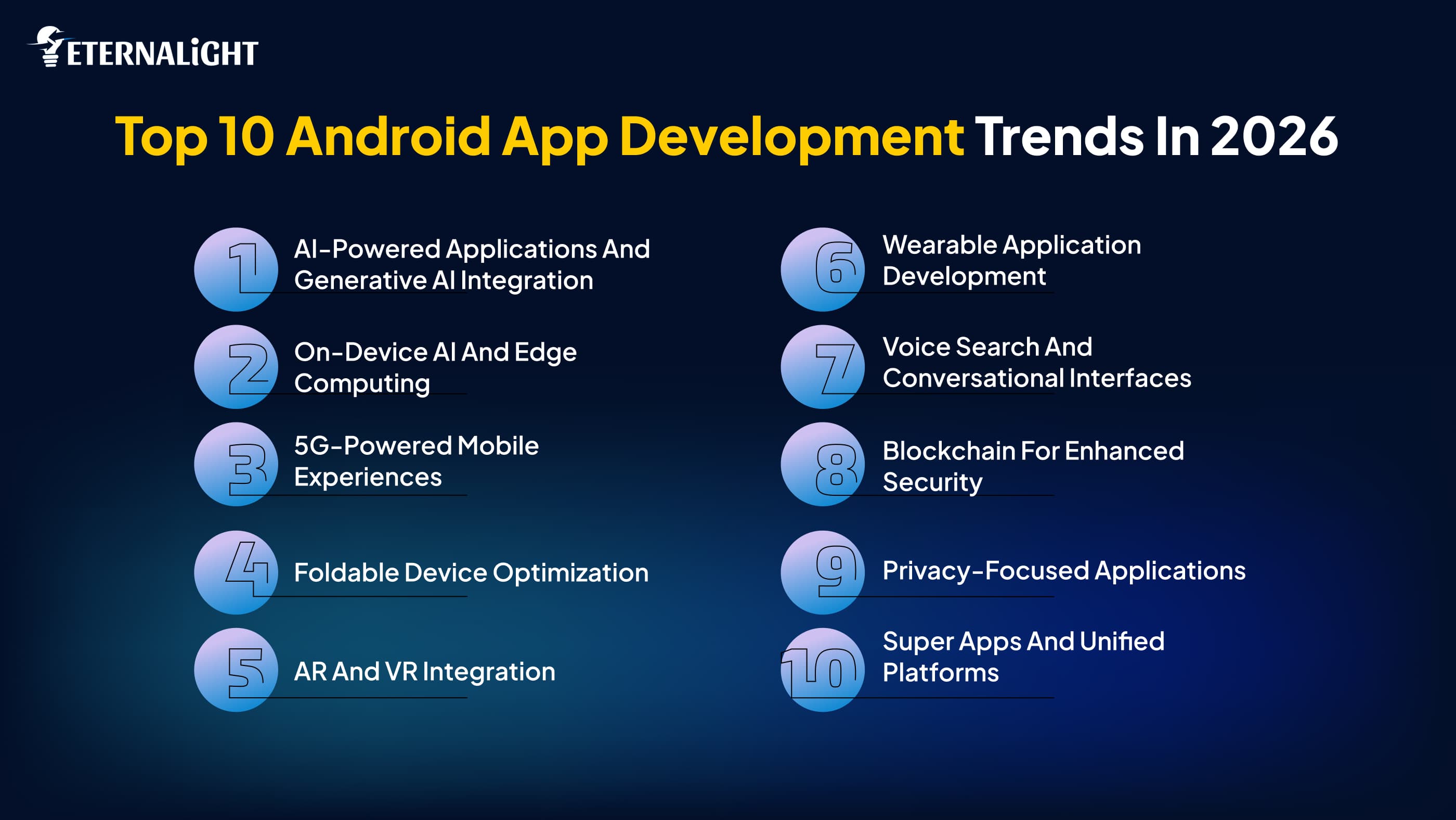
There is constant change in the mobile environment with emerging technology trends. Here are the top 10 Android application development trends that will affect business organizations and users in 2026.
AI-Powered Applications and Generative AI Integration
Artificial Intelligence has become a huge motivator in developing mobile applications. AI applications are capable of understanding user behavior, automating monotonous activities, and delivering highly customized experiences.
The implementation of generative AI has transformed the domains of customer support, content creation, recommendation engines, and virtual assistants. AI-driven chats and predictive systems have helped businesses optimize customer interactions.
Examples include personalized product recommendations, AI-driven content creation, and AI-driven chat support.
On-Device AI and Edge Computing
The cloud processing technology has been in use for many years now; however, on-device processing through artificial intelligence is gaining significance in 2026. Rather than transmitting data to the external servers, devices perform the data processing operation themselves.
There are several advantages of such a technique, which include increased speed, low latency, high levels of security, and less reliance on the internet.
5G-Powered Mobile Experiences
With the emergence of 5G technology, there is an impact on the performance of mobile applications. Faster internet connections and lower latencies are allowing mobile apps to handle big data volumes effectively.
There is an opportunity to develop applications that were limited by some technological constraints before. Streaming high-quality videos, multiplayer gaming, virtual teamwork, and real-time communication apps will work flawlessly.
In 2026, companies creating mobile solutions are predicted to optimize their applications for 5G technologies.
Foldable Device Optimization
The use of foldable mobile phones is on the rise within the mobile world. Compared to traditional mobile phones, the new foldable phones need applications to be able to adjust automatically to various screen states and resolutions.
Responsive interfaces are now being designed to adjust across various states.
Firms that design applications to work effectively with foldable devices will create a better user experience.
AR and VR Integration
Virtual reality and augmented reality technologies have gone beyond being used in video games. These technologies have been adopted by sectors like healthcare, education, retail, and real estate to enhance customer experience through immersion.
The retail sector is enabling users to virtually test products before buying them. The education sector is making use of virtual learning environments, while the healthcare sector is implementing virtual simulation training programs.
Virtual reality and augmented reality technologies will be increasingly adopted in Android apps in the future.
Wearable Application Development
The use of smart watches and other wearables is becoming increasingly common among users. Applications for wearable devices are moving beyond tracking fitness and include applications in healthcare, productivity, and communications.
Current wearable devices are able to track heart rate, level of physical activity, sleep patterns, and other health factors.
With connected systems expanding, there will be a continued need for applications for wearables.
Voice Search and Conversational Interfaces
With voice technology becoming more advanced, people are getting better interaction with applications due to increased convenience.
Users are opting for speaking commands rather than typing when performing activities like driving or working out.
Natural language processing and smart conversations are being leveraged by companies to create seamless interaction experiences using voice technology.
Blockchain for Enhanced Security
One of the major issues that mobile applications face is security. Blockchain technology has become an area of interest due to its potential to increase transparency and security.
Blockchain-enabled systems can ensure secure transactions, decentralized authentication, and enhanced data security.
Various industries, including banking, health care, and finance, are now looking forward to developing blockchain-based mobile applications.
Privacy-Focused Applications
Awareness about privacy and security of their data is growing among users. Companies should focus on providing security in their systems and transparency in data handling.
Security in modern software is ensured by such measures as biometrics, encryption, and multifactor verification.
Developers who value privacy can earn the trust of their customers and increase customer loyalty.
Super Apps and Unified Platforms
Super Apps integrate various functionalities in one application ecosystem. Rather than using distinct applications for chat, payment, shopping, and booking services, you can use them through a single interface.
The adoption of unified digital ecosystems keeps growing as users appreciate convenience.
Innovations in future Android application development include the consideration of all-in-one applications by businesses.
How an Android App Development Company Can Help Businesses Stay Future Ready
The need to meet new technological and consumer demands means more than just developing a mobile application. There needs to be solutions that are scalable, secure, and that will adapt well to future market needs. It is at this point that the importance of an Android app development company comes into play.
An organization that works with professionals in development will gain from the experience and skills of the professionals in implementing new technologies in their business. From developing applications that use AI technology and are optimized for 5G networks to developing applications for foldable screens, an experienced development company will ensure that your apps are designed for future success.
Such a company will also help an organization to pick the best technology stack for its applications, enhance the performance and security of the application, and maintain it.
Because all development firms have distinct capabilities, companies always have to weigh a number of different firms before choosing one. Examining various aspects such as technological know-how, industry knowledge, project history, and service delivery by the top android app development companies can help companies choose a firm that suits their business goals.
Conclusion
Android is ever-changing because of emerging technology trends, which affect people’s expectations from their digital experience. Artificial intelligence, wearables, improved privacy, and immersive technology are some of the factors that are redefining application design and use.
Companies that have knowledge about the emerging Android app development trends will have a competitive advantage. This will allow them to develop future-proof solutions.

Kusum Sethiya
Software Engineer
Kusum Sethiya is a Software Engineer at Eternalight Infotech, focused on building clean and intuitive. She enjoys turning ideas into reliable applications using modern technologies like Javascript, React, Node.js , and MongoDB.
Frequently Asked Questions
The latest trends include AI-powered applications, 5G optimization, wearable app development, foldable device support, blockchain integration, and privacy-focused mobile experiences.
AI helps applications deliver personalized experiences, automate tasks, improve recommendations, and increase overall user engagement.
5G improves speed and reduces latency, allowing smoother video streaming, real-time communication, and enhanced user experiences.
Professional companies provide technical expertise, modern technology adoption, scalability, and long-term support.
These services help organizations create customized applications, improve customer experiences, and build scalable digital products.
Related Blogs
 Software Development9 Mins
Why Choose Python for Fintech App Development?
Learn how Python helps fintech businesses build scalable, data-driven applications with powerful support for analytics, AI, APIs, and automation.
- Software Development8 Mins
Is It Time to Build Off the Self vs Custom Software for Your Business?
When should you build custom software? Learn the key signs, costs, limitations, and factors to consider before choosing custom software for your business.
- Software Development11 Mins
Website Security Checklist: What to Check Before It's Too Late
Worried about website security? Use this practical website security checklist to spot common risks and protect your website, data, and users.