Starting a company in 2026 is more exciting than ever, but it also comes with greater challenges. Technology advances rapidly, customers' requirements grow, and competition increases in many industries. While the good idea is a key to success, its execution will define whether your startup makes it through.
However, when it comes to startups, the hiring of the right specialists is crucially important. Most founders spend a lot of time fundraising, developing marketing strategies, and customer acquisition, but underestimate the process of hiring the right developers to build a successful product and avoid possible issues like delays, low-quality work, budget overruns, etc.
Moreover, in today's world, startups face many new obstacles: more opportunities for developers, remote hiring, global competition for technical personnel, and the development of new processes with the help of artificial intelligence.
Whether you need to hire software developers for an MVP, scaling of an existing product, or creation of a full technical stack, you need to know about the proper hiring process. In this article, we will tell you how to hire developers for startup businesses in 2026.
Why Hiring Developers Is Different for Startups in 2026
Recruiting developers in the startup environment is quite a different process compared to recruiting developers for established businesses. The latter always operates with structured teams and sufficient budgets, as well as processes. Startups operate under different conditions since they operate on tight deadlines and under tight resource constraints.
Among the main differences is the question of how to allocate the budget. Almost all startups are not able to hire large development teams straight away since they require efficiency in resource allocation. Everything depends on each decision, and the founder should make sure he invests in efficient people.
Another difference is time. Startups must act quickly since the market changes really fast. Any delays in the product release can provide an advantage to the competitors.
The need for multi-skilled developers increases in 2026. Not having to hire individual people for each duty, most startups prefer developers who can work with various technologies. It has become essential for full-stack developers and flexible tech professionals as they add value in terms of versatility.
Working remotely has completely changed approaches to hiring employees. Companies are no longer limited geographically. They have the opportunity to hire people from all over the world and form distributed teams. But in order to manage remote developers, a good communication process.
Also, new development methods with AI assistance change approaches to working with software. Nowadays, startups prefer to hire people who will be able to work with automation tools effectively and will be able to use new technologies. Moreover, startups prefer problem-solving skills to coding ones.
Many founders analyze different methods of hiring, even comparing dedicated developers and freelancers.
Step-by-Step Process to Hire Developers for a Startup
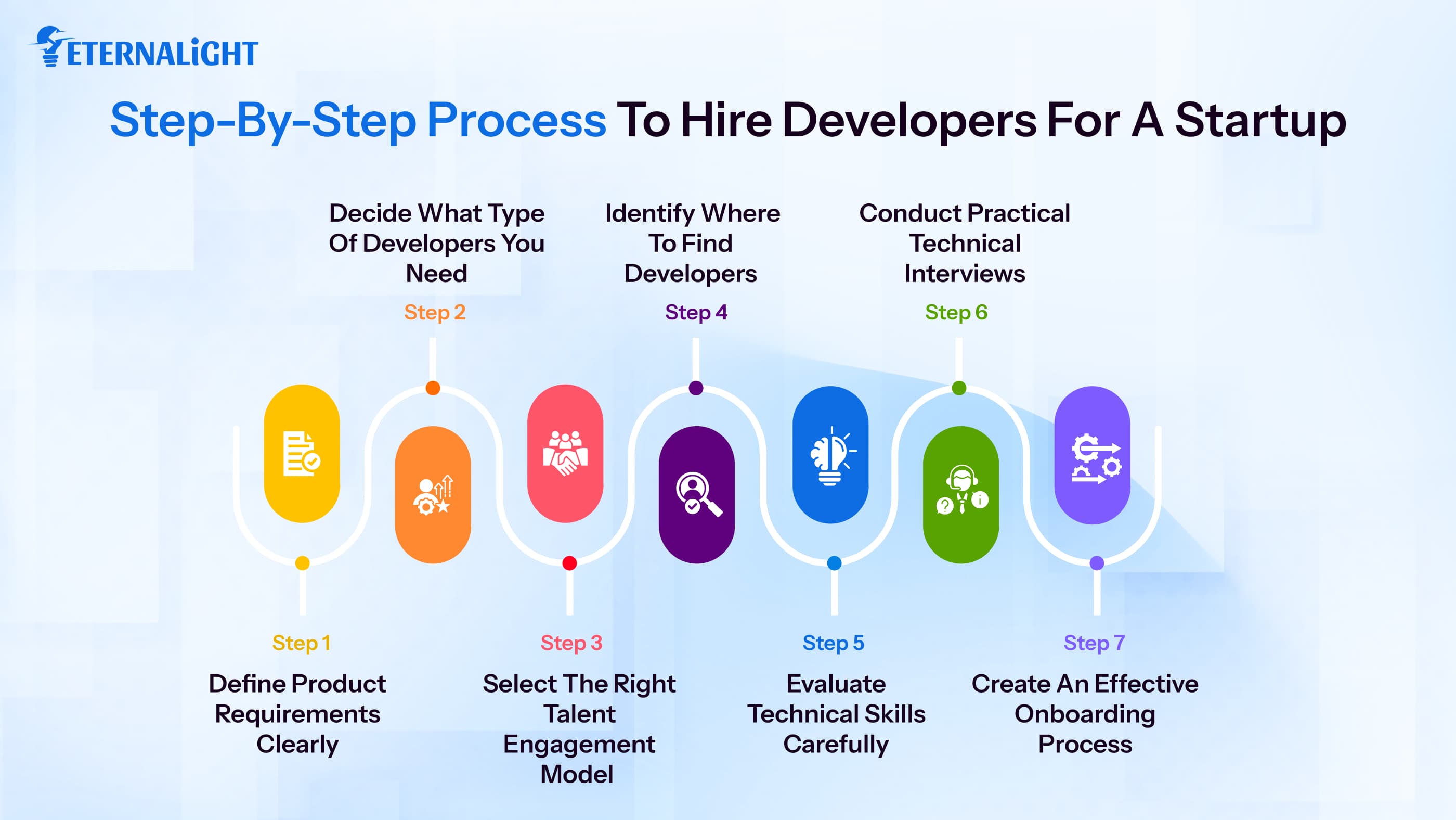
The process of forming an efficient startup development team implies developing a well-thought-out hiring process. Random hiring of developers always results in mistakes and higher expenses.
Step 1: Define Product Requirements Clearly
The first step when starting a search for developers implies a thorough understanding of the product you wish to create. Many startups look for developers to hire without having any idea about product requirements, which leads to problems down the line.
In this case, founders need to define a business problem they are going to solve and determine their target audience. You will have to determine whether you require a basic MVP or a complex product with all necessary functionality.
Understanding the scope of the project will allow you to define the budget and make realistic estimations of deadlines. When requirements are understood clearly from the start, developers understand the objectives better.
If your project needs highly customized features and business-related functionality, combining your goals and the Custom Software Development approach may be useful in your case.
Step 2: Decide What Type of Developers You Need
Not every product would require a similar type of developer to work on it. The decision about hiring the right developer should be dependent on the needs and goals of the organization.
For instance, a front-end developer would mainly be responsible for working on designing interfaces and user experiences, whereas a back-end developer would deal with databases, APIs, and applications. A full-stack developer could be responsible for both back-end and front-end development.
For startups that would be on a tight budget, a full-stack developer would often be a preferred choice since they would be able to perform multiple tasks at once.
Step 3: Select The Right Talent Engagement Model
Selecting the right model of hiring is the most critical part of the entire process.
It is best to go for freelancers in case of short-term projects and startups operating on small budgets. They bring flexibility and reduced upfront costs, but might not always be willing to collaborate on a long-term basis.
In-house developers suit companies where the continuous development of products is essential. In-house developers offer more collaboration and company culture alignment.
Many startups choose to go for dedicated developers as this model brings them flexibility and dedication to the project at hand. In this way, they become a balance between freelancers and in-house teams.
The fourth model worth considering is development agencies, in case you want the entire development process from A to Z. They offer you access to several specialists at once.
Step 4: Identify Where to Find Developers
Selecting the best developers depends on using the appropriate channels. It is not always the case that posting job descriptions anywhere you want will produce good results.
Professional social networking sites such as LinkedIn are still important tools when searching for experienced developers and professionals. Sites such as GitHub can help you analyze actual projects done by the developer before starting a conversation.
Start-up-specific networking sites and social networking sites such as Wellfound can be used to find people interested in working for a start-up company.
The role of referrals cannot be overlooked since referred candidates are normally reliable and culturally compatible. Companies seeking experienced technical collaboration partners can also consider Eternalight.
Step 5: Evaluate Technical Skills Carefully
A resume is not sufficient to make a hire. Sometimes, a very good profile and a highly impressive resume may not necessarily mean that a person has practical skills.
It would be wise for startups to assess a developer’s skill based on their portfolio and practical tests. It can often be more revealing than hypothetical questions.
It would also be wise to test a developer’s communication skills since they have to work with various people during their projects.
Step 6: Conduct Practical Technical Interviews
Technical interviews need to be centered around solving practical problems of business rather than just gauging one’s ability to memorize information.
For instance, instead of quizzing job applicants with easy theoretical questions, startups should talk about practical issues related to performance tuning and scalable architecture of the applications.
Step 7: Create an Effective Onboarding Process
However, hiring is not over once the recruitment process has been completed. Onboarding developers ensures their fast productivity.
Documentation of projects, the provision of necessary tools, communication policies, and clear expectations have to be set for developers.
Onboarding developers becomes important in companies using Team Augmentation approaches, as onboarding influences productivity and teamwork.
How Much Does It Cost to Hire Startup Developers in 2026
There are many different elements that influence the price to engage software engineers, such as experience level, geographic location, technological demands, and hiring approach.
A freelancer tends to charge less per hour and can be appropriate for small projects. Dedicated engineers usually demand monthly payments but concentrate on working only with you. In-house engineers are more expensive because of additional expenses connected to recruitment, infrastructure, etc.
Approximate cost estimates in 2026 are:
Hiring Model | Estimated Cost |
Freelancer | $25–100/hour |
Dedicated Developer | $5,000–12,000/month |
In-house Developer | $80,000–150,000/year |
Development Agency | Project-based |
Founders should avoid selecting options based only on lower costs because poor-quality development often creates larger expenses in the future.
Common Mistakes Startups Make While Hiring Developers
The first mistake is associated with the fact that many startups hire too fast. Most of the founders focus on speed and start recruiting people without evaluating them. Even though fast hiring seems like an attractive option at first, it almost always ends up poorly.
Another very common mistake is when startups put money before value. Lower prices do not necessarily mean good choices. Very experienced developers can be more expensive than cheaper developers; however, experience helps save time and makes products of higher quality.
Communication skills and cultural match are something else that some startups neglect. It is obviously important for developers to be skilled technically; however, it is also crucial for them to be able to work in teams and adapt to the constantly changing needs.
Unrealistic expectations are another common mistake. Founders look for those developers who will be able to do everything: frontend, backend, DevOps, AI integration, and design.
Key Traits to Look for in Startup Developers
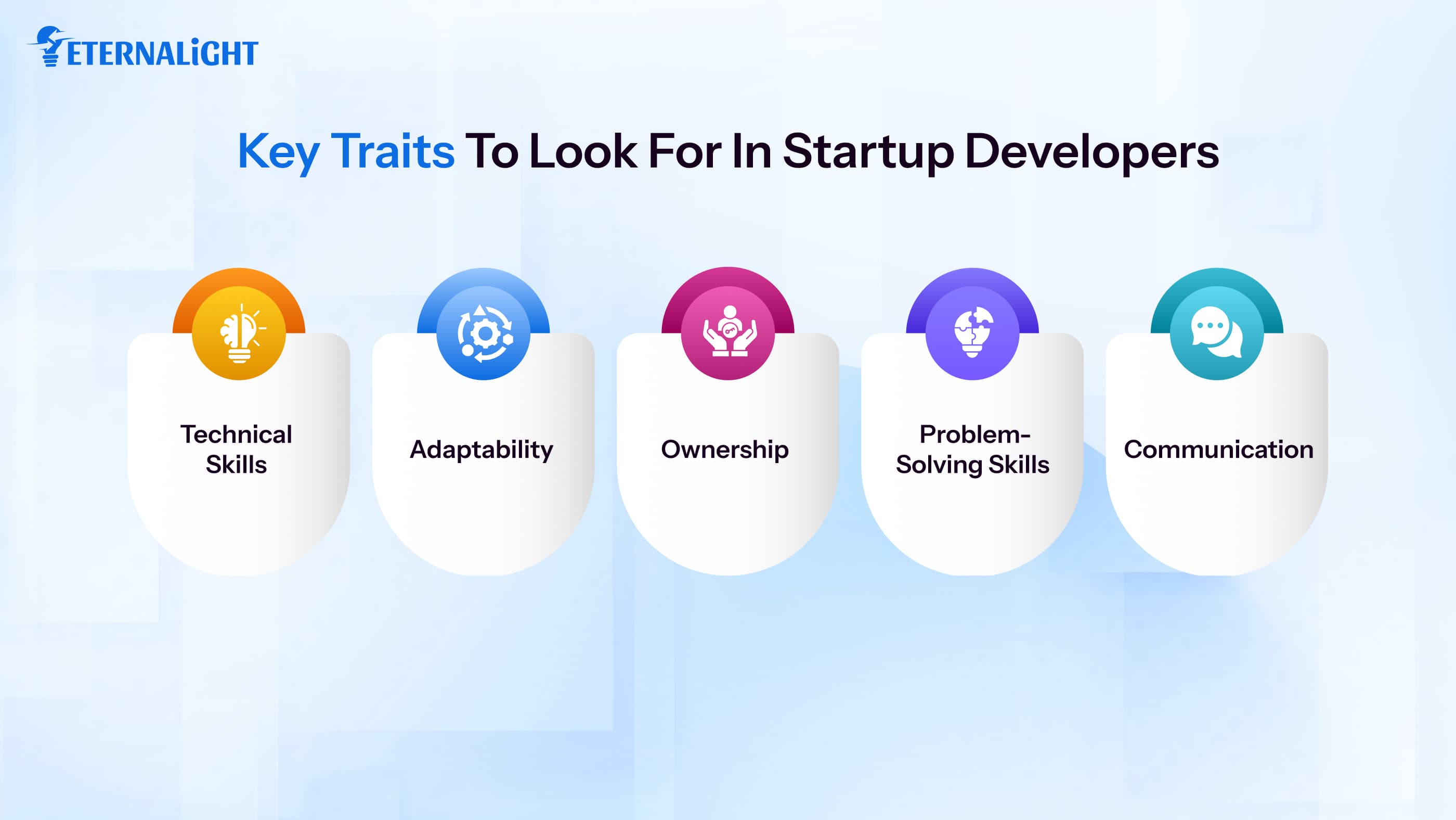
Although technical skills still remain essential for developers, many successful startup developers also have skills that go beyond programming.
Adaptability is probably the most precious skill, as the environment in a startup company changes quite fast. Developers should be ready to shift their priorities and deal with challenges.
A sense of ownership is another key point. Developers who are responsible for results and not only for completing their assigned tasks become very useful for product development.
Problem-solving skills help developers recognize problems and find solutions to them. Unexpected challenges become part of work for any startup, and therefore, the ability to analyze becomes very useful.
Developers should be good at communicating, as teamwork influences the progress of projects.
Being curious and always ready to improve become crucial skills for 2026, as technologies change fast.
Companies that develop scalable products tend to use the principles mentioned in the Software Product Development Lifecycle blog.
Conclusion
In the case of recruiting developers for startups, the process is not only about filling technical roles. It is about building a team that will help achieve your business goals and support the successful development of your product.
The recruitment process starts with understanding your business needs and selecting the hiring model that best fits your startup. Whether you plan to recruit software developers, expand your startup development team, or hire dedicated developers for growth initiatives, making the right hiring decisions will set the foundation for long-term success.
Successful startups don't just hire developers to write code—they build teams that share their vision, solve complex problems, and drive innovation.
Need assistance building the right development team for your startup? Partner with experienced developers who can quickly turn your ideas into scalable products that drive business growth.

Kusum Sethiya
Software Engineer
Kusum Sethiya is a Software Engineer at Eternalight Infotech, focused on building clean and intuitive. She enjoys turning ideas into reliable applications using modern technologies like Javascript, React, Node.js , and MongoDB.
Frequently Asked Questions
Initial development hires may range between two and five developers, depending on project scope, budgetary limitations, and business goals.
Freelancers tend to be best for short-term needs, while full-time developers offer greater potential in terms of growth and product ownership.
Depending on project complexity and hiring needs, hiring developers for startups typically takes two weeks to two months.
Developers should have technical expertise, communication abilities, adaptability, problem-solving skills, and familiarity with modern AI-assisted workflows.
Costs vary according to experience level, location, technology stack, and hiring model.
Related Blogs
 Software Development9 Mins
Why Choose Python for Fintech App Development?
Learn how Python helps fintech businesses build scalable, data-driven applications with powerful support for analytics, AI, APIs, and automation.
- Software Development8 Mins
Is It Time to Build Off the Self vs Custom Software for Your Business?
When should you build custom software? Learn the key signs, costs, limitations, and factors to consider before choosing custom software for your business.
- Software Development11 Mins
Website Security Checklist: What to Check Before It's Too Late
Worried about website security? Use this practical website security checklist to spot common risks and protect your website, data, and users.