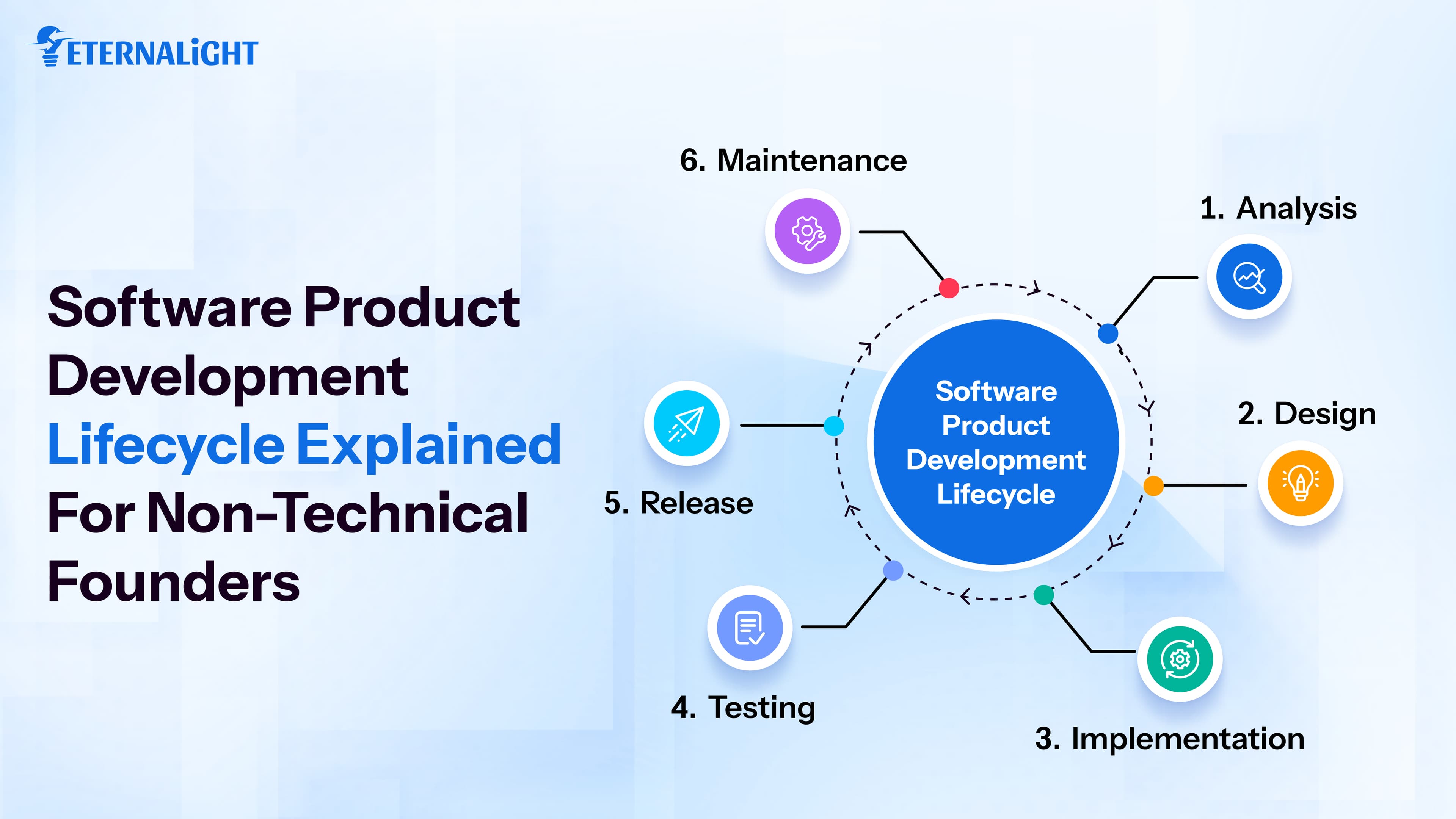
Nowadays, technical understanding is a baseline for creating digital products.
If you’re a founder looking to build a software product, you don’t need extensive technical knowledge to get started.
Understanding the software product development lifecycle fixes most of it. Once you know how software gets built, you can ask better questions and make better decisions.
To create great software and make it a resounding success, you need to ensure the journey to the finished product is efficient and done well.
If you’re a non-technical founder looking to understand the process and the timeline of a software product’s development lifecycle, this blog explains all of it.
Why Non-Technical Founders Need to Understand the SDLC
A lot of non-technical founders treat the SDLC process as something they can outsource to an external vendor, sit back and get their finished product. The reality of software product development is that it is a highly collaborative and iterative process that you as a founder and your development team will go through. The more involved you are, the better your product becomes.
When founders operate without a deep understanding of the software development process, they frequently demand quick launch timelines or the abrupt integration of complex features. This creates technical debt. The timeline pressures sometimes force developers to bypass architectural best practices, hardcode temporary solutions, and accumulate more and more technical debt.
Another critical factor is the prevention of scope creep and the preservation of financial runway. A founder may think that a minor interface feature like a notification dashboard is a trivial feature to add. The reality is these can require backend database restructuring and extensive testing.
For organizations seeking external engineering expertise while mitigating these systemic risks, engaging professional product development partners that guarantee transparency ensures that the execution of your project remains aligned with your business objectives.
The 7 Stages of the Software Product Development Lifecycle
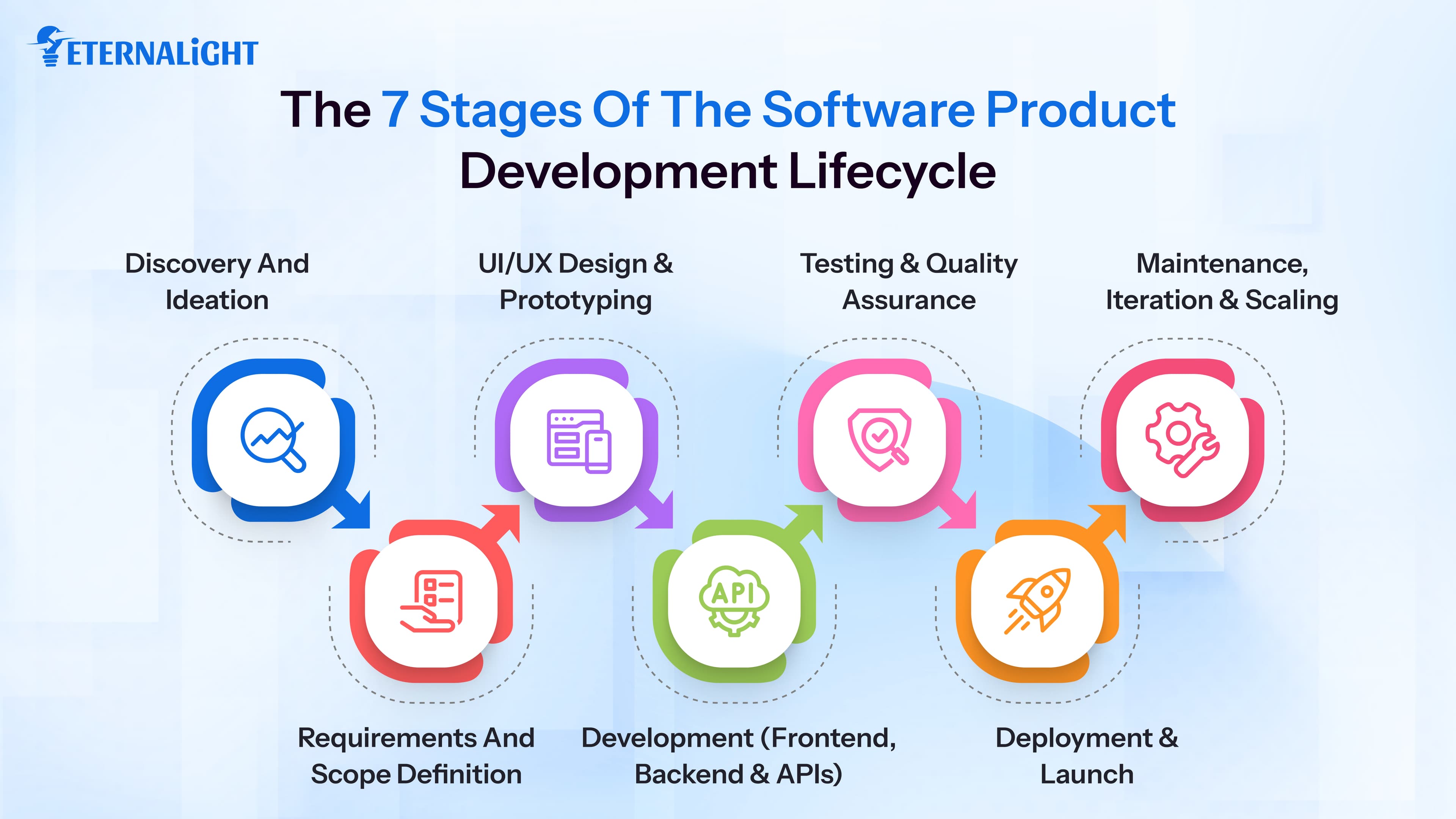
While many project management methodologies exist that change based on the pace and iteration of work—such as Agile, Scrum, or Waterfall—the fundamental phases of sdlc remain consistent. Understanding each of these phases in depth is important to understand the timeline of your project.
Stage 1: Discovery and Ideation
The first phase of the lifecycle is an exercise in rigorous market validation, problem identification, and risk assessment. The goal of this phase is to simply assess product market fit, whether your target demographic is willing to adopt the product and finance it and if the idea is a promising one.
The discovery and ideation phase requires founders to expose their ideas to target audiences through customer interviews, ethnographic research, surveys, and rigorous competitive analysis.
This phase seeks to answer fundamental foundational questions: Who is the primary user persona? What are the core features required for initial market entry?
The ultimate, defining deliverable of this stage is a thoroughly validated Minimum Viable Product (MVP). An MVP represents the leanest possible implementation of the solution.
Your role here as a founder is enormous. You are the domain expert. Your insights about the customer and the market are irreplaceable. The right amount of time and investment spent here will define and set the tone for the rest of your product implementation.
Stage 2: Requirements and Scope Definition
Once the idea is validated, it is now time to translate it into structured requirements.
During this phase, a Business Analyst or a Product Manager works with you to document:
- Functional requirements (what the product must do)
- Non-functional requirements (performance, security, scalability)
- User stories and acceptance criteria
- A clearly defined MVP scope
The output is typically a Software Requirements Specification (SRS) document. The SRS details the software's intended behavior. Consider it a blueprint for your software and a document that you can trace back most of your software development decisions to.
If technical requirements are vaguely documented, software developers are forced to make assumptions and work from there. Without comprehensive written documentation, failure and problems will arise early on.
Stage 3: UI/UX Design & Prototyping
The software product development lifecycle now transitions into the visualization and structuring of the product.
This stage is distinctly bifurcated into User Experience (UX) design and User Interface (UI) design.
User Experience or UX design involves mapping out user flows, creating low fidelity wireframes that dictate how a user progresses from point A to point B within the application. The primary objective of UX is to ensure the software operates intuitively and easily for the user.
User Interface or UI design focuses on the visual layer of the application. It dictates choices like color palettes, typography, interactive button states, and micro-animations.
Before any code is written, designers typically produce a clickable prototype. This is an interactive mockup that simulates the real product. This is one of the most valuable investments in the entire software product development process. It lets you test ideas with real users at a fraction of the cost of actually building them.
Stage 4: Development (Frontend, Backend & APIs)
This is the phase where your software finally gets built. The development phase is typically the longest stage across all software development life cycle phases. It is usually broken into the below workstreams:
Frontend Development: This is the development of the visual layer and everything the user can see. This includes buttons, screens, forms, animations. Common technologies include React, Vue.js, and Flutter. The frontend is exclusively responsible for rendering the UI designs precisely and handling immediate user inputs, such as clicks, biometric swipes, and text entries.
Backend Development: This includes development of databases, business logic, authentication, and data processing. Technologies here include Node.js, Python, Ruby on Rails, and Java, among others. The backend consists of the physical or cloud server infrastructure like DigitalOcean, the complex business logic, and the relational or non-relational database architectures.2
APIs (Application Programming Interfaces): These are the connectors that allow the frontend, backend, and third party services to communicate with each other. API driven architecture allows startups to leverage global infrastructures without having to engineer them from scratch.
If you're scaling your team or need specialised technical talent quickly, IT staff augmentation can be a strategic way to fill the gaps.
Stage 5: Testing & Quality Assurance
The Testing and Quality Assurance (QA) stage is the phase of the SDLC designed to rigorously identify, isolate, and eliminate any bugs and defects before the software is distributed to the public. As part of the phases of SDLC, testing typically includes:
- Functional Testing: This process verifies that every individual feature operates in accordance with the specifications outlined in the original SRS document.
- Performance and Load Testing: The application is subjected to simulated high stress situations such as thousands of concurrent user logins. This ensures the server infrastructure remains stable and responsive under heavy traffic and similar situations, which can be better understood through modern automation practices like end-to-end testing with Cypress automation.
- Security and Penetration Testing: Specialized security engineers execute vulnerability scans and cyberattacks to identify any vulnerabilities in the system. This ensures the protection of sensitive user data, payment information, and intellectual property.
- Usability Testing: This final qualitative check confirms that the user interface remains intuitive, everything renders correctly and works flawlessly across different mobile devices and operating systems.
According to IBM's Systems Sciences Institute, the cost of fixing a bug found in production is 6x higher than catching it during development. Testing is akin to insurance. Skipping it is one of the most expensive decisions a founder can make.
Stage 6: Deployment & Launch
Deployment is the process of moving your application from a controlled staging environment to a production server where real users can access it.
Modern software product development services typically use CI/CD pipelines that are automated systems that push code changes to production safely. Cloud platforms like AWS, Google Cloud, and Azure are usually the most common choices and industry standard for hosting at scale.
A launch, however, is more than a technical event. It also requires:
- A staged rollout strategy (beta users, phased release)
- Monitoring tools to track performance and errors in real time
- A rollback plan in case something goes wrong
- Clear internal and external communication to users and stakeholders
A properly planned deployment ensures your launch process goes as smoothly as possible. This is one of the most critical stages of the software lifecycle and the final stage depends on the success of this stage.
Stage 7: Maintenance, Iteration & Scaling
Maintenance covers bug fixes, security patches, infrastructure updates, and performance tuning. Iteration is driven by data. It depends on user feedback, analytics, support tickets, and A/B testing. Scaling means preparing your architecture to handle growing user loads without degrading the experience. To go more in depth:
- Maintenance: This involves the mandatory, routine software upkeep required to prevent the platform from degrading. Activities include applying critical security patches, upgrading server operating systems, maintaining third party API connections, and resolving any bugs discovered.
- Iteration: Iteration represents the continuous evolution of the product based on feedback loops. Instead of relying on assumptions regarding what users desire, the product team analyzes engagement metrics and user feedback to better the existing features and bring in requested ones.
- Scaling: Scaling refers to the architectural and business capacity to handle exponential growth. True software scaling means the platform infrastructure can accommodate a huge increase in transaction volume or user traffic. Achieving scale requires revisiting earlier lifecycle and refactoring some of the legacy backend codebases. Scaling includes many other ways of bringing about changes in the application that increase its longevity and keep it around long term.
As the technology landscape rapidly evolves, founders need to look beyond traditional human centric workflows. If you're considering more advanced capabilities at this stage, features like automation, personalization, and AI development services can help you integrate AI meaningfully into your existing product roadmap.
Key Roles in a Product Development Team
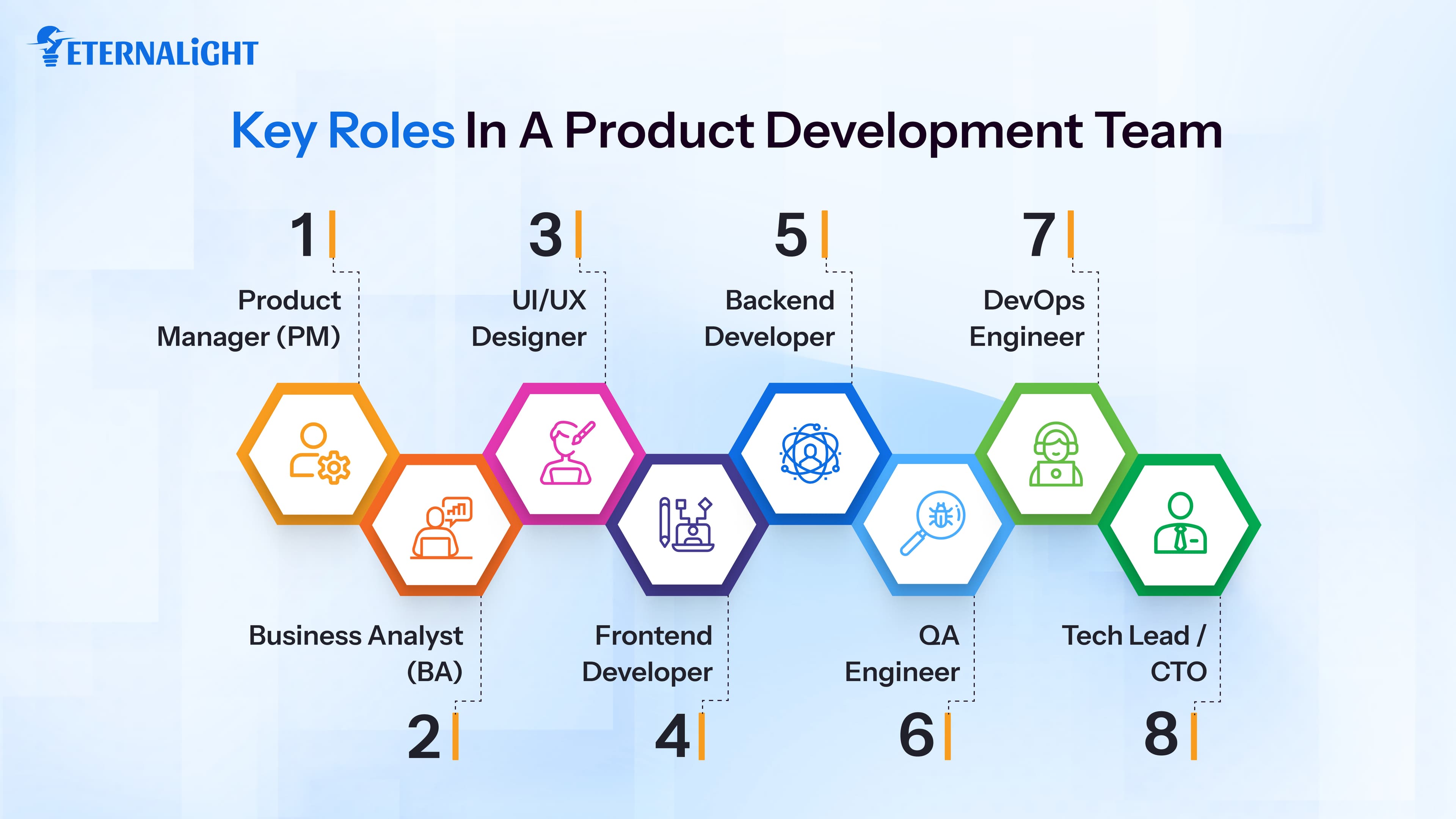
Understanding the software product development team structure helps you with hiring and knowing the role of each member of your team.
Role | What They Do |
Product Manager (PM) | Owns the roadmap, prioritizes features, bridges business and tech |
Business Analyst (BA) | Translates business needs into technical requirements |
UI/UX Designer | Designs user flows, wireframes, and visual interfaces |
Frontend Developer | Builds what users see and interact with |
Backend Developer | Builds server side logic, databases, and APIs |
QA Engineer | Tests for bugs, performance issues, and edge cases |
DevOps Engineer | Manages infrastructure, deployments, and CI/CD pipelines |
Tech Lead / CTO | Makes architectural decisions and sets technical strategy |
Each member of your team you should build a rapport with and ensure that your team is cohesive and works together well.
How to Work Effectively With Your Development Team
You don't need to understand the code to be a strong partner to your development team.
You just need to show up and be consistently involved. Explain the why behind your decisions properly. Context changes the quality of the solution. When your team understands the business reason behind a request, they make better technical decisions.
At Eternalight Infotech, we've seen firsthand how founder involvement at each stage of the lifecycle leads to faster delivery, fewer revisions, and products that users actually love.
A few principles that may help:
1. Respect the process. Agile sprints, standups, and sprint reviews exist for a reason. Participate consistently and communicate clearly with your team. Do not rush deadlines and processes that may cost you in the long run.
2. Document decisions. Every time a scope change is agreed verbally, follow up with a written summary. Misremembered decisions are a leading cause of conflict and costly rework.
3. Separate what from how. Your job is to define what the product needs to do and why. Let your engineers decide how to build it.
4. Give timely feedback. When your team shares a prototype or a build for review, respond on time. Delayed feedback can cause missed deadlines.
Conclusion
You don't need a technical background to build a great software product. But you do need to understand how the process works.
The Software Product Development Lifecycle gives your product a clear path from idea to launch to growth. Each of the software development life cycle phases exists for a reason, and understanding the reason behind each and their use cases will help you understand the process from start to finish better.
The founders who build great products are not always the most technical ones. They are the ones who take time to understand the process, communicate clearly, and listen to feedback and upskill their project often.
If you want a team that can guide you through every phase of software product development, or if you need experienced software product development services, our team is ready to help.

Gauri Pandey
Technical Content Writer
Gauri Pandey is a Technical Content Writer at Eternalight Infotech. She uses her expertise to break down complex topics into simple, value-driven narratives, bridging the gap between technology and real-world applications.
Frequently Asked Questions
The Software Product Development Lifecycle (SDLC) is a structured process that guides a software product from initial idea through discovery, design, development, testing, deployment, and maintenance.
Most frameworks define six to eight phases of SDLC. Usually we see a seven phase model covering Discovery, Requirements, Design, Development, Testing, Deployment, and Maintenance. The exact number varies by methodology, but the core activities stay consistent.
Software product development services are end to end services provided by a technology partner to design, build, test, and launch software products. These services include discovery workshops, UX/UI design, frontend and backend development, QA testing, DevOps setup, and post launch support.
Yes. AI tools now assist with code generation, automated testing, UX research analysis, and technical documentation. Learn more about how AI development services are reshaping what's possible for modern product teams.
Related Blogs
 Software Development9 Mins
Why Choose Python for Fintech App Development?
Learn how Python helps fintech businesses build scalable, data-driven applications with powerful support for analytics, AI, APIs, and automation.
- Software Development8 Mins
Is It Time to Build Off the Self vs Custom Software for Your Business?
When should you build custom software? Learn the key signs, costs, limitations, and factors to consider before choosing custom software for your business.
- Software Development11 Mins
Website Security Checklist: What to Check Before It's Too Late
Worried about website security? Use this practical website security checklist to spot common risks and protect your website, data, and users.