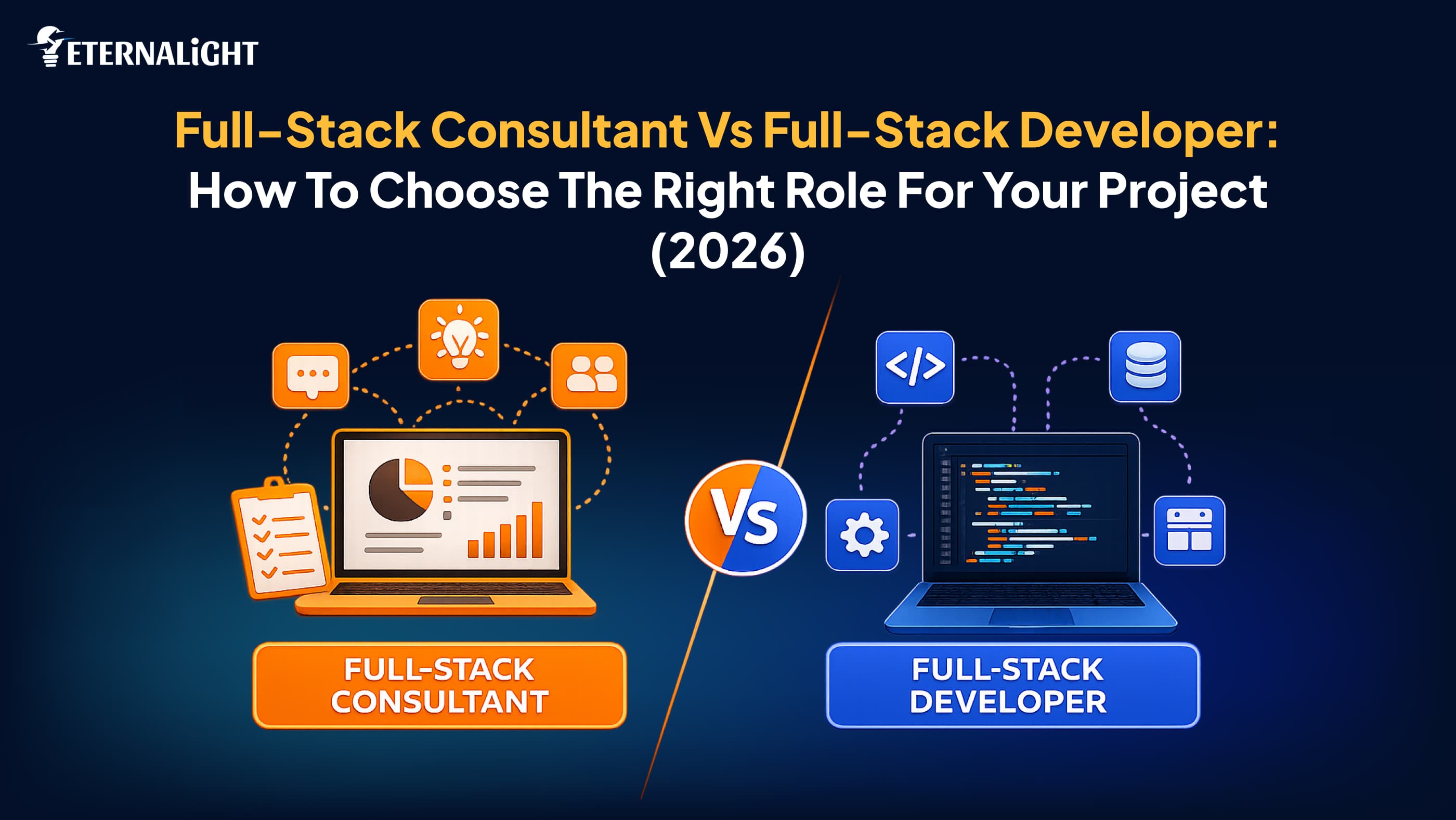
In the real world, we often face dilemmas involving roles that look similar at first glance but have significant differences, and one wrong decision can change the project's destiny. It could be a failure or a success. It depends on what you pick. The same is true for full stack consultants and full stack developers. Most projects don’t reach their outcomes due to financial issues, but because of the wrong direction. When requirements are not clearly defined, incorrect architectural decisions lead to failures, stretched timelines, and budget overruns.
Developers' core responsibility is to turn the requirements into a full-fledged functional product utilizing the right technology, implementation practices, feature delivery, and performance, while the consultant's role comes before production starts, during the planning stage, when the client is discussing the idea and a decision needs to be made. In this blog, we resolve the dilemma and define the roles and responsibilities most needed at the moment.
The Real Difference: Full Stack Consultant vs Full Stack Developer
No need to battle or be confused about the difference between a full-stack developer and a full-stack consultant. To help you make the right decision, we have compared them in the table below; you can easily get clarity on which one to hire for the distinct stage of your software development project.
Full Stack Consultant | Full Stack Developer |
Study architecture, system, technical audit, planning, identify risk | Build deploy test and maintain |
Decides whether the app need to build or not so basically doing feasibility check auditing the system | Execution and implementation of the technical knowledge using codebase |
From starting to mid phase of the development | Till the release of the app or later |
Flow of the architecture, process, tech audits and reviews, migration plan discovering risk and scalability with technological evolution | Production, API integration, AI coding , release, troubleshooting, quality assurance, CI/ CD |
Check the efficiency, scalability readiness, technical breaches | Uptime, code quality, milestone achievement |
From marketing team to developers to DevOps they engaged with all for product release | Engage with product managers, UI/ UX designers, QAs, to manage the development |
Engaged for tech guidance only or structural roadmap development or mid stage consultation and advisory | Monthly/ Hourly/ fixed price project completion targets |
Onboarding done in 7 to 15 days | From filtering the profiles to one to one class and final onboard it takes within a month |
Hired for migration & modernization, tech audits and avoid future tech debt with proper cost estimate and optimised strategy | Launching an idea as MVP or full fledge product with clean code |
When Should You Hire a Full-Stack Consultant?
One wrong tech decision can cost the company its reputation, so it's better to hire a full stack consultant along with a developer. Below, we explain how he makes a difference.
Validating the Idea
Not all projects follow the same path. Architectural design. The level of complexity, features, and scope make a difference. Suppose you have never worked on the project before; you’re not sure whether the client's expectations align with reality.
Eliminate Technical & Financial Risk
Having a full stack consultant in your development journey will help you clearly evaluate the risk, discover areas for future expansion, manage scalability and modern architecture design, and prioritize security norms.
Discover the Right Path
They also clarify whether you should develop the idea or make changes to it to make it stand out. Whether the app needs to be built from scratch? Or, by integrating the necessary APIs, plugins can exceed their capabilities. Do we need to spend money on new tech stack resources, or is the existing one sufficient for the project?
They also suggest whether we can build the tool in-house rather than rely on third parties.
Decision for Migration & Modernization
Whether it's a shift from cloud infrastructure platforms, an architectural migration from monoliths to microservices, or modernizing existing systems. Whether you’re optimizing a new technology or programming language for frontend and backend development, full stack consultant advice will save you from hazardous risk. They know how the market is going, whether the app is approved by end users, making a lasting impact.
Growth & Performance Enabler
Low performance, scalability issues, strategy, workflow modernization all these things can be controlled effortlessly by the full stack tech consultant. They save you from making false promises and faulty software.
Someone like a CTO
If you don’t have a CTO at your organization and want to hire a full stack consultant, it will fill the gap that impacts growth. It will drive a transition, providing the strategic roadmap, value-driven feedback, and delivery.
When Should You Hire a Full-Stack Developer?
Beyond the consultation and plan-making, some companies want real-time execution. Instead of words and commitments, they want to turn the promises into real action with the product. They want someone who can fix the code, manage the data pipelines, perform security checks with 24x7 maintenance, and it's a developer that can do the job.
You Have Clear Product Requirements
Do you have the clarity of what you need to build? Why do you want to build on this idea, and what technical complications do you need to resolve?
Is it a product that needs to be built from scratch, or do you want to embed modern tools, APIs, and AI integration to keep pace with evolving business dynamics?
Budget, feature confirmation, cost, future scope everything is defined already, or still needs discussion to meet with all the stakeholders.
If anything still needs validation from technical and non-technical aspects. It’s better to hold off for some time and finish that first. Once you start executing the plan for the prediction idea, any minor change will impact the infrastructure, architectural design, UI/UX, and delay deployment.
Idea is Ready for Execution
Hire the developer when you’ve figured out everything, and you just need to focus on building: its quality, scalability, accuracy, and delivery.
Beyond planning, blueprints, and assumptions, take the next step: actual coding practices to turn imagination into reality following the sprints.
You Want Rapid Product Development & Delivery
If you want to complete the app development on time and need an additional hand, go with the team augmentation strategy, which already has the technical expertise to understand the process, tech stack, and use cases without intense architectural design discussion.
Turning MVP to Full-fledge Product
Hire a full-stack developer when you want to exceed the tech capabilities of an MVP and turn it into a market-ready, full-fledged product; you already have a clear path; you just need someone to take responsibility.
Need Technical Efficiency & Evolution
You’ve just built a product and have a plan to continue advancing it with evolving technological features, so partnering with a dedicated developer will be worth it. They will remain valuable from MVP to the upgrade to a new, mature product. Also provide technical support to reduce downtime and optimize the architecture and infrastructure with CI/CD to make the product more efficient.
Why Full-Stack Consultant and Developer Cannot Replace Each Other

Full stack developers and full stack consultants are not one-man army. Just like the founder can't manage all responsibilities single-handedly, he needs the support of CTOs to make technical decisions after careful observations of projects. Likewise, the full stack consultant and full stack developer have distinct sets of responsibilities that they need to manage strategically.
Developers are focused on technical parts, codebases, databases, testing, and deployment, while the consultant can predict the uncertain nightmares.
Developers are highly involved in completing the sprints, aligning the release timeline, infrastructure complications, goals, and future scope, collaborating with vendors and development team.
Both have tech capabilities, but the context and execution are completely distinct. Senior developers undoubtedly have years of experience and the strategy to navigate complex scenarios so they can pull off the best work in their technical implementation.
At Eternalight Infotech, our team not only has exceptional engineering experience but also provides the best consultation from senior developers to understand your real-world problems. Sharing the responsibilities as a full-stack developer and full stack consultant is worth it to increase the project success rate. They don’t overlap in capabilities or replace each other, but complement each other at different phases.
Common Mistakes Businesses Make While Choosing Between Them
A few things must be considered to reduce project failure that can happen due to the wrong hiring of full stack consultant and developer roles.
Know the Project Stage First
Before hiring any full stack developer or full-stack consultant,companies should be clear about what they want. Initially, the company wanted to understand the client's expectations, domain features, challenges, and strategic roadmap for executing the project. The implementation comes later, so it's mandatory to align the role with the development stage.
Ignoring Business Requirements
Developing an app involves not only the technical aspect; the team must have an eye for various considerations, including budget, core requirements, challenges, and future evolution.
If things are overlooked and attention to detail isn't paid in the initial days, it may turn into a disaster.
Changing Decision Midway
Diagnosing the domain hurdles, legacy systems audit, and planning and implementation strategy come before technical execution, and after that, it shouldn't be discussed.
However, sometimes companies still take feedback midway and revisit the architecture multiple times, taking recommendations and initial workshops.
You have already spent long hours and days analyzing the problems, discovering the solutions, and defining the core strategy.
Overloading Expectations from One Person
Senior developers have years of experience and can handle complex development scenarios, but their primary focus is still execution and implementation.
Consultants are great at risk management, budget optimization, cross-functional collaboration, and inspecting infrastructure details.
Relying Only on AI Tools over Human Expertise
Hiring a full-stack consultant separately may add cost to the project because the company believes the AI-powered tool can do the job for them.
But in reality, they don’t have a human sense of where to reduce code or eliminate duplication; sometimes, sharing code across these tools can introduce security vulnerabilities and delay on-time releases.
Lack of Alignment
While building any app, it's better to sync with both a professional consultant and a developer to avoid conflicts and align expectations without chaos.
Suppose the consultant has already planned the budget, tech stack, execution strategy, cost, and all other things, but the developer is unaware, and if they ask for immediate changes, it will impact the entire process.
Missing the Technical Roadmap
Developers have the expertise to develop scalable, high-performance solutions with an evolving tech stack, but before heading down the production path, it's better to identify technical complications and their solutions, or it will disrupt the process.
Full-stack developers can cut costs and play a significant role in development and deployment, but consultants are responsible for eliminating potential bottlenecks well before execution.
Final Thoughts
Deciding between a full-stack consultant and a full-stack developer isn’t about fulfilling each other’s roles and responsibilities; each has distinct capabilities. Neither the full-stack developer nor the independent consultant can fully leverage the positive value.
If you need the strategy and advice for the tech stack, future evolution, and budget without letting you get lost in the crowd confusion, you can hire a full stack consultant and get the tech direction from ground zero. If everything is ready blueprint, infrastructure, architecture then you want someone for execution. To eliminate the risk of financial, technical, and successful market launch, hire both.

Ayushi Shrivastava
Senior Content Writer
Ayushi is a Content Strategist at Eternalight Infotech with 4 years of experience in transforming complex ideas into clear, engaging, and SEO optimized narratives. She specializes in crafting impactful content strategies that enhance brand visibility and drive meaningful engagement across digital platforms.
Related Blogs
 Software Development9 Mins
Why Choose Python for Fintech App Development?
Learn how Python helps fintech businesses build scalable, data-driven applications with powerful support for analytics, AI, APIs, and automation.
- Software Development8 Mins
Is It Time to Build Off the Self vs Custom Software for Your Business?
When should you build custom software? Learn the key signs, costs, limitations, and factors to consider before choosing custom software for your business.
- Software Development11 Mins
Website Security Checklist: What to Check Before It's Too Late
Worried about website security? Use this practical website security checklist to spot common risks and protect your website, data, and users.