A founder had an idea and engaged a software development company in Pune to turn it into a functional digital product. They discussed their expectations, delivery timeline, and the demo.
Everything was discussed briefly, but when the release date approached, the app started crashing, or bugs began appearing frequently. It becomes a nightmare.
The workflow is structured with an aggressive sprint plan, but the app is taking longer to ship.
When asked why, the development company said the requirements keep changing. The founder said the tech team members are taking time; the team was excused due to integration incompatibility or resource unavailability.
Then the real picture: the delay getting delayed, it is not the main reason the shipment is delayed. It reflects the reality of a failed project.
When the software project ended, it seemed as if all the time, effort, and budget had been wasted. With this, the company’s position and the development team’s reputation are at stake, reinforcing customer trust.
If you see the project is failing, don’t lose patience; it can still be rescued if it's planned strategically and communication remains transparent. Before the project's flag warning sign appeared, we avoided them in a rush; now it's more difficult to do so.
In this blog, we are outlining the red flags and strategic tips to avoid disaster in custom software development projects and regain control.
Take a Glance At a Real World Project Failure Incident
On our team, we have assigned a task to design the UI/ UX for a specific webpage. The designer was efficient and enjoyed experimenting, but he was swamped with multiple projects, so he initially referred to the doc and then started focusing on multiple tasks.
Due to exhaustion and multiple project responsibilities, the UI/ UX didn’t align with expectations. The project needs to be delivered within a month, but frequent fixes are delaying it, leaving everyone frustrated. That happened because he didn’t refer to the document to understand what needed to be done clearly.
The problem happened again, but, as the project manager had noticed before, the deadline was clearly communicated and explained in detail, saving time and effort.
Why Do Software Development Projects Fail?

Most founders believe they have invested significantly to ensure the project succeeds and have hired the best custom software development team, yet the project is taking longer to complete. They have multiple questions about why that happened.
Nobody wants their ideation to take a back seat or pause before reaching the final stage. An urgent meeting was fixed to evaluate the reasons, and a few things were discovered:
Frequent Changes
In this chaotic, competitive marketplace, it’s normal to experience confusion and to make an informed decision that's feasible and flexible given the circumstances.
So, taking an initiative in a rush just to seize the moment, or out of fear that competitors may launch first, may lead a development team to take a quick-to-deploy path that seems simple at first but can suddenly create a mountain of obstacles.
Whenever in doubt, confused, or lacking the energy to make a decision, take a break. A little delay at the start may save you from making costly mistakes.
Lacks Accountability to Accomplish
Deploying the full-fledged product is not a one-person effort; it requires a collaborative team. Still, one needs to act as a strategist and leader to make quick decisions in crisis situations and take accountability for both wins and failures.
Not everyone possesses leadership qualities, but if one can’t stand by their word, it will affect the project's progress, leading to it going off track. To avoid major problems, an individual should take ownership of the project and ensure everything is aligned.
Whether we have SRS and PRD ready, we still feel the need to connect on a call so that, if any team has doubts, they can ask the cross-functional team. Without proper communication, teams can lose their way, leading to delayed releases, technical debt, and financial debt.
Unclear of Resource
A lean budget and resource constraints don’t align with client expectations, which will make the project due. Sometimes the tech stack doesn't suit the modern mechanisms that are tuned as blockers to well-structured project workflows.
Misinterpretation of Resources
Custom software app development companies managed projects across different niches, following a well-structured sprint plan. They are very confident and optimistic in their approach, expecting that all phases will be completed within the scheduled timeline. They ignore that issues can arise at any moment, you can’t predict the future. It’s better to keep a buffer time to avoid delays.
Red Flags to Watch Before a Project Goes Off Track

Code can crash, or UI/UX may encounter technical glitches; it's common, but that doesn’t mean the project failed. Before a crisis hits, software flags the signals to take action and mend it on time.
Conversation based on Assumption
Customers don’t want fake promises or false estimates; they want the exact release date. If the tools are not available or the dates keep changing, the team also loses interest. They often reply that we can figure it out, or we will try to get it done. When the team doesn’t feel confident, and the conversation keeps going on in disguise, it means everything isn't synced as planned.
Sparing time to fix the glitches instead of focusing on experimenting with something new. If team members are facing too much technical rework in the initial phase, it’s a red flag to review the project plan immediately; otherwise, the team will get stuck in the middle, juggling crises frequently. It usually happens when the goals are defined well or the roadmap is prepared in a rush.
Pressure to Achieve More and with Aggressive Speed
Hasty decisions lead to major mistakes; also, when someone is under pressure to achieve a goal faster, performance levels drop. Sometimes the development team starts working on the project, just taking the briefs or checking the documentation in the initial phase.
They are just going with the flaw without referring to the doc, which may lead to misunderstandings or misalignments in requirements if something needs to be modified midway. It will recur bugs and technical glitches in the future due to an imbalance. Even if they complete the project on time, quality will still be affected.
Collaboration Stopped with Stakeholders
All stakeholders have different opinions on the project; they may share their inputs to evaluate its progress. If the stakeholder says they raise no issues, lack interest in regular scrum, or shut themselves completely out. The project may lose direction.
It's an alarming point for the development team to ask stakeholders to engage. If no doubts arise in meetings or discussions, the development team should recognize that the relationship is fading.
Team Has No Bandwidth
All the team members are swamped with projects and multiple project responsibilities, but there’s no clue how many milestones have been achieved without any fatigue or frequent fixes. It shows that the team is productive, but most of their time is wasted on scrum calls, ground-level research, or bug fixes, and the milestones that need to be completed within the given timeline are not being completed in sequence.
What Happens When a Project Gets Delayed?
Custom software developed to address the specific business domain operations and products in mind; they’re not leveraged with generic features that fit all.
By the time, due to frequent changes in requirements or client needs, or if a team member is assigned to another project, the project stalled in the middle and failed to deliver optimal results. Other real-world problems due to project delay:
Disturb the Partnership
No matter what, leading to project delay, issues, but a late release date shatters customer trust. Everyone is under pressure and tension because they are accountable for completing the project on time.
If anything delays the project, the client will not listen to the explanation; they have nothing to do with what is causing the delay or any hurdles. The team tries their best to complete their job, but in such a stressful environment, anyone can lose their temper and feel no motivation.
Negative Impact on Brand Reputation
If a team always delivers on time but misses the delivery date this time, it will definitely reduce their points and impact their ranking and reputation. It raises questions about the team's capabilities.
The department will think twice before assigning any responsibility in the future. No matter how efficient the team is, a missed deadline puts the reputation on the line.
Uncertainty to Lead Future Project
If the same team members have multiple responsibilities and one project is delayed, it also affects the projects scheduled after that one. The project manager can’t assign new responsibilities, free up or scale resources, or use tools for further projects until the previous project is finished. It affects the business's growth and progress.
Justification Can’t Mend Relationships
Every penny matters, but even a minute's delay in the project makes the development team anxious. If the project code is being restructured or fixed every single day, or if the testing-and-technical-glitches loop keeps rolling, then it makes developers anxious. Because every project, for every phase, has a predefined budget, spending most of it in the initial UI/UX fixes phase will create a financial burden.
3 Days Plan for Project Stabilisation
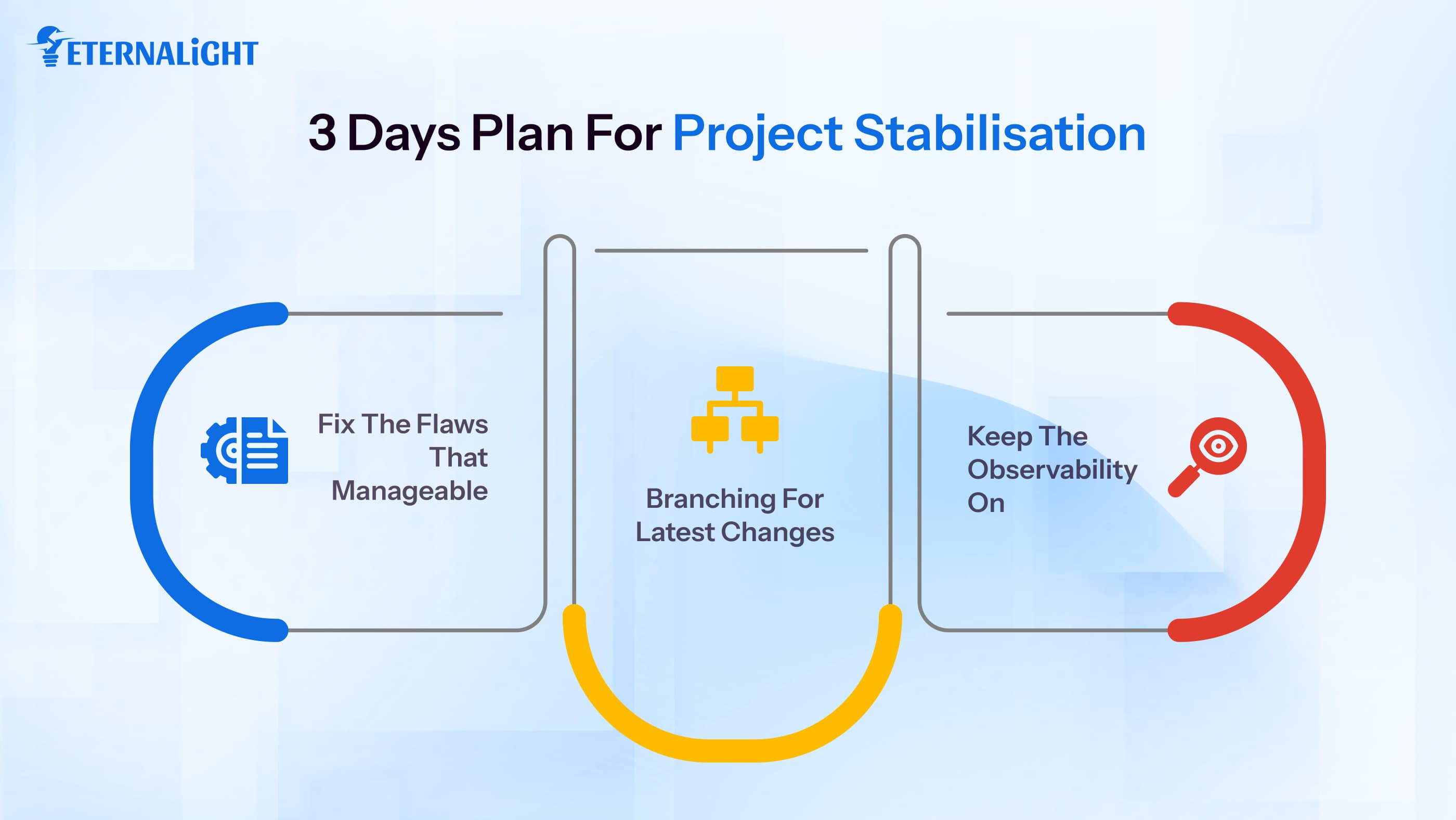
The moment we see a warning, our mind starts thinking straight to a solution. With multiple thoughts in mind, is there any way to refactor, or do we need to do it from scratch? Show that we reset the priority and features. Stop panicking and take a pause, and first try to regain control by stabilizing the situation.
Fix the Manageable Flaws
Set up the plan to control what is in your hands. You don’t need to stop the development process completely; you just need to manage it gradually. Prioritize small changes immediately and defer hard functionality changes for later. If you just wait for the situation to improve, don’t forget that a new problem can also arise in the meantime.
Branching for Latest Changes
In the backend, you can see when the last changes were made and when the deployment was completed. You will be able to see production failure incidents and bugs. A few features may be half-baked, and some other one tonrefarctor code. You need to create a branch named stabilisation to regain confidence.
Keep the Observability On
Without monitoring the KPIs, you can’t predict the progress. By evaluating failure rates, load, latency, and data flow speed, you can understand what's blocking progress. Through the KPI setup, it would get easier to avoid the noise and tune the signals, aligning the goals.
Hire the authoritative person to make a decision, evaluating the situation to hold, go forward, or roll back. It enforces accountability to take an immediate call if a risk is encountered.
Creating a risk log is advantageous for keeping the process transparent and clear. Where you can check risk factors, dependencies, issues, and assumptions.
10-day Plan to Gather the Facts
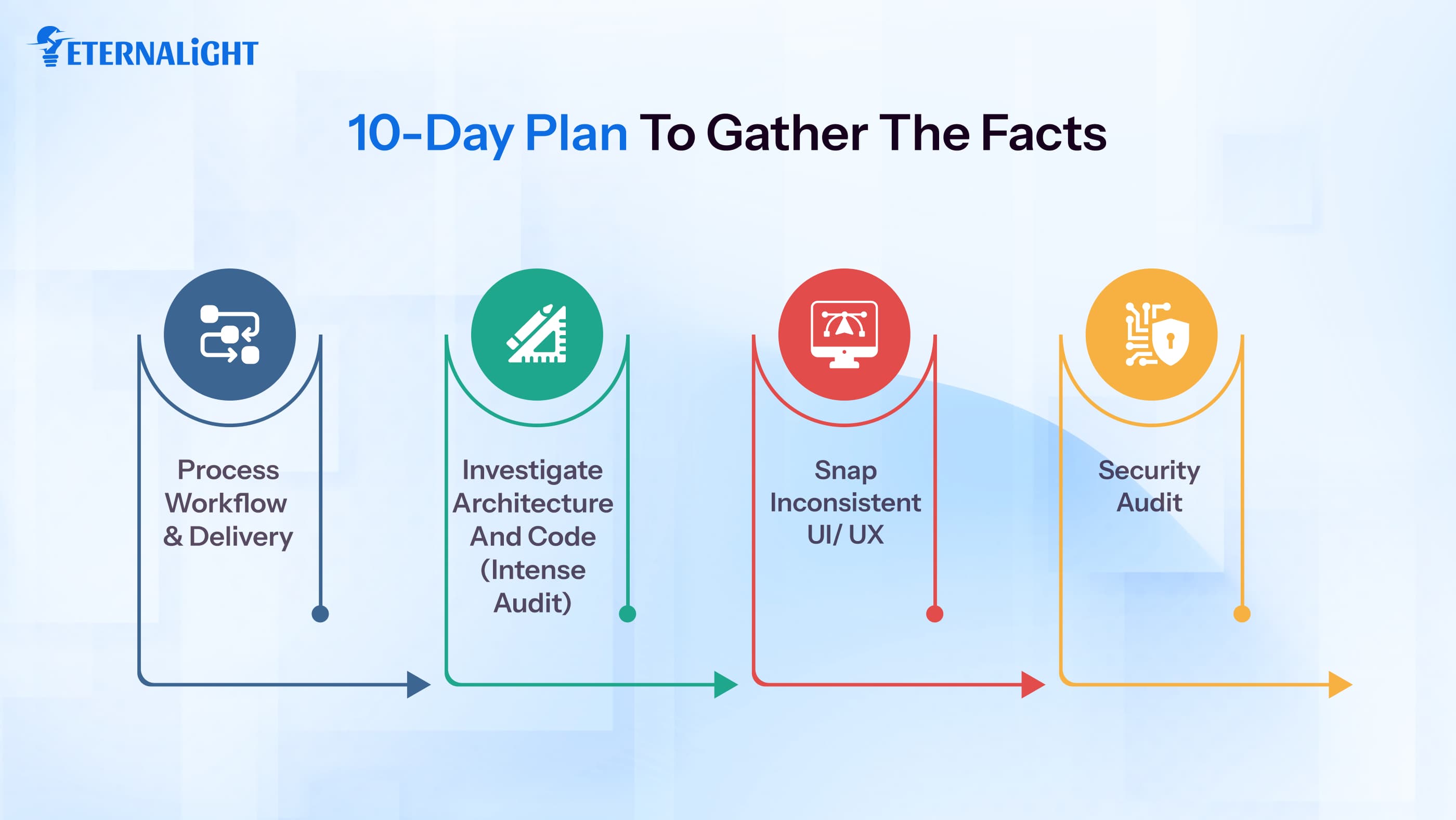
In this phase, you are collecting root cause evidence that stages the drama of project failure.
Process Workflow & Delivery
- Start with basic DORA metrics, including deployment frequency,
- failure rate inflation, and
- mean time to restore.
- Review the branching strategy
- Prioritizing trunk-based deployment
Investigate Architecture and Code (Intense Audit)
Without evaluating all the phases, it’s harder to understand the root causes until we know how to resolve them and regain control. Auditing the project will provide a health report that identifies hidden risks and gaps to optimize the workflow.
Along with the tech stack audit, it's time to reevaluate the budget estimate, deadline, and potential dynamics to maintain transparency.
Snap Inconsistencies in UI/ UX
Beyond the technical need to gather user funnel data when they sign in, sign out, and drop off to estimate the conversion. Poor UI/UX forces users to drop the app faster.
Security Audit
Assessment survey to discover hidden vulnerabilities and check whether the app complies with all security compliance standards, such as OWASP, DPIA, or GDPR.
These diagnosis phases establish the broken trust and help to restructure the product development track.
Recovery with Valued driven Replanning
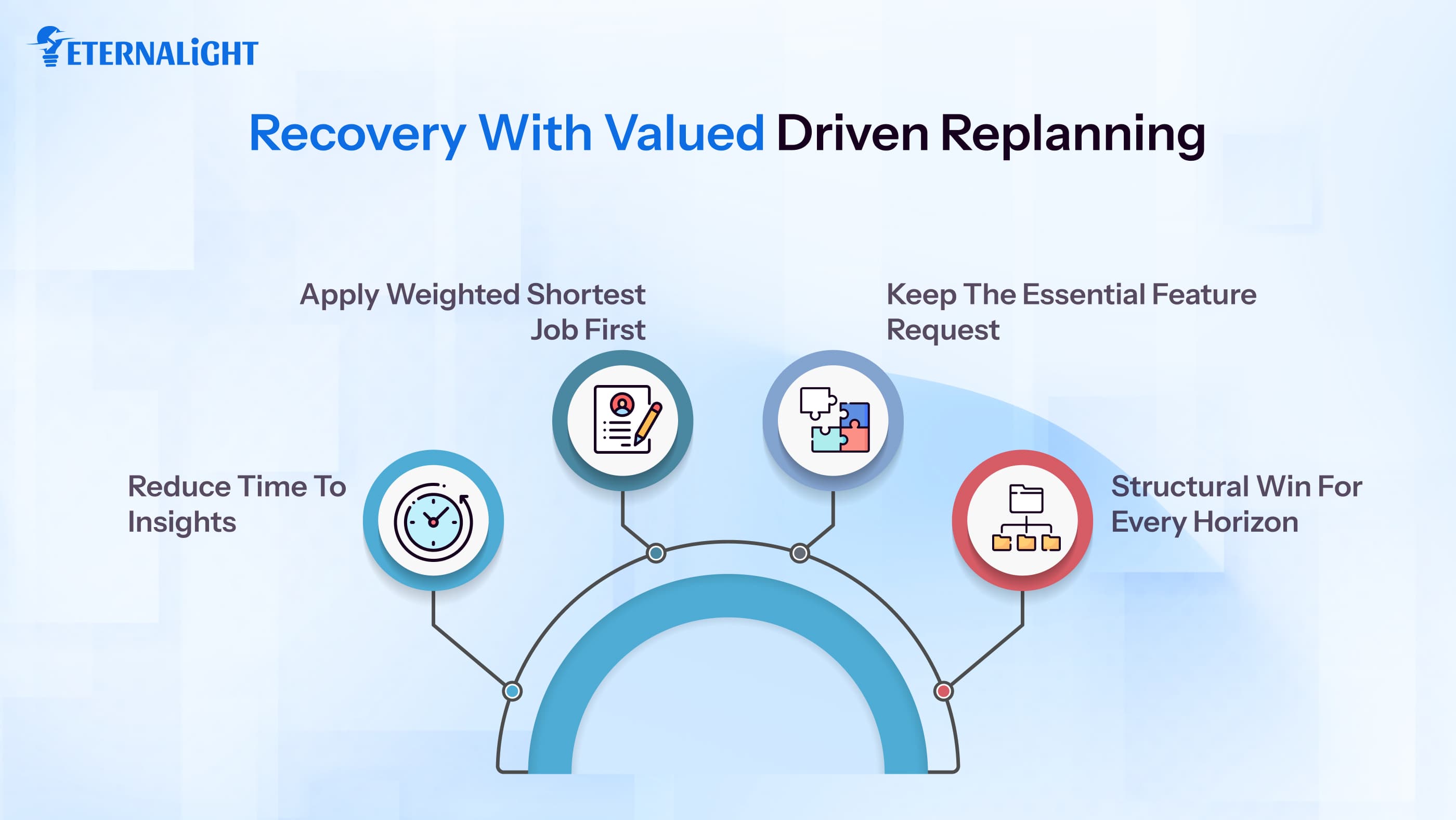
Once you diagnose the issues and also gather the facts, the temptation will reduce. It's time to structure the plan to add value to the project.
Reduce Time to Insights
Instead of focusing on the count of features aimed to accomplish: such as boosting conversion, reducing bounce rate, and extend time, users spend. Your outcomes will indicate whether the project is on track.
Apply Weighted Shortest Job First
To keep the process evidence-based, you need to calculate the incentive to maximize value as quickly as possible.
Incentive=Cost of delay/ job size
Keep the Essential Feature Request
Remove the features that don’t drive the major outcome. Reduce its scope for the time being until it is urgent. It will help to narrow the workflow, saving time.
Structural Win for Every Horizon
Don't be trapped in a quarter-or 6-month sprint plan. Divide the task into small chunks of weekly goals and milestones. Don’t be exhausted with more work.
Let the momentum establish once you start seeing outcomes, and you have bandwidth to do more, you can add more tasks to win.
These small milestone accomplishments will give you confidence and build trust among all stakeholders, as evidenced by the visual task.
What to Prioritize: Refactor or Rebuild
You are done with replanning. Now, two things create a dilemma as they seem similar at first: Refactor or Rebuild
Whatever you choose will cost effort and time, so you need to think wisely and make a call. To make your decision easier, here are the points:
Refactoring is a smart move to rescue the project from approaching failure. You fix the problematic parts one by deafault eliminating functional errors in a limited time, making the delivery faster.
On the flip side, refactoring works best for all the critical scenarios involving security, financials, an outdated tech stack, and architecture. To achieve sustainable, long-term success and outcomes, we recommend consulting a custom software development company in Pune.
Confirm the Delivery System
We at Eternalight focus on developing a reliable pipeline because even the best-structured, readable code can sometimes seem vulnerable to users. Aim for swift project delivery with visible wins.
Trunk based Development
If the feature branches are long and code-heavy, it will lead to conflicts with frequent modifications. Developers prefer trunk-based development leveraged with robust, rapid automation testing, enabling swift shipping with low risk.
Instead of doing a full switch, developers should narrow the branch scope to allow more mergers in the future.
Stage Feature Flag
Isolate the feature flags from the release, keeping the production in a dark state. Which to release when it feels secure, because not all fresh feature deployments you release will act normally; they may disturb other features, disrupting the app's performance. Instead of implementing changes across the entire release, implement them when the risk is low.
Redefine Update Story
Every change you make should be accompanied by multiple test cases, unit, integration, and stress tests to verify stability each time you release a change/update and to ensure quality.
Daily Disciplined Review
Whether you require it or not, dedicated 15 to 30 minutes standups will be worth it to avoid project drowning. Monitor the RAID log and discuss strategies and issues to ensure timely delivery.
Applying this strategy makes the project safe, sustainable, and secure, eliminating risks.
Security & Compliance
Security isn’t optional; it is the critical factor in the rescue phase. Generally, vulnerabilities arise when tools, libraries, or functionality are not aligned with real-world use cases and outdated systems.
- Keep it on by default in delivery with limited-privilege access to address broken authentication, insecure components, and inconsistent injection flaws, which are common critical security patches that can put the project at risk.
- To validate your app, prioritise OWASP application security verification standards to trace potential risks.
- Prepare the project for failure scenarios by complying with backup and restore processes and aligning the recovery time objective and recovery point objective.
- Test real-world flaws by integrating the CI/CD pipeline with static and dynamic application testing.
- Confirm all the security standards requirements to prevent awful scenarios.
Done with technical recovery, it's time to look over the financial debt, too, which also leads to the project delay.
Financial Transparency with Realistic Forecast
Don’t think fixing the technical part is your win, and now that the project is in control, while tackling the technical part, finances need to be managed. If it is neglected this time, you will be disappointed by sudden changes and hidden maintenance.
Being optimistic isn’t wrong, but we can’t plan for success based solely on probabilities. According to Little’s law, stop focusing on what's in progress and focus on throughput to achieve on-time final delivery.
While planning the budget, give them a label to identify where your money is going so you can make future work and take decisions.
Having financial clarity establishes credibility and confidence. As we know, financial leads and other stakeholders care only about outcomes, not velocity charts.
Choose the Right Approach for Recovery
While you plan to recover the project, you must determine whether it requires only minor fixes or major changes. Do you need a major upgrade, high-level mapping with stabilisation, or diagnosis? Decide on the approach based on your business needs and outcome; choose light, easy, medium, or high.
Light Plan (for Patch Work and Drive Stability)
Suitable for where short term goals have not been accomplished, building blocks are good, and only a few module modifications can drive the outcome. It can be done in 15 to 25 days.
Medium Plan (Technical Debt, including UI/ UX, delivery)
Tackle the root issues without the full recovery mode, adapting 3 day audit and 10 day stabilisation plan, compliance configuration, eliminating toxic modules, backlogs, and prioritising the trunk-based development, strangler fig pattern or feature flags, full project sprint plan for 60 days
Full Plan (Intense Transition Needed)
From architecture and UI/ UX to critical security vulnerabilities, if everything needs to be addressed, including the financial cost, custom software development teams need to think from scratch. It will take around 90 days to 6 months to save the project from failure.
In this approach, it is essential to proceed with the stabilisation and audit phase, but alongside this, there’s a need for assessment to apply the trunk-based workflows, the TIME model, and the progressive delivery method with automated fallback recovery strategies.
Blend of agile and DevOps methodologies, FinOps governance
It will actually extend the budget needed to reset everything for long-term success.
Whatever you select, it must align with the intent and business goals and resolve all technical and financial glitches strategically.
Tips To Rescue an App Development Project from Failure
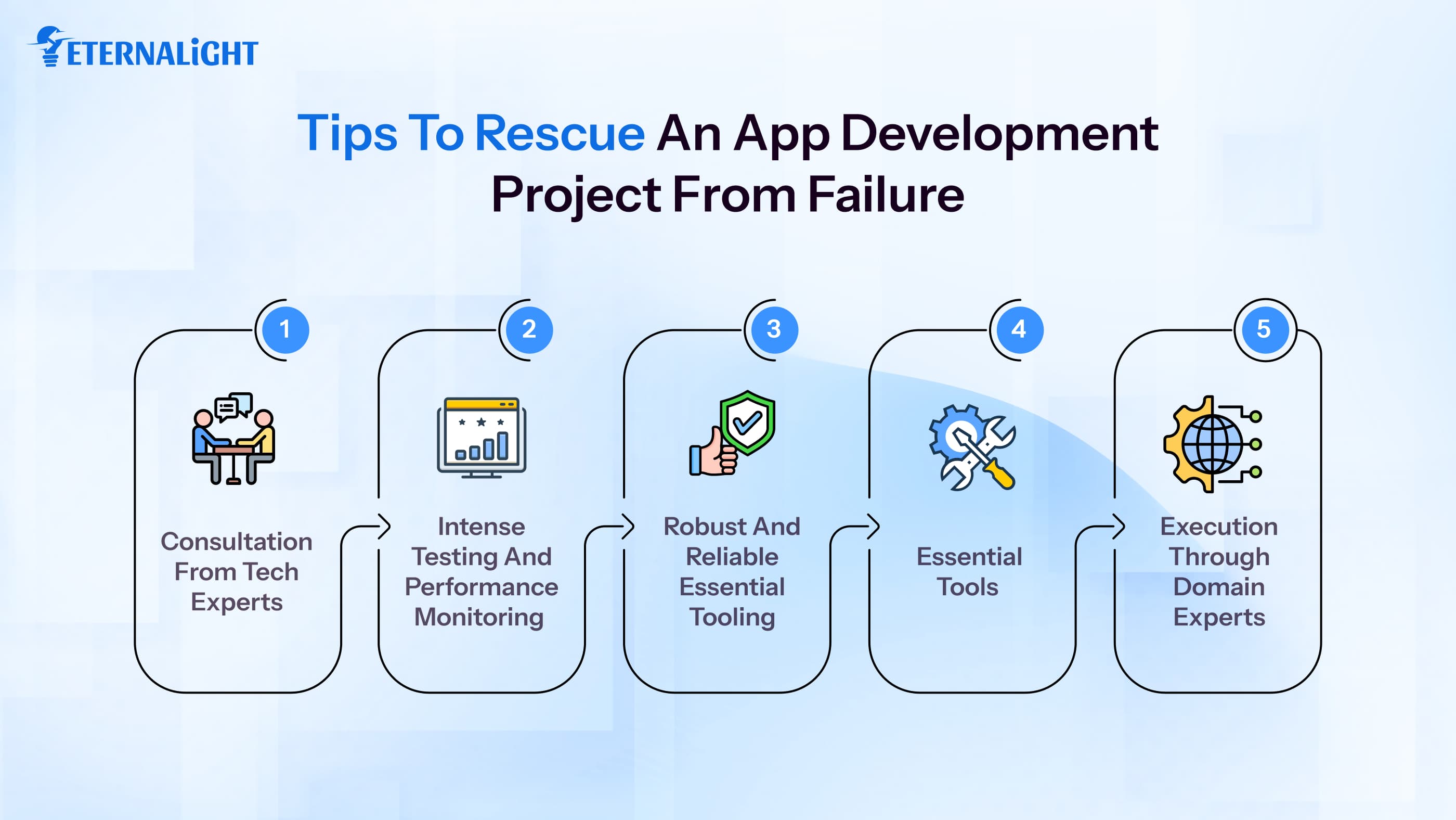
Consultation from Tech experts
A professional custom software development company focuses on code readability. They connect with all developers and stakeholders to define project goals for each phase, finalize the right tech stack compatible with the project idea and legacy systems, and help make necessary decisions.
Intense Testing and Performance Monitoring
To ensure code reliability and quality, we use automation tools such as Postman and Cypress, which reduce the time and effort required by the quality analyst. We aim to resolve potential technical glitches in advance and ensure compliance with security requirements before serving the app to users.
Robust and Reliable Essential Tooling
Modifying the process alone won’t save the project from failure. To get confidence, we need a modern, reliable techstack that can align well with the business goals. No need to fall for expensive subscriptions, go for a minimum viable tooling kit and resources essential to stabilise the project and visible wins.
Essential Tools
GitHub, GitLab, Jira, ConfigCat, ESLint, New Relic, Datadog, Slack, LogDNAOWSAp, DAST/SAST, GDPR, FinOps Tools, Autoscaling rules, cloud tagging policies, and other tools enable CI/CD testing, branching, source control, and intensive project monitoring and management. All these tools contribute to project success.
Execution through Domain Experts
No matter how efficient the team players are, not everyone is a jack of all trades, so if you have the option to outsource product development company experts from a different timezone, that’s worth it.
Before hiring, you must review their work in the relevant domain and their years of experience to build your trust. Clutch, TopDevelopers, and GoodFirms are some of the top ratings and review sites that list the best outsource companies, recognizing their work in the industry.
How at Eternalight Infotech We Rescue the Project Failure?
Project failure isn’t a failure of the project, but a waste of time and effort and a financial burden. No founder thinks of this worst-case scenario.
One wrong move, a slight change in requirements, or missed details can lead to the project's failure. Not all experiments are worth it; some may fail, too.
At Eternalight, we maintain a full, transparent, structured, and straightforward approach. We evaluate all the critical factors and align the user persona to avoid financial and tech debt.
From idea to development team costs, resource planning and allocation, tech stack as per requirements, and keeping a buffer of time and money with senior-level experts/CTOs. Ensuring all milestones will be achieved on time, sustaining growth.

Ayushi Shrivastava
Senior Content Writer
Ayushi is a Content Strategist at Eternalight Infotech with 4 years of experience in transforming complex ideas into clear, engaging, and SEO optimized narratives. She specializes in crafting impactful content strategies that enhance brand visibility and drive meaningful engagement across digital platforms.
Related Blogs
 Software Development9 Mins
Why Choose Python for Fintech App Development?
Learn how Python helps fintech businesses build scalable, data-driven applications with powerful support for analytics, AI, APIs, and automation.
- Software Development8 Mins
Is It Time to Build Off the Self vs Custom Software for Your Business?
When should you build custom software? Learn the key signs, costs, limitations, and factors to consider before choosing custom software for your business.
- Software Development11 Mins
Website Security Checklist: What to Check Before It's Too Late
Worried about website security? Use this practical website security checklist to spot common risks and protect your website, data, and users.