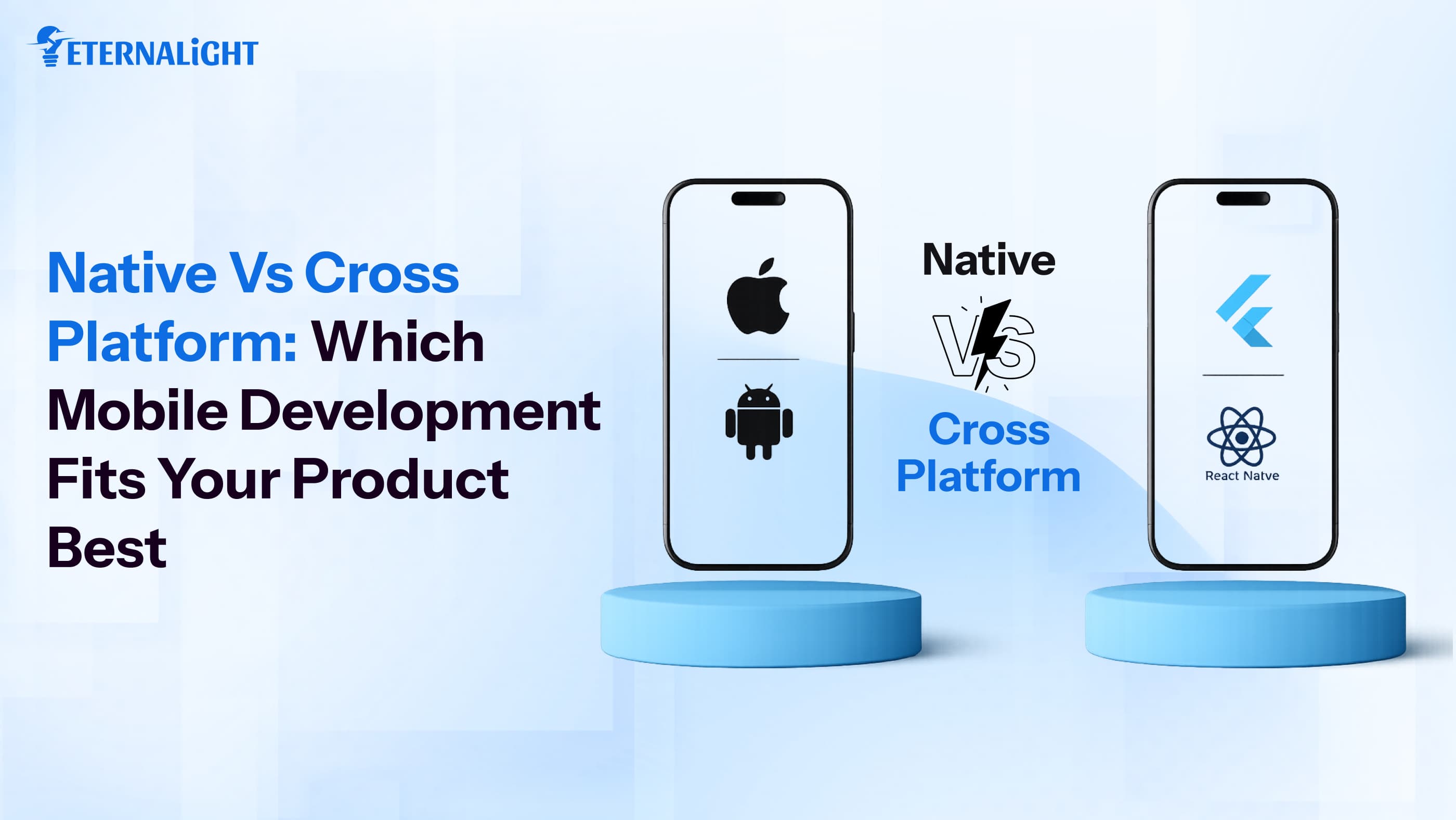
Choosing between Native vs Cross Platform app development is one of the biggest decisions in mobile app development. The right approach can affect your app’s performance, development cost, launch time, and overall user experience.
Some businesses choose Native App Development for better speed and performance, while others prefer Cross Platform App Development to reduce cost and build apps faster for both Android and iOS.
Both approaches have their own strengths, and the best choice depends on your business goals, target audience, budget, and app complexity. Understanding the differences between these development methods can help you avoid costly mistakes in the future.
In this blog, we’ll compare native vs cross platform mobile app development, including their advantages, limitations, and best use cases, to help you choose the right solution for your product.
An Overview of Native vs Cross-Platform Mobile App Development
The debate around Native vs Cross-Platform App Development has existed for years, and even in 2026, businesses continue to evaluate both options carefully before starting app development.
At its core, the difference lies in how the application is built and deployed across platforms like Android and iOS.
- Native App Development focuses on creating separate applications for each operating system using platform-specific technologies
- Cross-platform app development uses a shared codebase that runs on multiple platforms simultaneously.
Both approaches can produce high-quality mobile applications, but the development process, cost, structure, flexibility, and user experience differ significantly.
Before comparing them deeply, let’s understand both concepts individually.
What is Native App Development?
Native App Development refers to building mobile applications specifically for a single operating system using official programming languages and development tools.
For Android apps, developers typically use Kotlin and Java. And for iOS apps, developers use Swift and Objective-C.
Native apps are developed using official SDKs and frameworks provided by Google and Apple. Since these apps are designed specifically for one platform, they can directly access device features, APIs, hardware components, and operating system capabilities without compatibility layers.
Popular examples of native applications include:
- Spotify
- Snapchat
- Google Maps
These apps provide highly optimized performance, smooth animations, faster response times, and a platform-specific user experience.
Key Features of Native App Development
High Performance
Native applications are optimized directly for the target platform, making them extremely fast and responsive.
Better User Experience
They follow platform-specific UI/UX guidelines, which makes the app feel natural for Android and iOS users.
Strong Security
Native apps can implement advanced security mechanisms more efficiently because of direct platform integration.
Full Hardware Access
Developers can easily use camera APIs, GPS, Bluetooth, sensors, NFC, and other device-level functionalities.
Offline Capability
Many native apps offer better offline functionality and smoother local data handling.
However, native development also come with certain limitations-
- Separate development teams for Android and iOS
- Higher development cost
- Longer development timelines
- Increased maintenance efforts
Despite these challenges, businesses that prioritize premium user experience and performance often choose native apps.
What is Cross Platform App Development?
Cross Platform App Development is a development approach where a single codebase is used to create applications for multiple platforms, mainly Android and iOS.
Instead of building two separate apps, developers write shared code using frameworks like- React Native, Flutter, Xamarin, and Ionic.
This approach allows businesses to launch apps faster while reducing development and maintenance costs.
Modern frameworks have significantly improved over the years, making Cross platform app development a strong competitor to native development. Today, many successful apps use cross-platform technologies effectively.
Key Features of Cross Platform App Development
Single Codebase
Developers write one codebase that works across multiple platforms.
Faster Development
Shared code accelerates development cycles and reduces time-to-market.
Cost-Effective
Businesses save money because fewer developers and fewer resources are required.
Easier Maintenance
Bug fixes and updates can be implemented once and deployed everywhere.
Wider Market Reach
Apps can be launched simultaneously on Android and iOS.
Although cross-platform frameworks have improved tremendously, there are still certain trade-offs:
- Slightly lower performance compared to native apps
- Limited access to some advanced hardware features
- Platform-specific customization challenges
- Dependency on third-party frameworks
Still, for many startups and mid-scale businesses, the advantages often outweigh the drawbacks.
Quick Comparison- Native vs Cross-Platform App Development
Factor | Native App Development | Cross-Platform App Development |
Codebase | Separate for Android & iOS | Shared single codebase |
Development Cost | Higher | Lower |
Performance | Excellent | Good to Very good |
User Experience | Highly optimized | Consistent but less platform-specific |
Development Time | Longer | Faster |
Maintenance | More complex | Easier |
Scalability | High | Moderate to High |
Hardware Access | Full access | Limited in some cases |
Security | Strong | Good |
Best For | High-performance apps | Budget-friendly multi-platform apps |
This table highlights why the Native vs Cross-platform discussion depends heavily on business priorities rather than a universal “best” option.
Pros and Cons of Native vs Cross Platform App Development
Understanding the strengths and weaknesses of both approaches helps businesses make more informed decisions.
Pros of Native App Development
Native apps are known for delivering high performance, better security, and smooth user experiences. They are ideal for businesses that want advanced functionality and platform-specific optimization.
Superior Performance
Native applications are built specifically for a single platform, which helps them deliver faster loading speed and smoother performance. They can handle heavy processing, animations, and complex functionalities more efficiently than shared-code solutions.
Better UI and UX
These apps follow Android and iOS design guidelines closely, making the interface feel more natural for users. This improves overall engagement, navigation experience, and customer satisfaction.
Easier Integration with Device Features
Native apps can directly access device hardware like GPS, camera, microphone, Bluetooth, and biometric authentication. This makes it easier to build feature-rich applications with advanced mobile capabilities.
Stronger Stability
Since native apps are developed specifically for one operating system, they usually face fewer compatibility issues. They also perform more consistently across different devices and OS versions.
Better for Complex Applications
Applications with advanced graphics, real-time updates, or intensive processing perform better with native development. Industries like gaming, finance, and streaming often prefer this approach for reliability and speed.
Cons of Native App Development
Although native development offers excellent performance, it also comes with higher development effort and cost. Businesses must manage separate applications for Android and iOS platforms.
Higher Cost
Native development requires separate teams or resources for Android and iOS development. This increases the overall project budget compared to cross-platform solutions.
Longer Time-to-Market
Building two separate applications takes more time for development, testing, and deployment. Businesses looking for quick launches may find this process slower.
More Maintenance
Every update, bug fix, or new feature must be implemented separately for both platforms. This increases long-term maintenance efforts and operational complexity.
Pros of Cross Platform App Development
Cross-platform development helps businesses build applications for multiple platforms using a single codebase. It is widely preferred for faster launches, lower costs, and easier maintenance.
Lower Development Cost
Since developers use one shared codebase for Android and iOS, businesses can reduce development expenses significantly. It also lowers the need for maintaining separate teams.
Faster Launch
Cross-platform frameworks speed up the development process and help businesses release apps quickly. This is especially useful for startups and MVP development.
Easier Maintenance
Updates and bug fixes can be applied once and reflected across multiple platforms simultaneously. This simplifies app maintenance and saves development time.
Code Reusability
A large portion of the code can be reused across Android and iOS applications. This improves development efficiency and reduces repetitive work for developers.
Ideal for MVPs
Startups often choose cross-platform frameworks to validate their ideas quickly without investing heavily in separate app development. It allows faster testing and market feedback collection.
React Native also supports advanced mobile functionalities with less development effort. Businesses building location-based apps can improve user experience with seamless geolocation integration for features like live tracking and real-time navigation.
Cons of Cross Platform App Development
While cross-platform development is cost-effective and fast, it may still face limitations in performance and platform-specific customization for highly complex applications.
Performance Limitations
Cross-platform apps may not perform as smoothly as native apps in graphics-heavy or highly interactive applications. Some complex features can experience slight delays or reduced responsiveness.
UI Inconsistencies
Maintaining the same look and behavior across Android and iOS can sometimes be difficult. Developers may need additional customization to match platform-specific experiences.
Dependency on Framework Updates
Cross-platform applications rely heavily on third-party frameworks and libraries. If framework updates are delayed, it can impact compatibility and app performance.
Limited Native API Access
Some advanced device-level features may require custom native modules for proper functionality. This can increase development complexity in certain projects.
Native vs Cross-platform: How to Choose?
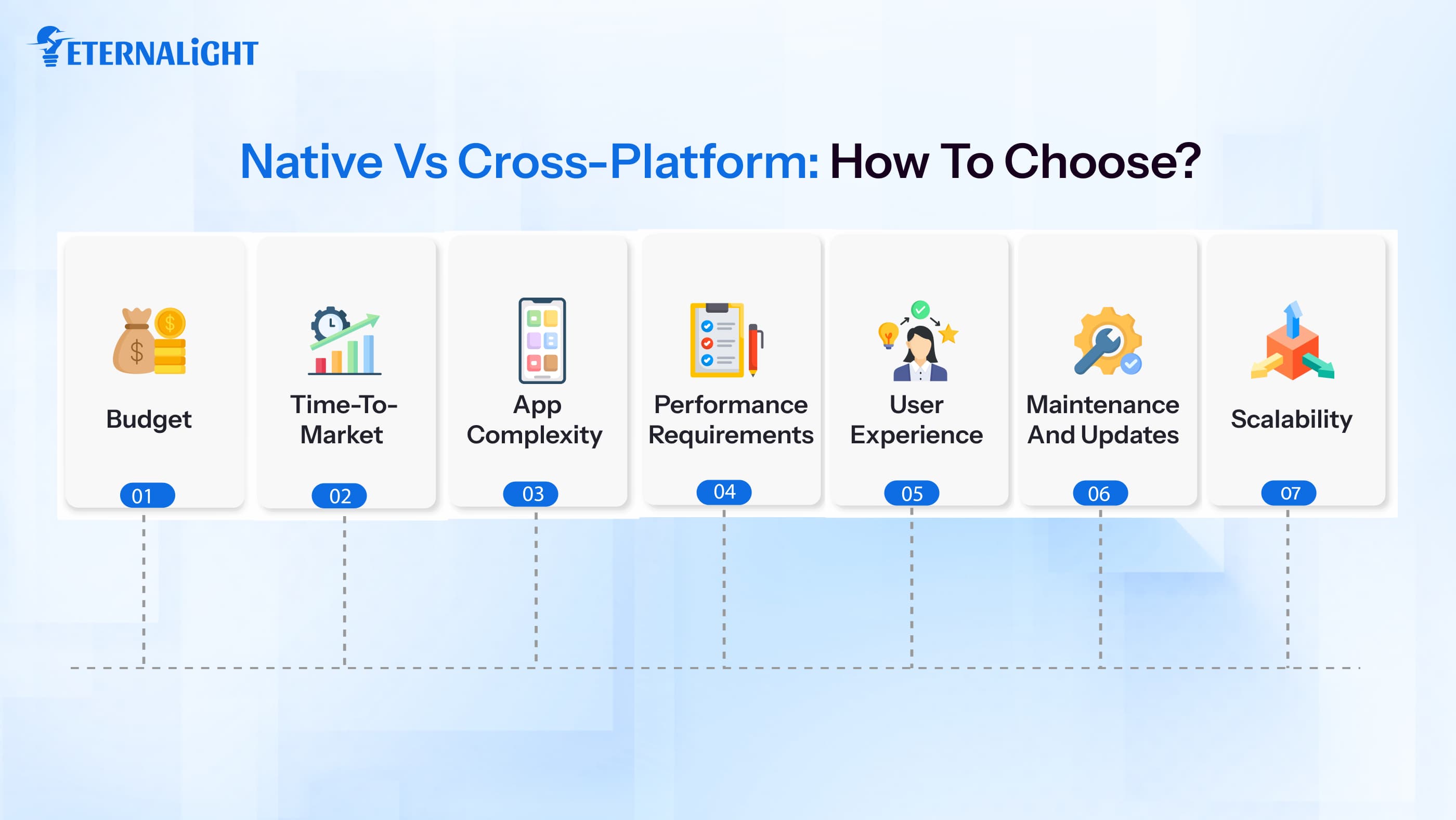
Choosing between Native vs Cross Platform App Development depends on multiple business and technical factors.
Here are the key considerations businesses should evaluate before making a decision.
Budget
Budget plays an important role when selecting a mobile app development approach. Native development usually costs more because separate apps are built for Android and iOS.
Cross-platform development is more cost-effective since developers use a single codebase for multiple platforms, reducing overall development expenses.
Time-to-Market
If you want to launch your app quickly, cross-platform development can be a better option. It helps businesses release apps faster on both Android and iOS simultaneously.
Native development takes more time because each platform requires separate development, testing, and maintenance processes. Businesses planning their mobile strategy should also understand how long it takes to develop a mobile app.
App Complexity
Complex applications with advanced animations, gaming features, or heavy processing usually perform better with native development. It provides better control over device capabilities and performance optimization.
Cross-platform development works well for standard business apps, eCommerce apps, social platforms, and productivity applications.
Performance Requirements
Native apps are known for delivering smoother performance and faster response times. They are optimized specifically for a single operating system.
Cross-platform apps also provide good performance, but highly interactive or graphics-intensive apps may still benefit more from native development.
User Experience
Native apps follow platform-specific design guidelines more naturally, which creates a smoother and more familiar experience for users.
Cross-platform apps focus on maintaining a consistent interface across platforms while reducing development effort.
Maintenance and Updates
Cross-platform development simplifies maintenance because updates can be managed from one shared codebase. This helps businesses save time and resources.
In native development, updates and bug fixes must be implemented separately for Android and iOS applications.
Scalability
Native development offers better flexibility for future customization and advanced platform-specific features. It is often preferred for long-term scalability.
Cross-platform apps are scalable too, but some advanced functionalities may require additional native support later.
When to Use Native vs Cross Platform - An Industry-Specific Verdict
Every industry has different app requirements, which is why the choice between native and cross-platform development depends on the type of product you are building. Some businesses focus more on speed and budget, while others need stronger security and better performance.
eCommerce Applications
Cross-platform development is a popular choice for e-commerce apps because businesses usually want to launch quickly on both Android and iOS. Features like product browsing, online payments, notifications, and user accounts work smoothly with cross-platform frameworks.
But if the platform is very large and includes advanced animations or highly customized shopping experiences, native development can provide better speed and stability.
Banking and Finance Apps
Finance apps handle sensitive customer information and secure transactions every day. Because of this, many banking applications prefer native development for better security and smoother performance.
Native apps also work better with features like biometric login, real-time transaction updates, and device-level security integrations.
Social Media Applications
For small or medium-sized social apps, cross-platform development can be a practical and budget-friendly solution. It helps businesses launch faster without managing separate codebases.
However, larger social media platforms with live streaming, real-time messaging, and video-heavy features often rely on native development for a smoother user experience.
Gaming Applications
Gaming apps usually require fast graphics processing and smooth animations. Native development is often preferred because it handles heavy performance requirements more efficiently.
This is especially important for multiplayer games, AR/VR experiences, and apps with advanced visual effects.
Healthcare Applications
Healthcare apps often need strong security because they manage personal health records and sensitive user data. Native development is commonly used for apps connected to wearable devices or real-time monitoring systems.
At the same time, simpler healthcare solutions like appointment booking or fitness tracking apps can still work well with cross-platform development.
Startup MVPs
Startups often choose cross-platform development when building MVPs because it saves both time and money. A single codebase helps launch the product faster on multiple platforms.
This approach allows businesses to test their idea in the market before investing heavily in full-scale native development.
Conclusion
The decision between Native vs Cross Platform development is not only about technology but also about business priorities. Every app has different goals, user expectations, and technical requirements, so the best approach depends on what fits your product the most.
Native development is a strong choice for apps that need better speed, security, and platform-specific performance. In contrast, cross-platform development is ideal for businesses looking for faster development, easier maintenance, and reduced costs.
As mobile technologies continue to evolve, businesses should stay up to date with the latest mobile app development trends to make future-ready technology decisions, as both approaches are becoming increasingly advanced and capable.
Instead of focusing on which option is universally better, businesses should focus on which solution aligns better with their product vision, budget, and future growth plans.

Kusum Sethiya
Software Engineer
Kusum Sethiya is a Software Engineer at Eternalight Infotech, focused on building clean and intuitive. She enjoys turning ideas into reliable applications using modern technologies like Javascript, React, Node.js , and MongoDB.
Frequently Asked Questions
Native apps are built separately for Android and iOS, while cross-platform apps use a single codebase for multiple platforms.
Cross-platform app development is usually more affordable because developers maintain one shared codebase.
Yes, React Native is widely used for Cross platform app development because it offers faster development and near-native performance.
Businesses should choose Native App Development for high-performance apps, gaming platforms, and security-focused applications.
Startups often prefer Cross Platform App Development because it reduces cost, speeds up launch time, and simplifies maintenance.
Related Blogs
 Software Development9 Mins
Why Choose Python for Fintech App Development?
Learn how Python helps fintech businesses build scalable, data-driven applications with powerful support for analytics, AI, APIs, and automation.
- Software Development8 Mins
Is It Time to Build Off the Self vs Custom Software for Your Business?
When should you build custom software? Learn the key signs, costs, limitations, and factors to consider before choosing custom software for your business.
- Software Development11 Mins
Website Security Checklist: What to Check Before It's Too Late
Worried about website security? Use this practical website security checklist to spot common risks and protect your website, data, and users.