In 2026, mobile apps have become the primary way people shop, communicate, and consume information. A lot of business and work interactions now happen through a tiny screen in your pocket.
The world today cannot be imagined without mobile phones. One of the most groundbreaking inventions of this century, phones have forever changed the way the world works. The mobile industry shows no signs of slowing down. The global mobile app market is generating hundreds of billions in revenue annually.
But the way technology has adapted also requires companies to adapt as well. Building a decent app is no longer enough. Users expect apps that match the pace of current technology. They want seamless, smooth interactions, zero lag and downtime, and everything to be easily accessible. Enterprises want apps that integrate across devices and systems.
If you are building a mobile app or planning to, understanding the mobile app development trends that are shaping the years to come is essential. If you are a founder looking for mobile application development services, you need to look for a partner that is aware of the trends and areas of growth for mobile apps.
The State of Mobile App Development in 2026
Global mobile app downloads are expected to surpass 181 billion in 2026.
The average person now spends approximately 4 hours on their phone daily, with 90% of that time spent inside apps.
Non-gaming apps have also crossed a significant milestone. For the first time, they have outperformed gaming apps in monthly revenue. This reflects a bigger trend in user behavior. People are now paying for productivity tools, health apps, and other services at rates much bigger than they used to be.
63% of mobile app developers are already integrating AI features into their apps. Generative AI apps alone have generated around $3 billion in annual revenue in 2026.
All these numbers paint a very clear picture. The future of mobile app development is not just about writing code but about building experiences that keep your users engaged and hooked.
Top Mobile App Development Trends in 2026
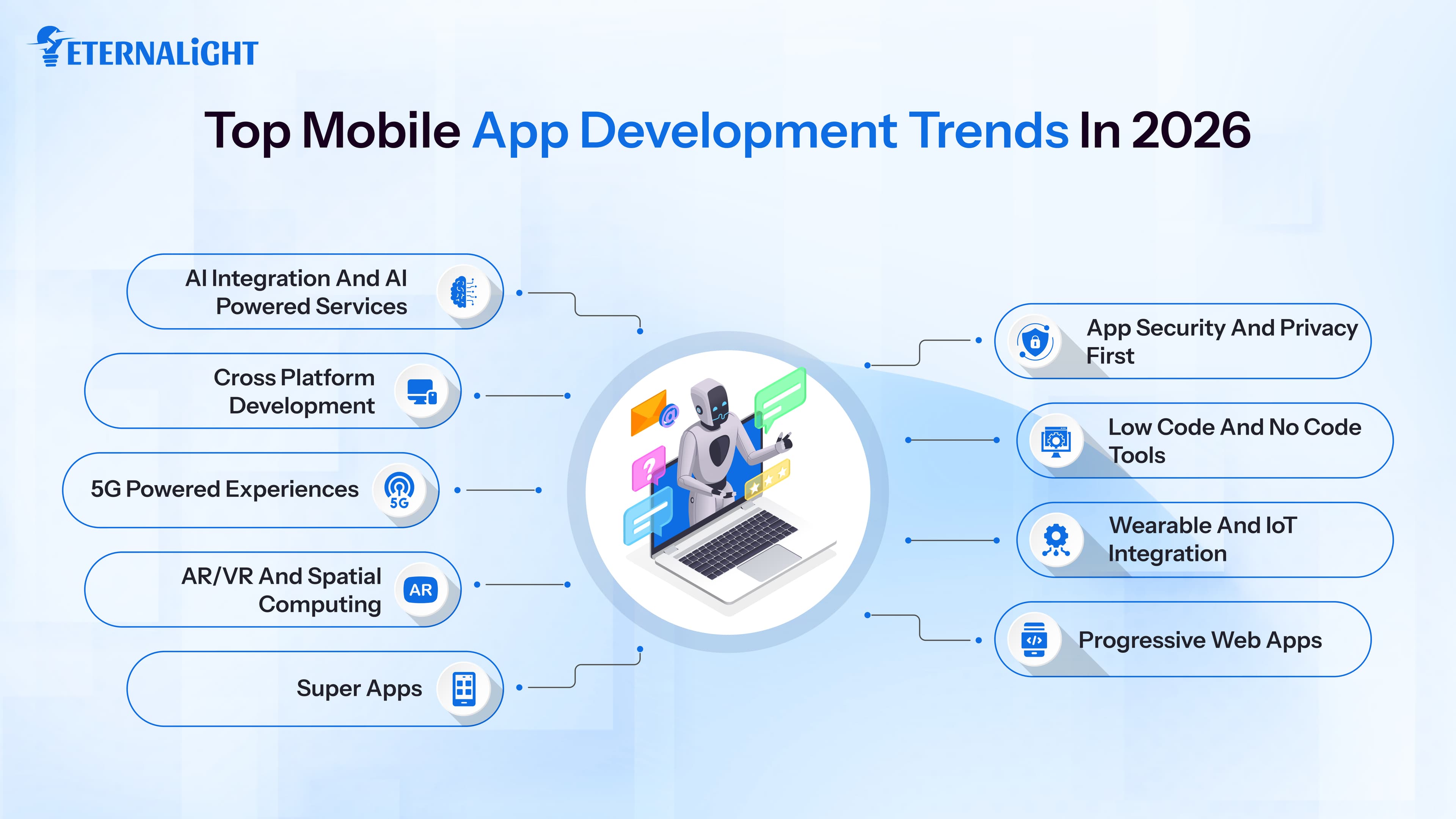
These are the most popular mobile app development trends in the world right now.
AI Integration and AI Powered Services
Artificial intelligence has cemented itself as a non-negotiable feature for many apps now. Apps have gone from providing features to predicting what users need and meeting them halfway with their expectations.
A lot of startups are now choosing to integrate AI at the foundation of their apps, while pre-existing applications now integrate AI in some form. From customer service integration to AI chatbots, the new global trend of AI requires mobile applications to make the best of this new technology.
This is one of the most defining mobile app development trends 2026 has introduced. As we are advancing into the future of AI, we are going to see personalized content feeds and predictive health monitoring. If your product roadmap does not include AI, it is worth asking why not. AI brings value to most products and might bring value to your application too.
Cross Platform Development Is Now Standard Practice
For years, a lot of mobile applications were either exclusively Android or exclusively iOS. Nowadays, supporting both iOS and Android is becoming standard across enterprises.
Development teams using cross-platform frameworks like React Native and Flutter can share more than half the code between platforms. This cuts maintenance costs and speeds up the time to market. As competition intensifies, having both quality and speed is a huge differentiator for success.
This is an app development trend that directly affects your budget. A well-executed cross-platform approach can reduce your total build cost compared to building native apps separately.
5G Powered Experiences
5G network expansion is here, and it is changing what apps can realistically do.
Low-latency 5G enables seamless real-time video, high-quality augmented reality experiences, cloud gaming, and instant data syncing between devices. Apps that previously required heavy processing on the device can now offload that work to the cloud in milliseconds. Using 5G to your advantage is going to be a blessing for your mobile application. If you are building something that requires heavy processing, you need to ensure you optimize it for the network of mobile devices.
For businesses building in healthcare, logistics, or live streaming, 5G is bringing a great shift that changes the landscape of possibilities for these apps.
AR/VR and Spatial Computing
Augmented reality and virtual reality have been a topic of discussion for years. Spatial computing now sits at the center of serious mobile roadmaps as the next user interface layer.
Apple Vision Pro, Meta Quest 3, and a growing range of lightweight AR glasses have made it practical to experiment with immersive interfaces, even if these experiences still need a lot of growth and development.
The overall AR and VR market is projected to reach over $220 billion by 2026, with mobile AR contributing a major portion of that growth.
Retail apps have also started to use AR to let users try products before buying. Healthcare apps are using it for patient education, while real estate platforms let buyers walk through a property from anywhere in the world.
ARKit for iOS and ARCore for Android have matured enough to let skilled development teams build new augmented reality features into apps without custom hardware or massive budgets.
Super Apps Are Reshaping User Expectations
Users no longer want ten separate apps. They want one app that can handle everything.
The super app model, which was popularized by WeChat and Grab in Asia, is slowly expanding globally. Businesses across fintech, healthcare, and e-commerce are exploring how to consolidate services into a single unified experience for their users.
For founders and enterprises, this is an important mobile app trend to watch. Users are now expecting their apps to handle payments, communication, bookings, and support all in one place.
App Security and Privacy First Builds
Data breaches and privacy violations have made users far more skeptical about the apps they trust with their information. Regulatory pressure is increasing globally. The rise of tech and AI has caused an increase in data breaches and privacy attacks, whether on big organizations or on your personal Facebook account. Data is currency, and users now focus on the privacy and security of their data in applications.
Security is being built into the development process of applications from the start. This includes end-to-end encryption, biometric authentication, secure API management, and compliance with frameworks like GDPR, CCPA, and emerging regional data laws.
If your app handles any sensitive user data, your development team needs good expertise and experience with modern security standards to ensure privacy and security are not compromised.
Low Code and No Code Tools
Low-code and no-code platforms are now the future of building products and applications. They enable product teams to prototype and ship features without writing everything from scratch. This does not replace skilled developers, but it does change how teams allocate their time and resources.
Product managers can test their ideas faster. Developers can focus on complex features instead of focusing on the same repetitive logic. And early-stage startups can reach their first users with a working product in weeks rather than months.
This is one of the app development trends that directly empowers non-technical founders to validate ideas before committing to a full development cycle.
Wearable and IoT Integration Is Expanding Fast
Smartwatches, fitness trackers, and connected health devices are mainstream products, finding their way into the category of household products now. As adoption grows, users expect their mobile apps to sync seamlessly with these devices.
Apps that ignore wearable integration risk losing users to competitors who offer a more connected experience, especially if your app falls in the health, wellness, and productivity categories. These apps require continuous data syncing across a device and are quickly becoming an expected standard feature.
IoT integration connects mobile apps with smart devices for real-time control and monitoring. It is an innovative trend when it comes to smart homes, healthcare, and industrial solutions. Mobile apps are acting as control hubs for connected devices, enabling remote monitoring and automation at scale.
Progressive Web Apps Offer a Smart, Lean Alternative
Progressive web apps deliver an app-like experience through a browser without requiring the user to download the app. For businesses that are entering new markets or testing product ideas, this alternative offers a practical path that reduces upfront investment.
These become more relevant when your audience uses lower-end devices or is in regions with limited data plans. They also perform better in search engines, giving you an SEO benefit that native apps cannot match. For businesses early in their mobile journey, this is worth serious consideration.
Conclusion
The mobile app development trends defining 2026 share some common qualities: intelligence, speed, and user trust.
AI is now embedded in the core of app functionality. Cross-platform frameworks have now become the default choice for most application builds. Privacy and security of data has more emphasis than ever.
Businesses that understand the trends and make smart decisions about which mobile app trends in 2026 are worth pursuing now will see growth with their applications.
Not all trends need to be integrated into your mobile application. You can pick and choose based on your needs and user expectations. If you are an early stage startup, prioritize cross platform development and low code tooling to reduce your build costs and ship quickly. If you are an enterprise, then app security, on device AI, and wearable integration deserve your focus.
And if you are still deciding whether to build inhouse or with an external team, this guide on outsourcing app development for startups covers the real triggers and smart strategies worth knowing. You can also explore our roundup of the best companies to outsource your product development if you are evaluating partners.

Gauri Pandey
Technical Content Writer
Gauri Pandey is a Technical Content Writer at Eternalight Infotech. She uses her expertise to break down complex topics into simple, value-driven narratives, bridging the gap between technology and real-world applications.
Frequently Asked Questions
The most significant mobile app development trends in 2026 include AI integration, cross platform development, 5G powered features, augmented reality, on device AI, app security, and wearable integration.
AI is now a core part of mobile app functionality. It powers personalization, predictive features, automated support, and on device intelligence. Most applications are now integrating AI in some form, and it will continue to impact the future of app development.
Cross platform frameworks like Flutter and React Native let teams build for both iOS and Android with a shared codebase. This reduces build costs and speeds up delivery significantly.
On device AI means the AI model runs on the smartphone itself rather than in the cloud. This results in faster responses, stronger privacy, and functionality that works even without an internet connection. It is particularly important for apps in healthcare, finance, and any category where user data sensitivity is a concern.
It depends on your goals. Native apps offer the best performance and deepest device integration. Progressive web apps are faster to build and perform better in search, making them a smart option for testing ideas or reaching users in markets where connectivity or device capability is limited.
Related Blogs
- Software Development11 Mins
Website Security Checklist: What to Check Before It's Too Late
Worried about website security? Use this practical website security checklist to spot common risks and protect your website, data, and users.
- Software Development7 Mins
From Off Track to Success: Custom Software Development Challenges to Fix Early
Custom software projects don’t always go as planned. Learn which challenges to catch early before they become costly problems for your budget, scope, and product.
- Software Development8 Mins
Product-Market Fit vs Revenue: What Should Indian Startups Chase
Product-market fit vs revenue: What should Indian startups focus on first? Explore the right metrics, customer signals, and growth priorities at each stage.