-1.jpg&w=3840&q=75)
The global SaaS market will surpass $374 billion in 2026.
If you have an idea, now is the time to start working on it. The market is favourable, and the tools are at your disposal.
Founders think releasing a SaaS product means that you need to build everything before launch. They want the product to be perfect before it even reaches its target audience. So they add another feature, fix another screen, and push the launch date back again. By the time they finally ship, they spend hours of time and money on something they don’t even know will be a success or not.
If you want to start and build a SaaS product, it doesn’t have to be perfect. You can begin with an MVP, launch, and reiterate based on the response and feedback.
This guide gives you a day-by-day plan to build and launch your SaaS MVP in 21 days. From a roadmap to the right partner for your MVP development services, this guide has it all.
What Is a SaaS MVP and Why Should You Build One?
SaaS stands for Software as a Service. MVP stands for minimum viable product. It seems like a mouthful but at its core a SaaS product is simply the version of your software that solves the problem and is functional enough to be distributed to the general public. It is not half-finished or rough. You strip out everything except the core features that users need.
Eric Ries popularised this approach in The Lean Startup. The logic is simple. Instead of a complex project, make the simplest version of your software and let your users decide how much more complexity it needs.
For SaaS founders, an MVP does three things. It validates demand before you invest in development. It generates early revenue to fund the full build. And it creates a feedback loop with actual users, so every version after that is built on evidence, not assumptions.
Why 21 days?
Three weeks is long enough to build something real and short enough to keep the team focused with micro app development or MVP.
It matches what is possible with today's tools. AI coding assistants, no-code platforms, prebuilt auth libraries, and managed cloud infrastructure have cut development time dramatically.
Pre-Launch Planning Before You Start Building
Before you begin your 21-day cycle, you need to set up some prerequisites.
Define the Problem and the User
Ideally, you should have a single problem statement that describes what your product solves or is focused on. If you cannot write that clearly, you are not ready to build yet. Consider an example: "Our app helps freelance designers send professional invoices and track payments without logging into many different tools."
The more specific your problem and your target audience, the cleaner and easier building your MVP will be.
Find your riskiest assumption
Every product idea rests on different assumptions.
You need to find the one that could kill your business if it were wrong. Most of the time it is the demand assumption: will people actually pay for this?
Test it firsthand by running a landing page or by doing user interviews. Run a small paid ad test. You need to validate your core demand before building your MVP.
Set Your Success Metrics Before Day One and Lock the Scope
Decide what success looks like before you build your MVP. Pick three to five numbers you will track. These could be the number of signups, retention rate, conversion rate etc. The numbers tell you whether your MVP is working and what to fix or focus on next.
Write down every feature you think the product needs. Cut the list in half. Scope creep is the number one reason MVPs take longer than planned. Ask yourself what a user must be able to do to get value from your product. Just one thing. That is your MVP. Everything else goes on a waiting list.
Steps to Build a Successful SaaS MVP
Before the week-by-week plan, here is the overall approach that makes the 21 days work.
- Validate before you build. Confirm the problem is real and users will pay to solve it.
- Build in the order users experience the product. Auth first, core feature next, dashboard and settings next and payments last.
- Ship on Day 15, test for six days, launch on Day 21. Testing before your real audience arrives is critically important.
- Set up analytics as early as possible. You need data from the beginning.
The 21 Day Blueprint
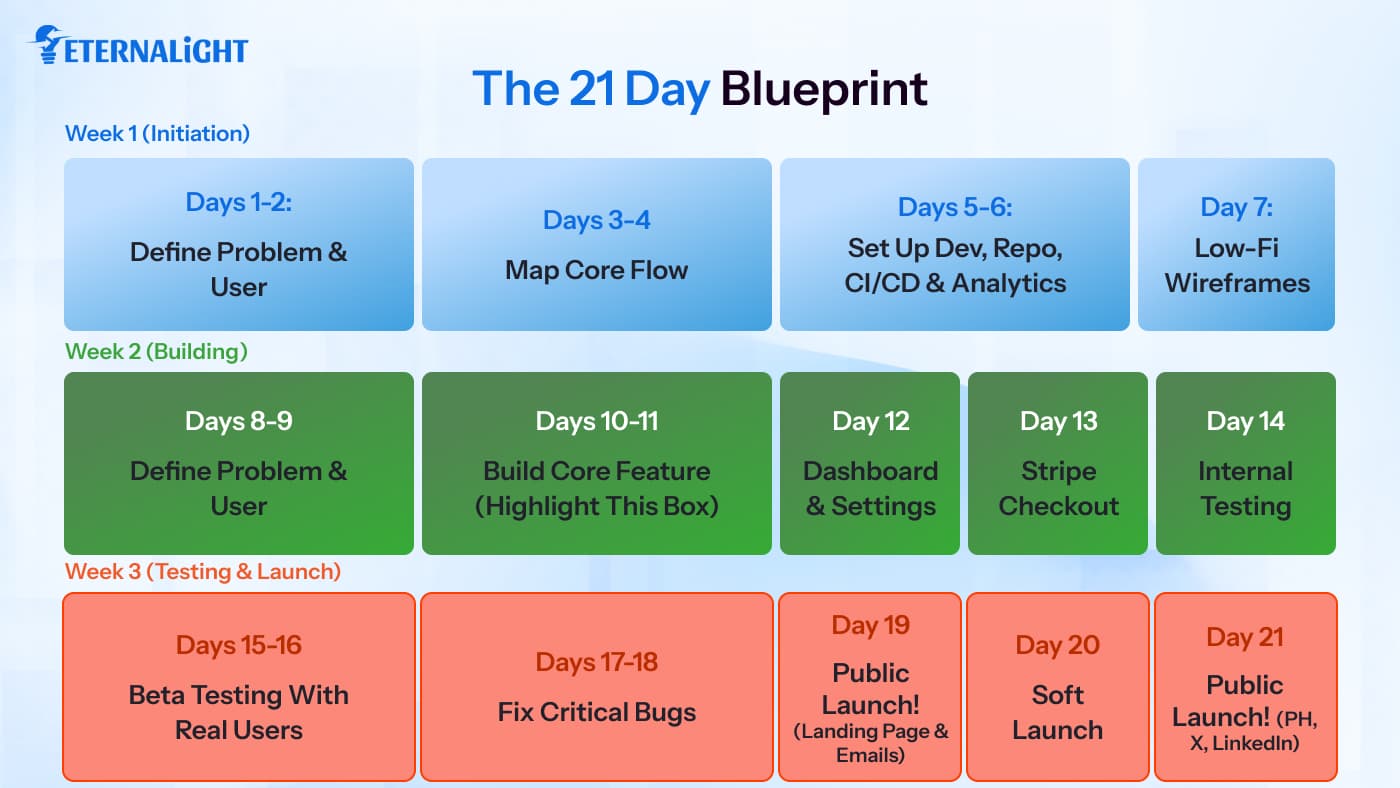
Here is a week and day by day blueprint to follow if you want to make a SaaS MVP in 21 days or less:
Week 1: Initiation
Week one is about making the right decisions. The decisions you make here shape every day that follows for the remaining weeks.
Days 1 and 2: Finalise your problem statement, target user persona, and core user story. Write it down and share it with the whole team.
Days 3 and 4: Map the core user flow. What does a user do from the moment they sign up to the moment they get value from your product?
Days 5 and 6: Set up your development environment, repository, project management tool, and CI/CD pipeline. Choose your analytics tool and configure it now.
Day 7: Build low-fidelity wireframes for the core flow. You don’t need a full visual design yet. Simple sketches work as well. If you do want a full visual design, you can use an AI tool to help you.
Week 2: Building the Core Product
Week two is going to be all about building your core product. Build the flow you mapped in week one.
Days 8 and 9: Work on authentication. User signup, login, and password reset. Do not build auth from scratch in an MVP. It adds days of work and introduces security risk. Better to use pre-existing libraries like NextAuth or Clerk.
Days 10 and 11: On these days you build all the core features. This is the part of the product that delivers the value you promised. If you are building a project management tool, this is creating and viewing tasks.
Day 12: Dashboard and basic user settings. Users need a home screen after login and a way to manage their account. Make this work reliably.
Day 13: Payment integration. Stripe Checkout is the fastest path for an MVP that needs to finish quickly. Even if you plan to launch with a free tier, build the payment infrastructure now. Adding it after launch always takes longer than you think.
Day 14: Internal testing. Get the whole team using the product. Find the obvious issues and fix them before external testing starts.
Week 3: Testing and Launch
Week three is all about making the product ready for the real users.
Days 15 and 16: Now is the time to start beta testing with some real users from your target audience. Take their feedback and work on things you need to improve.
Days 17 and 18: Fix the critical issues from beta testing. Not every issue needs to be resolved but the critical ones do.
Day 19: Prepare your launch assets. A landing page that clearly explains what the product does and who it is for. An onboarding email sequence. Whatever you need to prepare it for launch must be done on this day.
Day 20: Soft launch to a small audience/users. This is your last day to check for any issues that can be resolved.
Day 21: Public launch on this day. Post it on Product Hunt, LinkedIn, X, and relevant communities. Email your list. Reach out personally to the potential users you identified during validation.
This is the timeline it takes to make a SaaS MVP in less than 21 days. Adjust this timeline according to your requirements.
AI Tools That Accelerate Your MVP Timeline
This timeline works because of how much AI tools have changed the way products get built.
The 2025 Stack Overflow Developer Survey found that 76% of developers already use or plan to use AI tools in their workflow.
Teams that use AI report several reductions in repetitive tasks and boilerplate code. Using AI tools can help you save time and resources on actual product building.
Here are the tools that make the biggest difference in an MVP sprint.
Tool | Best Used For |
GitHub Copilot or Cursor | Code generation and autocomplete |
v0 by Vercel | UI component generation from text prompts |
Supabase AI | Database schema and SQL query generation |
Warp Terminal | AI-assisted CLI commands and debugging |
OpenAI API | Adding AI features directly to your product |
If your SaaS product includes an AI feature, integrating OpenAI into your product is significantly faster now than it ever was before. Google Gemini is also worth evaluating, especially if your product involves document processing, image analysis, or voice input.
If you want a practical breakdown of which tools work best at each stage of development, our guide on AI tools for software development startups covers this in detail before you finalise your stack.
Post Launch: What to Do After Your MVP Goes Live
Most founders treat launch as the finish line. It is the starting point.
The 21 days produced a simplistic product but the weeks after launch decide whether it becomes a success.
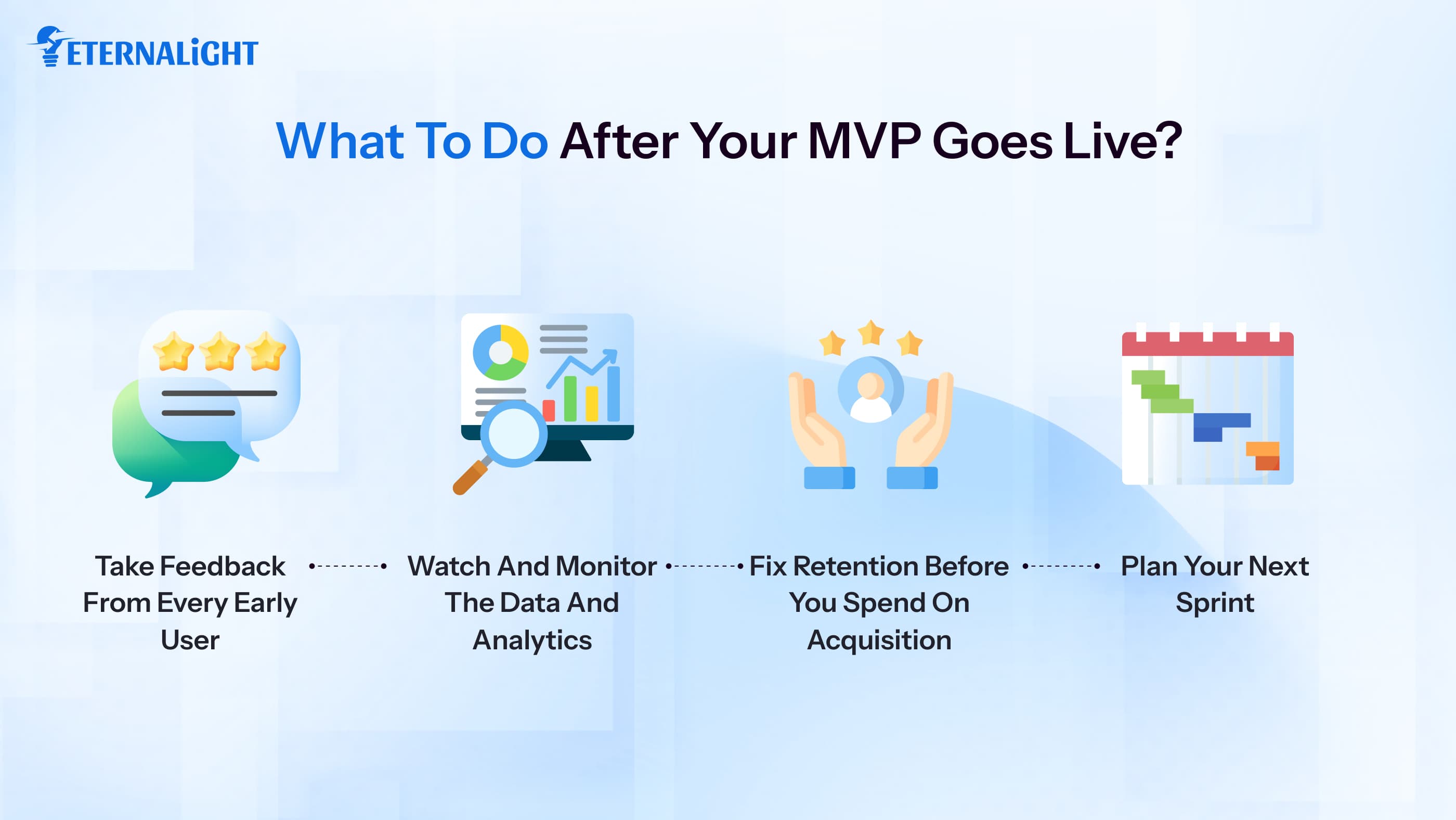
Take feedback from every early user
Your first users are the most valuable people your product will ever have. They chose it when it was rough and incomplete. Ask what brought them in, what they were trying to accomplish, and what almost made them leave. Those conversations shape your next three months of development.
Watch and monitor the data and analytics
You set up analytics before launch. Look at where users drop off in the onboarding flow. Look at which features get used and which ones get ignored.
Fix retention before you spend on acquisition
Acquisition gets users to sign up. Retention decides whether the business survives. If users are not coming to your product again and again, fix that before.
Plan your next sprint
Based on user feedback and your analytics, define your next sprint. What are the most critical changes needed? Build that.
How Eternalight Can Help You Launch Your SaaS MVP Faster
At Eternalight, we have built many products across fintech, HR tech, edtech, and AI-powered productivity tools.
We are a focused team that goes above and beyond to ensure our clients are satisfied with the products we build. We build on a proven stack. We use AI to ensure the process is streamlined faster and more efficient.
We think like product people, not just engineers. Before we touch a keyboard, we want to know what you are testing, who you are building for, and what success looks like.
And we stay involved after launch. We help you read the data, decide what to build next, and scale when you are ready.
If you have an idea and you want to move fast, talk to our team.
Conclusion
Twenty one days is a constraint. And constraints force the decisions most people avoid. How you choose to go after the launch is done depends on you.
The SaaS market is enormous and still growing. You have the blueprint. You have the tools. Three weeks from now, you could have a live product and real users giving you feedback that shapes the next six months of your roadmap.
With the help of AI and other automation tools, you could have your product done and dusted much earlier than you think. Three weeks, that’s all it takes.

Gauri Pandey
Technical Content Writer
Gauri Pandey is a Technical Content Writer at Eternalight Infotech. She uses her expertise to break down complex topics into simple, value-driven narratives, bridging the gap between technology and real-world applications.
Frequently Asked Questions
A SaaS MVP is the smallest version of your software product that delivers real value to real users. It includes one core feature, basic authentication, and enough functionality to solve a specific problem, without trying to build everything at once.
Costs range from $2,000 to $80,000 depending on your approach. No code tools are at the lower end. Custom development with a professional team depends on their prices.
Yes, with a focused scope and the right tools. The founders who hit the 21-day window are the ones who commit to one core feature and resist the urge to add more before launch. Teams that try to build too much always miss the deadline.
They cut the time to build significantly. Coding tools like Cursor and Copilot generate functions in real time. v0 by Vercel builds UI components from text descriptions. Supabase handles your entire backend out of the box. Together, they let a small team move at a pace that simply was not possible a few years ago.
Building too much before launch. Scope creep kills more MVPs than bad code ever does. Decide what you are building, build it, and ship it. Add everything else based on what users ask for.
Related Blogs
 Software Development9 Mins
Why Choose Python for Fintech App Development?
Learn how Python helps fintech businesses build scalable, data-driven applications with powerful support for analytics, AI, APIs, and automation.
- Software Development8 Mins
Is It Time to Build Off the Self vs Custom Software for Your Business?
When should you build custom software? Learn the key signs, costs, limitations, and factors to consider before choosing custom software for your business.
- Software Development11 Mins
Website Security Checklist: What to Check Before It's Too Late
Worried about website security? Use this practical website security checklist to spot common risks and protect your website, data, and users.