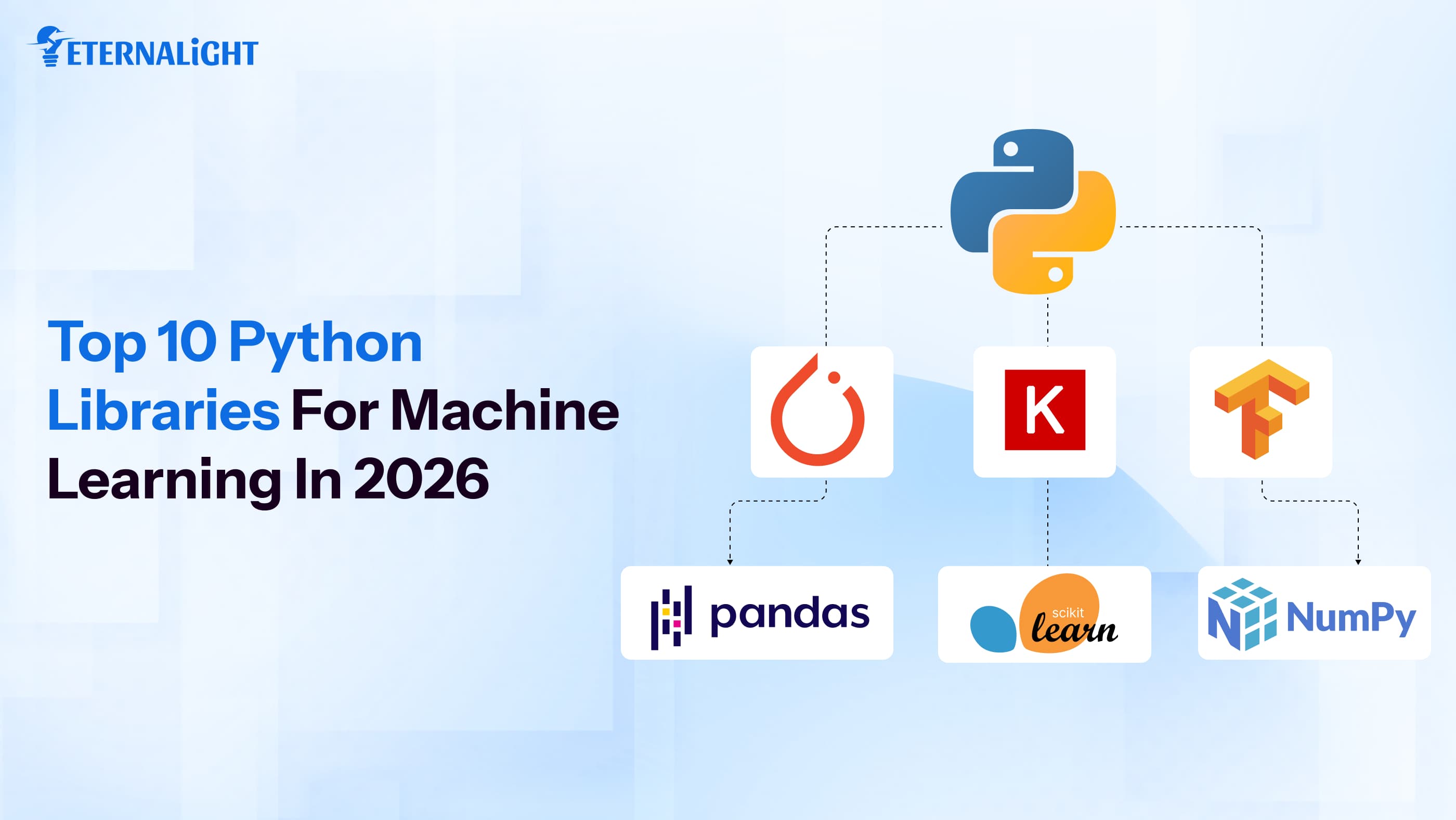
Machine learning is rapidly changing the way businesses operate in 2026. From recommendation systems and predictive analytics to AI chatbots and fraud detection, companies are adopting intelligent technologies to improve efficiency and customer experiences.
Behind most of these innovations is Python - one of the most powerful and beginner-friendly programming languages in the world.
Python has become the preferred choice for AI development because of its simple syntax, flexibility, and massive ecosystem of tools. Many developers exploring the top programming languages to learn in 2026 consider Python a leading option because it supports machine learning, automation, web development, and data science from a single ecosystem.
One of the biggest advantages of Python is its collection of powerful Python libraries for machine learning. These libraries enable developers to build AI models more quickly without needing to write complex algorithms from scratch. Whether you want to work on neural networks, data analysis, computer vision, or natural language processing, there is a Python library for machine learning designed for the task.
In this blog, we will explore the top 10 Python machine learning libraries of 2026, their key features, practical use cases, and relevant code examples.
What is a Python Library?
A Python library is a collection of pre-written code modules and functions that developers can use to perform specific tasks efficiently. Instead of building everything manually, developers can import libraries to simplify development.
For example, a machine learning Python library can help:
- Train AI models
- Process datasets
- Perform mathematical calculations
- Create visualizations
- Analyze text
- Build neural networks
Libraries improve productivity and reduce development time significantly. Businesses using Python development services often rely on these libraries to create scalable AI-powered applications efficiently.
Top 10 Python Libraries for Machine Learning
Python offers a wide range of powerful libraries that make machine learning development faster and easier. Below are some of the best Python machine learning libraries widely used in 2026 for AI, data analysis, deep learning, and NLP applications.
TensorFlow
TensorFlow is one of the most popular Python libraries for machine learning and deep learning. Developed by Google, it is widely used for building neural networks, AI models, and enterprise-scale machine learning systems.
TensorFlow supports deployment across cloud platforms, mobile devices, and web applications, making it highly scalable.
Key Features
- Deep learning support
- Neural network development
- GPU acceleration
- Scalable deployment
- Enterprise AI capabilities
Example 1: Create a Neural Network
Import tensorflow as tf

model = tf.keras.Sequential([
        tf.keras.layers.Dense(8,
activation=’relu’),
        tf.keras.layers.Dense(1)
])
Example 2: Tensor Operations
Import tensorflow as tf

x = tf.constant([1, 2, 3])
print(tf.reduce_sum(x))
Scikit-learn
Scikit-learn is one of the most beginner-friendly Python machine learning libraries available today. It provides simple and efficient tools for data mining, classification, regression, clustering, and predictive analytics.
The library is built on top of NumPy and SciPy, making it lightweight yet highly efficient.
Key Features
- Beginner-friendly API
- Machine learning algorithms
- Data preprocessing tools
- Model evaluation support
- Efficient performance
Example 1: Linear Regression
from sklearn.linear_model import LinearRegression

model = LinearRegression()
model.fit(X_train, y_train)
Example 2: Train-Test Split
from sklearn.linear_model import
LinearRegression

model = LinearRegression()
model.fit(X_train, y_train)
For developers entering the AI field, Scikit-learn is often the first machine learning Python library they learn.
PyTorch
PyTorch has become extremely popular among researchers and AI developers because of its flexibility and dynamic computational graph capabilities.
Developed by Meta, PyTorch is widely used for deep learning, neural networks, and academic research.
Key Features
- Dynamic graph computation
- Easy debugging
- GPU acceleration
- Faster experimentation
- Strong research community
Best Use Cases
- Research projects
- Computer vision
- NLP models
- Generative AI systems
Example 1: Tensor Creation
Import torch

x = torch.tensor([1, 2, 3])
print(tensor)
Example 2: Random Tensor
tensor = torch.rand(2, 2)
print(tensor)
Many advanced AI applications in 2026 use PyTorch because it offers faster experimentation and model customization.
Keras
Keras is a high-level deep learning API that simplifies the process of building neural networks. It works seamlessly with TensorFlow and helps developers create models quickly with minimal code.
Key Features
- User-friendly interface
- Fast prototyping
- Modular architecture
- Supports convolutional and recurrent neural networks
- Great for beginners
Best Use Cases
- Rapid AI development
- Deep learning prototypes
- Educational AI projects
Example 1: Import Keras
from tensorflow import keras

model = keras.Sequential()
Example 2: Add Layers
model.add(keras.layers.Dense(64, activation=’relu’))
model.add(keras.layers.Dense(10))
Keras is considered one of the easiest Python libraries for machine learning for developers who want to learn deep learning quickly.
NumPy
NumPy is the foundation of scientific computing in Python. Almost every Python library for machine learning depends on NumPy for mathematical and numerical operations.
It provides support for multidimensional arrays, matrix operations, and high-performance calculations.
Key Features
- Fast array processing
- Mathematical functions
- Memory-efficient operations
- High-performance computation
Best Use Cases
- Data manipulation
- Mathematical operations
- AI algorithm development
Example 1: Create an Array
import numpy as np

arr = np.array([1, 2, 3])
print(arr)
Example 2: Matrix Addition
a = np.array([1, 2])
b = np.array([3, 4])

print(a + b)
Without NumPy, many modern machine learning frameworks would not function efficiently.
Pandas
Pandas is one of the most essential Python machine learning libraries for data analysis and preprocessing.
Before training a machine learning model, developers must clean, organize, and analyze data. Pandas simplifies this process using DataFrames and powerful data manipulation tools.
Key Features
- Easy data handling
- Data cleaning tools
- CSV and Excel file support
- Data transformation capabilities
- Time-series analysis
Best Use Cases
- Data preprocessing
- Business analytics
- Data cleaning
- Reporting systems
Example 1: Read CSV File
import pandas as pd

data = pd.read_csv(“data.csv”)
print(data.head())
Example 2: Filter Data
filtered = data[data[“Age”] > 25]
print(filtered)
Pandas is heavily used in AI workflows because quality data preparation directly impacts model accuracy.
Matplotlib
Matplotlib is a visualization library that helps developers create graphs, charts, and plots for data analysis and machine learning insights.
Data visualization is extremely important in AI because it helps teams understand trends, identify patterns, and improve decision-making.
Key Features
- Line charts
- Histograms
- Scatter plots
- Interactive visualizations
- Publication-quality graphs
Best Use Cases
- Data visualization
- AI model analysis
- Statistical reporting
Example 1: Line Chart
import matplotlib.pyplot as plt

plt.plot([1, 2, 3], [4, 5, 6])
plt.show()
Example 2: Bar Graph
plt.bar([“A”, “B”], [10, 20])
plt.show()
Matplotlib helps convert complex datasets into meaningful visual insights.
XGBoost
XGBoost is one of the most powerful gradient boosting libraries used for supervised learning problems. It is highly efficient and widely used in competitive machine learning projects.
Key Features
- High-speed performance
- Excellent accuracy
- Parallel processing
- Regularization support
- Handles missing data efficiently
Best Use Cases
- Fraud detection
- Predictive analytics
- Recommendation systems
- Structured data problems
Example 1: Import XGBoost
import xgboost as xgb

model = xgb.XGBClassifier()
Example 2: Train Model
model.fit(X_train, y_train)
predictions = model.predict(X_test)
Many data scientists consider XGBoost one of the best Python libraries for machine learning when working with structured datasets.
OpenCV
OpenCV is a computer vision library used for image processing and video analysis. It enables machines to understand visual data.
This machine learning Python library is commonly used in security systems, facial recognition, autonomous vehicles, and healthcare imaging.
Key Features
- Real-time image processing
- Object detection
- Face recognition
- Motion tracking
- Video analytics
Best Use Cases
- Computer vision
- Surveillance systems
- Medical imaging
- AI-powered cameras
Example 1: Read Image
import cv2

image = cv2.imread(“photo.jpg”)
Example 2: Display Image
cv2.imshow(“Image”, image)
cv2.waitKey(0)
OpenCV continues to play a major role in visual AI applications in 2026.
NLTK
NLTK (Natural Language Toolkit) is one of the oldest and most trusted libraries for natural language processing in Python.
It provides tools for text analysis, language processing, tokenization, sentiment analysis, and speech tagging.
Key Features
- Text processing
- Tokenization
- Language parsing
- Sentiment analysis
- Educational NLP tools
Best Use Cases
- Chatbots
- AI assistants
- Text classification
- Sentiment analysis
Example 1: Tokenization
from nltk.tokenize import word_tokenize

text = “Machine learning is powerful”
print(word_tokenize(text))
Example 2: Stopwords
from nltk.corpus import stopwords

print(stopwords.words(‘english’))
NLTK remains an important Python library for machine learning and NLP education.
Why Python for Machine Learning & Natural Language Processing?
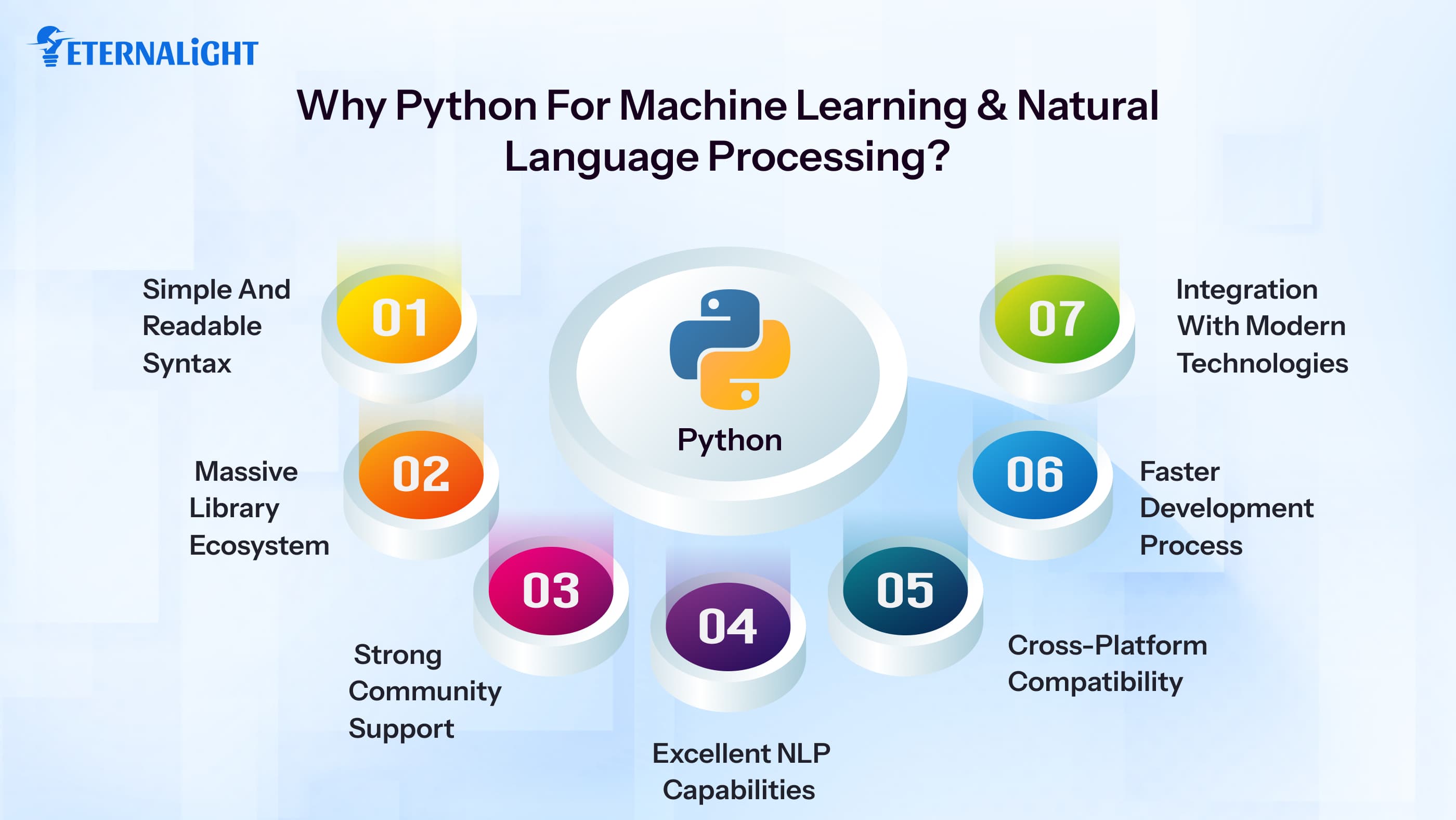
Python has maintained its position as the top programming language for AI and machine learning because of several important advantages.
Simple and Readable Syntax
Python’s syntax is clean and easy to understand. Developers can focus on solving AI problems instead of dealing with complicated code structures.
This simplicity makes Python ideal for beginners as well as experienced developers.
Massive Library Ecosystem
The biggest reason for Python’s popularity is its rich ecosystem of Python machine learning libraries.
Libraries like TensorFlow, PyTorch, Scikit-learn, and Pandas reduce development time significantly.
Developers can build advanced AI systems without writing algorithms from scratch.
Strong Community Support
Python has one of the largest developer communities in the world. This means:
- Better documentation
- Faster issue resolution
- Open-source contributions
- Continuous innovation
Community support plays a major role in improving machine learning development.
Excellent NLP Capabilities
Natural Language Processing has become essential for modern applications such as:
- Chatbots
- AI assistants
- Language translation
- Voice recognition
- Sentiment analysis
Python provides specialized NLP libraries like:
- NLTK
- SpaCy
- Transformers
- TextBlob
These tools simplify complex language-processing tasks.
Cross-Platform Compatibility
Python works smoothly across:
- Windows
- Linux
- macOS
- Cloud platforms
This flexibility allows developers to build scalable machine learning systems for different environments.
Faster Development Process
Compared to many programming languages, Python reduces development time significantly.
Its ready-to-use frameworks and machine learning Python libraries help teams build prototypes and production applications much faster.
Integration with Modern Technologies
Python integrates well with:
- Cloud computing
- Big data tools
- IoT systems
- Automation platforms
- APIs
This makes it highly suitable for enterprise AI development.
Importance of Machine Learning Libraries in Modern Businesses
Machine learning is no longer limited to research labs. Businesses across industries now use AI to automate processes and improve customer experiences.
Python libraries help organizations:
- Analyze customer behavior
- Predict market trends
- Automate workflows
- Improve cybersecurity
- Build recommendation engines
- Detect fraud
- Enhance customer support
Industries using machine learning include:
- Healthcare
- Finance
- Retail
- Education
- E-commerce
- Manufacturing
- Logistics
The demand for reliable Python libraries for machine learning continues to grow because businesses need scalable and intelligent solutions. Machine learning plays an important role in modern technology by helping systems learn from data and make smarter predictions with minimal human intervention.
Conclusion
Python continues to dominate the AI and machine learning industry because of its simplicity, flexibility, and extensive ecosystem. The availability of advanced Python libraries for machine learning makes development faster, smarter, and more efficient.
From data analysis and visualization to deep learning and natural language processing, Python offers tools for every stage of AI development. Libraries such as TensorFlow, Scikit-learn, PyTorch, Pandas, and OpenCV are helping developers and businesses create intelligent systems capable of solving real-world problems.
As technology advances in 2026, the demand for scalable AI solutions will continue to rise. Choosing the right Python library for machine learning can significantly improve development efficiency and project success.
Whether you are a beginner exploring AI or an enterprise building advanced intelligent systems, Python remains one of the best choices for machine learning and NLP development.

Kusum Sethiya
Software Engineer
Kusum Sethiya is a Software Engineer at Eternalight Infotech, focused on building clean and intuitive. She enjoys turning ideas into reliable applications using modern technologies like Javascript, React, Node.js , and MongoDB.
Frequently Asked Questions
TensorFlow, PyTorch, and Scikit-learn are among the best Python machine learning libraries because of their flexibility and advanced features.
Python is preferred because of its simple syntax, huge library ecosystem, community support, and fast development capabilities.
Scikit-learn is ideal for beginners because it offers easy-to-use tools for classification, regression, and predictive modeling.
Pandas helps clean, organize, and analyze data before training machine learning models, improving overall accuracy and efficiency.
NLTK and SpaCy are commonly used Python libraries for natural language processing, text analysis, and chatbot development.
Related Blogs
 Software Development9 Mins
Why Choose Python for Fintech App Development?
Learn how Python helps fintech businesses build scalable, data-driven applications with powerful support for analytics, AI, APIs, and automation.
- Software Development8 Mins
Is It Time to Build Off the Self vs Custom Software for Your Business?
When should you build custom software? Learn the key signs, costs, limitations, and factors to consider before choosing custom software for your business.
- Software Development11 Mins
Website Security Checklist: What to Check Before It's Too Late
Worried about website security? Use this practical website security checklist to spot common risks and protect your website, data, and users.