Have you ever had a word zone out?
That's common nowadays: people lose the thread of what they’re talking about and spend time trying to remember where they left off.
In humans, it can indicate a health issue, but what if an AI system does the same?
In this fast-paced AI world, where most people depend on these tools to complete projects, even a slight recall delay can be annoying. Likewise, human AI systems have memory issues, and we can fix them. The blog covers AI memory loss and how to fix it with a context graph.
What’s Wrong with AI Models and Systems
People are swamped with work, so they forget things. But they still know who they’re connecting with. If multiple team members are accountable for a task, what do they need to do after what?
If they need extra information or support from another team member, they can sync on a call or meet face-to-face. They can take meeting notes to capture the details of what they discussed.
AI tools use NLP and large language models trained on vast amounts of data to generate responses that align with the prompt. You may also have noticed that ChatGPT can revisit the conversation and understand the external context. A normal person can pick things up exactly where they left off because they know the context.
A tool knows what it needs to deliver, but if it doesn’t have enough information in the delivery environment, that creates a gap.
Why AI Still Struggles With Context?
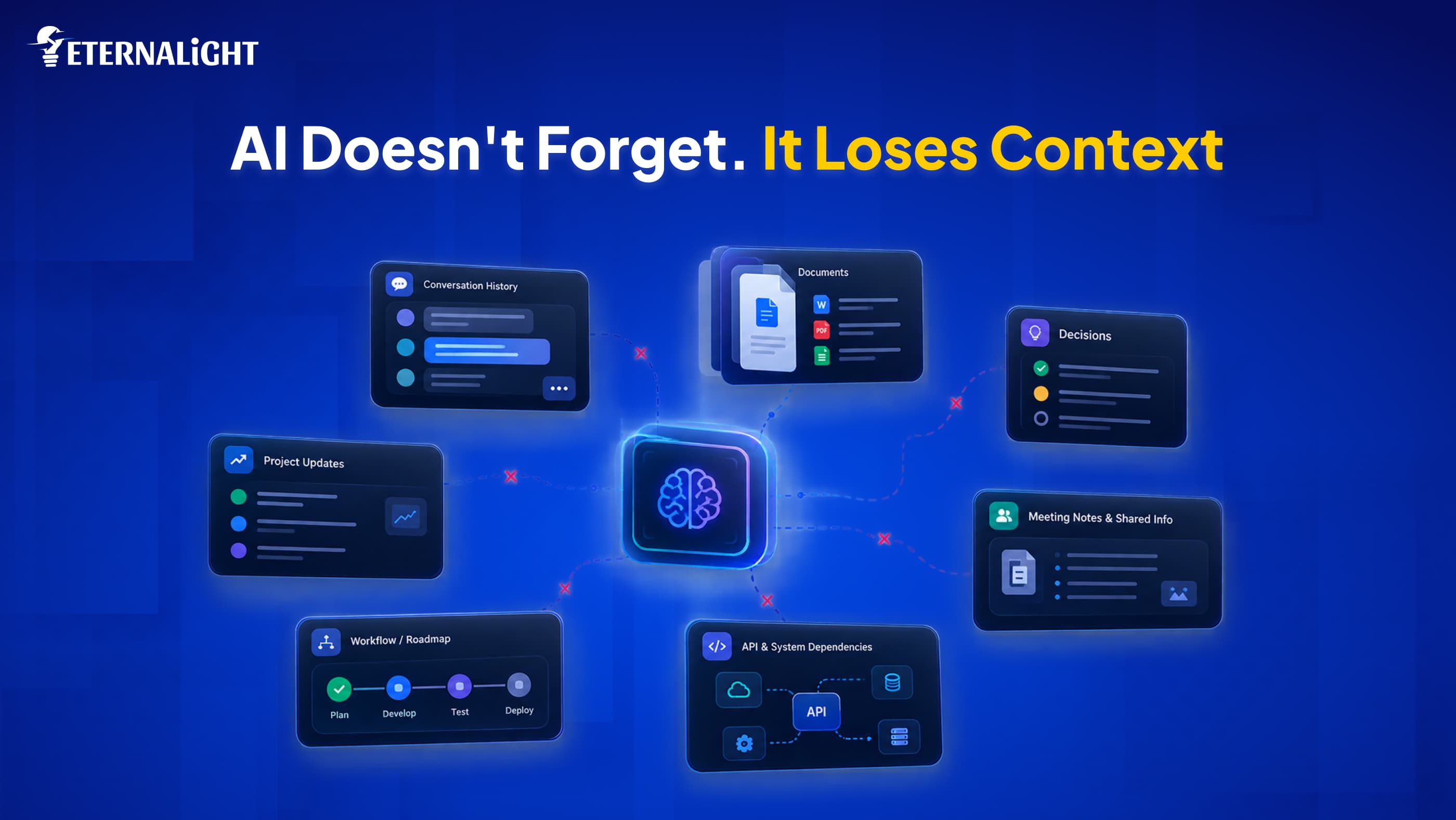
Tools don't know about sync-up calls, the roadmap, the sprint plan, constraints, or library APIs; they also don't know the QA strategy. If tools and models aren't aware of recent interactions, the context problem still exists.
Some AI platforms connect to external sources and tools to extend capabilities, keep chat history, and use that information in the future. They learn from historical data, not in real time. The tools work with that stored information: they retrieve it and summarize it according to the prompt.
Development teams are trying hard to break the ice and keep up with relevant delivery to match the prompts; they have also brainstormed ways to make the context real-time.
The Problem With Manually Managing Context
Whenever the team discusses a new project, they gather requirements, features, functionalities, scope, and objectives. They write everything out, and it can look lengthy because they want to explain every detail to the machine. But not all team members are good at prompt writing; they still discuss what to write in a prompt to get optimal output and responses that work.
To speed up work and reduce dependency and time, the team now uses shareable documents so members can reuse prompts in the future. But when a new session starts and a new member logs in, the model may not understand the context the previous user provided.
The prompts may be ready to use, but they become irrelevant when another meeting is scheduled and a new key discussion note is prepared, and the model generates a response based on the previous prompt; it doesn’t know what happened a few minutes ago. They are not synced in real time.
What is happening here?
The team might be using the AI tool, but they still do a lot of things manually, including making decisions.
Why More Files and Longer Prompts Don't Solve the Problem
Just think about the scenario.
Is it possible to write or copy-paste every single long context during a session?
Maybe someone else can paste updated information, but I don’t think it accumulates because every team member has a different mindset; their skills, ways of working, and how they explain things differ.
Maybe they’re seeing the situation from a different lens, or their sentence formation is different.
When a file is up to 20 30 pages, that's fine, but if it's more than that, will the tools be capable of reading and accessing it?
Are they getting confused or generating the responses exactly the way the user wants?
We've used Gemini, Claude, and others, and even when we give them full context, files, and images the model needs to understand to generate responses, the tools still can’t reliably decide whether to move forward.
What Is a Context Graph?
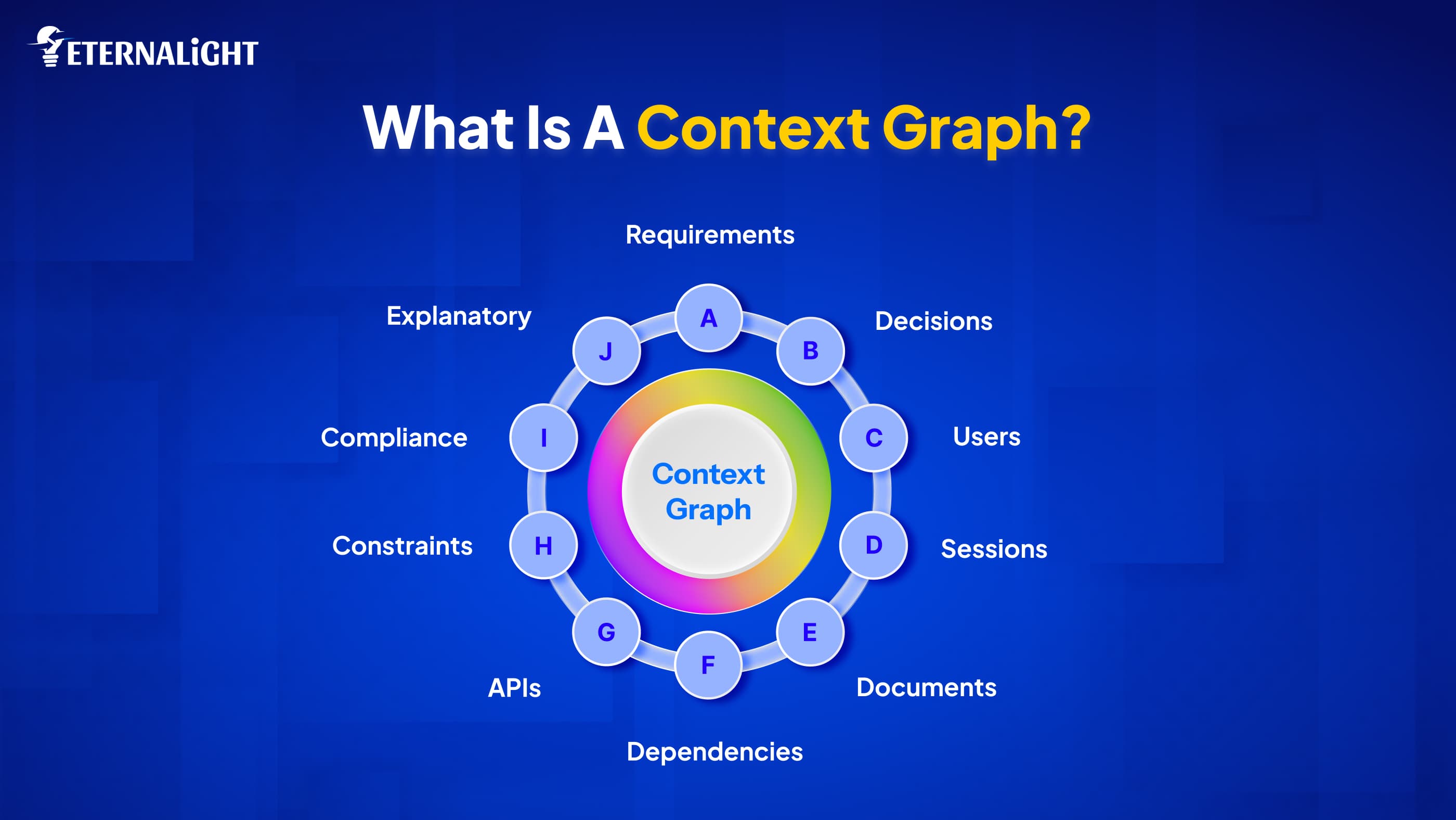
With a context graph, we are not building a whole new database; we’re establishing a trustworthy source of information. It includes all the entities, decisions, relationships, and definitions the AI agents need to understand. We are not building a large data warehouse here, but it makes sense to move ahead given the dynamic environment and project needs.
We are handling the stack of files, but we are providing a connected point, an index, to explore all the information. The database contains facts, documents, and graphical representations, but the context graph defines the proper connectivity of the facts with the real project, authorized users, sessions, real users with preferred past moves, selected decisions (what was picked, what was removed), the compliance rules and constraints, and which dependencies third-party or internal APIs are connected to.
How Context Graphs Help AI Agents Make Better Decisions
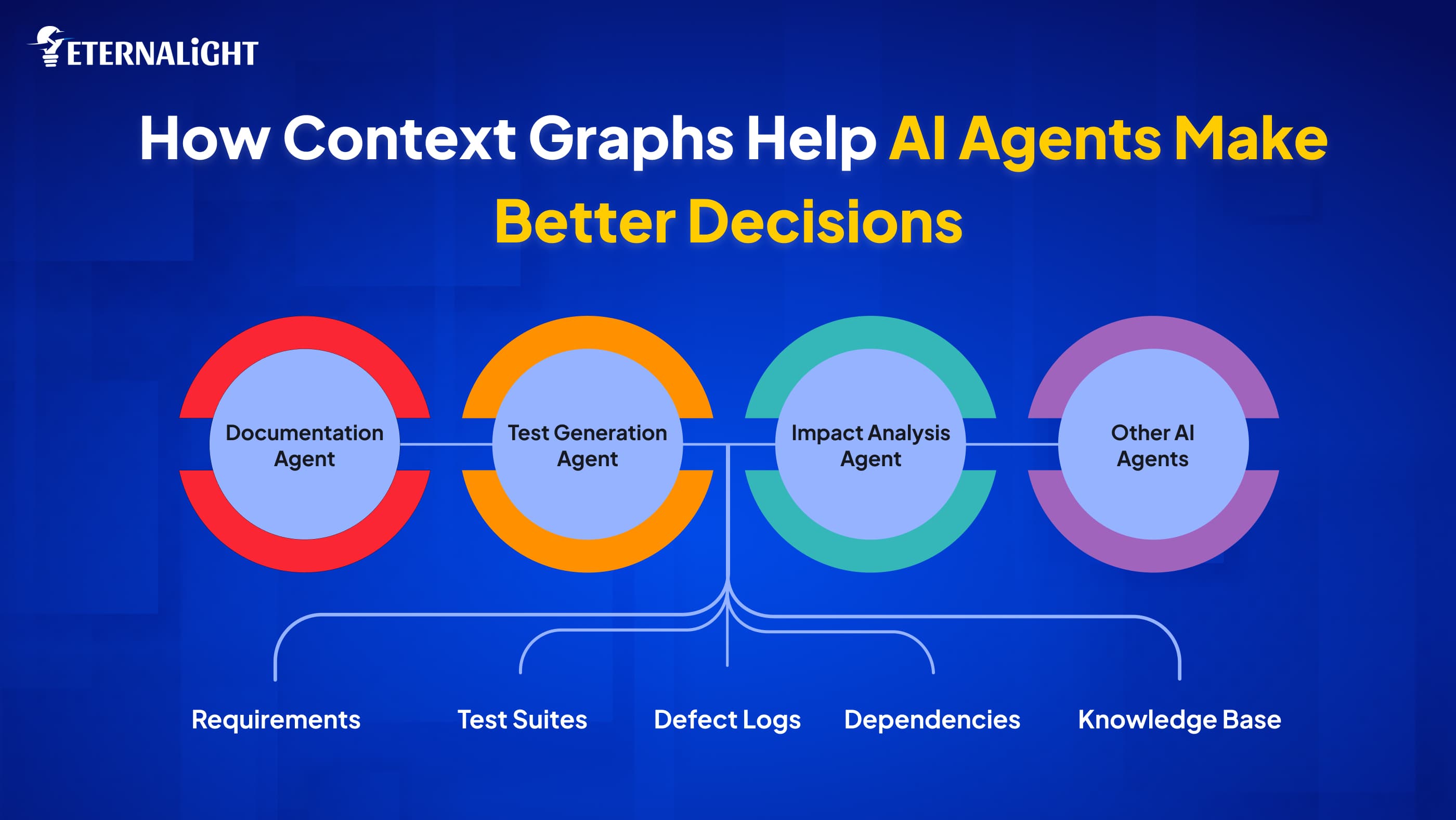
How a human makes a decision in the nervous system: all nerves are connected; even the brain can’t work if it's disrupted, just as an AI model can't decide without a context graph to guide the agentic system to make moves and handle multiple jobs at once.
One agent handles documentation, another generates tests, another performs impact analysis, and another handles documentation.
From requirements, user pain points, test suites, previous workflow tests, defect logs, run logs, dependencies, and the knowledge base, everything is stored in the same place in the context graph.
The agents understand the shared memory. That's all; the stuff is visible to all agents involved in the delivery workflow.
But here's the thing to pay attention to.
Context Quality Matters as Much as Context Availability
Whatever data you enter into the model should be accurate, not based on false rumors. If two statements from different sources conflict, they create a contradiction that can cause the response to fail. The model may be working properly, but anything built on incorrect information will not be convincing.
Sometimes the model connects to external sources, but they aren't compliant or validated under governance rules to fit the delivery architecture. If one started from scratch and then, in the next session, another user joined with a new session to complete the task with an AI agent, then it may miss something important. If an AI agent keeps proceeding based on previous direction and information, but the real context isn't there, it can’t understand or generate the right things.
Why RAG and Vector Databases Aren't Always Enough
Now, we've come a long way from chatbots to agentic AI, but RAG and vector databases are still the primary way to store information. But they can’t store long-term or much in one session; you've probably received prompts about time limits or storage issues.
Top Context and AI Memory Tools to Consider
No matter how efficient the model looks, the problem persists: it forgets past interactions, requires constant updates and edits, and struggles to manage real-time context.
So now, companies developing adaptive AI agents prefer memory-native tools that fit the AI agent delivery ecosystem. Organizations can choose any flexible tools that fit their needs and build AI agents.
Mem() or EmbedChain
When developing any AI- or LLM-driven solution, companies need a reliable way to manage memory and store past conversations, and Mem() does that efficiently by adding a memory layer.
Because it's open source and handles dynamic scenarios, it's easy to integrate and well-loved by the community. You can check their plans; most are free. The only drawback is that setup requires self-hosting.
Cognee
More than 70 companies have plugged Cognee into their LLM-based applications with native MCP and other integration support. What starts as an experiment can become the first choice across memory pipelines. It's open source, enabling self-hosting, and works as a hybrid retrieval engine: it ingests data as vectors and manages search as a knowledge graph, enabling multi-step reasoning.
It enables RDF ontologies and a domain-specific ECL pipeline memory architecture to add, retrieve, update, and extract data from 30 sources beyond the generic one.
Zep
It's worth it; it's accessible for low-latency, rapid, and robust conversational memory arrangement. When an AI development company builds AI assistants or agents, it also needs to integrate a real-time memory service to understand the context of what the user explored in past conversations. Zep's best feature is its built-in summarization and faster retrieval and extraction. It avoids cross-application memory. It charges 1K episodes/month; for more, you can check Zep pricing.
Pinecone
When building cloud-native or cloud-smart applications, development companies often embed serverless vector memory tools to understand high-level context, and Pinecone delivers that seamlessly.
It's generous, robust, reliable, and provides hassle-free serverless architecture. Like most tools, it requires a credit card to subscribe or access memory-layer tools; it doesn’t need one.
LlamaIndex
Before going on the premium options, developers love to explore free or freemium tools that can elevate the level of context for the enterprise-grade application of data-heavy type RAG-based memory arrangements. LlamaIndex is excelling as a large memory bank that is worth it for long-term LLM-based tools. It offers unique data-ingestion connectors and next-level RAG querying techniques, where memory evolves in a dynamic environment.
Letta/ MemGPT
Try it for long-term, sustainable, multi-step AI agent application development leveraging LLMs. It enables memory augmentation with a REST API for hierarchical in-context vs. out-of-context models. It supports human, persona, and task-based context analysis, archival, and stateful agent memory definition. Projects with larger context windows sometimes lack this memory framework, which is powered by cloud and Apache 2.0 and is efficient.
Supermemory
Save time and effort with minimal configuration, making AI application and memory API development simpler. It provides self-hosted Docker hosting, a universal memory store, semantic search across documents, URLs, and notes, and note ingestion. It has a REST API and an open-source MIT license.
It can’t handle enterprise-grade traffic loads or data volumes and is less preferred than other tools because it lacks graph support and reasoning capabilities.
Other AI Agent Memory Frameworks to Explore
Furthermore, AI app development companies also look for frameworks with memory modules to sync AI agent collaboration and interaction, such as MemGPT, LangMem, LangChain and LangGraph, AutoGen, Flowise, MemoryLabs, etc.
Enterprises want to excel across all industries; as technology evolves, they outsource AI app development services to launch high-performance solutions. This can drive automation, efficiency, intelligence, personalized experiences, and other IDE integrations with stateful agent orchestration with persistent memory blocks. Since most tools are self-hosted, outsourced, and leverage multimodal ignition, this approach aligns with infrastructure requirements.
Conclusion
A bucket of information isn’t enough for an AI system to respond; it needs context for why it needs to access specific data and what happens when it executes an action prompt. It must have the intelligence to connect the dots and make meaningful decisions by considering dependencies.
The tools we mentioned in this blog, like Cognee, Letta, and others, address different memory and retrieval needs. However, the right choice depends on the AI system’s data requirements, use case, and architecture. Companies now understand that having more information isn't enough unless it's relevant, reliable, and available from secure sources when the system needs it most.

Ayushi Shrivastava
Senior Content Writer
Ayushi is a Content Strategist at Eternalight Infotech with 4 years of experience in transforming complex ideas into clear, engaging, and SEO optimized narratives. She specializes in crafting impactful content strategies that enhance brand visibility and drive meaningful engagement across digital platforms.
Related Blogs
- AI & ML10 Mins
How to Test Generative AI Applications: A Practical Guide to Reliable AI Systems
Learn how to test generative AI applications for accuracy, hallucinations, performance, security, RAG workflows, and reliability.
- AI & ML10 Mins
AI Data Security Strategies: 8 Ways to Protect Data in AI Systems
Explore 8 AI data security strategies to protect sensitive data across prompts, AI models, RAG systems, APIs, access controls, storage, and outputs.
 AI & ML17 Mins
AI-Ready Data Architecture: A Complete Guide for Modern AI
Learn how AI-ready data architecture works, its key components, framework, how to build it, and how it supports generative AI, machine learning, and AI agents.