AI has real-world business applications that extend beyond just automating routine tasks. AI can be used to build predictive and recommendation systems, as well as text, image, and video generation applications. However, these systems cannot be successfully deployed without access to reliable, accessible, and well-governed data across structured, semi-structured, and unstructured formats
AI-ready data architecture is built to address gaps in modern business data infrastructures. The main purpose of AI-ready data architecture is to leverage the potential of the modern data flows that constitute the backbone of AI workloads. AI-ready data architecture is built to scale data infrastructure and simplify the preparation of data for consumption by AI tools.
For businesses that are targeting enterprise-level AI adoption, having a quality data foundation can improve data quality and simplify integration, making it easier to build custom AI solutions.
What Is Data Architecture?
Data architecture is the design of a system to collect, store, manage, govern, and enable access to data in an organization that is connected and consistent across multiple data sources and technologies.
A data architecture system typically includes databases, data warehouses, data lakes, APIs, data pipelines, processing systems, and governance layers. The combination of these systems and layers defines the data architecture of a system and the control, protection, and efficiency of the data within the system.
Traditional data architectures build data pipelines that primarily fulfill reporting and operational business needs. However, modern AI workloads demand the processing of large volumes of data, including structured and unstructured data, at a very high speed, offer low-latency access to data, impose more complicated data governance, and integrate seamlessly with data management systems.
Preparing a data environment that is optimized for machine learning and AI workloads is the next step beyond a traditional data architecture. This architecture is designed for data to undergo various operations such as cleaning, transformation, refinement, and delivery in a format that is optimized for machine learning.
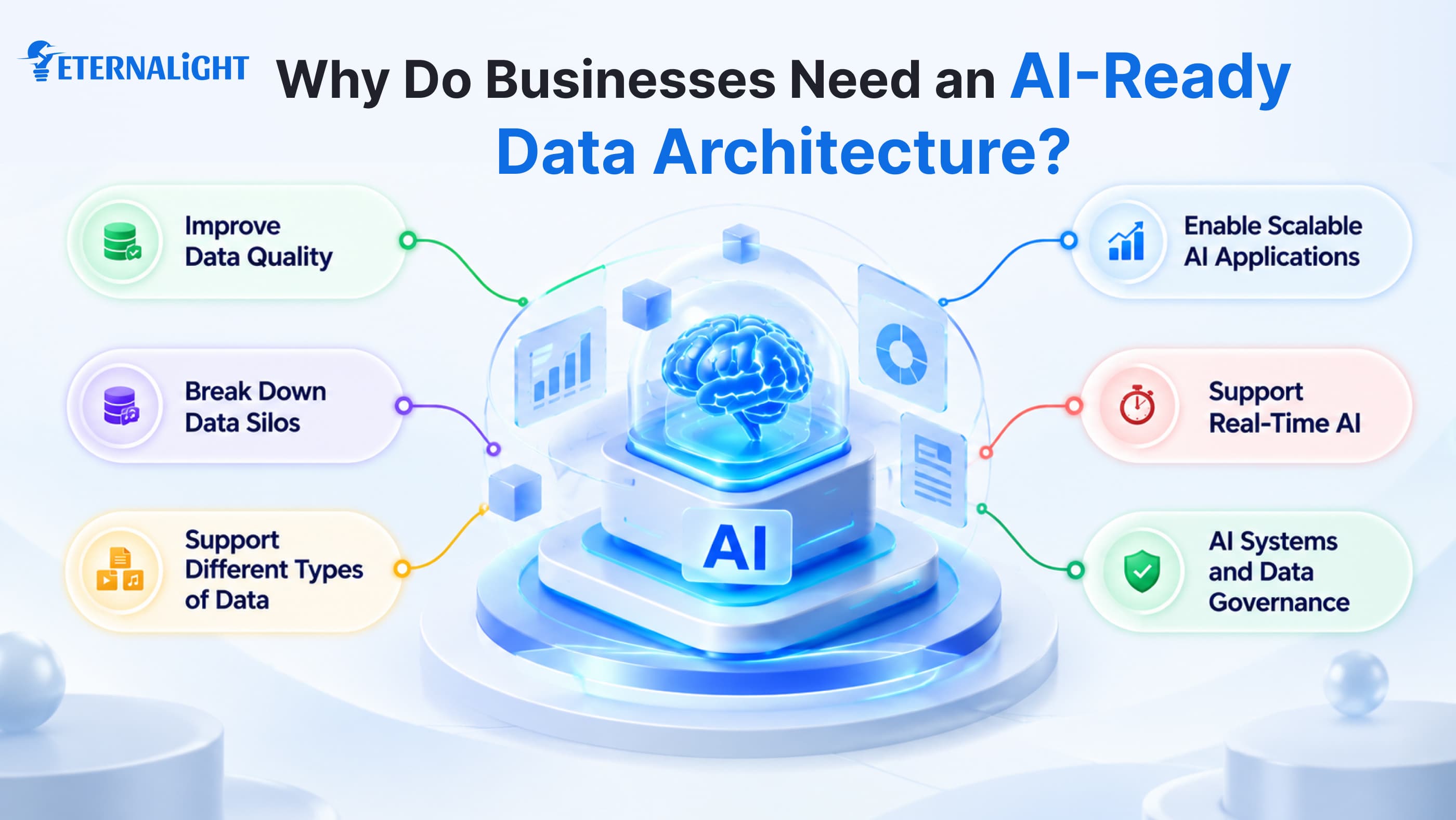
Why Do Businesses Need an AI-Ready Data Architecture?
The quality of AI depends on the quality of data. Databases, cloud services, APIs, code, etc. contain a business's valuable data, but these services make it difficult to gather this data for use in an AI system. Without the appropriate architecture, it can be both difficult and costly to bring this data together.
AI-ready data architecture allows businesses to design a scalable foundation for the adoption of AI.
Improve Data Quality
A robust data architecture implementation helps businesses reduce the negative effects of poor data by building automated data validation, cleansing, transforming, and monitoring pipelines.
Break Down Data Silos
AI systems struggle to process data in the presence of data silos. A comprehensive data architecture integrates data from disparate systems and provides a more unified data foundation.
Support Different Types of Data
AI will transform unstructured data such as scanned documents, audio files, videos, and images. An AI-ready architecture offers the storage and processing needed for disparate data.
Enable Scalable AI Applications
An architecture built with the flexibility of scalability gives a business the ability to grow its data capabilities without having to rebuild the entire foundation of its data computing environment.
Support Real-Time AI
Some AI use cases require current data, not data that is updated periodically. An architecture deployed with real-time or near-real-time data pipelines gives a business the ability to have AI systems for use cases such as fraud detection, personalization, monitoring, and intelligent systems.
AI Systems and Data Governance
At the core of many businesses is potentially sensitive or business-critical data. Data governance, access control, encryption, data lineage, and compliance mechanisms serve when businesses must control access to and usage of data by AI applications.
Key Components of AI-Ready Data Architecture
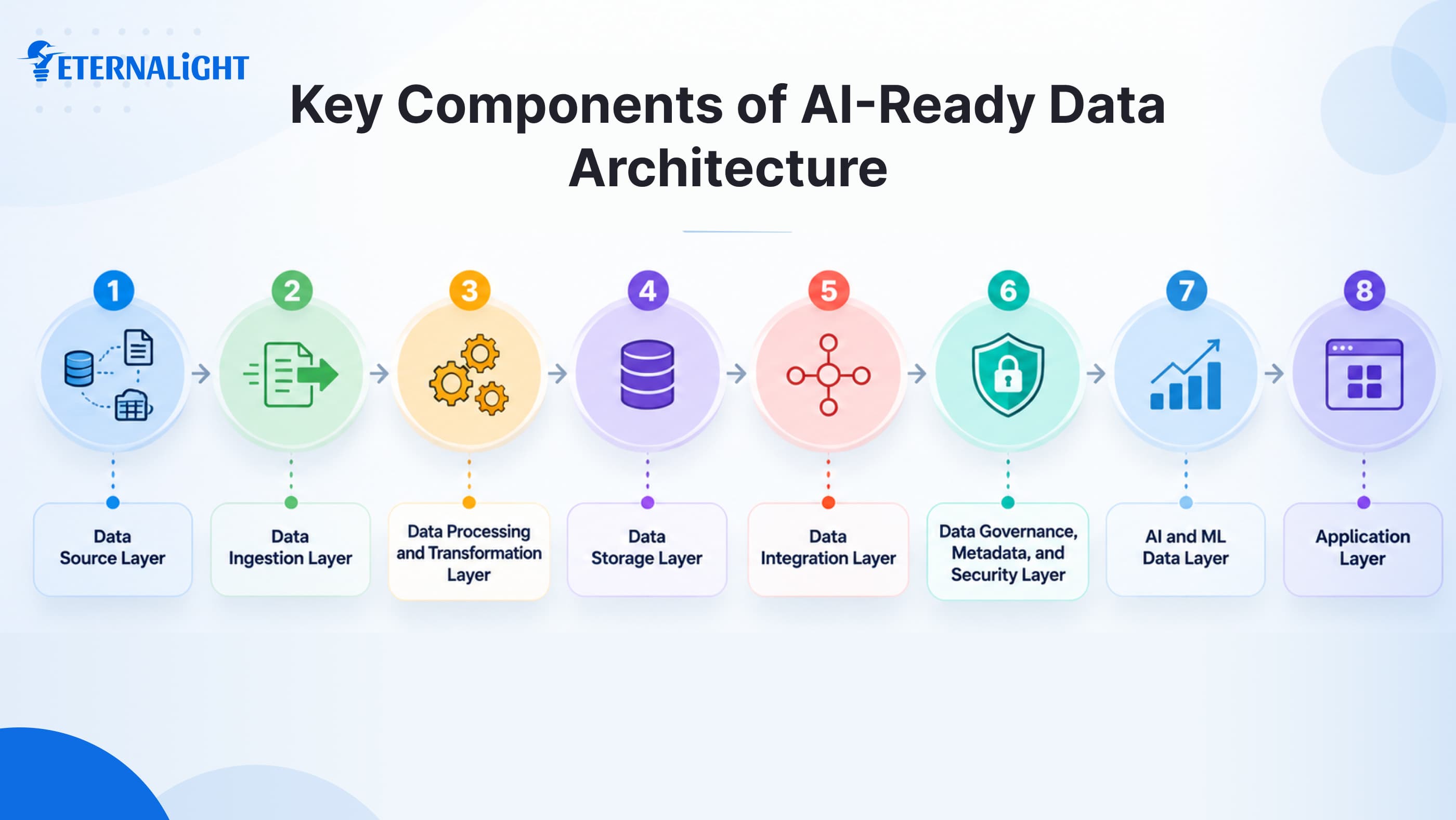
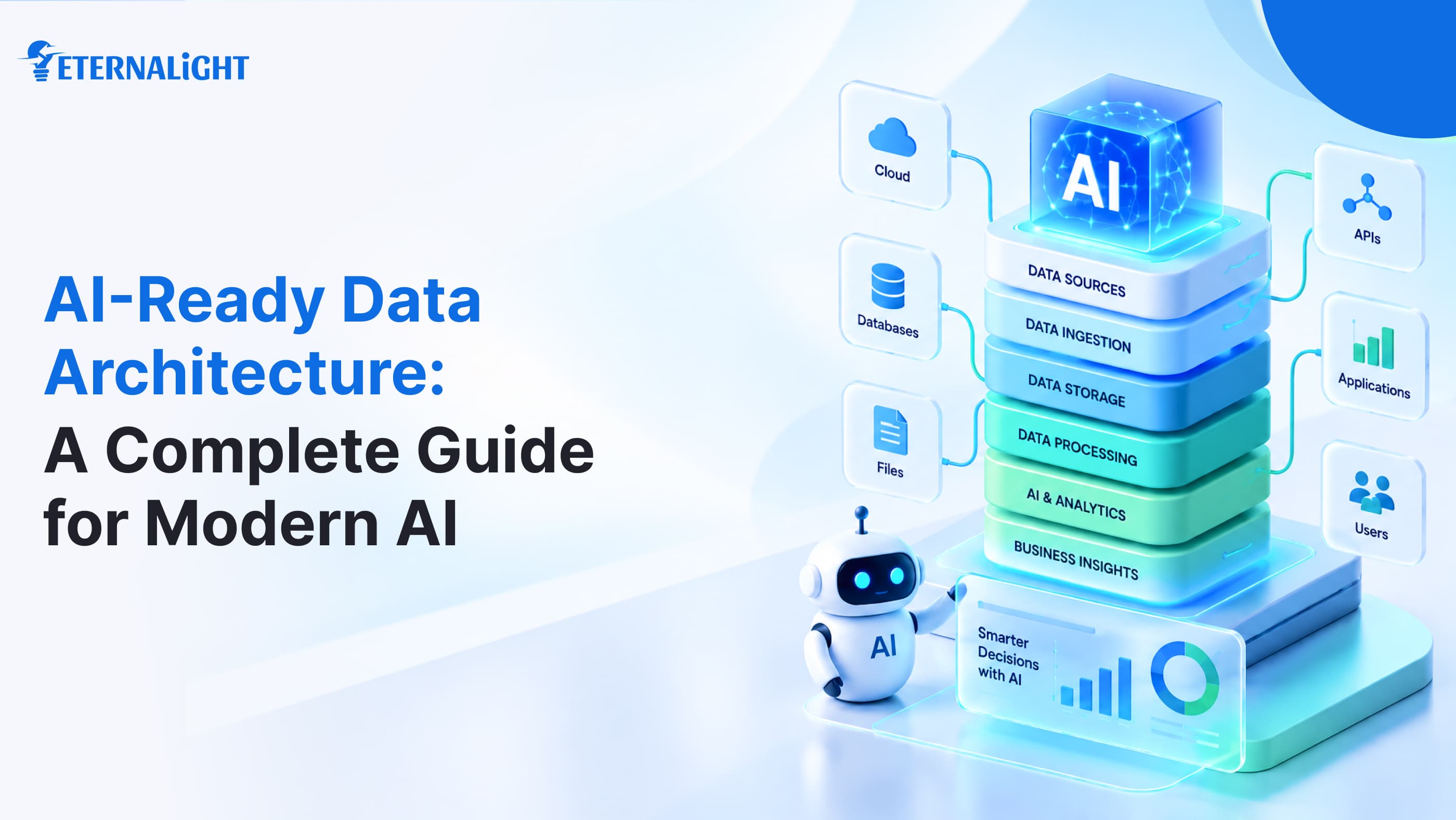
An AI-ready data architecture can be viewed as a layered framework that moves data from its sources through ingestion, processing, storage, governance, and AI/ML systems before delivering it to business applications. Each layer has a specific role in making data reliable, accessible, secure, and suitable for AI workloads.
1. Data Source Layer
The bottommost layer of an AI-ready data architecture is the data source layer. This layer consists of the systems and protocols that store business data, like operational databases, SaaS applications, cloud services, APIs, Internet of Things (IoT) devices, files, documents, and customer interactions.
2. Data Ingestion Layer
This layer is responsible purely for moving raw data from its source into the data environment - it is the entry point, not a linking or reconciliation step. Depending on the AI use case, data can be collected through batch pipelines or through real-time, continuous data streams. At this stage, data typically lands largely as-is, ready to be handed off for processing and, later, integration.
3. Data Processing and Transformation Layer
Raw data will most likely have to undergo several processing and data transformations to be ready to be used by AI systems. This layer will also ensure consistency and quality of data throughout the data domain.
4. Data Storage Layer
All AI-ready architectures will have a high degree of flexibility and scalability when it comes to the storage layer of the data architecture. Organizations will choose to use systems like data warehouses, data lakes, data lakehouses, or operational data stores to retain and make available different types of data.
5. Data Integration Layer
Where ingestion is about bringing data in, integration is about combining and reconciling data that has already been ingested - linking related records across disparate systems (for example, matching a customer ID across a CRM and a billing system) so that data from different sources can be consumed as a unified whole. This layer can leverage APIs, ETL/ELT, and integration tooling to connect data and reduce silos across the organization.
6. Data Governance, Metadata, and Security Layer
Data governance and security must be designed into the architecture. Data governance spans data quality, data ownership, access control, privacy, encryption, data protection, data lineage, data provenance, data lifecycle management, and metadata.
Metadata can provide more context to a dataset. Additionally, data catalogs can help teams determine what data is available, its provenance, and how to consume the data. With the growing datasets that organizations are expected to manage for AI-related workloads, data catalogs become critical to an organization's success.
7. AI and ML Data Layer
The AI/ML Data Layer processes and delivers data to fulfill the requirements of advanced ML and AI frameworks and applications. Depending on the use case, this layer can incorporate feature stores, embedding pipelines, vector databases, model data pipelines, and retrieval systems.
For generative AI offerings, this layer can fulfill the data preparation and retrieval requests of language models. For ML workloads, this layer can fulfill data preparation and model data pipelines.
8. Application Layer
The Application Layer consumes prepared data and exposes AI and automated capabilities to business applications and end users. This layer can encompass predictive systems, recommendation engines, automated business applications, and AI-based customer support chatbots, as well as other advanced automated systems.
This stack is a flexible AI-ready data architecture framework made by combining the following layers:
Data Sources → Data Ingestion → Data Processing → Data Storage → Data Integration → Governance & Security → AI/ML & Analytics → Applications
Different organizations will have different combinations of these components depending on their data environments, AI use cases, requirements for scalability, and governance. The layered approach provides a solid way to make data functional for AI in a ready state, regardless of the use case.
How Does AI-Ready Data Architecture Work?
AI-ready data architecture organizes the movement of data from many different sources to AI applications. This architecture starts the data collection process from a variety of sources such as databases, applications, APIs, cloud services, etc. The data is loaded into either batch or real-time pipelines to fulfill the use case of the AI application.
After data collection, the data goes through the processing and transformation phase. This phase corresponds to the preparation of the data for consumption by the business or end user. Data preparation can include data cleaning, normalization, and enrichment. The data is then stored in a data warehouse, data lake, or a lakehouse.
Governance and security controls access, privacy, quality, lineage, and compliance. When an AI application requires data, the datasets are retrieved from the analytics platform, machine learning pipeline, API, or other application interfaces, and delivered to the application.
The overall architecture can be represented as:
Data Sources → Data Ingestion → Data Processing → Data Storage → Governance & Security → AI/ML → Applications
This architecture provides a way for a business to create easily repeatable data flows to help avoid ad hoc data preparation for each AI project. The architecture is flexible to accommodate additional data sources and new AI use cases.
How to Build an AI-Ready Data Architecture
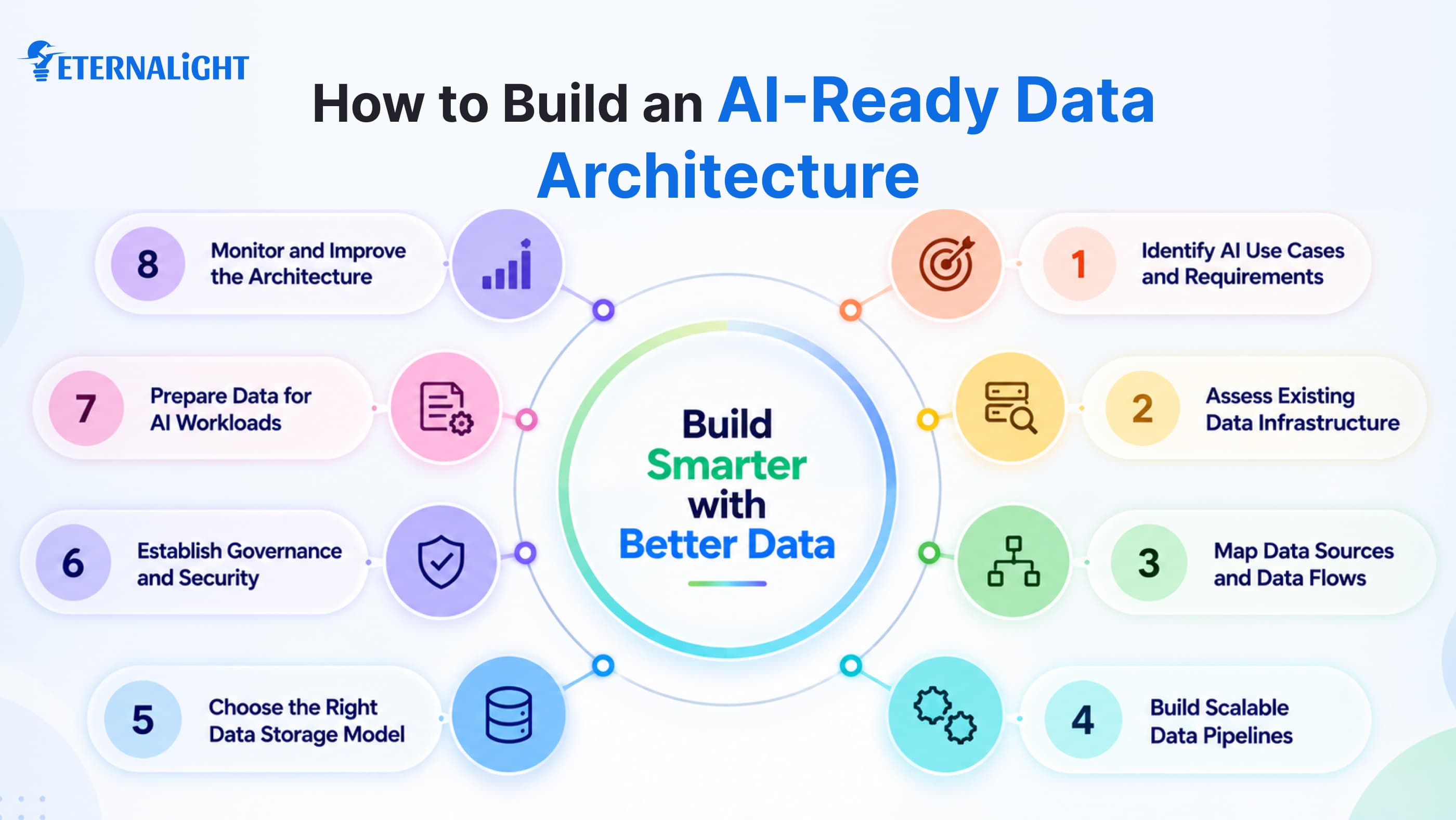
Creating an AI-ready data architecture goes beyond adding AI tools to an existing data architecture. Organizations must evaluate their existing data infrastructure and design a flexible data foundation that is prepared to support diverse AI use cases.
1. Identify AI Use Cases and Requirements
AI tools have various requirements (e.g., volume of data, time latency, storage, total processing capacity, security, and accessibility) depending on the business needs and use cases. Before anything, you must define what you want AI to do for your company.
2. Assess Existing Data Infrastructure
Take a close look at your existing data infrastructure (databases, applications, integrated systems, data pipelines, and storage). Find out where data is locked, which systems need to be updated, and which might be harming your AI efforts.
3. Map Data Sources and Data Flows
Understanding the data flow will allow for the mapping of data sources and integrations, showing where data is coming from and where it is moving to and being consumed. This will identify unneeded data movements and show system integration gaps.
4. Build Scalable Data Pipelines
Design data pipelines that are capable of processing both real-time and batch data. These data pipelines must include mechanisms for data validation, transformation, and monitoring as well as data error handling.
5. Choose the Right Data Storage Model
Choose a data storage model depending on the type of data and AI workload. Consider a combination of data warehousing, operational databases, and specialized data stores as opposed to a single data store.
6. Establish Governance and Security
Policy must be designed to define data ownership, access, quality, privacy, retention, and compliance. Security must be part of the design of the architecture and integrated into the processes as opposed to an afterthought.
7. Prepare Data for AI Workloads
Different types of AI have their own types of data preparation. Some machine learning workloads require feature engineering, but a lot of workloads for generative AI will utilize document processing, chunking, embedding, and retrieval.
8. Monitor and Improve the Architecture
The types of data and AI workloads a business performs will change rapidly. Your architecture needs to change rapidly as well. Monitor data quality and performance of pipelines and infrastructure while focusing on the overall demands of AI workloads to prioritize where improvement efforts are spent.
Benefits of AI-Ready Data Architecture
A well-designed AI-ready data architecture can create a stronger foundation for both current and future AI initiatives.
Faster AI Development
When reliable and prepared data is readily available, development teams spend less time locating, cleaning, and integrating data for individual AI projects.
Better Data Quality
Centralized data processes and governance can improve consistency, accuracy, validation, and monitoring across different data sources.
Greater Scalability
An AI-ready architecture can accommodate growing data volumes and increasing AI workloads without requiring a complete redesign of the underlying infrastructure. This is the practical payoff of the flexibility described earlier: growth doesn't force a rebuild.
Improved AI Performance
Access to relevant, timely, and high-quality data can contribute to better model training, retrieval, predictions, and AI-generated outputs.
Support for Real-Time Applications
Streaming data pipelines can help AI applications respond to current information, which is useful for use cases such as fraud detection, personalization, monitoring, and intelligent automation.
Stronger Data Governance
Clear governance and security mechanisms provide better control over how data is collected, accessed, processed, and used by AI systems.
Easier Integration of New AI Use Cases
A reusable data foundation makes it easier to introduce additional machine learning, generative AI, and AI-agent applications without creating separate data pipelines for every project.
AI-Ready Data Architecture for Generative AI
Generative AI systems involve more work because they are designed to integrate with various kinds of large, unstructured, and unique business data. This data can include documents, knowledge bases, product, and support data. It can also include support chat data, images, and other content. This data needs to be processed to be useful to LLMs.
Most generative AI-ready architectures include additional specialized components in the existing data architecture.
Data Preparation
Some data systems have unstructured data and need to clean, structure, and partition it into usable data. This data can be in the form of support tickets, web pages, documents, and other forms.
Embedding and Vector Storage
Data can be converted to semantic representations and stored in a vector database where they can be retrieved using semantic similarity.
Retrieval Layer
Applications with Retrieval-Augmented Generation (RAG) use this layer to retrieve data from a company's data sources and provide it to the language models. Retrieval often goes beyond vector similarity search - hybrid search, metadata filtering, reranking, API calls, and structured queries are common too. A vector database isn't a strict requirement for every RAG setup.
LLM Integration
This architecture bridges prepared data and retrieval systems to the large language model of choice. It allows applications to generate domain-specific responses based on company data, ensuring the model is not the primary source of knowledge.
Security and Access Control
Access control and authorization should be set at a fine-grained level due to the sensitivity of the data retrieved by generative AI.
The architecture ensures that users and AI applications are prohibited from retrieving data they are not authorized to access.
A simplified view of GenAI data flow looks something like this:
Data Sources → Data Processing → Chunking → Embeddings/Indexing → Retrieval( Vector, hybrid, or structured) → LLM → AI Application
This model is useful for developing AI assistants, intelligent search systems, chatbots, document analyzers, and copilots across multiple disciplines.
AI-Ready Data Architecture for AI Agents
AI agents access data in many ways beyond the use of a static dataset. They retrieve data, communicate with business systems, use third-party tools, keep context, and act for the user. For dependable development of agentic AI, the data architecture is a significant component.
AI-oriented data architecture offers controlled access to the information and business systems that allow agents to perform their functions. Data can be sourced from databases, APIs, business applications, documents, and knowledge bases, and can even be obtained from real-time data sources. The architecture provides access to relevant information to the agent through the proper retrieval and integration mechanisms.
Real-Time Data Access
Some agents must have real-time information to make a decision or complete a task. Information can be made available to the agent through an API, an event stream, or a real-time data pipeline, rather than relying on a static dataset.
Context and Memory
AI systems often require information about past interactions or continuing activities. Such a memory and context architecture can be designed to support the required access control systems and memory.
System and Tool Integration
Agents can be required to access a company's CRM system, an internal payment system, a project management tool, a company database, or an internal company application. Integration APIs allow agents to access data and execute allowed commands.
Knowledge Retrieval
Agents can access systems like vector databases that provide access to a large and unstructured set of data documents and help agents ground their decisions in business information.
Security and Permissions
Permissions must be set in order for agents to have the necessary level of access to data and to execute certain actions. Authentication, authorization, audit logs, and role-based access provide improvements to security and compliance for access controls.
A simplified agent-ready data flow may look like the following diagram:
Data Sources → Data Processing → Knowledge & Data Stores → Retrieval/API Layer → AI Agent → Tools and Business Applications
Best Practices for Building AI-Ready Data Architecture
Building an AI-ready architecture is not about prioritizing one element over the others. It is about the right balance. Below are a few considerations for longer term AI opportunities and use cases.
Design Around Business Use Cases
Don’t fall into the trap of building an elaborate data architecture just to support experimentation with AI. Focus on specific business requirements and design data flows to the AI use case.
Prioritize Data Quality
Data quality should also be prioritized for AI use cases, as poor data quality will impact the training of the model as well as the accuracy and quality of outputs generated by AI.
Build for Structured and Unstructured Data
AI use cases can process data in a more structured and unstructured format; therefore, data storage and processing frameworks should be flexible to support all use case formats.
Use Scalable and Reusable Pipelines
It should also be a priority to use a processing framework that is able to support multiple transformations and use cases.
Implement Governance From the Start
Governance frameworks should be built from Day 1 so business data is consistently managed and processed in an accessible way.
Support Both Batch and Real-Time Processing
While not all AI use cases rely on real-time data, some use cases like fraud detection, recommendation engines, and AI assistance tools rely on real-time data. Real-time data can also be processed in batches.
Monitor Data and AI Workloads
Keep an eye on pipeline failures, data quality, latency, storage, retrieval performance, and the metrics that concern you. Monitoring data continually ensures that AI application pain points become evident before they affect users.
Common Challenges in Building AI-Ready Data Architecture
Creating an AI-ready data foundation presents various associated challenges that are both technical and organizational. Designing around these challenges early on can help make AI adoption predictable and sustainable.
Fragmented Data Sources
Data is distributed among various applications, databases, and cloud and on-premises environments. Integrating these systems usually takes a lot of effort and time.
Poor Data Quality
Systems that rely on AI become less reliable when business data is incomplete, duplicated, stale, or inconsistent. Businesses must have data quality processes that run continuously to identify and correct these issues.
Legacy Infrastructure
Many legacy systems provide little to no support for real-time systems and workloads, APIs, or integration with cloud and artificial intelligence. Before new AI systems can be integrated effectively, legacy systems must be replaced or modernized.
Unstructured Data Complexity
Unstructured formats such as text, audio, video, and images require different methods of storage, processing, indexing, and retrieval.
Security and Compliance Risks
AI increases the number of systems and users interacting with the company’s data. AI also leads to an increase in uncontrolled access and a risk of non-compliance.
Integration Complexity
Connecting data platforms with AI models and applications increases the complexity of the system. This can be controlled by a well-designed architecture and by implementing a standardized approach to integration.
Cost and Scalability
Designing for optimum performance also means taking into account the costs associated with larger workloads and real-time processing in the context of an AI and data platform.
Conclusion
Implementing AI systems requires more than just an AI model. It starts with a strong data foundation. Precise, relevant, secure, and easy-to-access data lays the foundation for the productivity and utility of AI systems.
AI-ready data architecture integrates systems for data ingestion, data transformation, storage, and data integration with AI-centered functionality. It enables organizations to prepare their data for the range of advanced capabilities offered by modern AI and ML technologies, as well as prepare data for generative AI systems and intelligent applications.
AI-ready data architecture should be flexible and easily adaptable to business changes. It enables the introduction of new extended AI platforms and capabilities while preventing the need for significant changes to data infrastructure.
If you are looking to create or modernize the data foundation of your organization for AI integration, Eternalight can provide you with a fully scalable structure for AI integration tailored to meet your specific needs. From AI integration to intelligent systems and application development, we can help you build fully functional systems for your AI requirements.

Kusum Sethiya
Software Engineer
Kusum Sethiya is a Software Engineer at Eternalight Infotech, focused on building clean and intuitive. She enjoys turning ideas into reliable applications using modern technologies like Javascript, React, Node.js , and MongoDB.
Related Blogs
 AI & ML16 Mins
LangChain vs LangGraph: Which Fits Your AI Agent Workflows?
Compare LangChain vs LangGraph to understand their key differences, use cases, and how each framework fits modern AI agent workflows.
- AI & ML9 Mins
Comparison of n8n vs LangGraph: Which Fits Your Project
Compare n8n vs LangGraph to understand their strengths, use cases, AI agent capabilities, scalability, and governance, and choose the right fit for your project.
- AI & ML9 Mins
AI Proof of Concept in Software Development: When to Build, Process & Benefits
Learn how an AI proof of concept helps validate your idea, reduce development risks, and decide whether it’s ready for production.