Many companies still use legacy applications in order to manage their business processes. But keeping such systems running has become very difficult owing to changing demands from customers, rising security concerns, and evolving technologies. Legacy system modernization is no longer just an information technology project; it has become a business mandate for all organizations seeking to survive.
Modernization efforts, on the other hand, may come with their own difficulties. Lack of documentation, technical debts, obsolete designs, and interdependent systems may make such efforts lengthy, expensive, and unpredictable. Development teams often require several months to fully comprehend an existing system before implementing changes.
That is where Agentic AI is revolutionizing how enterprises tackle modernization. While conventional AI solutions mainly focus on content creation and answering queries, the Agentic AI solution allows for the analysis of legacy apps, the development of multi-step workflows, automation of routine engineering tasks, and guidance of the developer in the modernization process. Thanks to the ability to assist in automating the process, Agentic AI helps accelerate legacy system modernization.
In this blog, we'll explore how Agentic AI is transforming legacy modernization, the role AI agents play in accelerating software transformation, and how businesses are increasingly partnering with experienced AI development service providers to build custom AI agents and modernization workflows.
What is Legacy Modernization?
Modernization of legacy is defined as the activity of modifying or converting old software applications and infrastructure to make them fit for modern business needs. Organizations have legacy systems that were developed years ago. Though these systems facilitate many important business functions, at times they become hard to manage and costly, and are not compatible with present-day technology.
Modernization of legacy applications need not necessarily be a replacement of these applications. Depending on the objective, organizations adopt various modernization strategies such as:
- Rehosting: Moving applications to a new infrastructure or cloud environment without major code changes.
- Replatforming: Updating the application's platform while keeping its core functionality intact.
- Refactoring: Improving or restructuring existing code to enhance performance, maintainability, and scalability.
- Rearchitecting: Redesigning the application's architecture to support modern technologies like microservices and cloud-native environments.
- Rebuilding or Replacing: Developing a new application when the existing system can no longer meet business requirements.
Choosing an appropriate modernization approach is based on different considerations like technical debt, business focus, available funding, and scalability aspirations. In continuing their transformation into a digital enterprise, organizations have started considering how the use of Agentic AI and AI agents could make their efforts more effective.
Why Traditional Legacy Modernization Projects Fail
While legacy modernization has much to offer from a business perspective, there are many cases where the implementation takes longer than planned, costs more than budgeted, or does not yield the desired results. This happens mostly because legacy systems are complex.
Some of the most common challenges include:
Insufficient or Outdated Documentation
Most old software applications have insufficient or outdated documentation that makes it difficult to know about the business logic, application architecture, and dependencies.
Technical Debt
Decades of band-aid solutions, quick fixes, and bad coding practices may have created technical debt within an organization.
Complex Dependencies
Old software applications are usually linked to many different databases, third-party tools, APIs, and internal applications. Making any changes will affect some other part of the application.
Manual Code Analysis
Usually, developers need weeks or even months to review thousands of lines of code before embarking on modernization efforts. This kind of manual approach to code review leads to delays and increased costs.
Challenges in Estimating Timeline for Projects
Due to the complexity involved in identifying all technical challenges at the beginning of the project, project timing remains a huge problem for most projects. Most projects are delayed because of this challenge.
Risks of Downtime and Disruption of Business Activities
Whenever one attempts to modernize critical business applications, there is a high likelihood of bugs, integration issues, or service disruptions.
These difficulties are the reason why modernization processes tend to be slow and unpredictable. There is a need for a smarter method that can help in automating routine processes, providing visibility, and eliminating uncertainties during modernization.
Traditional Legacy Modernization vs. Agentic AI-Powered Modernization
Legacy modernization processes traditionally have been dependent on manual analysis, documentation, and decision-making, which leads to lengthy processes and delays. Agentic AI provides development teams with intelligent AI agents that can automate repetitive tasks and increase visibility, enabling quick decisions based on data.
Traditional Legacy Modernization | Agentic AI-Powered Modernization |
Manual code analysis and system assessment | AI-driven code analysis and intelligent system understanding |
Time-consuming documentation | Automated documentation generation |
Hidden dependencies discovered late | AI-powered dependency mapping and early risk detection |
Manual testing and validation | AI-assisted test generation and continuous validation |
Difficult project estimation | More accurate planning and effort estimation |
Higher chances of delays and budget overruns | Improved predictability with proactive insights |
Separate tools for different engineering tasks | AI agents assist across multiple stages of modernization |
Slower feature delivery | Faster development and release cycles |
High maintenance effort | Improved maintainability through intelligent recommendations |
Reactive problem-solving | Proactive risk identification and optimization |
This comparison demonstrates how Agentic AI allows companies to update legacy applications effectively by minimizing potential risks, ensuring high-quality software, and facilitating faster digital transformations.
How Agentic AI Makes Legacy Modernization Faster
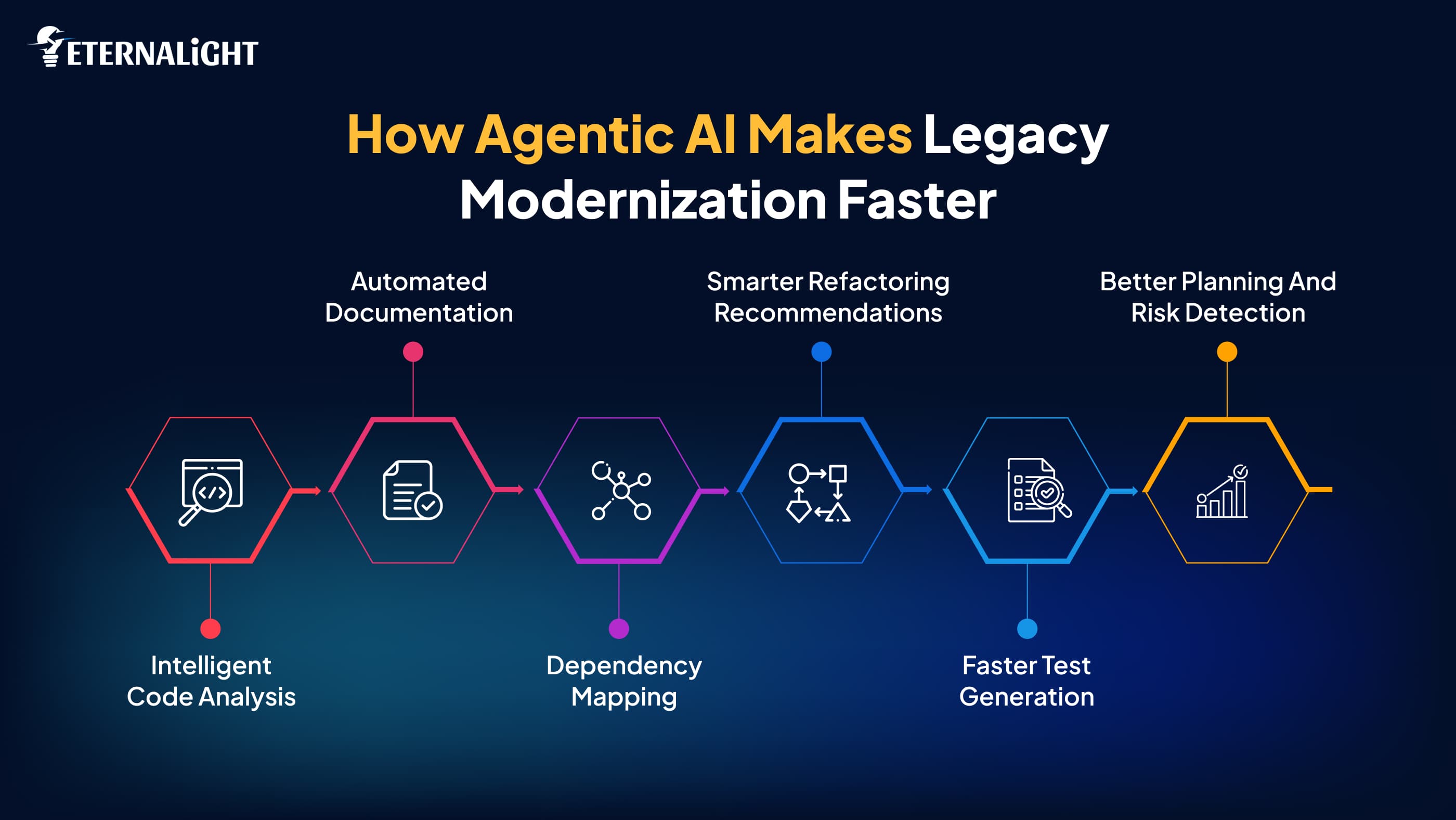
Uniquely different from conventional automation systems that conduct pre-programmed activities, Agentic AI leverages the logical thinking ability of LLMs and AI agents that can think through data, decide on action, and implement multiple workflow steps with little human involvement. As such, development teams can easily automate their legacy apps and better control the process.
While the two are often confused with each other, it is essential to note that AI Agents and Agentic AI are not the same thing. The main difference between AI agents vs Agentic AI is that while AI Agents are built with a particular task in mind, Agentic AI uses several intelligent agents to accomplish a workflow.
Here's how Agentic AI accelerates legacy modernization:
Intelligent Code Analysis
The AI agents have the capacity to perform analysis on large codebases. This allows the development team to understand the logic of applications and identify problems within them. It saves time required for code review processes.
Automated Documentation
Documentation plays a vital role in legacy modernization, which is often missing. Agentic AI provides documentation on technical information and explains code functionalities.
Dependency Mapping
Many legacy applications have hidden dependencies between their database, API, and services. By utilizing AI agents, one can map out these dependencies to help the developer in planning the migration process.
Smarter Refactoring Recommendations
Using Agentic AI, one does not have to go through each part manually; rather, the AI will assist the developer in finding ways in which the code can be improved and refactored.
Faster Test Generation
Testing is one of the most time-consuming processes during modernization. AI-based systems can be utilized for creating unit tests, integration tests, and regression testing cases, allowing for the validation of the changes faster and ensuring high-quality software.
Better Planning and Risk Detection
Agentic AI can analyze system complexity, highlight potential migration risks, and recommend implementation priorities. These insights help organizations estimate effort more accurately and make modernization projects more predictable.
While Agentic AI doesn't replace experienced software engineers, it empowers them to focus on high-value engineering decisions instead of repetitive manual tasks. By combining human expertise with intelligent automation, businesses can modernize legacy systems faster, reduce project risks, and accelerate their digital transformation initiatives.
Real-World Example - Modernizing the eMeals App with AI-Powered Development
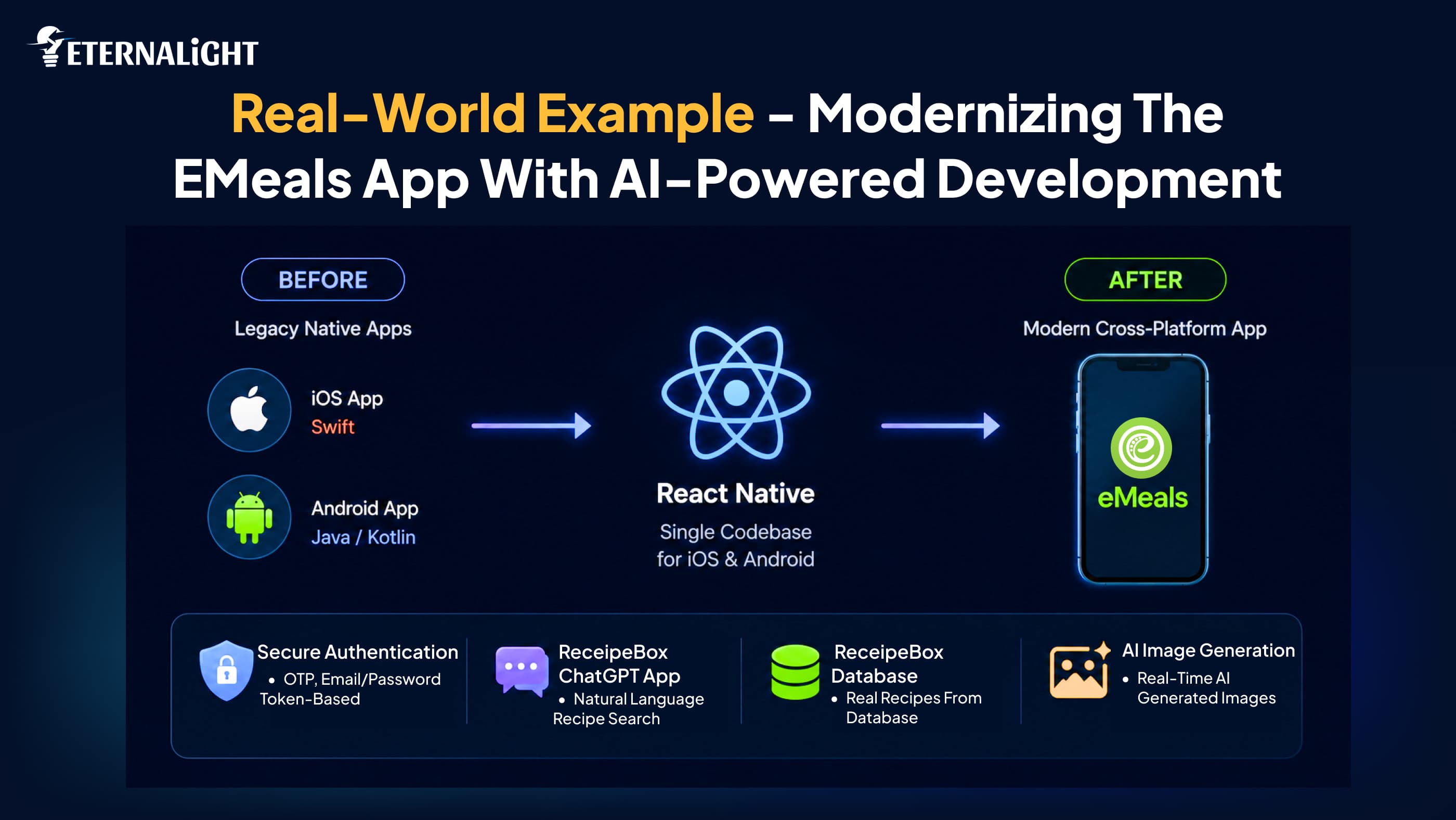
At Eternalight, we have implemented AI technology into actual software modernization solutions, one of which is our current project related to the eMeals application, a recipe-discovering and ingredient purchasing app.
Previously, the application was developed using Swift on iOS and Java/Kotlin on Android, which meant having to maintain separate code bases for both platforms, thereby taking up too much time in feature development. We updated the application, and it is now built using React Native, meaning that the same code base will work on both iOS and Android platforms.
This modernization project shows how using artificial intelligence-driven automation together with custom software development solutions can help companies move their legacy applications in accordance with their individual needs and scalability objectives.
In order to streamline the process of development, our developers used AI technologies such as Codex, Claude, and Cursor for various tasks, including generating, refactoring, and debugging code. Moreover, our team added security measures to the application in the form of OTP based authentication and Email/Password login with token-based authentication.
Moreover, our team developed the RecipeBox ChatGPT app by connecting it to ChatGPT with the help of the Model Context Protocol (MCP), which lets users access all of their favorite recipes through ChatGPT using natural language interactions. The details about the recipe are fetched from the RecipeBox database and are not generated by ChatGPT. We have added real-time AI image generation as well.
This solution demonstrates our approach to implementing modern solutions, AI development, and smart integrations in order to modernize applications and increase productivity and user experience.
Best Practices for Adopting Agentic AI
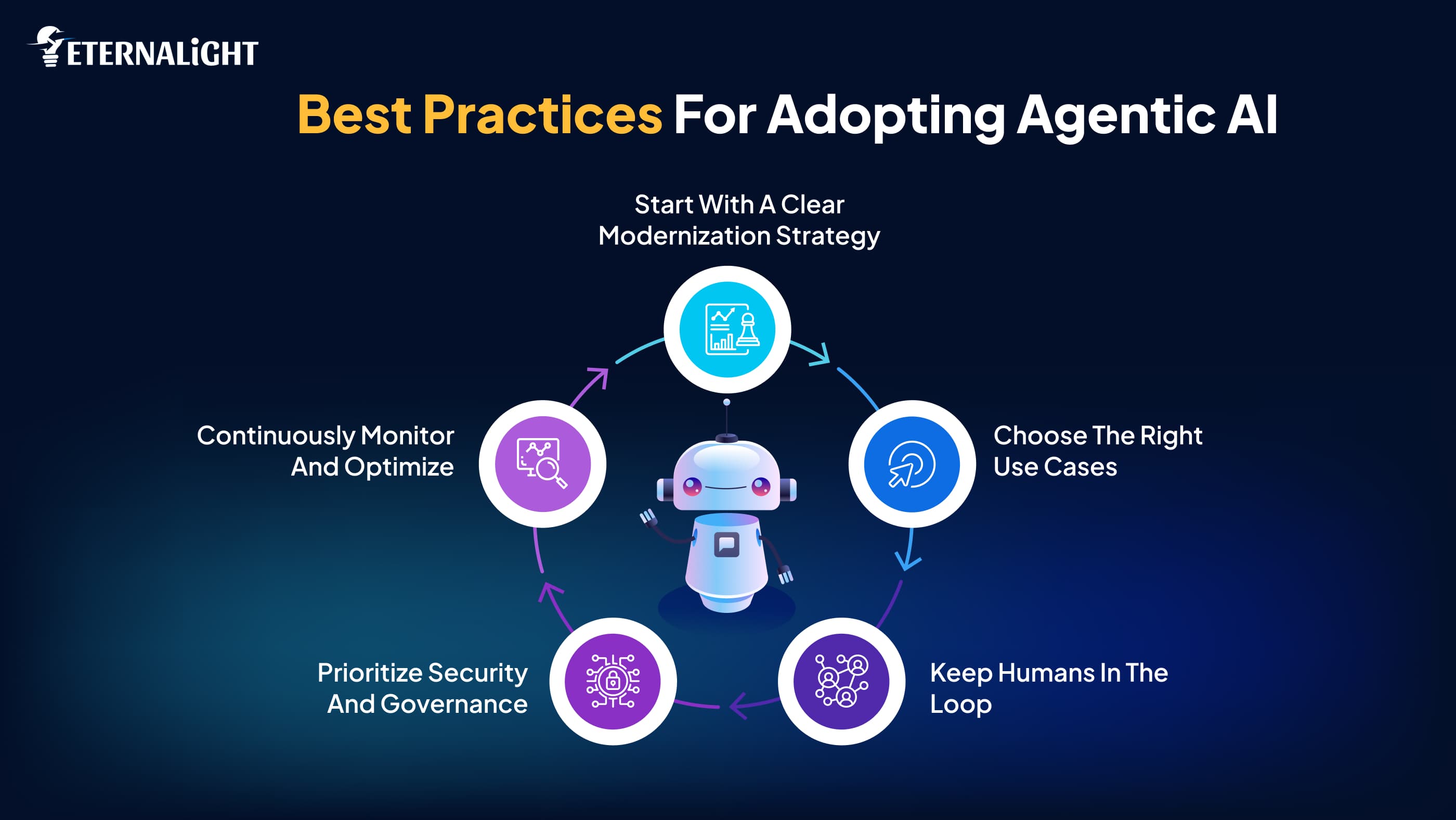
Adopting Agentic AI is not only about the inclusion of the latest AI systems in your software development life cycle process. There should be an effective strategy for leveraging the technology. The mentioned practices will help you to adopt agentic AI technology while minimizing the implementation risk.
Start with a Clear Modernization Strategy
Before implementing agentic AI, ensure you understand the purpose behind the modernization effort for your organization. Irrespective of whether it is about addressing the technical debt problem, cloud migration, or any other purpose, a clear roadmap will go a long way towards helping the AI agents prioritize and make decisions.
Choose the Right Use Cases
Modernization does not require the use of autonomous AI in every case. Let’s start with routine processes such as code analysis, creation of documentation, dependencies, testing, and migration. When confidence levels are achieved, then AI agents can be introduced into increasingly complex engineering processes. Getting acquainted with different types of AI agents will allow organizations to choose the best agents for every step of modernization, starting from code analysis and testing and ending with optimization.
Keep Humans in the Loop
Even though Agentic AI is capable of performing a large number of tasks, it is critical to have professionals who will be able to verify and evaluate the advice generated by the algorithm.
Prioritize Security and Governance
In legacy systems, there is usually very important information related to customers and the business itself. The company should have specific governance policies concerning AI agents in relation to access control, privacy measures, auditing, and regulatory requirements.
Continuously Monitor and Optimize
The modernization journey is a continuous process and not just a single activity. Monitor performance indicators like time for development, deployment frequency, defect rate, and migration. This ensures that the organization is able to enhance its AI processes and get improved results in the long run.
By incorporating intelligent automation with experienced engineering teams, the organization will be able to harness the power of Agentic AI.
Challenges of Adopting Agentic AI
While there are many benefits associated with using Agentic AI for legacy modernization, it is important to keep in mind the difficulties associated with the implementation of this technology as well.
Some common challenges include:
- Data Quality: The accuracy and proper structure of the data available are essential for AI agents in order to make appropriate recommendations.
- Integration Complexity: Integrating AI agents with legacy systems, APIs, and enterprise applications may prove to be difficult.
- Security and Compliance: Data security and privacy regulations have to be satisfied by organizations using AI.
- Human Intervention: AI agent-based recommendations have to be checked by competent developers and architects before implementation.
- Change Management: Change management will be required to incorporate AI agents in the work processes of companies.
By taking care of these issues, a well-thought-out AI strategy can help organizations reap maximum benefits from Agentic AI.
The Future of Agentic AI in Enterprise Modernization
As organizations seek to evolve their tech infrastructures, it is anticipated that agentic AI will become an even more integral part of software engineering and digital transformation processes. While agentic AI has hitherto been confined to aiding software engineers, future AI systems are forecast to partner with engineering teams on modernization efforts.
Over the next few years, one may observe that AI agents help companies in tasks like code migration without any external aid, recommending intelligent architectures, optimizing applications continuously, and providing intelligent system monitoring. All this will help in modernizing applications quickly, efficiently, and successfully.
Development in large language models, orchestrators, and enterprise AI platforms will also permit several AI agents to coordinate their activities for performing dedicated tasks. For instance, while one AI agent could perform the task of analyzing old codes, another AI agent could be responsible for generating the relevant documents, and a third AI agent could validate the security requirements before the launch of the application.
Even with these developments, however, the future looks unlikely to see Agentic AI replacing software engineers altogether. On the contrary, the Agentic AI will be a formidable engineering ally capable of automating repetitive tasks, enhancing problem-solving, and enabling developers to concentrate on innovation. Companies that embrace Agentic AI early and develop the required infrastructure will be better placed for the modernization of legacy technologies.
Conclusion
Legacy modernization has become a must for organizations that want to increase agility, reduce operational costs, and remain competitive in the changing digital environment. Still, conventional modernization efforts are usually hampered by high technical debt, obsolete architectures, manual work, and an uncertain project schedule.
With Agentic AI, intelligent AI agents are able to inspect legacy systems, automate routine engineering activities, gain meaningful insights, and assist developers throughout the modernization process. Thanks to this unique combination of autonomous decision-making and human knowledge, organizations can modernize applications faster and avoid any risks or uncertainties during the process.
With the progression of Agentic AI, faster digital transformations, better-quality software development, and future readiness for enterprises have become possible. Whether you plan to modernise your application or legacy ecosystem, the combination of intelligent AI agents and a sound modernization approach will decrease risks and increase the speed of your project completion, and provide value for the business.

Kusum Sethiya
Software Engineer
Kusum Sethiya is a Software Engineer at Eternalight Infotech, focused on building clean and intuitive. She enjoys turning ideas into reliable applications using modern technologies like Javascript, React, Node.js , and MongoDB.
Related Blogs
- AI & ML10 Mins
AI Doesn't Forget. It Loses Context: How Context Graphs Can Help
Learn how context graphs help AI agents connect information, retain context, and make better decisions with AI memory tools and retrieval systems.
- AI & ML10 Mins
How to Test Generative AI Applications: A Practical Guide to Reliable AI Systems
Learn how to test generative AI applications for accuracy, hallucinations, performance, security, RAG workflows, and reliability.
- AI & ML10 Mins
AI Data Security Strategies: 8 Ways to Protect Data in AI Systems
Explore 8 AI data security strategies to protect sensitive data across prompts, AI models, RAG systems, APIs, access controls, storage, and outputs.