Want to start a new project but confused about which approach is good for frontend as a Monolith or Micro-frontend architecture?
Most teams ask this question too early and often choose the wrong architecture.
In this guide, we'll compare both frontend system design approaches across scalability, deployments, performance, architecture complexity, real-world case studies, migration strategies, and help you decide which one fits your team, not just the latest trend.
The Evolving Landscape of Frontend System Design Architecture
Frontends are going through a revolution in architecture. The 2024 State of Frontend survey reveals that over the last couple of years, its use has dropped precipitously from 75.4 percent in 2022 to 23.6 percent in 2024. It's not a signal of the end of micro-frontends, it's just a piece of evidence of their maturity and usage. Today, teams aren't assuming that micro-frontends are always in play and are determined to implement them in some cases.
What is Monolithic Frontend Architecture?
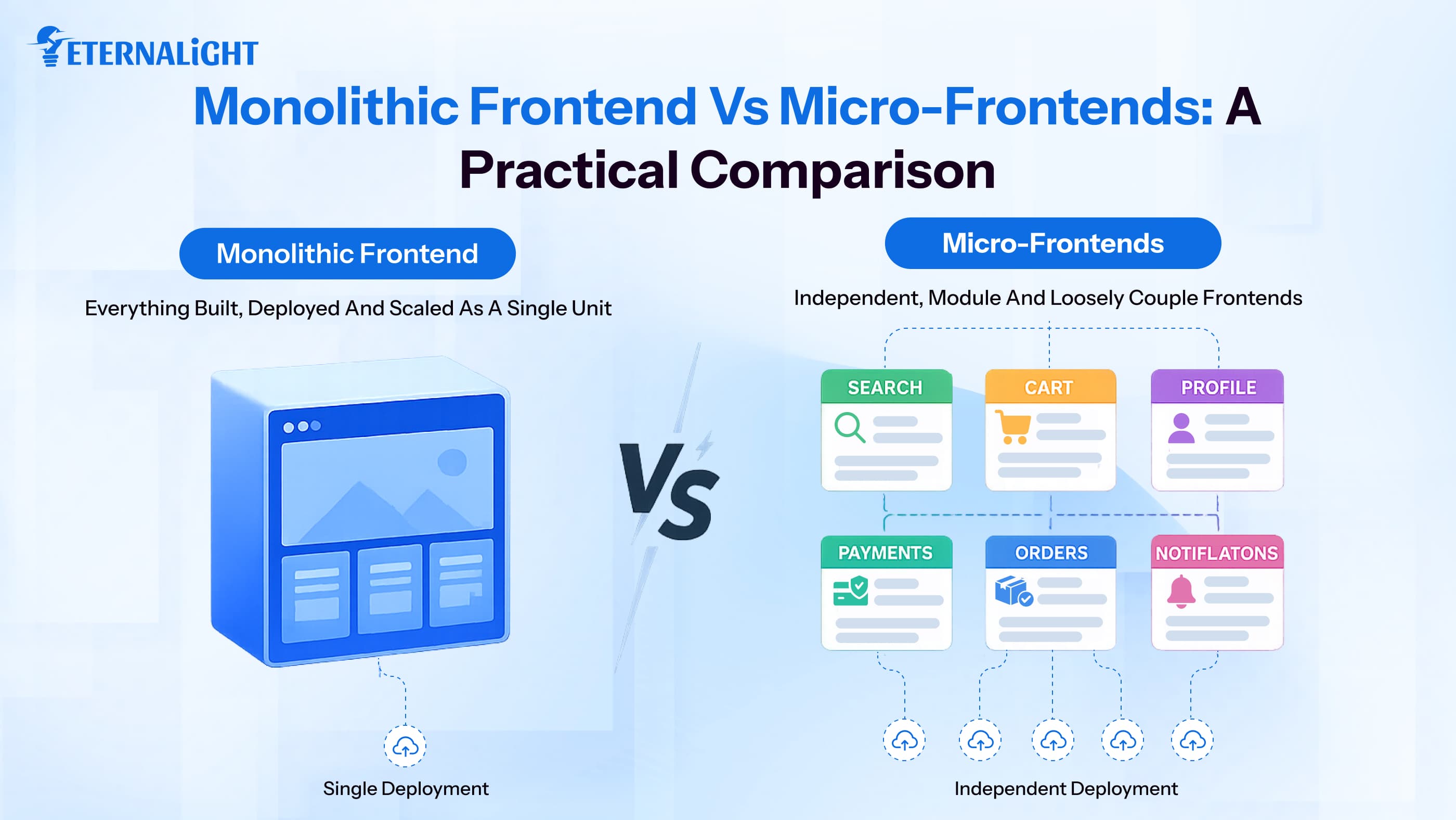
A Monolithic front-end is about having a single codebase, with each page, route, and feature consolidated and packaged into one. It could be a single team or a team of teams. They all work on the same repository to build, test, and release the entire project as a single entity. The core elements of monolithic architecture frontend are one repository, one pipeline, and one deployment, all or nothing.
What is Micro-frontend Architecture?
The concept behind micro-frontend is what microservices state when it comes to the home front, and the UX platform turns into a set of (completely developed, tested, deployed, and hosted) application fundamentals that are independently created and linked. All these applications blend together and provide a seamless product experience in the browser. Each micro-frontend has its own UI, state management, routing and, preferably its own backend microservice to serve it.
Practical Comparison Of Key Dimensions for Monolithic and Micro Frontend-architecture
To give a better understanding of frontend framework system design, we are going to list the key dimensions highlighting both frontend architectures: Monolithic and Micro Frontend architecture.
Dimension | Monolith | Micro-Frontend |
Team Scalability | Hard beyond 5–8 developers | Supports dozens of teams |
Deployment | Entire application | Independent per MFE |
Build Time | Increases with app size (10–15 min for 500K LoC) | Small, fast builds (~30 sec) |
Technology Stack | Single framework/stack | Multiple frameworks (with governance) |
UI/UX Consistency | Easy to maintain | Requires shared design system |
Performance | Single optimized bundle | Possible duplicate dependencies |
Architecture Complexity | Low | High (orchestration, contracts, versioning) |
Testing | One E2E test suite | Individual + integration testing |
Fault Isolation | One bug can affect entire app | Failures isolated to one MFE |
State Management | Easy (Redux, Context, etc.) | Challenging (events, props, URL, shared services) |
When to Choose Each Approach?
Let' s understand when you can prioritise monolithic and micro frontend.
Start With a Monolith Architecture When:
- Small to medium teams (1-5 teams)
- Early-stage products with evolving requirements
- Performance-critical applications where bundle size matters
- Limited operational resources for complex orchestration
- Homogeneous scaling needs across features
Consider Micro-Frontends When:
- Large organizations with 5+ autonomous teams
- Teams need different release cadences
- Clear domain boundaries (e.g., search, product, cart, checkout)
- Need to incrementally migrate a legacy monolith
- Mixed technology stacks are required
Real-World Success Stories: Frontend Shift
Sharing the real-life brand stories that adopted the evolution and migrated the frontend system design.
Udemy's Homepage Migration
Udemy successfully migrated their logged-out homepage from a monolithic to micro-frontends architecture. Key outcomes included:
- Enhanced web performance metrics, especially for international users
- Increased development speed
- Streamlined sharing of components across applications through shared npm packages
- Teams can now develop and update shared components independently
Expedia's Performance Gains
Expedia's Flights web application achieved a 52% reduction in page-usable time by adopting micro-frontend architecture. They implemented:
- Independent shareable packages for better ownership and optimization
- Package-size limits enforced via Git commit hooks
- GraphQL query optimizations with horizontal/vertical slicing
- Enhanced observability across frontend and backend components
Dunelm's Iterative Migration
Dunelm implemented micro-frontends using AWS Compute within their CDN, enabling:
- 60,000 product detail pages migrated without downtime
- 2x faster release frequency compared to legacy website
- Improved Core Web Vitals across all mobile devices
- Reduced coupling between teams enabling faster innovation
Implementation Strategies for Frontend System Design
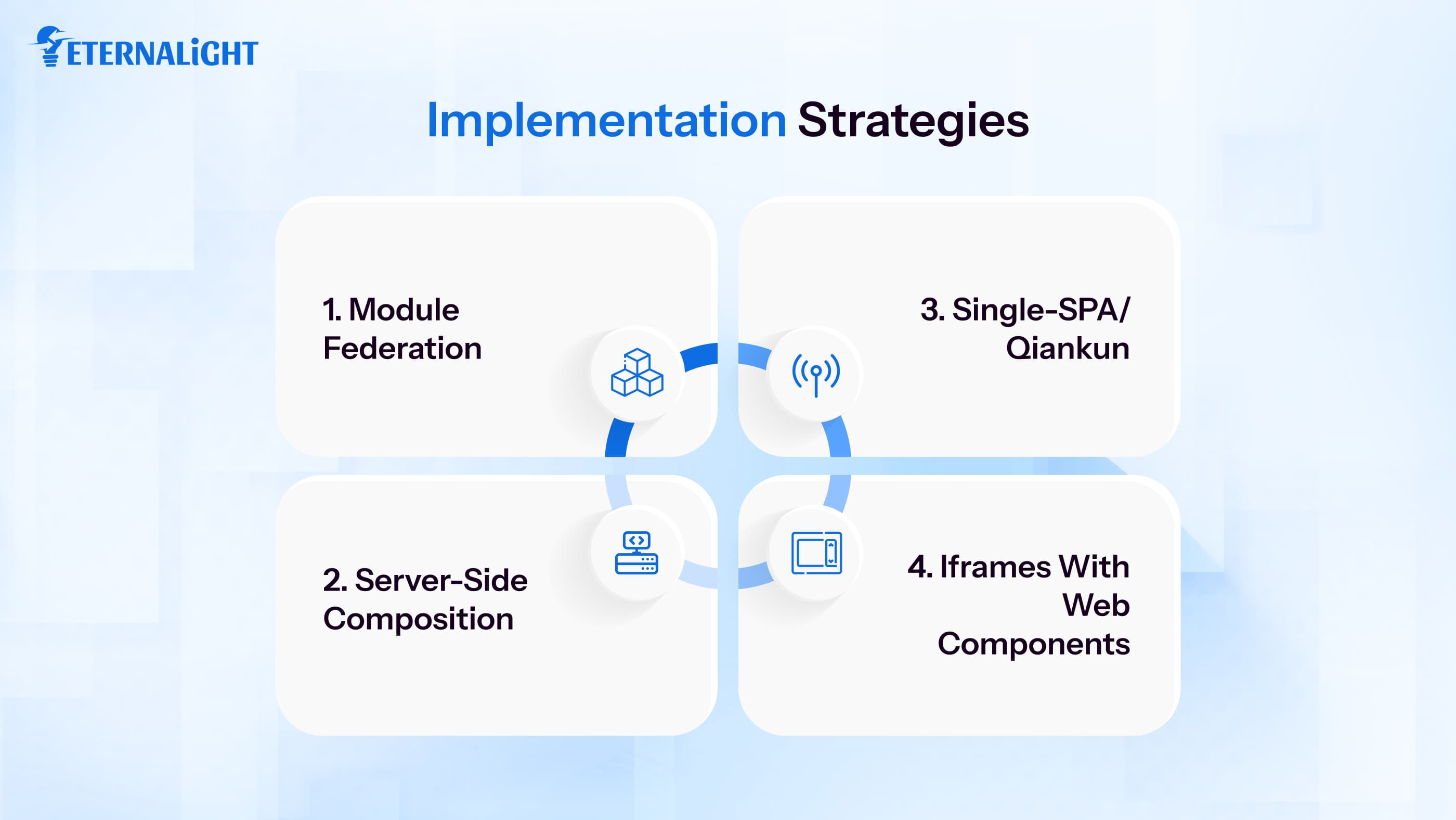
You can’t randomly choose the micro-frontend architecture; for every project, you need to pick the right stack that aligns with the project's complexity and the talented engineers experienced in building the desired project.
1. Module Federation (Most Popular)
Webpack Module Federation is the dominant approach for React teams. It solves the shared dependency problem through runtime code sharing. Use MF 2.0 for type safety and bundler flexibility.
2. Server-Side Composition
Ideal when SEO is critical or when you need to avoid JavaScript-heavy pages. This approach uses platform-native loading with strong governance.
3. Single-SPA/Qiankun
Best for multi-framework migration scenarios. These orchestration frameworks provide extra runtime layers but enable teams to gradually transition between them.
4. iFrames with Web Components
Use when you need strong isolation or security boundaries, particularly for third-party content.
Common Pitfalls and How to Avoid Them
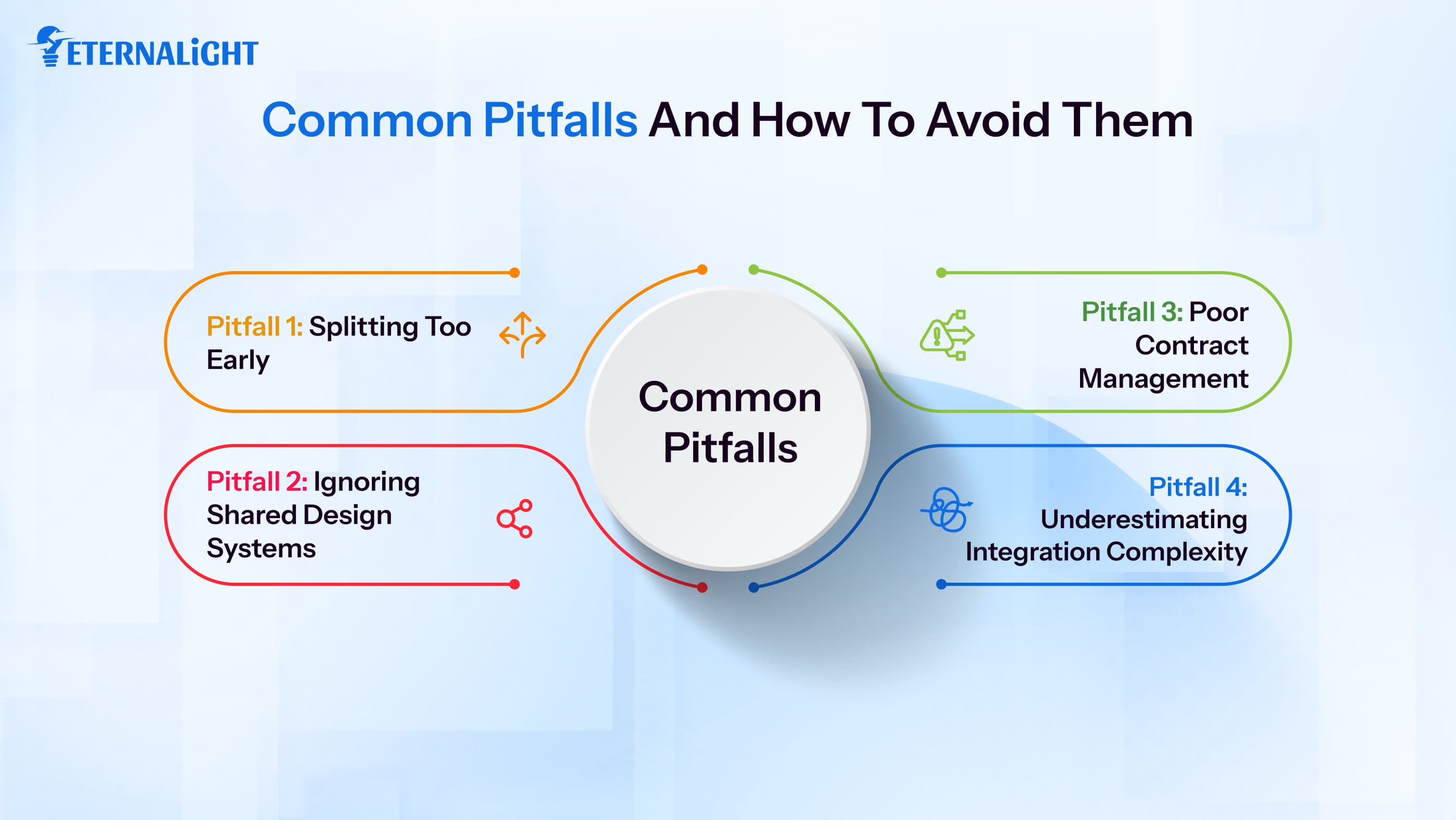
In terms of flexibility and interoperability, deployment of micro-frontends stands out, but the architectural complexity is a challenge. So to avoid costly mistakes, teams can remember the following pitfalls.
Pitfall 1: Splitting Too Early
Problem: Have 5-10 developers create micro-frontends to fulfill their requests, which generates a significant overhead and spending on extra structure.
Solution: Only make micro-frontends when team coupling becomes a real deployment problem, as creating them in advance causes a lot of overhead and additional investment into extra structure.
Pitfall 2: Ignoring Shared Design Systems
Problem: Lack of a design system in micro-frontends
Solution: Invest in a design system (like TravelPerk's "Suitcase") before getting to the point of creating micro-frontends
Pitfall 3: Poor Contract Management
Problem: Version skew, caching problems
Solution: come up with clear contracts: public APIs surface, routing boundaries, events, design tokens and compatibility rules
Pitfall 4: Underestimating Integration Complexity
Problem: Cross-cutting concerns (auth, i18n, analytics) become fragmented
Solution: Plan shared infrastructure early and consider Backend-For-Frontend (BFF) patterns
The Hybrid Approach: Modular Monoliths
Feature-Sliced Design (FSD) offers a middle ground. It delivers the same scalable frontend benefits inside a single codebase while making "extracting a micro-frontend later" far safer. This approach:
- Improves modularity in a monolith
- Creates clean seams for future extraction
- Reduces boundary costs while maintaining simplicity
- Works well for teams of 3-5 developer
Migration Path: Strangler Fig Pattern
Most successful migrations follow the Strangler Fig pattern:
- Identify vertical fragments based on page groups
- Create shared packages for common components
- Implement a routing layer to direct traffic
- Migrate incrementally one page group at a time
- Monitor performance and user experience continuously
How to Make a Decision Regarding Frontend System Design Architecture?
Before choosing an architecture, evaluate these questions:
- What's your team size and structure?
- How often do different parts of your app need to be deployed?
- Do you have clear domain boundaries?
- What are your performance requirements?
- Do you have operational resources for complex tooling?
- Is UX consistency across features critical?
Performance Considerations
It's really crucial to decide which architecture is rapid and robust in terms of performance. Even if you think the frontend approach seems faster to build, it may not deliver a faster UX. So we can compare both approaches: microfrontends vs. a monolithic architecture.
Build Performance
- Monolith: 10.7 seconds build time for comparable functionality
- Micro-Frontends: 113.8 seconds build time due to orchestration overhead
Runtime Performance
- Monolith: ~1.85 MiB JavaScript bundle
- Micro-Frontends: ~50.75 MiB JavaScript bundle
Monolithic comes with small bundles and lower runtime overhead. However, micro-frontends can achieve better lazy loading and independent optimization, potentially improving perceived performance for individual features.
Next Steps for Software Development Team
- Assess your current pain points - Are they organizational or technical?
- Evaluate your team structure - Do you have natural domain boundaries?
- Start with Feature-Sliced Design if you're between monolith and micro-frontends
- Plan for incremental migration - Don't try to boil the ocean
- Invest in shared infrastructure early - design systems, routing, and contracts
Remember: The right frontend system design architecture is the one that solves your specific problems, not the one that's most fashionable. Choose based on your team's needs, not industry trends.
Bottom Line
Monolithic Frontends remain the optimal choice for:
- Small to medium-sized teams
- Performance-sensitive applications
- Early-stage products
- Projects with homogeneous scaling needs
Micro-Frontends become justified when:
- You have teams that truly need independent deployment
- Clear domain boundaries exist
- The organizational complexity outweighs technical complexity
- You can invest in governance and shared infrastructure
The key is to measure boundary cost rather than adopt trends blindly. Start simple, measure the actual pain points, and evolve your architecture when the benefits clearly outweigh the costs.

Tarun Kumar
Software Engineer
2 Years Of Experience| Backend Developer with expertise in Go, Java, Spring Boot, Node.js, C++ | AI-driven software development & scalable systems
Related Blogs
 Software Development9 Mins
Why Choose Python for Fintech App Development?
Learn how Python helps fintech businesses build scalable, data-driven applications with powerful support for analytics, AI, APIs, and automation.
- Software Development8 Mins
Is It Time to Build Off the Self vs Custom Software for Your Business?
When should you build custom software? Learn the key signs, costs, limitations, and factors to consider before choosing custom software for your business.
- Software Development11 Mins
Website Security Checklist: What to Check Before It's Too Late
Worried about website security? Use this practical website security checklist to spot common risks and protect your website, data, and users.