Most apps don’t lose users because they think that the product is bad; they leave because the frontend or UI slows down as they grow.
Scaling the frontend is not a technical approach; it's more like a business strategy. A better frontend can retain users, drive conversions, and positively impact revenue.
Alternatively, it's a silent ingredient in the recipe for building fast-growing products that increases the success rate.
In this blog post, we share how to scale the frontend and its impact on driving transformation in real-world business scenarios.
Is Scaling a Frontend Worth it for Future Business Outcomes
Instead of jumping into the technical details, we will relate it to real-world examples across different brands. Let’s understand the problematic scenarios and the impact of scaling the frontend.
Scenario:1
In 2015, Spotify's desktop application used iframes to render the web application's UI in a CEF container as an independent app. This approach was slow at initial load because it required multiple JS chunks to load each time the user navigated between pages.
The Solution: Migration to a React-based platform.
This platform is like a box with many smaller parts inside, making it easier to work with. The team took all the parts that were loading in their own windows and consolidated them into one app. This made everything faster. Now it does not have to manage multiple code sources, which is a significant advantage. We just have the React platform to worry about.
The Impact
The changes made had an impact. We saw the website load a lot faster at first; it was 65% faster. It was also 58% better in Time To Interactive. The changes even helped with memory usage; it was 47% lower.
The best part was that teams could now work on features for both platforms simultaneously from a single codebase.
Scenario: 2
Something else happened with Goibibo in 2017. Users of the Goibibo mobile web app were not completing their bookings. They would reach the payment section. Then stop.
20% of these people would then download the Goibibo mobile app to finish paying and confirm their bookings. The core issue was a slow and unreliable mobile web experience that could not scale with user growth.
It was awful when people tried to authenticate and make payments on Goibibo's mobile web app. Goibibo’s mobile web app experience was just not good enough.
The Solution: Building a PWA
Progressive Web App provides a mobile app-like experience without requiring users to download the app.
The Impact
This delivered strong results in user conversions: logged-in users increased to 20%, and OTP retry calls dropped to 25% (these changes occurred at a 6x rate).
Key Takeaways: Why Scaling Frontend is Power Move
- Slow or unreliable frontends drive user drop-off, reducing conversions and revenue.
- Performance issues compound at scale, increasing cost and slowing engineering velocity.
- Poor frontend experience erodes brand trust and long-term retention.
Investing in frontend performance improves speed, engagement, and conversion rates. A scalable frontend enables faster delivery and sustained business growth.
We have at Eternalight also developed a scalable document parser to manage several buisness world issues.
What are Progressive Web Apps and Modern Monolithic Architecture?

Progressive Web App (PWA) Architecture is a web-based approach that uses frontend web technologies to deliver native-app-like experiences in web browsers.
PWAs use service workers for offline functionality and caching, web app manifests for installation, allowing them to work offline, send push notifications, and be installed on device home screens without app stores.
Modern modular monolith architecture is a single unified application that maintains strict internal module boundaries. Unlike traditional monoliths, it organizes code into self-contained, independent modules with clear interfaces.
While deploying as one unit, combining the simplicity of monolithic deployment with the modularity and team autonomy of microservices.
How Does the Hybrid PWA + Modern Monolith Model Work in Scaling the Frontend?
Combining the PWA with modern monolith architecture can deliver fast load times, an app-like experience with offline support, and a unified codebase with clean, independent module boundaries.
The hybrid approach can increase developer productivity and drive long-term business growth without adding micro-frontend complexity.
What Exactly is the Approach to Building a Scalable Frontend?
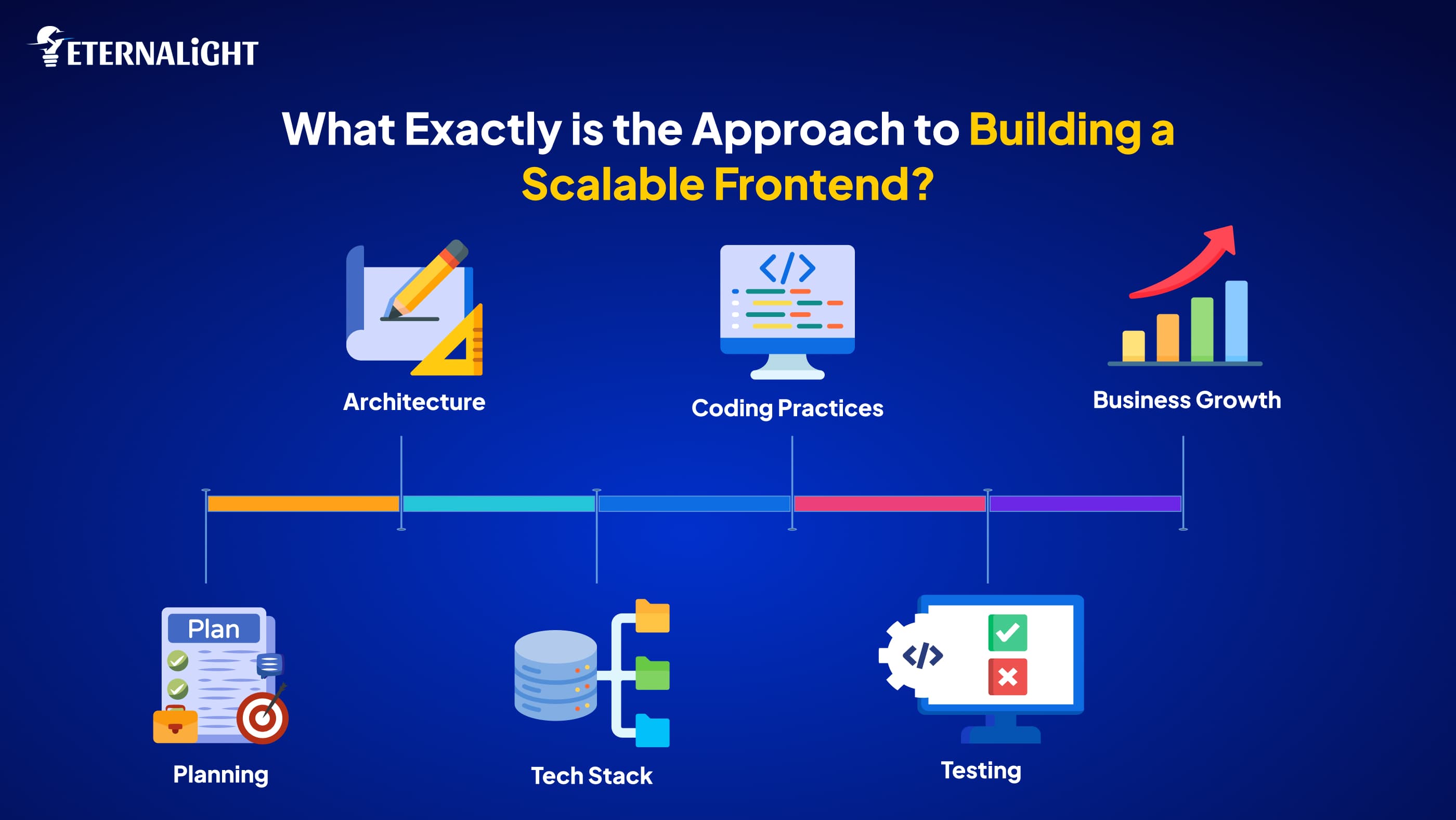
Building a scalable frontend is more than just writing code. It requires a modular architecture with reusable components and innovative state management to prevent chaos.
In addition, performance optimization through code splitting and lazy loading, along with code maintenance, continuous testing, independent deployments, and version control, helps keep your application fast as it grows.
Planning a Proper Scalable Frontend Architecture
The best way to build a frontend is to use a progressive web app and a modern Monolith.
A scalable frontend is composed of loosely coupled units that can evolve, scale, and fail independently without impacting the whole system. Then you add progressive web app features to it. This means you use service workers so users can access your application even when offline.
You also use a web app manifest to enable users to install your application on their devices. You use push notifications to keep users engaged with your application.
This approach is beneficial because you only need to work on a single codebase, saving time and money. It also gives teams the freedom to work on their parts of the application without affecting other parts. It makes your application feel like a native app on all devices, which users prefer.
You get the benefits of a progressive web app and a modern monolith, which is highly beneficial for your application.
Companies like Spotify prove this works: their unified React architecture gains PWA benefits while maintaining modularity, fast deployment, offline support, and cross-platform reach without sacrificing performance.
Choosing a Tech-stack Strategy
Your tech stack must align with your chosen architecture and scale effortlessly as your business grows.
Choose component-based frameworks that support modular development, state management libraries for predictable data flow, and build tools that enable code splitting and tree-shaking.
Consider headless CMS integration for content flexibility, serverless functions for scalability, and modern bundlers that optimize performance.
The right stack supports both current needs and future architectural pivots without requiring complete rewrites.
Opting for the Best Coding Practices
Building scalable frontends requires disciplined coding practices. Implement code splitting to break applications into smaller chunks, reducing initial bundle sizes by up to 40%.
- Use lazy loading to defer non-critical components until users actually need them, dramatically improving load times.
- Design reusable components that follow atomic design principles, with UI elements functioning as independent building blocks.
- Route-based splitting works well for distinct pages, while component-based splitting provides granular control, supports lazy loading of modals and heavy widgets, and keeps critical elements in the initial bundle.
Testing to Ensure a Smooth User Experience
As your frontend grows, automated testing and CI/CD pipelines become essential. Implement a testing pyramid with unit tests for components, integration tests for interactions, and end-to-end tests for critical flows.
Integrate e2e testing with cypress into your deployment pipeline, trigger smoke tests on every pull request, and complete regression before production. Write modular, reusable test scripts using clear selectors and a data-driven approach.
Monitor flaky tests, maintain detailed dashboards, and enable continuous delivery with feature flags and staged rollouts.
Adopt this approach to enhance frontend performance optimization and see the difference. For now, we’re wrapping it!
Final Outcome: Expectation from Scaling the Front End
We are discussing the end goal: what will happen if we scale the front end?
The front end is what users interact with, so scaling it will likely affect conversions.
When scaling the front end, it is not a one-time process; it is an ongoing commitment to adaptability and excellence. Companies like Spotify and Goibibo demonstrate that the proper methodology delivers measurable business impact.
Start with your current needs, design for the future.
Plan your frontend scaling roadmap today, stay agile, and always prioritize the user experience.

Ketan Somani
CEO, Founder
I am the CEO and Founder of Eternalight Infotech, with 12 years of experience in building software products. Feel free to pick a date and time that suits you, I’ll personally connect with you to understand your project requirements.
Related Blogs
 Software Development9 Mins
Why Choose Python for Fintech App Development?
Learn how Python helps fintech businesses build scalable, data-driven applications with powerful support for analytics, AI, APIs, and automation.
- Software Development8 Mins
Is It Time to Build Off the Self vs Custom Software for Your Business?
When should you build custom software? Learn the key signs, costs, limitations, and factors to consider before choosing custom software for your business.
- Software Development11 Mins
Website Security Checklist: What to Check Before It's Too Late
Worried about website security? Use this practical website security checklist to spot common risks and protect your website, data, and users.