Businesses that hire the right developers faster often bring better products to market sooner. Instead of competing for limited local talent, companies are expanding their search globally by hiring remote developers with the skills their projects need.
For startups that want to create minimum viable products (MVPs), growing businesses looking to expand their products, and even enterprises trying to boost their engineering capabilities, remote developers have the flexibility and expertise to work on projects of varying scales and complexities.
However, remote work becomes successful beyond resume reviews. Each of the steps required to establish a productive remote workforce should be prioritized: from evaluating communication and technical skills to determining the right engagement model and establishing successful collaboration practices.
This guide has been designed to specifically show you how to hire remote developers, assess different hiring models, evaluate candidates, and select the best possible remote development partner for your project.
What Does It Mean to Hire Remote Developers?
Hiring remote developers involves partnering with software engineers who will develop your application from another place rather than your office space. They will work with your team via virtual collaboration.
In accordance with the specific requirements of your project, you can hire remote developers as freelancers, dedicated developers, or a remote development team.
They can be involved in all processes of software development: planning, design of UI/UX, frontend and backend development, testing, deployment, and further maintenance. The only difference between remote software engineers and in-house software engineers is the place where they work.
Many startups and enterprises often prefer to hire remote software engineers due to reasons such as wider access to the global market of talent, a fast hiring process, and scalable teams. If you hire and work with them correctly, then you will have efficient results from the projects.
Why Businesses Prefer Hiring Remote Developers
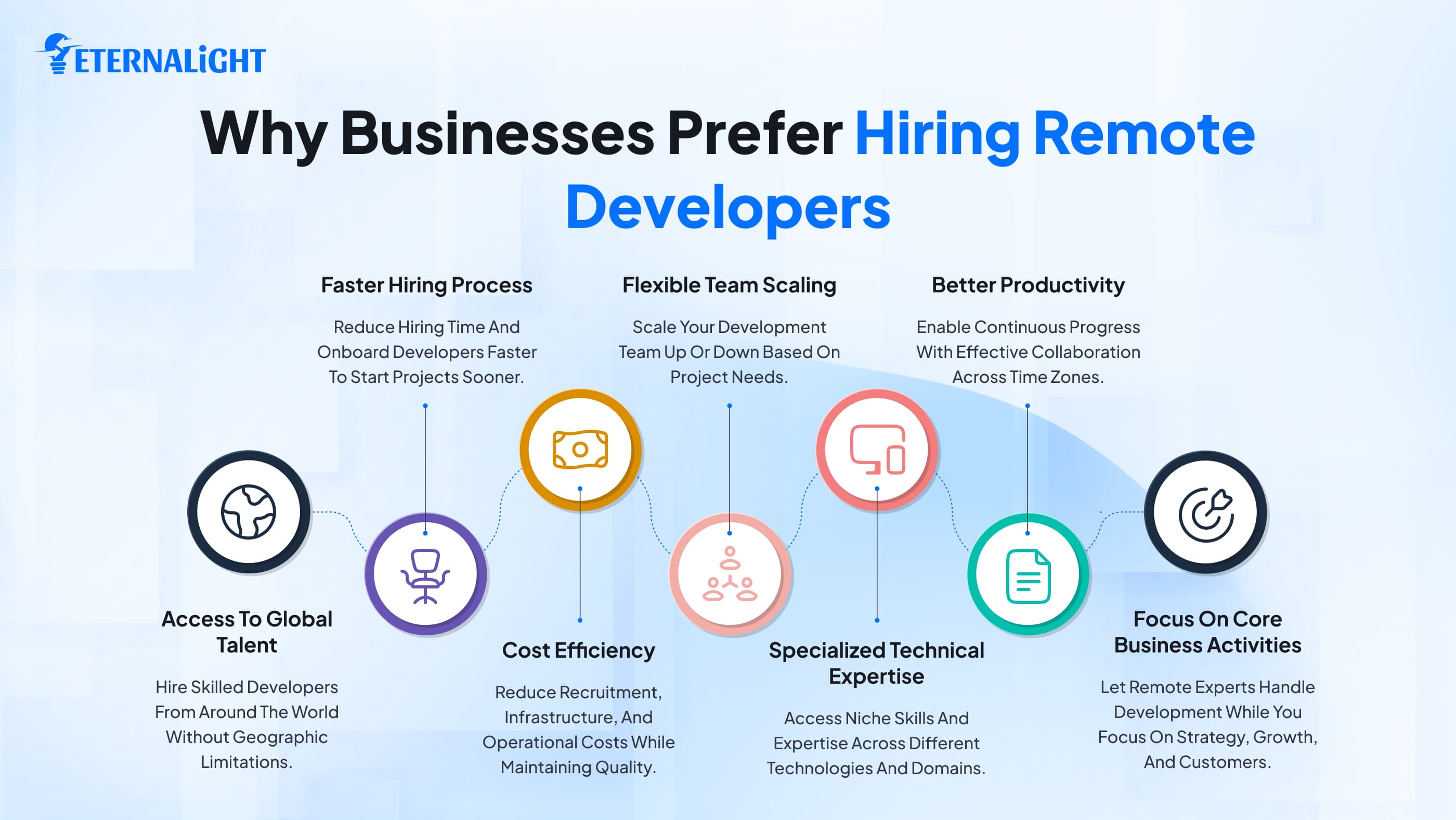
Hiring remote developers has turned into a great opportunity for companies that want to speed up development processes and have access to a pool of talented people. Regardless of whether you run a startup or a big company, remote developers will help you keep pace with the modern world and be competitive in the digital arena. Here is a list of advantages of employing remote developers:
Access to Global Talent
Hiring remote developers eliminates geographic boundaries and enables you to recruit skilled remote developers who have the advanced programming and technical skills that your specific development project requires.
Faster Hiring Process
Instead of using the traditional recruiting method, which has businesses spending months recruiting locally, more businesses can cut this time and quickly onboard remote developers and initiate the development phase earlier.
Cost Efficiency
Cutting recruitment, infrastructure, and operational costs is possible with hiring remote developers. Companies can maintain their development standards.
Flexible Team Scaling
One developer or an entire remote development team can be successfully hired. Resources can be scaled accordingly to meet the requirements for the project.
Specialized Technical Expertise
Remote developers are used to working within varying domains and technologies, making them more adaptable to identifying the required expertise for particular projects.
Better Productivity
With the right collaboration tools and methods in place, remote developers can work effectively in various time zones, thus ensuring that work progresses continuously.
Focus on Core Business Activities
By outsourcing the development efforts of remote experts, businesses can concentrate on strategy, customer acquisition, and growth.
When Should You Hire Remote Developers?
However, hiring remote developers is not the right choice for every project. It can be highly effective when your business requires specialized expertise, faster development timelines, or greater team flexibility. Here are some situations where hiring remote developers makes the most sense:
You're Building a New Product or MVP
For example, startups are able to form an efficient team very quickly without spending much time on hiring procedures.
You Need Specialized Skills
When your project requires knowledge in a certain technology, framework, or language, you are able to hire the right person globally.
Your In-House Team Needs Additional Support
The remote developers will work along with your current team members, helping them with increased workloads, development, or filling skill gaps for a short period of time.
You Need to Scale Your Team Quickly
Depending on whether you launch new features or deal with the increased number of customers, remote developers help you increase the team's capacity without involving a long hiring process.
You're Working with Budget Constraints
Using remote developers is much cheaper than hiring a whole team of people for your company.
Your Project Has Tight Deadlines
The remote development team can help speed up the process by recruiting experienced professionals who will carry out development processes in parallel.
You Want Long-Term Development Support
Moreover, the remote developers can help you maintain your product after its launch.
Step-by-Step Process to Hire Remote Developers
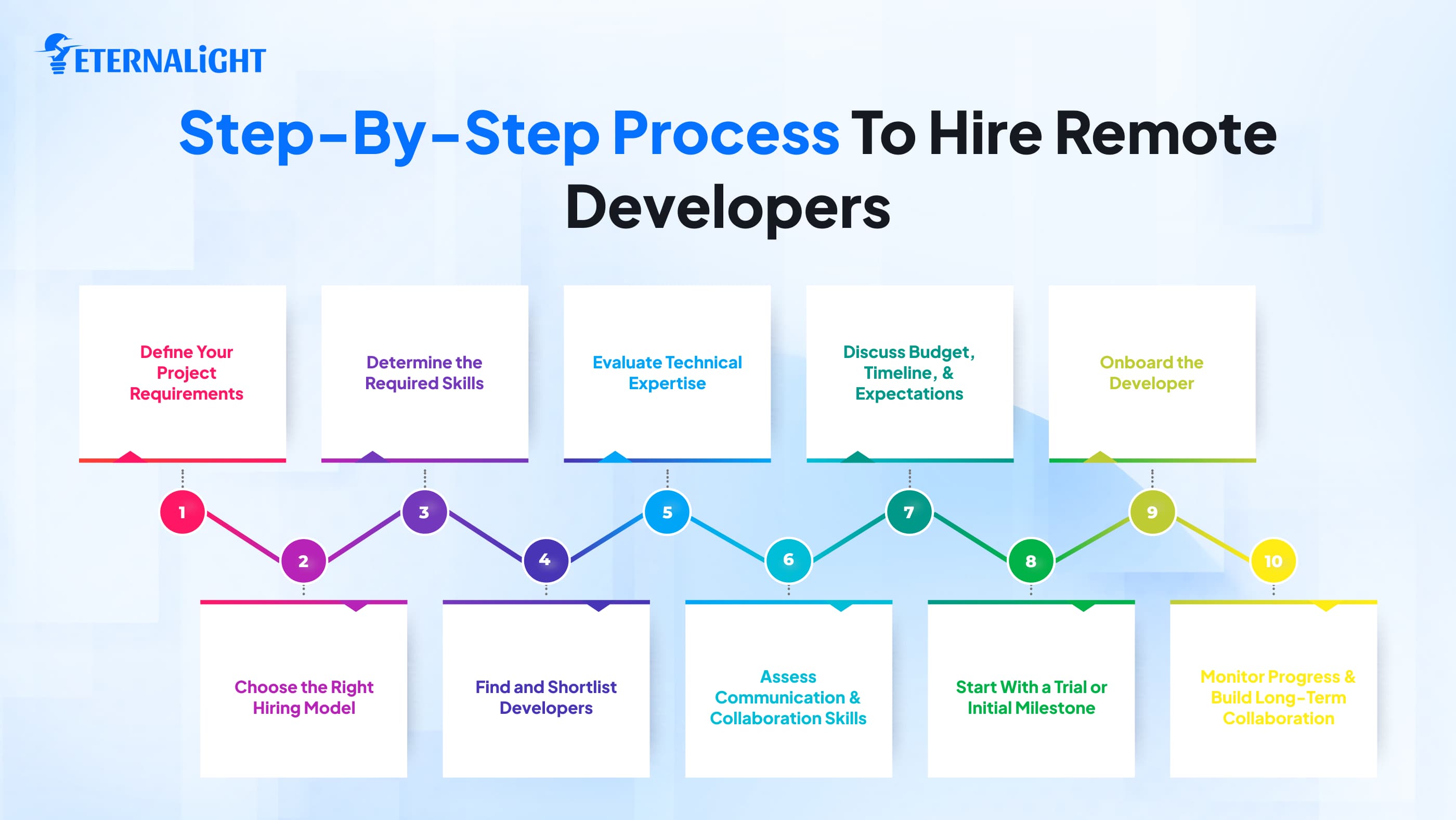
When employing remote developers, it is not enough just to put up a vacancy and hire any candidate that meets your needs. You can benefit from using a step-by-step approach, which will allow you to find developers with desired technical skills and abilities corresponding to your project’s objectives and working conditions.
Here are the key steps to follow:
Step 1: Define Your Project Requirements
First of all, you should define what exactly you plan to develop and what type of competencies will be required. Specify the scope of your project, its main features, technologies, timeline, etc.
Besides that, it is important to know if you require one developer, several developers, or a whole team of remote developers. Having specific requirements for the project will make your selection process easier and more effective.
Step 2: Choose the Right Hiring Model
Choose how you would like to collaborate with remote developers depending on your project’s time frame, budget, and engagement level.
Some common approaches are using freelancers, hiring remote developers exclusively, staff augmentation, and dedicated development teams. Choose the approach that will work for you.
Step 3: Determine the Required Skills
Prepare a list of technical and soft skills that you need for your project. Depending on your requirements, the skills may range from front-end or back-end development to mobile development, cloud computing, database systems, artificial intelligence, and various frameworks.
Apart from the technical skills, it is also important not to overlook soft skills such as communication, problem-solving, adaptability, and time management skills.
Step 4: Find and Shortlist Developers
You can search for suitable candidates using your professional connections, developers’ forums, referrals, freelancing websites, or software development firms.
Examine their portfolios, work history, technical knowledge, and client reviews. Select those candidates who have a track record of working on projects similar to yours.
Step 5: Evaluate Technical Expertise
Interview or assess the developer technically on how they will handle the project's requirements.
Inquire about their past experiences, technical decisions, problem-solving skills, and experience with your technology stack. If the project is complex, you can also do a coding test or technical conversation.
Step 6: Assess Communication and Collaboration Skills
Successful remote development is dependent on effective communication. Determine whether candidates can communicate technical information, provide status reports, address comments, and work with other team members.
You should take into account their working hours and time zones, especially if you have regular working hours for your team.
Step 7: Discuss Budget, Timeline, and Expectations
Before closing the deal, talk about the developer’s fees, project duration, work schedule, deliverables, and payment terms.
Set out clear roles and goals in order not to get into confusion later on. In case of bigger projects, think about milestone contracts.
Step 8: Start With a Trial or Initial Milestone
With respect to long-term projects, beginning with a smaller assignment or milestone may allow you to judge the developer's true performance.
It will give you a chance to check out how well the code is written, how good the communication is, and if he can deliver on time.
Step 9: Onboard the Developer
After selecting the right developer, give access to all the required tools and documents.
Make sure there is a proper communication channel and familiarize him with your existing team and development process. An efficient onboarding process will be helpful for the developer to get started quickly.
Step 10: Monitor Progress and Build Long-Term Collaboration
Hiring doesn’t stop there; regular follow-ups, progress evaluations, code reviews, and feedback will ensure that the project moves in the right direction.
Thanks to clear communication, you can turn remote developers into a dependable long-term extension of your in-house team.
Essential Skills to Look for When Hiring Remote Developers
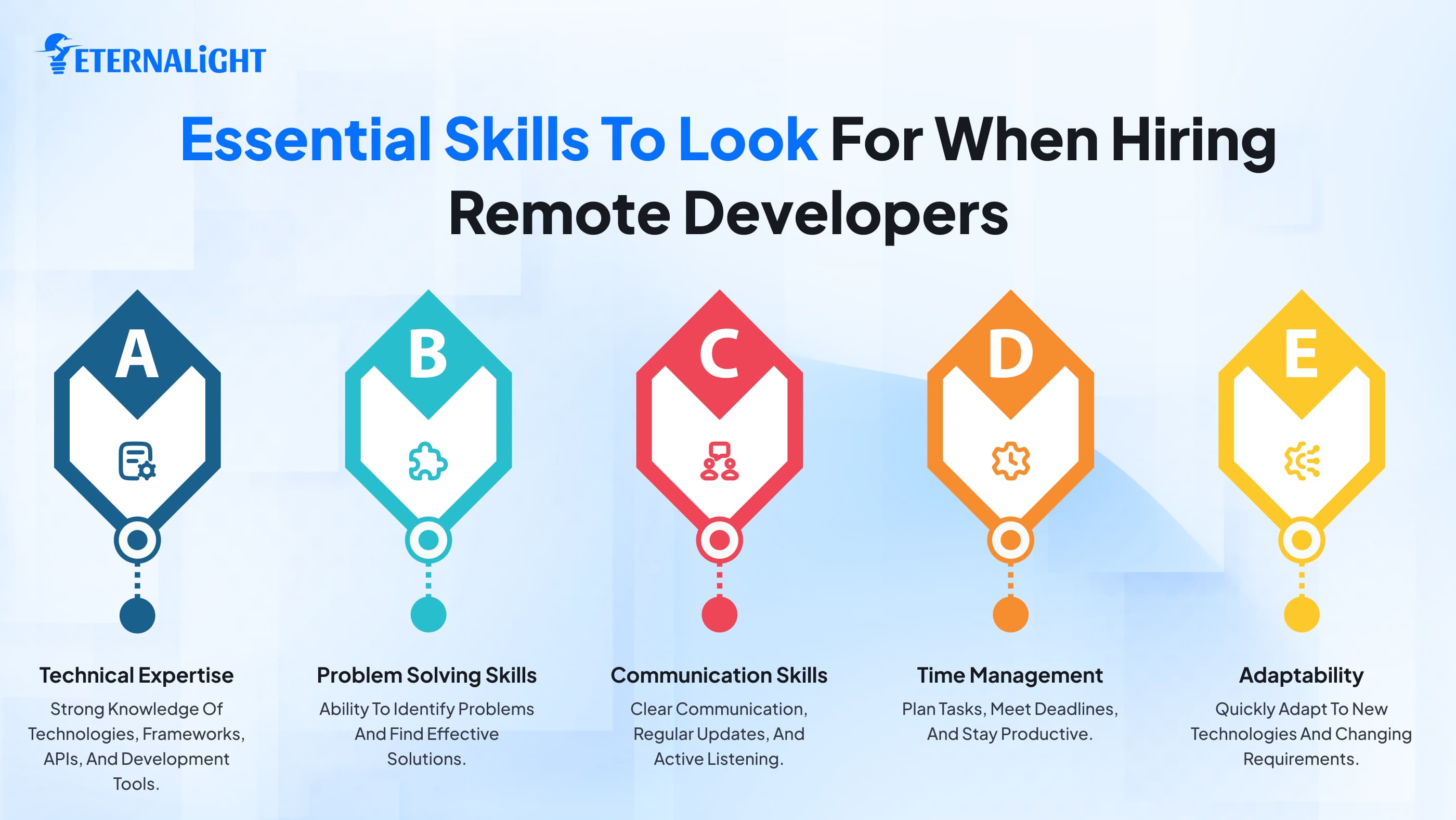
It is essential to find a developer who possesses technical skills. But apart from that, there are other skills, such as good communication and collaboration, which are also needed.
Tech-Stack Expertise
A developer must have excellent knowledge of the technologies needed for your projects. You must examine their skills regarding different languages, frameworks, databases, APIs, cloud technologies, and development environments.
Problem-Solving Skills
Projects don’t usually run smoothly. A developer must be capable of identifying the problem and solving it effectively by making rational decisions.
Communication Skills
It is also essential for remote developers to express themselves well both through emails and meetings, and provide updates regarding the tasks assigned to them.
Time Management
Remote developers often work independently, making strong self-management skills essential. Look for candidates who can effectively prioritize tasks, meet deadlines, and maintain consistent productivity.
Adaptability
Requirements and technologies may vary from time to time. Candidates who are capable of learning new technologies and requirements and can work under different development methodologies should be preferred.
Team Collaboration
While working remotely, developers still need to work with designers, project managers, other developers, and others. Being adept at working together and using an agile process is a definite plus.
Common Challenges When Hiring Remote Developers (and How to Overcome Them)
Prospecting for remote employees gives your company access to the best talent around the world; however, you can find difficulties while working with developers from various locations. If you know about these difficulties in advance, you will be able to prepare for hiring more thoroughly.
Communication Gaps
The problems may arise due to a diverse communication style or unclear requirements.
How to overcome them:
Set clear communication channels, clarify the reporting issues, and conduct project meetings regularly.
Time Zone Differences
It can be difficult to have meetings and collaborate when you have people working in different time zones.
How to overcome it:
Have developers who can work overlapping hours and have asynchronous communication for things that don't need an instant response.
Difficulty Evaluating Technical Skills
The resume is not an accurate representation of the ability level of a developer.
How to overcome it:
Go through past work, conduct a technical interview, and carry out a practical assessment related to your project.
Maintaining Project Visibility
In the case where the developers work remotely, there could be some difficulties in tracking their progress.
How to overcome it:
Use project management tools, milestone setting, and progress tracking.
Security and Data Protection
Remote developers require source code, databases, and other sensitive information for the projects that they work on.
How to overcome it:
Secure access controls, non-disclosure agreements, code repositories, and good security practices.
Team Integration
It can take remote developers time to learn and understand your team's culture and processes.
How to overcome it:
Provide proper documentation and onboarding to your team, and introduce key personnel before giving them their main duties.
Best Practices for Managing Remote Developers
Recruiting the right developers is just one step. Good management ensures that the remote developers work toward project objectives and cooperate effectively with your team.
Set Clear Expectations
Clarify responsibilities, deadlines, deliverables, working schedule, and other communication-related issues at the very outset.
Use the Right Collaboration Tools
Utilize project management, communication, documentation, and code collaboration tools.
Establish Regular Communication
Regular stand-ups, sprint meetings, and status updates are effective at identifying any blockages to ensure development stays on course.
Follow an Agile Workflow
Agile methodologies enable remote teams to divide projects into small tasks, prioritize requirements, and change as per the business needs.
Maintain Proper Documentation
Create documentation for all the requirements of the project, technical decisions, workflow, and processes so that developers don’t have to rely on meetings.
Conduct Regular Code Reviews
Code reviews ensure that coding standards are followed, help to find possible problems, and promote the exchange of knowledge among the team.
Track Milestones Instead of Micromanaging
Instead of watching the clock of a developer at all times, it is better to concentrate on the results, deliverables, and milestones of the project.
Encourage Feedback
Develop an atmosphere where developers can voice their opinions about what needs to be improved in order to make the process better.
Cost Factors When Hiring Remote Developers
Costs of employing remote software engineers depend largely on project needs, expertise, location, and engagement model. Rather than paying attention to hourly/monthly rates, try to take into account the total cost of developing and supporting a development team.
Developer Experience and Expertise
Qualified specialists with specific technical competencies will cost you more than junior programmers. But thanks to their expertise, you can save money on the development process itself.
Location
Developer rates will differ between countries/regions depending on salary rates and other factors. Remote hiring will allow a company to research different talent pools, which will suit its budget while at the same time meeting the necessary skill set requirements.
Technology Stack
The use of specific technologies will also contribute to the developer’s rates, making the technology stack more relevant and, accordingly, the hiring cost.
Project Complexity
A simple website or application will always need fewer resources compared to a complex SaaS application, AI, or enterprise software.
Hiring Model
The type of engagement affects your budget as well. Different types of freelancers, dedicated remote developers, staff augmentation, and dedicated development teams have their own price models and terms of engagement.
Team Size and Project Duration
Hiring one developer for a small job will cost you less than having a bigger development team working for a few months. Defining your project scope will give you an idea of how many resources you will need.
Additional Services
Think about the services included in your engagement, like project management, UI/UX design, quality assurance, DevOps, maintenance, and support after launch.
What Is the Difference Between In-House Developers and Remote Developers?
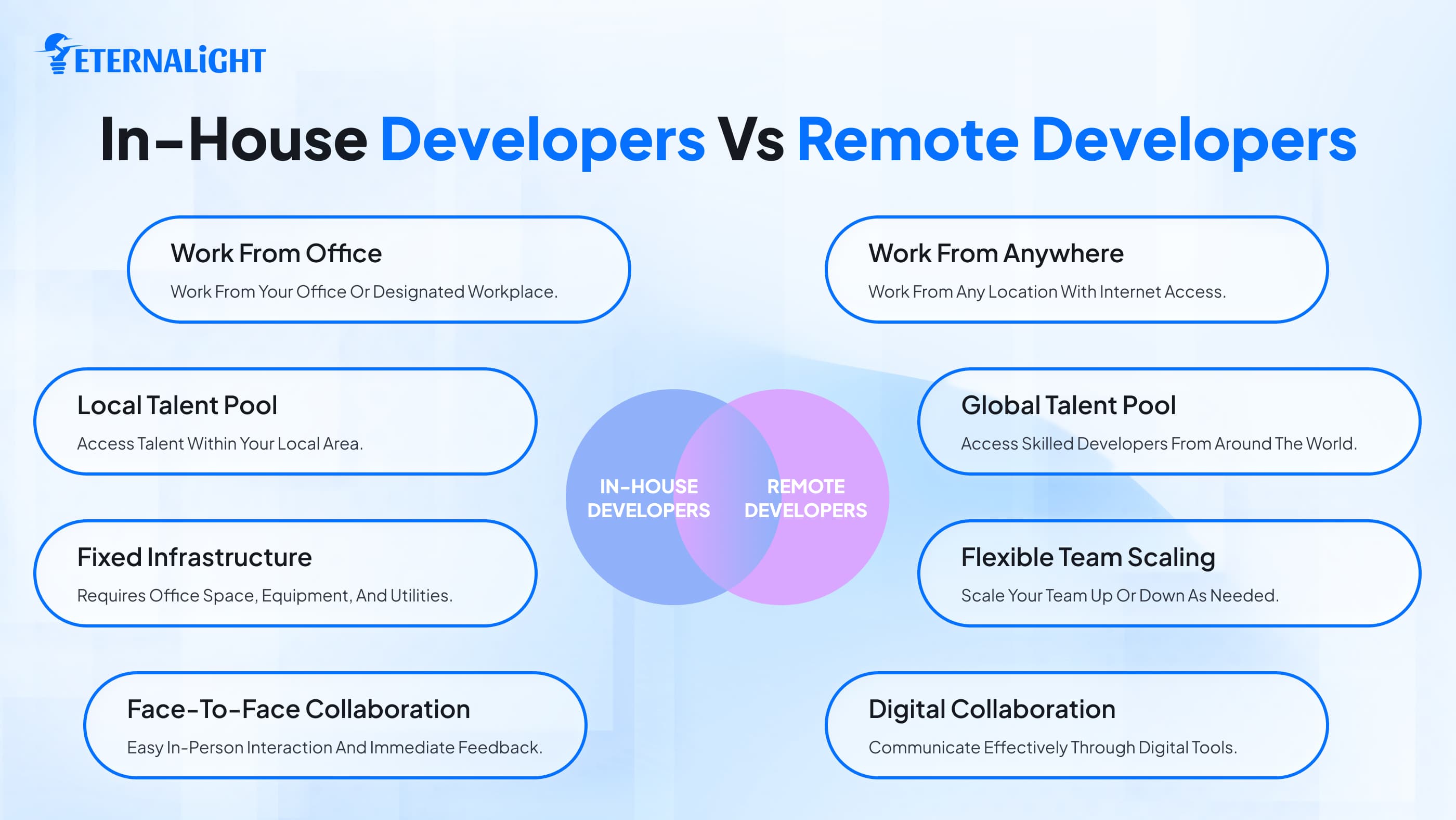
There are cases when in-house software developers as well as offshore software developers can work successfully on software projects, although the ways of hiring them as well as managing them are different. This is something you should be aware of.
Factor | In-house Developers | Remote Developers |
Location | Work from your office or designated workplace | Work from different locations |
Talent Pool | Usually limited by location | Access to talent globally |
Hiring Time | Can take longer due to local recruitment | Often faster with access to wider talent |
Infrastructure | Requires office space and equipment | Lower infrastructure requirements |
Team Scaling | Can be slower and more resource-intensive | Easier to scale based on project needs |
Operating Costs | Includes salaries, benefits, office, and other overheads | Costs depend on engagement and project requirements |
Flexibility | Generally follows fixed employment arrangements | More flexible engagement options |
Communication | Easier face-to-face interaction | Relies mainly on digital collaboration |
Specialized Skills | May require additional recruitment | Easier to access niche expertise globally |
Which One Should You Choose?
In-house developers may prove to be a good option for you if you require people to join your company on a long-term basis and integrate themselves well with the rest of your organization.
On the other hand, remote developers may prove to be better suited to your requirements if you require specialized knowledge, rapid team scaling, or flexibility without the requirement of setting up an entire in-house team.
Many startup companies have been using a combination of both types of developers successfully.
Conclusion
Hiring remote developers may assist companies in reaching out to world-class professionals, scaling development teams, and delivering software products to the market in a more efficient way. Still, it is not enough just to compare their technical abilities and hourly rates in order to find the best developer.
First, identify your project requirements and select an appropriate engagement model. Secondly, pay attention to technical skills, communication abilities, experience, and self-sufficiency.
Having everything mentioned above in mind, you will be able to create a reliable remote development team for your project.

Kusum Sethiya
Software Engineer
Kusum Sethiya is a Software Engineer at Eternalight Infotech, focused on building clean and intuitive. She enjoys turning ideas into reliable applications using modern technologies like Javascript, React, Node.js , and MongoDB.
Frequently Asked Questions
Define your project requirements, required skills, budget, and timeline before you start. Then select the appropriate developers, check their technical and communicative skills, and choose the proper engagement model.
It will depend on parameters such as the level of experience of the developers, location, technology stack, the complexity of the project, team size, and engagement model. Knowing the scope of the project, you can better assess its overall cost.
A single remote developer will be enough for small projects or some specific technical requirements. A team of developers will be more relevant to large projects that involve various skills.
Focus on relevant technical skills, problem-solving, communication, time management, flexibility, and collaboration. Such skills will be especially needed in remote developers.
Communicate your expectations, set up project milestones, establish regular communication, use collaboration tools, document your requirements, and review code and performance regularly.
Related Blogs
 Software Development9 Mins
Why Choose Python for Fintech App Development?
Learn how Python helps fintech businesses build scalable, data-driven applications with powerful support for analytics, AI, APIs, and automation.
- Software Development8 Mins
Is It Time to Build Off the Self vs Custom Software for Your Business?
When should you build custom software? Learn the key signs, costs, limitations, and factors to consider before choosing custom software for your business.
- Software Development11 Mins
Website Security Checklist: What to Check Before It's Too Late
Worried about website security? Use this practical website security checklist to spot common risks and protect your website, data, and users.