Thinking of scaling a fintech app but stuck midway?
Maybe you’re making the same mistake as other founders and developers: trying to implement the wish-listed features to make your app outperform your competitors.
Building a fintech platform isn't just about adding the latest features. It also needs to comply with industry regulations, security standards, and regional requirements. Then we need to think about the core issues the fintech platform needs to solve, with secure IP and clear boundaries. Users want a reliable and robust app that they can truly trust.
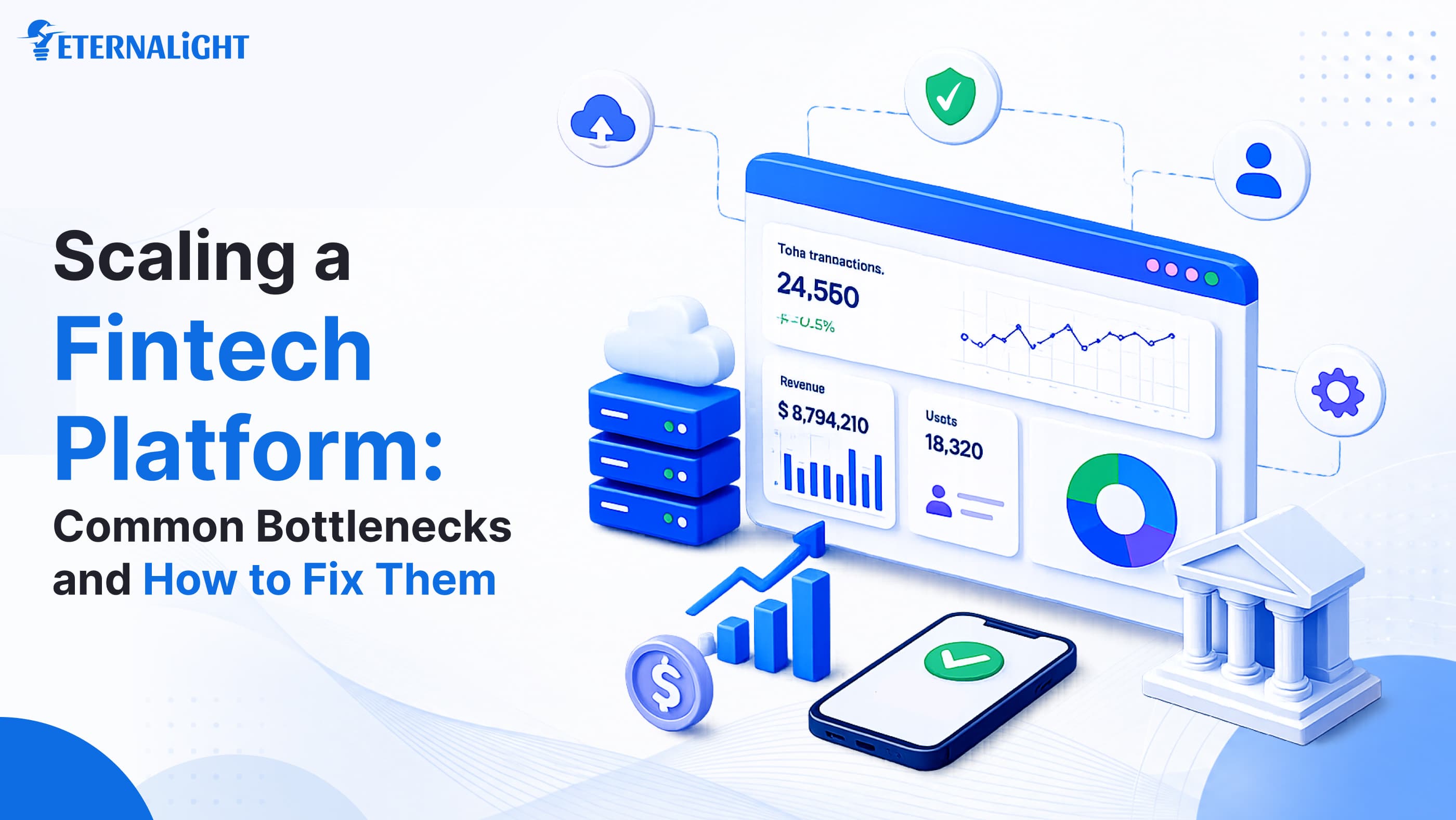
Before stepping into the development process, have a scalable architecture design strategy for your fintech platform to avoid costly mistakes later. In this blog, we'll explore the most common bottlenecks that slow fintech solutions growth and practical ways to fix them.
Why Scaling a Fintech Platform is More Challenging Than Other Applications
Scaling a fintech app and mobile platform is like solving a maze. We need to evaluate multiple factors: regulations, compliance, authentication, secure data transmission, scalable architecture design, regular audit trails, and more to verify whether the app will withstand real-life circumstances or not.
Approx 3 to 4 months are suitable for launching and validating the app idea, but if you think the sprint plan applies to scaling the fintech platform, then it's not easy. We’re not saying that it’s impossible, but sometimes the hasty move leads you to hell.
After launching the MVP, users give feedback you may have missed in the rush, and you step in to further integrate. It often shows up as serious technical glitches, bugs, errors, lag, or low performance.
Developing the full-fledged app and releasing it incrementally is different. You need to think and strategize beyond finance only. In fintech software development, you need to consider regional regulations, compliance, payment methods, other relevant integrations, and data-residency standards. This makes the app onboarding smoother and more efficient.
Schedule and allocate everything with dedicated timelines that align with your ambitions and goals. All these elements are growth and performance enablers, so don’t leave them for last. Plan everything: what integration and payment methods need to be adopted to comply with federal regulations and norms that will accelerate growth.
Fintech software development and expansion is a combination of technology, finance, and business strategy. Thus, it also requires tracking business metrics such as CAC, CLV, and customer retention to measure long-term growth.
Key Bottlenecks in Every Growing Fintech Platform Should Address

After investing months and hours day and night, it gets difficult to prevent gaps in fintech platforms, and if they aren’t fixed at the right time, they will impact traffic, compliance risk, and more.
Many founders only notice the downfall when the user count drops, the fintech app platform isn't getting much traction, or the idea isn’t the best one. But the problem is poor execution, poor planning, and skipping the foundation blocks that make the system fragile.
Rigid Infrastructure System Design
While planning the lean version of a fintech platform, developers may plan to launch faster and opt for a monolithic architecture that takes minimal time to develop, debug, and deploy for the project scope.
If you have a mindset of letting go of the future or are uncertain about what to do next, the problem appears. Because you haven’t strategized initially and developed a centralized database with shared data models.
If you make changes to one place, it will impact all other connected modules and models. In the future, when the volume increases, or new functionality is added, or similar requirements evolve, the platform will immediately go down.
How can we fix these failures:
- Define auto-scaling thresholds and create a rollback mechanism in infrastructure runbooks
- Deploy the complex, important workflows as independent modules so you can monitor deployments through version control and CI/CD pipelines and have the logic for scalability.
- Always test the architecture to ensure it can handle the load of new integrations, simulating injection and dependency failures.
Not Revamping the Compliance & KYC
Fintech is a diverse domain in itself. The days are gone when it was just an item to be added on. Now the industry domain and its dynamics have evolved so far. So what you implemented as compliance regulation during the MVP deployment may not work when the platform scales. The industry has set up a different schema, a transaction ledger to count, and a regular audit trail that will always be in action.
If compliance breaks down, the fintech software platform will face governance barriers and lead to failure.
How can we fix these failures:
- Policies shouldn't exist only as paper that can be trashed later. It's an inevitable practice where policies and rules are seriously created using frameworks.
- Agility in governance: Use verified services and tools for compliance verification and fraud detection as market dynamics keep evolving.
- Adaptive control systems with compliance layers to identify dynamic configuration events, compliance rules, and jurisdictional KYC from start to finish
Database Bottlenecks Under Heavy Transactions
Even a single transaction mismatch can affect customer trust and create financial risks. Thus, every transaction and every flow needs to be monitored by fintech systems. When the user base is limited, the domain is separated, and single operational processes are limited, it's easy to predict and manage the data.
But when the platform expands, integrating new services, multiple databases, analytical dashboards, AI-driven tools, and regional compliance standards becomes more complex.
The truth is revealed in sudden data breaches because it's very difficult to organize asynchronous data and protect it from cyberattacks.
How can we fix these data management failures:
- Eliminating cross-team ambiguities with data ownership boundaries and structured data sets or schemas. Dedicated schema for each domain where each data element is treated as a model.
- Tracking data reliability SLA metrics to detect anomalies, consumption, injections, record drops, volume spikes, and mismatched data structures
- Automating the data source and receiver contracts to identify changes in data schema and pipeline failures. Tracing all changes one by one for each modification and version update from verified improvements and integrations
Security and Compliance Add Performance Overhead
In fintech software development, every touchpoint, event, and process is a testament to trust and reliability. Thus, all the API, webhooks, and forms should be tested in a secure environment. If the system can’t notify of a failed process action, delay the alert, or report an unauthorized login, the user will stay anonymous.
When the user limit and transaction limit are set to 100, it's easy to find out, but when the system scales across regions and cross-platform users connect to third-party APIs and service partners, control slips and credentials may be exposed. 41 % of cyberattacks happen due to unverified, insecure third-party integrations.
How can we fix these failures:
- Mapping the failure events with real-time behavioral events
- Setting up the analytical tools to analyze the data insights
- Simulate real-world scenarios, identifying dependency drops, node failures, and latency
- Zero-trust architectural design: Validating and authenticating each service with secure credentials
- Single platform to monitor performance and security leakage:
- Setting up the dashboard to trace and review all technical glitches and malicious behavior
How does Eternalight Support the Growth of Fintech Software Platform?
We at Eternalight work with fintech development companies like Razorpay and SmartHeritance, which need robustness, resilience, and agility in their core operations. We build solutions with 99% uptime, creating a growth-driven blueprint to handle market chaos, sudden spikes, and evolving industry standards.
- Evaluating all the essential factors like load, traffic, regulations, and data infrastructure, architecture, and design
- Setting up the disaster recovery plan cloud ecosystem, automating the process with agile and DevOps practices like CI/ CD and containerization
- Smoothing decision-making with real-time analytical platforms to predict demand and future outlooks
- Setting up event-driven and data-driven workflows with policy as code and data as a product to secure authentic access, applying rate limiting and token methods
Conclusion
Success doesn’t lie in scaling the MVP or prototype into a final product, or in integrating the latest features and mapping innovative trends, but in staying stable, resilient, and reliable in all scenarios.
If the platform infrastructure is not flexible or scalable and you need to rework from ground zero, that's not an achievement; it's an additional burden. Whenever you're planning to build a fintech platform, you must think about how you will scale it as volume grows and more users access it.
At any moment, the data pipeline shouldn’t break; compliance and security are non-negotiable because fintech platforms grow with trust, and if it breaks, your business will be impacted. If you’re confused about transforming the MVP into a scalable fintech solution, then get connected with our fintech app development team for future expansion.

Ayushi Shrivastava
Senior Content Writer
Ayushi is a Content Strategist at Eternalight Infotech with 4 years of experience in transforming complex ideas into clear, engaging, and SEO optimized narratives. She specializes in crafting impactful content strategies that enhance brand visibility and drive meaningful engagement across digital platforms.
Related Blogs
- Software Development11 Mins
Website Security Checklist: What to Check Before It's Too Late
Worried about website security? Use this practical website security checklist to spot common risks and protect your website, data, and users.
- Software Development7 Mins
From Off Track to Success: Custom Software Development Challenges to Fix Early
Custom software projects don’t always go as planned. Learn which challenges to catch early before they become costly problems for your budget, scope, and product.
- Software Development8 Mins
Product-Market Fit vs Revenue: What Should Indian Startups Chase
Product-market fit vs revenue: What should Indian startups focus on first? Explore the right metrics, customer signals, and growth priorities at each stage.