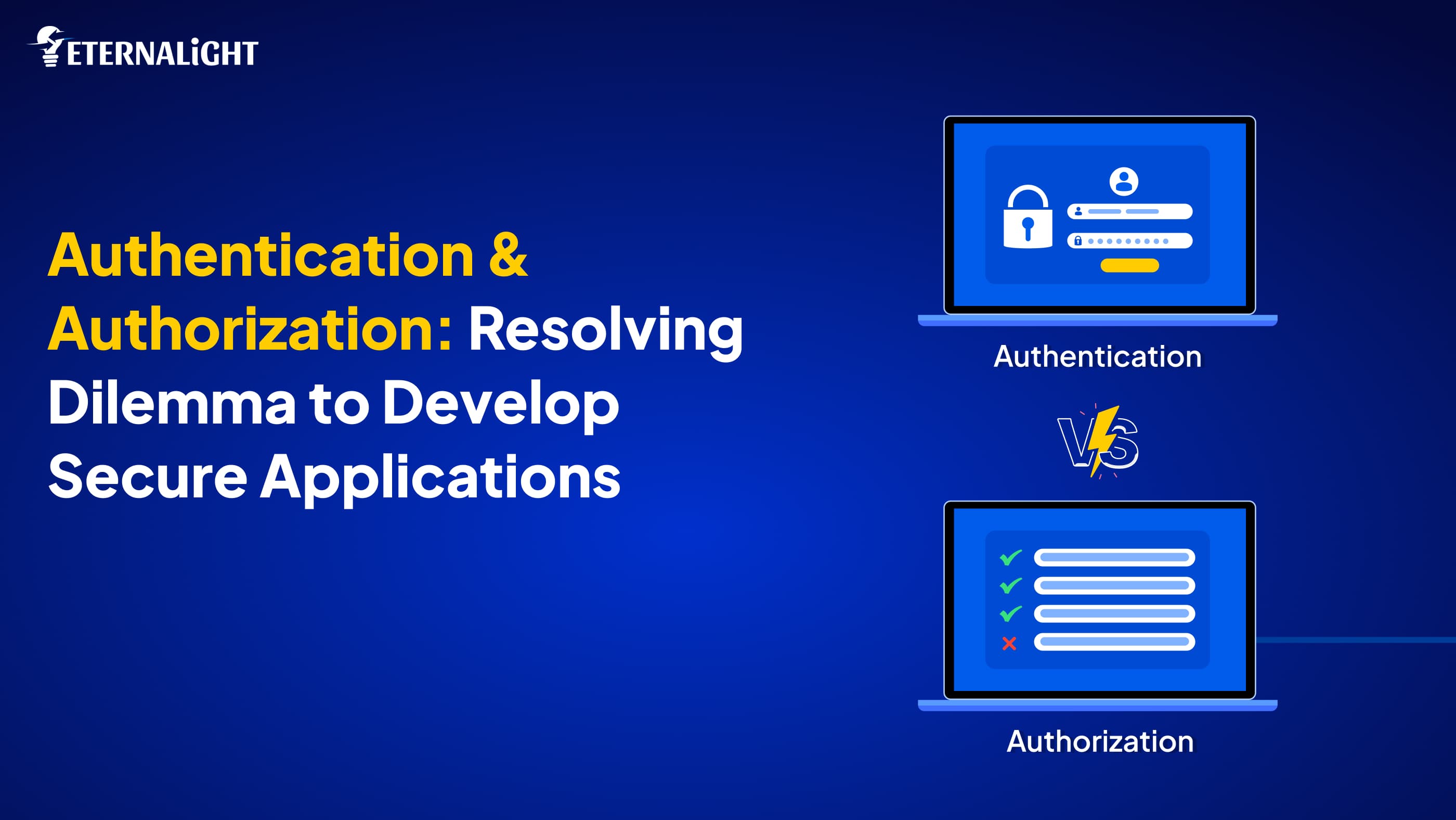
Have you ever been in a dilemma of the two standard terms: Authentication and Authorization?
How do we keep the system secure without making life difficult for our users?
It seems simple, but real-world systems tell a different story. As products grow, teams often face the same set of problems repeatedly.
In this blog, we break down the challenges of authentication and authorization, the fundamental differences between them, and what a practical, scalable solution looks like.
Explore Modern Authentication Techniques that Fit in the Real World
Initially, when accessing any application, we used usernames, passwords, and credentials. In modern application architectures, there are multiple clients. Undoubtedly, traffic and access request volumes are heavy, making it challenging to keep everything in sync, seamless, and uninterrupted. Security methods should be used. Below, we outline our modern system authentication approach at Eternalight.
1. JWT (JSON Web Tokens)
Preferable for stateless authentication today.
The server issues a signed token, and clients send it with each request.
Why teams love JWT:
- No server-side session storage
- Works perfectly across microservices
- Ideal for mobile apps
The tradeoff:
Need to put in some extra effort to revoke a JWT without first expiring it.
2. OAuth 2.0 + OpenID Connect
You may have noticed that you can log in with a particular profile, such as Google/ github/ microsoft/ apple.
Your app doesn’t handle passwords.
A trusted identity provider does.
Benefits:
- Huge security upgrade
- Smoother UX
- Less liability for your product team
3. MFA (Multi-Factor Authentication)
Combining:
- Something you know (password),
- Something you have (phone)
- Something you are (biometric)
This one upgrade blocks a massive number of attacks. If your app deals with customer data or payments, MFA is no longer optional.
4. Passwordless Login
Magic links. WebAuthn. Biometrics.
The industry is slowly moving toward a world with fewer passwords—and users absolutely love it.
Modern Authorization Approaches while Scaling Application
Authentication verifies identity, but the pattern for accessing an application is determined by authorization. Depending on complexity, behaviour, and real-world needs, the development team implements flexible, robust authorization models to simplify application access.
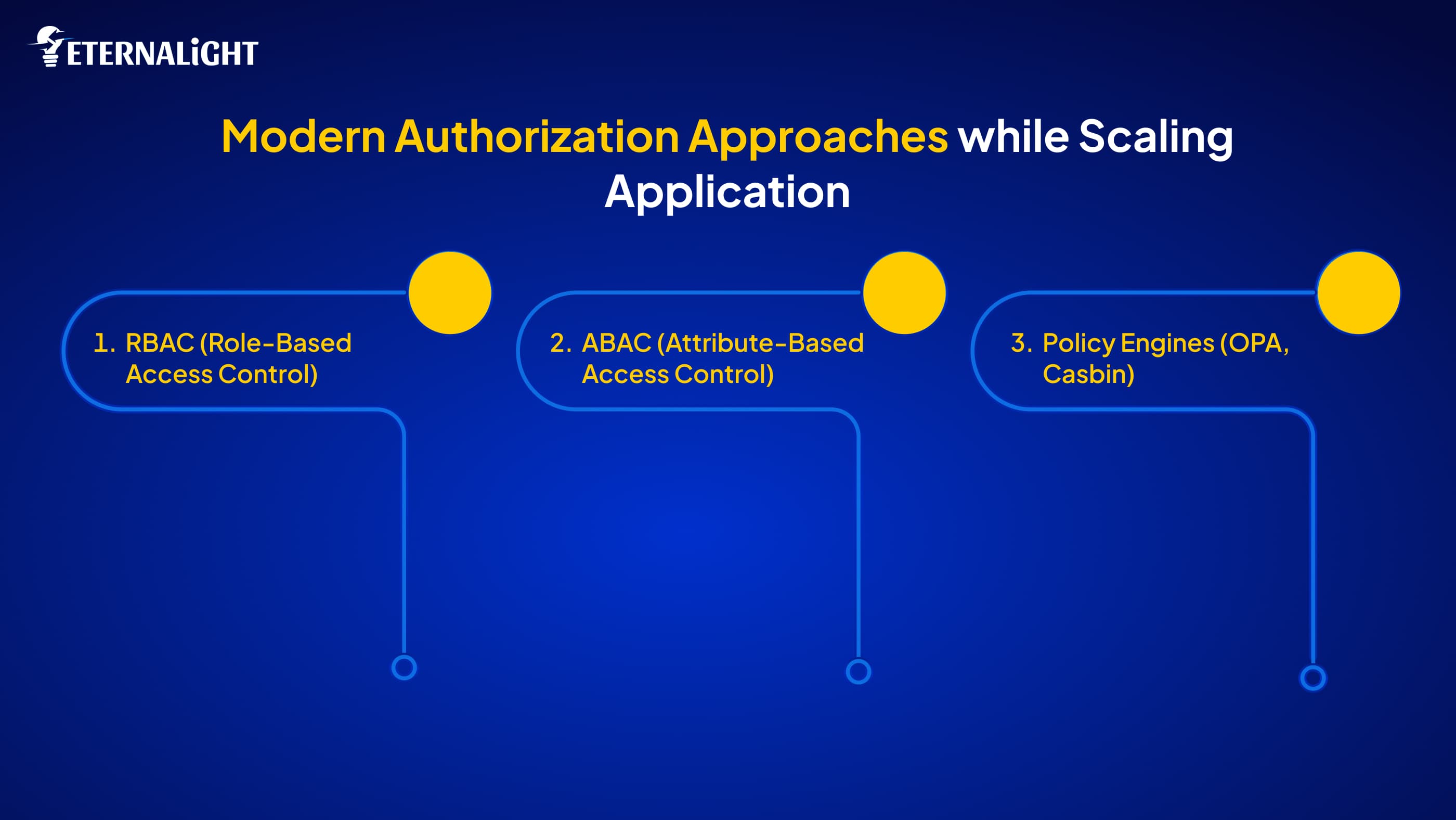
1. RBAC (Role-Based Access Control)
Simple and effective:
- Admin
- Editor
- Viewer
Map roles → permissions.
80% of applications are developed with this.
2. ABAC (Attribute-Based Access Control)
It's a strong and standard one. A rule might look like:
“Allow access if user.department == document.department AND request happens between 9 AM – 6 PM.”
Useful for:
- Enterprises
- Multi-department systems
- Compliance-heavy products
3. Policy Engines (OPA, Casbin)
Your authorization logic moves out of code into a policy file.
Why this matters:
- Easier audits
- Faster changes
- Cleaner application logic
Great for microservices and Zero Trust environments.
Best Practices From Experience to Develop a Secure Access Control System
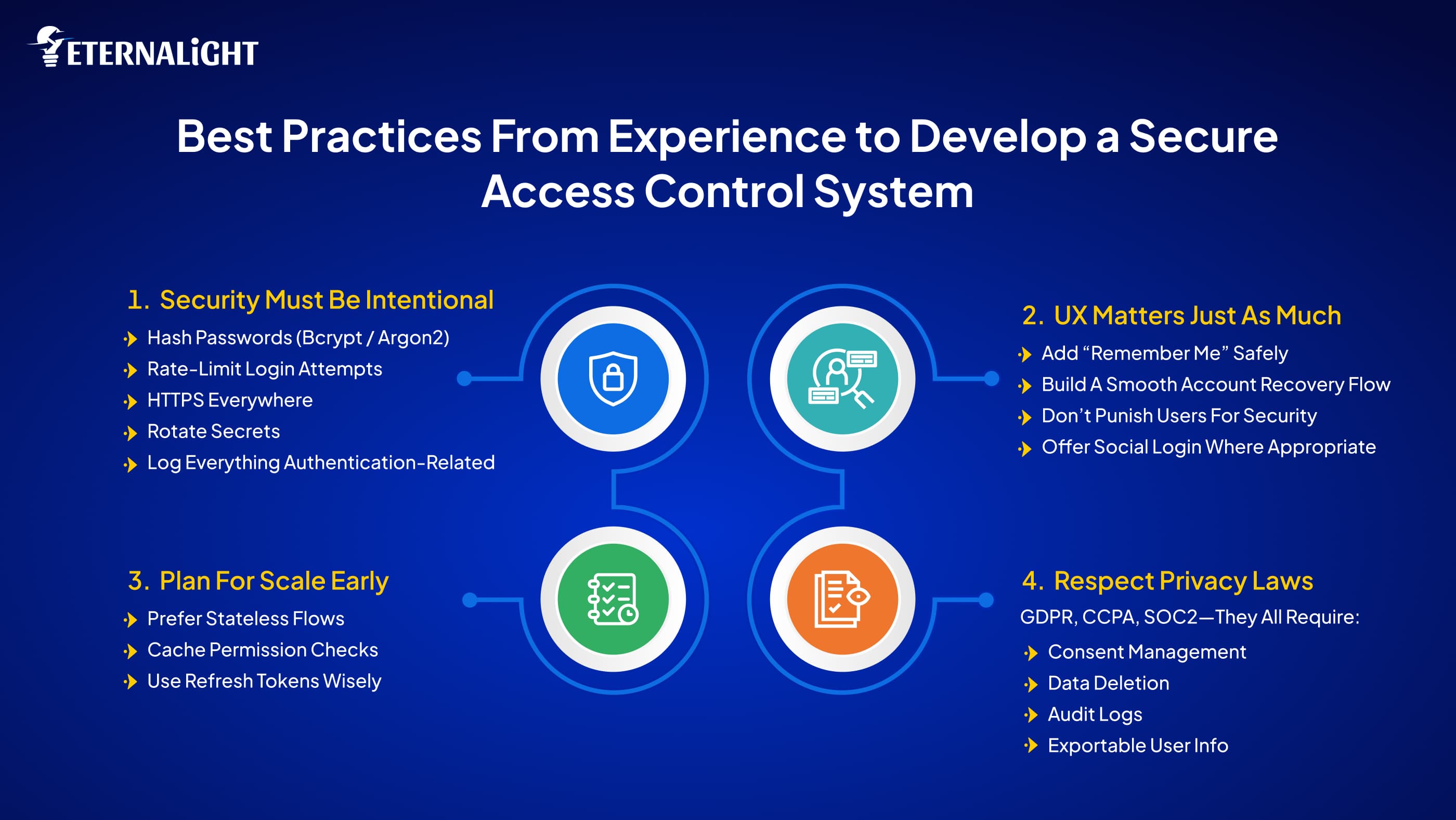
You must use tools and frameworks to implement secure access control, maintain consistency, and optimize the user experience. However, this fold outlines best practices for creating scalable authentication and authorization systems.
Security Must be Intentional
- Hash passwords (bcrypt / Argon2)
- Rate-limit login attempts
- HTTPS everywhere
- Rotate secrets
- Log everything authentication-related
UX Matters Just as Much
- Add “Remember me” safely
- Build a smooth account recovery flow
- Don’t punish users for security
- Offer social login where appropriate
Plan for Scale Early
- Prefer stateless flows
- Cache permission checks
- Use refresh tokens wisely
Respect Privacy Laws
GDPR, CCPA, SOC2—they all require:
- Consent management
- Data deletion
- Audit logs
- Exportable user info
Final Thoughts
Authentication and authorization aren’t “set it and forget it” features. As your product evolves, these systems need to grow with it.
Start simple:
- Strong password handling
- Clear token authentication
- Clean role-based permissions
As you scale:
- Move toward ABAC or policy-based models
- Introduce MFA
- Adopt centralized identity services
The goal is always the same:
Strong security, minimal friction.
Security shouldn’t feel like a burden.
Users shouldn’t even notice it when done right.
Build auth systems you’d trust with your own data because your users already do.

Shubham Rajput
Senior Software Developer
I'm a backend developer with over 5 years of experience building scalable, reliable, and performance-driven systems. Currently, I work as a Senior Software Developer at Eternalight, where I focus on backend architecture, APIs, and system optimization. I enjoy solving real-world engineering problems and simplifying complex concepts. Through my writing, I share practical backend learnings, system design insights, and experiences from my day-to-day work in the industry.
Related Blogs
 Software Development9 Mins
Why Choose Python for Fintech App Development?
Learn how Python helps fintech businesses build scalable, data-driven applications with powerful support for analytics, AI, APIs, and automation.
- Software Development8 Mins
Is It Time to Build Off the Self vs Custom Software for Your Business?
When should you build custom software? Learn the key signs, costs, limitations, and factors to consider before choosing custom software for your business.
- Software Development11 Mins
Website Security Checklist: What to Check Before It's Too Late
Worried about website security? Use this practical website security checklist to spot common risks and protect your website, data, and users.