An API today isn't just a technical integration; it's part of the business and software. The API is at the core of the microservices community and partner integrations, and it underpins mobile applications. As more products are utilized and data grows exponentially, a non-scalable API becomes an even stronger hindrance to innovation and negatively affects user experience.
So what type of API architecture is scalable?
More than just serving more requests per second. Any design that is to be scaled should allow features to be added easily, be flexible in the event of traffic build-up and new customers arriving, and be expandable with no engineering head-scratchers.
With this in mind, organizations are shifting towards loosely coupled monolithic systems. To achieve scalability, distributed architectures, or independent evolution of systems of components, are needed. This guide explores patterns and technologies that help design an API that can meet today's needs while scaling for future demands.
Principles of Scalable API Design
Before introducing advanced architectural models, it's essential to understand the core principles that give scalability its structure.
Statelessness: The Cornerstone of Horizontal Scaling
A stateless API treats every request as self-contained. Servers do not retain session-specific information between requests.
Why does this matter?
Because stateless services can scale horizontally with ease. Any server instance can process any request, enabling:
- On-demand autoscaling
- Simplified load balancing
- No dependency on shared session data
For authentication:
- Stateful systems: Store sessions on the server.
- Stateless systems: Use JWT or similar tokens so servers validate identity without querying session storage.
Benefits
- Faster scaling
- Better fault tolerance
- Easier infrastructure management
Asynchronous Communication: Decoupling and Smoothing Peaks
Not every operation should make users wait.
Examples of expensive operations:
- Video rendering
- Large report generation
- Email sending
- Notification processing
Instead of processing immediately:
- Accept the request
- Queue the workload
- Process in the background
- Return 202 Accepted
Technologies:
- RabbitMQ
- AWS SQS
- Kafka
Benefits:
- Better responsiveness
- Handles traffic spikes efficiently
- Prevents server overload
Loose Coupling: Designing for Independent Evolution
Scalable systems require services that evolve independently.
Loose coupling means:
- Communication through API contracts
- No assumptions about implementation details
- Independent deployments
- Minimal impact when one service changes
Using OpenAPI/Swagger encourages contract-first development and parallel work across engineering teams.
Architectural Patterns for Scalable APIs
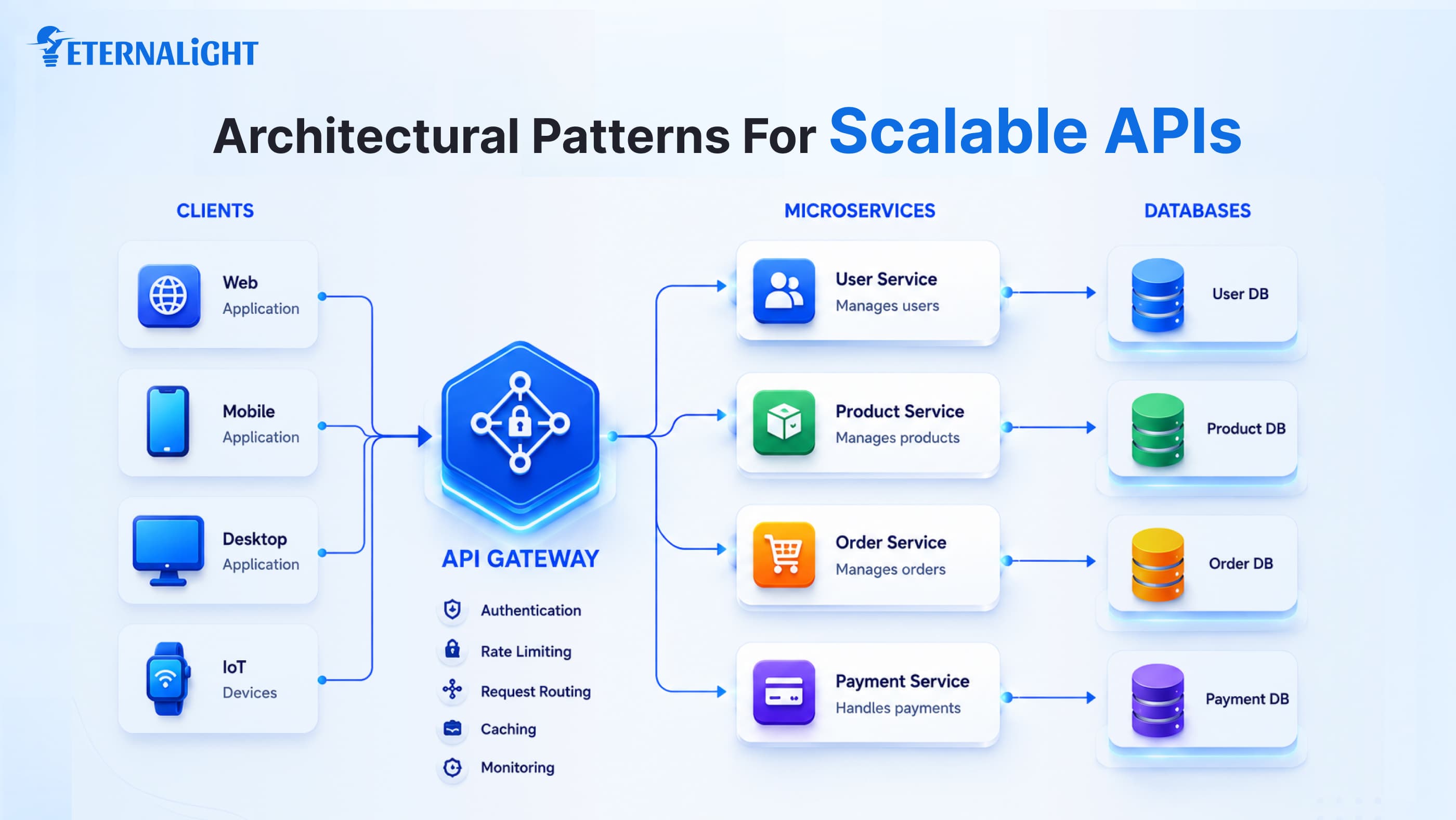
Microservices Architecture
Microservices divide applications into small services aligned with business capabilities.
Advantages
- Independent deployments
- Faster delivery
- Technology flexibility
- Better fault isolation
Challenges
- Increased operational complexity
- Distributed data management
- Requires observability
- Service coordination
Best suited for
- Large organizations
- Multiple engineering teams
- Well-defined business domains
For smaller projects, a modular monolith is often a better starting point.
API Gateway Pattern
An API Gateway acts as the single entry point for clients.
Responsibilities:
- Authentication
- Authorization
- Rate limiting
- Throttling
- Payload transformation
- Response caching
- Request routing
- Service aggregation
Benefits:
- Simplifies client applications
- Improves security
- Centralizes API management
Database Scaling Strategies
Even the best API cannot scale if the database becomes the bottleneck.
Read Replicas
Purpose:
- Offload read traffic
- Reduce load on the primary database
- Ideal for read-heavy applications.
Sharding (Horizontal Partitioning)
Split large datasets across multiple servers using a shard key.
Example: user_id
Choosing the right shard key is critical because it determines how evenly data and traffic are distributed.
Advantages:
- Higher throughput
- Better scalability
Challenges:
- Cross-shard transactions
- Data consistency
CQRS (Command Query Responsibility Segregation)
Separate:
- Read models
- Write models
Benefits:
- Independent optimization
- Better scalability
- Excellent fit for Event-Driven Architecture
REST vs GraphQL vs gRPC: Choosing the Right API Technology
Choosing the right API technology depends on your application's performance, scalability, and client needs. REST is ideal for public APIs, GraphQL offers flexible data fetching for modern frontends, and gRPC provides high-performance communication for internal microservices. Selecting the right protocol ensures better efficiency and scalability.
Protocol | Best Use Case | Characteristics |
REST | Public APIs | Stateless, HTTP-based, widely adopted |
GraphQL | Mobile & complex frontends | Flexible queries, single endpoint |
gRPC | Internal microservices | HTTP/2, binary protocol, high performance |
Choose based on:
- Performance requirements
- Client flexibility
- Internal vs external APIs
Choose the API according to your system architecture design, as each fits differently. So, if we are picking for public APIs, then it’s REST; if it's mainly about communication and performance, then GraphQL is best in terms of frontend system design. To get more high speed, choose gRPC.
API Caching Strategies
Caching improves API performance by reducing latency and server load. Using browser caches, CDNs, and in-memory caches like Redis helps deliver faster responses, while proper cache invalidation ensures data stays fresh and consistent.
Common caching layers:
- Browser Cache (Cache-Control, ETag)
- CDN
- In-memory cache
- Redis
- Memcached
The hardest challenge isn't caching—it is cache invalidation.
Common strategies:
- TTL expiration
- Event-driven invalidation
Containerization & Orchestration
Containerization and orchestration simplify application deployment, improve scalability, and ensure consistency across environments. Tools like Docker package applications into portable containers, while Kubernetes automates deployment, scaling, load balancing, and self-healing.
Docker
Provides:
- Environment consistency
- Application isolation
- Easy deployment
Kubernetes
Provides:
- Horizontal Pod Autoscaling
- Self-healing
- Service discovery
- Traffic balancing
Together they enable reliable and elastic API deployments.
Operational Best Practices for Scalable APIs
Operational excellence ensures APIs remain reliable, secure, and performant in production. It involves monitoring system health, managing traffic, preventing failures, and maintaining high availability through observability and resilience patterns.
Rate Limiting & Throttling
Protect APIs against:
- DDoS attacks
- Buggy clients
- Traffic spikes
Benefits:
- Fair resource usage
- System stability
The Three Pillars of Observability
Observability provides deep visibility into the health and behavior of distributed systems. By collecting metrics, logs, and traces, teams can quickly detect issues, troubleshoot failures, and optimize application performance.
Metrics
Examples:
- Prometheus
- Grafana
Monitor:
- CPU
- Memory
- Latency
- Error rate
Logs
Examples:
- ELK Stack
Provide:
- Event history
- Debugging information
Traces
Examples:
- Jaeger
- Zipkin
Provide:
- End-to-end request visibility
- Performance bottleneck detection
Without observability, scaling becomes guesswork.
Circuit Breaker Pattern
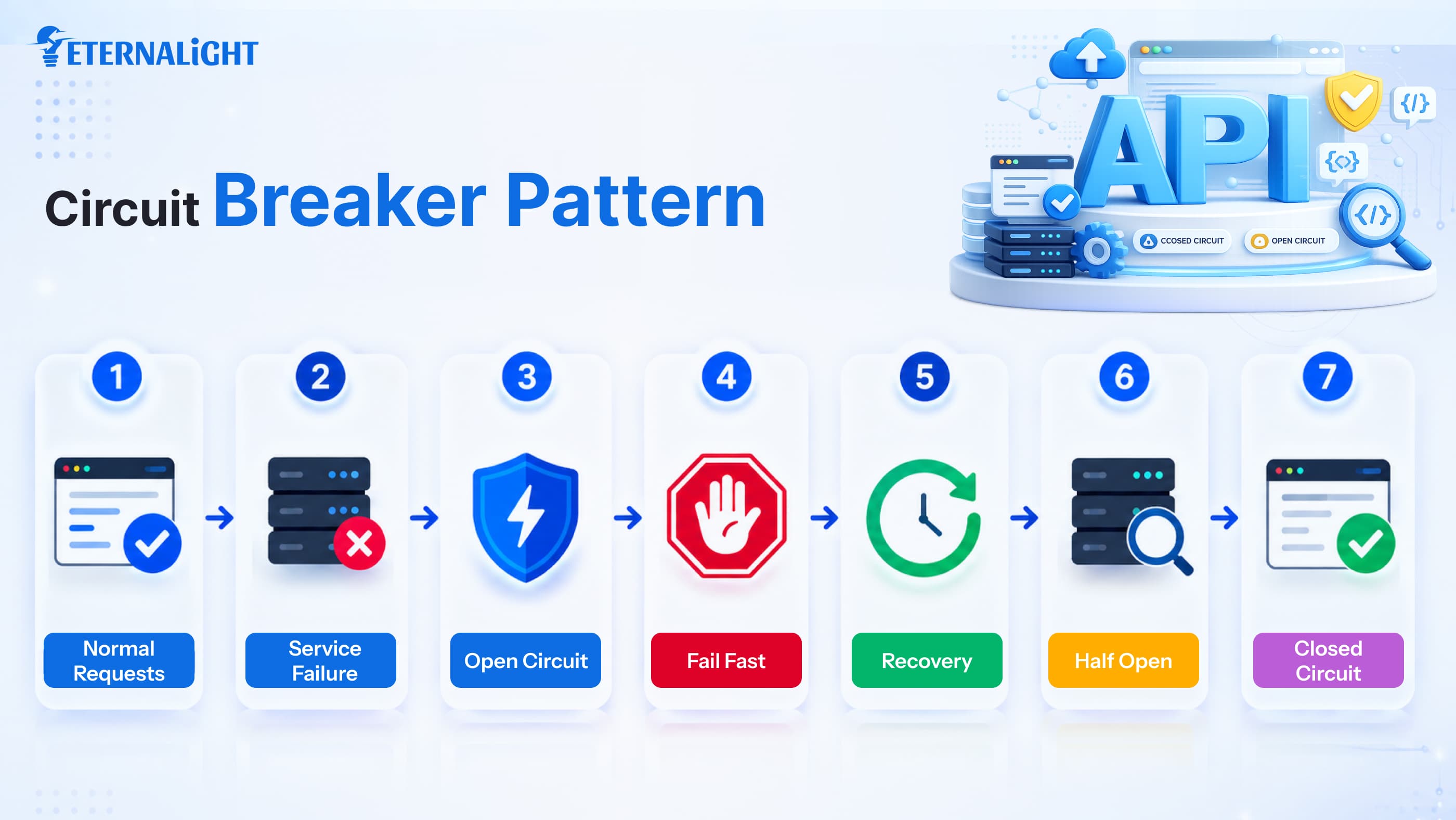
The Circuit Breaker pattern improves system resilience by preventing repeated requests to failing services. It detects failures, temporarily blocks requests, and automatically retries when the service recovers, helping avoid cascading failures and improve system stability.
Prevents cascading failures
Flow:
Failures exceed threshold
↓
Open Circuit
↓
Fail Fast
↓
Timeout
↓
Half Open
↓
If Success
↓
Closed Circuit
Benefits:
- Prevents repeated failures
- Protects downstream systems
- Improves resilience
APIs are a common target of cyberattackers; if they break down, the entire system can break down. So security isn’t the last step just before deployment; it should be planned from the first stage. Our developers at Eternalize prioritize building robust applications that blend traditional and modern authentication & authorization practices to prevent AI security threats and keep data secure and user privacy protected.
How to Secure Scalable APIs
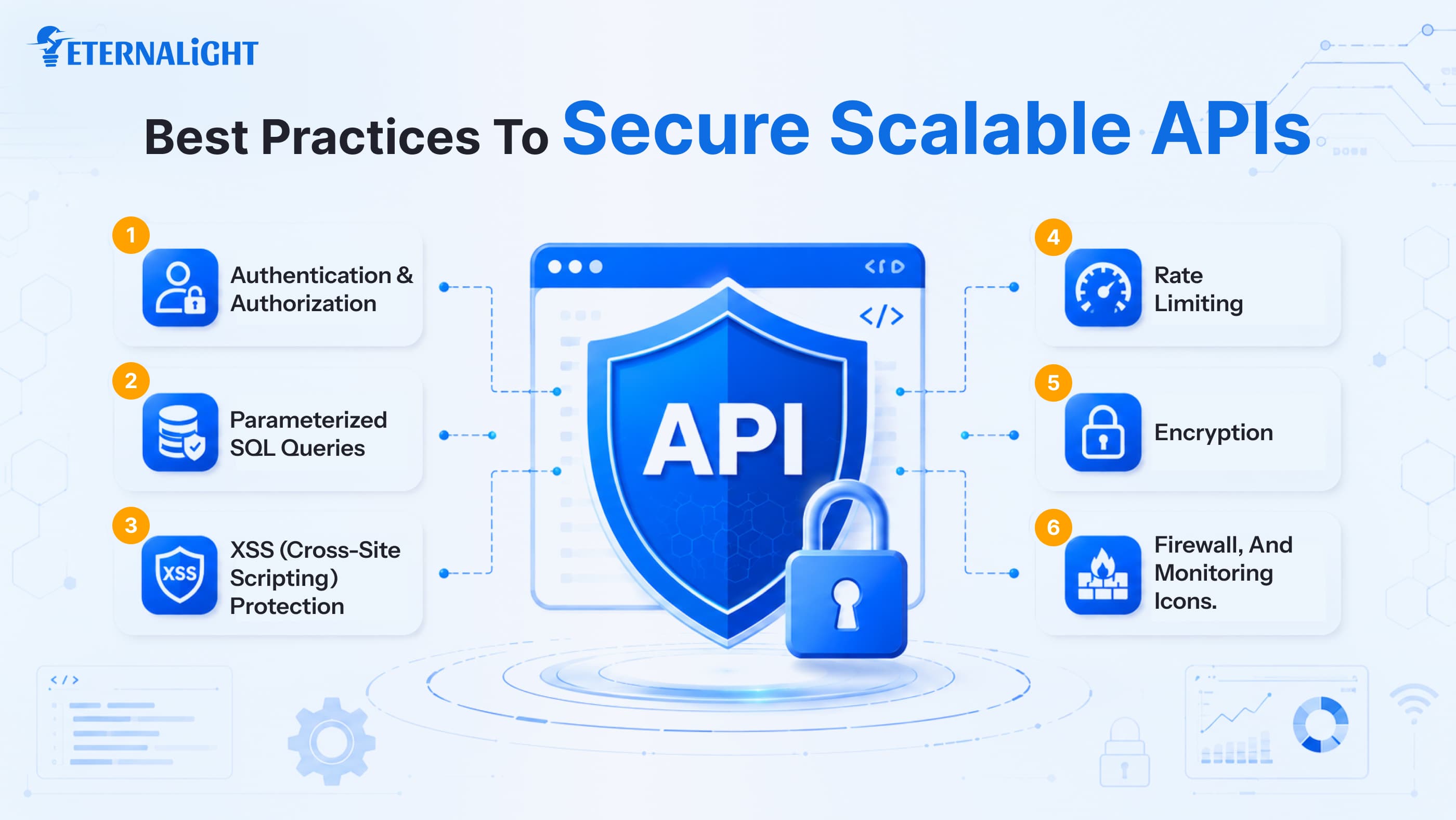
API security protects applications and data from unauthorized access, attacks, and misuse. By implementing strong authentication & authorization, encryption, and security best practices, APIs can remain secure while maintaining performance and reliability.
Authentication & Authorization
Common approaches:
- OAuth 2.0
- OpenID Connect
- JWT
- API Keys
- Mutual TLS (mTLS)
Security Best Practices
1. Input Validation
Purpose: Ensures user input is valid before processing.
Goal: Prevent invalid or malicious data from entering the application.
Example: Rejecting an age of -5 or an email like abc@.
Best Practice: Validate on both the client side and server side.
2. Parameterized SQL Queries
Purpose: Prevents SQL Injection attacks by separating SQL code from user input.
Goal: Treat user input as data, not executable SQL.
Example:
String sql = "SELECT * FROM users WHERE email = ?";
PreparedStatement ps = connection.prepareStatement(sql);
ps.setString(1, email);
Instead of:
"SELECT * FROM users WHERE email = '" + email + "'";
3. XSS (Cross-Site Scripting) Protection
Purpose: Prevents attackers from injecting malicious JavaScript into web pages.
Goal: Protect users from script execution in their browsers.Example: If a user enters:
<script>alert('Hacked')</script>
the application should display it as plain text rather than executing it.
Common Techniques: Output encoding, input sanitization, Content Security Policy (CSP).
4. Rate Limiting
Purpose: Restricts how many requests a client can make in a given time.
Goal: Prevent abuse, brute-force attacks, and denial-of-service (DoS).
Example: Allowing only 100 API requests per minute per user or IP.
Common Algorithms: Token Bucket, Leaky Bucket, Fixed Window.
5. TLS 1.3+
Purpose: Encrypts data while it travels between the client and server.
Goal: Prevent eavesdropping, tampering, and man-in-the-middle attacks.
Example: HTTPS websites use TLS to secure login credentials and payment information.
Benefit: TLS 1.3 is faster and more secure than older TLS versions.
6. Encryption at Rest
Purpose: Encrypts data stored on disks, databases, or backups.
Goal: Protect sensitive data if storage devices are stolen or compromised.
Example: Encrypting customer passwords, bank details, or documents stored in a database or AWS S3 bucket.
Common Algorithms: AES-256.
API Security Tools We Prefer at Eternalight
1. API Gateway with WAF (Web Application Firewall)
Purpose: Secure and manage all incoming API requests through a single entry point.
Goal: Block malicious traffic before it reaches backend services.
Example: An API Gateway routes requests to microservices, while the WAF blocks SQL Injection, XSS, and malicious IPs.
Popular Tools: AWS API Gateway + AWS WAF, Kong, NGINX.
2. API Discovery Tools
Purpose: Identify and inventory all APIs in an organization, including undocumented or "shadow" APIs.
Goal: Ensure every API is known, monitored, and secured.
Example: Detecting an old public API that developers forgot to remove after a project ended.
Popular Tools: Noname Security, Salt Security, Akamai API Discovery.
3. Runtime Protection
Purpose: Continuously monitor applications while they are running and stop attacks in real time.
Goal: Detect and block exploits that bypass traditional security measures.
Example: Preventing a remote code execution (RCE) attack even after the application has been deployed.
Popular Technologies: RASP (Runtime Application Self-Protection), Falco, CrowdStrike.
4. Secrets Management
Purpose: Securely store and manage sensitive credentials such as passwords, API keys, tokens, and certificates.
Goal: Avoid hardcoding secrets in source code or configuration files.
Example: Instead of storing a database password in application.properties, the application retrieves it from a Secrets Manager at runtime.
Popular Tools: HashiCorp Vault, AWS Secrets Manager, Azure Key Vault, Google Secret Manager.
How AI is Transforming API Development
AI-powered APIs leverage artificial intelligence to automate development, enhance security, and optimize performance. They enable smarter applications through capabilities such as code generation, intelligent testing, anomaly detection, and automated threat response.
Artificial Intelligence has transformed the way we build, inspect, and troubleshoot. Nowadays, developers use Claude Code, Cursor, and tools to build applications, prepare documentation, and detect bugs and inconsistent code. Furthermore. It has reduced the time and effort to optimize API quality.
This doesn’t mean traditional practices aren't applicable, but AI and automated tools like Cypress can efficiently detect anomalies and issues.
AI-Enhanced Development
AI can assist with:
- Code generation
- API documentation
- Automated testing
- Performance optimization
AI-Enhanced Security
AI enables:
- Anomaly detection
- Automated threat response
- Behavioral authentication
- API discovery
API Testing Strategies for Reliable APIs
API testing ensures that APIs function correctly, perform efficiently, and remain secure under different conditions. By validating functionality, performance, security, and compatibility, testing helps deliver reliable and high-quality APIs.
Types of Testing
We plan the scalable architecture and API functionality by keeping future scope and functionality extension in mind, so you have the buffer time to test the APIs
Without testing the API, there’s no way to assess whether it will function well in the real world; how will you evaluate that?
Planning regular API testing sessions helps you identify potential vulnerabilities and technical glitches, rectify issues, and avoid system compatibility concerns.
1. Unit Testing
Purpose: Tests a single unit of code (usually a method or function) in isolation.
Goal: Verify that individual components work correctly.
Performed by: Developers.
Example: Testing a calculateTotal() method to ensure it returns the correct amount for different inputs.
Popular Tools: JUnit, Mockito, NUnit.
2. Integration Testing
Purpose: Tests how multiple components or services work together.
Goal: Ensure data flows correctly between integrated modules.
Performed by: Developers or QA engineers.
Example: Verifying that the User Service correctly saves user information into the PostgreSQL database.
Popular Tools: Spring Boot Test, Testcontainers, Postman.
3. Performance Testing
Purpose: Measures how the application performs under different workloads.
Goal: Identify bottlenecks and ensure the system meets performance requirements.
Checks: Response time, throughput, scalability, and resource usage.
Example: Simulating 10,000 concurrent users accessing an API.
Popular Tools: JMeter, Gatling, k6.
4. Security Testing
Purpose: Identifies vulnerabilities and ensures the application is protected against attacks.
Goal: Verify confidentiality, integrity, and authentication/authorization mechanisms.
Checks: SQL Injection, XSS, CSRF, broken authentication, insecure APIs.
Example: Testing whether a user can access another user's data without authorization.
Popular Tools: OWASP ZAP, Burp Suite, Snyk.
5. Contract Testing
Purpose: Ensures that services (especially in microservices) follow the agreed API contract.
Goal: Detecting breaking API changes before deployment.
Performed between: API providers and API consumers.
Example: If the User Service promises to return {id, name, email}, contract testing verifies that the response structure doesn't unexpectedly change.
Popular Tools: Pact, Spring Cloud Contract.
Popular Testing Tools
API testing tools help developers validate functionality, performance, security, and reliability throughout the development lifecycle. They simplify testing, automate workflows, and ensure APIs meet quality and performance standards.
- Postman
- Insomnia
- Karate DSL
- Apache JMeter
- OWASP ZAP
The Evolving Blueprint for Scalability
Building scalable APIs is an ongoing process that combines the right architectural principles, technologies, and operational practices. By adopting modern patterns and continuously evolving with new technologies, organizations can create APIs that are reliable, resilient, and ready for future growth.
Successful scalable architectures rely on:
- Stateless services
- Asynchronous processing
- Microservices
- API Gateways
- Smart data distribution
- Operational excellence
Emerging trends:
- Serverless APIs
- Service Mesh
- Edge APIs
- GraphQL Federation
- WebAssembly
Technology will evolve, but the architectural principles remain constant.
Conclusion
Developing an API that scales must be constantly kept in mind before the present is realized, and requirements are designed for future growth. The concepts of statelessness, asynchronous communication, and loose coupling are the foundation, and more recent architectural patterns such as microservices and API gateways drive systems to scalable efficiency.
It's not just about making the best website work well with more users; it's about helping organizations experiment at speed, deploy themselves, and offer their users the best possible experience as they expand.

Tarun Kumar
Software Engineer
2 Years Of Experience| Backend Developer with expertise in Go, Java, Spring Boot, Node.js, C++ | AI-driven software development & scalable systems
Frequently Asked Questions
A scalable API can handle increasing traffic, users, and data without significant performance degradation. Key principles include statelessness, asynchronous processing, caching, horizontal scaling, efficient database design, and observability.
Start with a modular monolith if your application is small or your team is limited. Move to microservices when you have multiple teams, independent business domains, and a need for independent deployments and scaling.
An API Gateway acts as a single entry point for clients, handling authentication, authorization, rate limiting, routing, caching, and request aggregation. This reduces complexity in backend services while improving performance and security.
REST: Best for public APIs and broad compatibility. GraphQL: Ideal for mobile apps and complex frontends requiring flexible data fetching. gRPC: Best for high-performance communication between internal microservices. The choice depends on performance needs and client requirements.
The most common challenges include database bottlenecks, cache invalidation, distributed system complexity, service failures, traffic spikes, and maintaining observability. These can be addressed using caching, read replicas, sharding, circuit breakers, rate limiting, monitoring, and resilient architecture patterns.
Related Blogs
- Software Development11 Mins
Website Security Checklist: What to Check Before It's Too Late
Worried about website security? Use this practical website security checklist to spot common risks and protect your website, data, and users.
- Software Development7 Mins
From Off Track to Success: Custom Software Development Challenges to Fix Early
Custom software projects don’t always go as planned. Learn which challenges to catch early before they become costly problems for your budget, scope, and product.
- Software Development8 Mins
Product-Market Fit vs Revenue: What Should Indian Startups Chase
Product-market fit vs revenue: What should Indian startups focus on first? Explore the right metrics, customer signals, and growth priorities at each stage.