Suppose you have a concept that sounds brilliant, but are you sure end users will adopt it and it will make a lasting impression?
Is it feasible and aligned with the user requirements and market dynamics?
Are you done with the research or discovery phase, or is it still in progress?
Before you put all your energy, time, and development resources into a project, it's better to validate all your intentions and assumptions; otherwise, you will have to battle with risks. To move from an idea to a digital product, the software development industry follows a proof-of-concept approach. This blog covers the backstage story behind AI proof of concept product development in detail.
What is an AI Proof of Concept in Software Development?
Building an AI PoC is not like you’re walking in the park. The two initial drivers shift to capabilities, integration, infrastructure, etc.
In the first instance, the idea in your mind seems simple because you noticed a problem and then thought about the solution and ways to resolve it. But you’re still confused about the approach and its impact on your business and user base.
If you assume the idea works and is feasible, you can turn it into a mini product, but it won't be successful or drive returns until you launch it in the real world.
A POC actually helps business owners and startup founders to check whether their decision is right or needs an intense audit and evaluation.
If the intent isn't clear or if the answers to the questions below are false. then it's better not to move into the production phase.
- Do you have accurate, sufficient datasets to support decision-making? The AI product development process doesn’t move forward.
- Is your AI-driven product efficient at executing the given task?
- Who will adopt this product frequently?
- Everyone is adopting AI to make product development faster and more realistic, but it doesn't guarantee success. Determine whether your PoC delivers real, profitable outcomes.
How an AI PoC Differs From an MVP
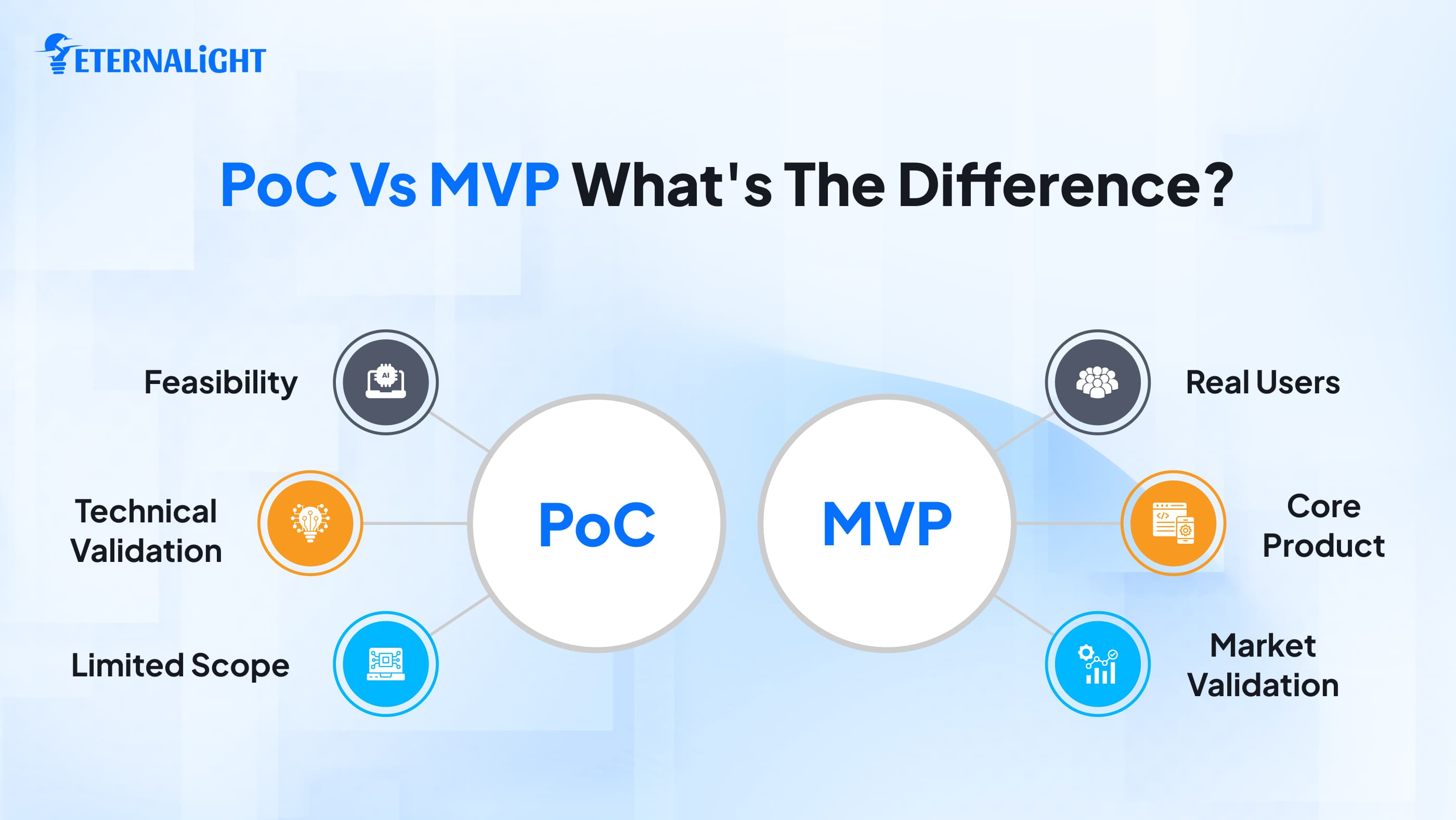
Don’t confuse PoC and MVP; they are distinct. In a PoC, founders validate whether the idea is feasible and whether the real world will adopt it or ignore it. In an MVP approach, founders validate the idea's functionality as a lean product.
Swapping them can change the thinking and outcome, although both are worth it to reduce financial and tech debt, make the right decision, and operate the business confidently.
Not all the ideas or products are developed utilizing the same tech stack depending on their technical and non-technical requirements and domain-specific scenarios; CTOs need to assess the feasibility ratio.
POC takes less time than an MVP, as we just need to validate the intent and the infrastructure, integrations, third-party tools, and emerging technologies and trends.
Our minds don’t stop; thoughts keep coming, but only a few are drawn on paper and then moved into production. Not all ideas drive business growth; we need to choose the concept with the least risk and ambiguity.
In traditional POCs, we test whether the idea is true or false. It may work or it may not. In an AI POC, we have to validate accuracy, efficiency, latency, and data quality.
AI systems act by analyzing behavior, data quality, and different types of inputs; sometimes they can generate the output faster, but sometimes they can take a little longer.
Key Types of Proof of Concept in Software Development
The first thing a founder should determine is the type of PoC: is it totally technical, non-technical, a business-oriented mix of both, or AI-driven? Differentiating this reduces the risk.
Technical PoC:
This approach tests the feasibility, efficiency, and accuracy of written code, integrations, and cloud-native solutions, using agile and DevOps practices while modernizing systems.
Business PoC:
This type of PoC tests the specific product to gauge response and current demand, whether it meets business goals, and whether it's worth pursuing to deliver financial outcomes.
Functional Design PoC:
When we think about the idea, there’s always an intent behind that ideation. This type of PoC tests workflows and potential outcomes, laying out the logic and design.
How to Build an AI Proof of Concept: 7-Step Process
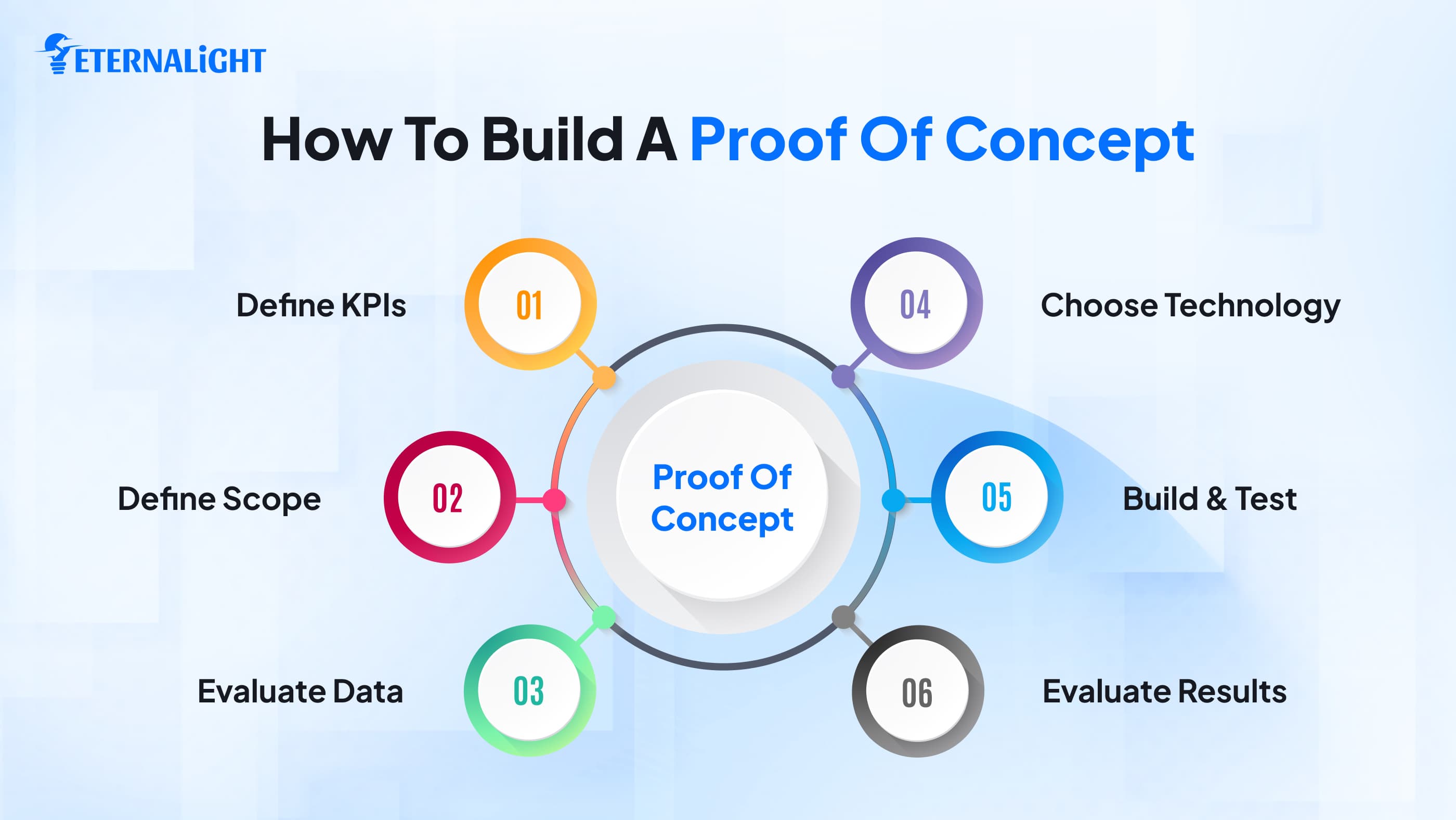
Building an AI-driven proof of concept is a smart way to launch the product confidently. During the PoC, we can identify pros and cons and avoid costly missteps later. We're all excited to build something innovative, but before jumping into production or allocating the full budget and resources, it's better to think through every small detail.
Determine the KPIs
To measure a product's performance, you need performance indicators that signal growth.
- Can it manage the volume if traffic spikes or requests multiply
- Is the product accurate by 90% or not
- Is it fit for the intent it is going to launch
You can add more KPIs based on your product domain. If you're unsure about anything, get clarity first, then move forward.
Scope Definition and Expansion
You have an idea; a use case verifies it and clarifies the scope. Now you can expand the functionality and test it for another use case. If you notice positive outcomes, you can proceed with building blocks.
Criteria for Success Acceptance
Set rules for every KPI test pass, including latency, accuracy, speed, cost, time for queries, and user experience.
Evaluate Data Before Starting PoC
Without structured, organized data, we can’t guarantee the PoC will succeed. You must evaluate data quality, accuracy, and modality to fit the PoC environment and validate all assumptions.
Choose the Right Production Tool
When choosing a tool, it must be reliable and robust, whether it's a low-code/no-code software platform, infrastructure, AI integration, or cloud-native architecture. This ensures PoC development can proceed smoothly for every use case, supporting pipelines, IP, and other dev needs.
Build PoC with IaC
If the PoC environment is coded, it will be easier to fix mistakes and make changes. If this PoC product performs well, it can scale further without wasting time and effort on technical audits or replication; it will also be reliable and shareable.
While doing this, confirm whether the technical KPIs align with the business metrics and goals.
AI Security Compliance
Implement AI governance and compliance rules from the beginning to give least privilege and access controls over tools and data. Do this before the first task, prompt, or resource is provided to the product.
Benefits of Building a PoC
A successful PoC gives the idea credibility, enabling the business to move forward, reduce uncertainty, and avoid potential nightmares. Like an MVP, it isn't launched to users; it helps founders confirm whether the idea is worth building or should be rethought.
Here, the main goal is to assess the capabilities, potential crucial factors, and financial gains and losses. The following are the plus points of building the PoC:
Rapid Risk Identification
When building any product, many technical and financial concerns can arise, and they need attention to prevent errors during final development or after release. A PoC helps optimize the timeline and maintain flow by tackling problems in advance.
Better Product Planning
Before developing the first version of the product for real users, we need to test whether the architecture, design, and functionality are sufficient and align with system and product requirements.
Data-driven Decision-Making
During the PoC project, we can test our assumptions and potential risks, restructure the plan, and take more time to make a final decision before moving into the design or coding phase.
Structured and Controlled Budget Planning
A PoC teaches us how to balance the budget by identifying where our money is going and whether we are spending it on the right tools and resources for a feasible idea.
Common AI-PoC Mistakes that Startups Should Avoid
One wrong move can drain effort and time, increase tech debt, and hurt competitiveness and project credibility. If you repeat the same mistakes most startup founders make, it will affect your future partnerships and growth.
Ignoring Users' Feedback Leads to Failure
You test the assumption with a PoC, find the idea doesn't meet the KPIs, and still move forward by adding new functionality, expanding the scope, and turning it into the MVP; chances are users will not adopt it.
Assuming Technical Success = Product Success
Your assumption reflects exactly the way you want it to look, but it doesn’t mean you will get applause. A successful PoC doesn't mean you should scale the product immediately; first, test it with your team and a few users.
PoC is Not the End Goal
You don't need to put all functionalities together or design practices first; focus on feasibility and aligning the intent. It will take time to analyze and validate whether you’re on the right path. Split product development into small milestones, then move forward.
Starting Without a Clear Approach
Don’t build an idea in a hurry; first identify the market dynamics and problem, then start working on your idea to prove your assumptions and instincts.
Limit Your Innovation
You’re just experimenting with the new idea to evaluate the financial and feasibility aspects; launch is too far off now. Build it so users are curious, but don’t let all your efforts drain in the PoC phase.
What Happens After an AI-PoC?
Once you validate your instincts, you'll know whether building this idea is the right move.
If it is, you can move forward, using feedback from market buyers to build the product they actually want.
If you are still uncertain and didn’t get a positive response, no need to spend much on integration, functional resources, and tools, increase your financial debt, and reduce your competitiveness. Ignoring the feedback will lead to technical glitches and delay the product's final release.
You can take your time to strategize and save your idea from being ditched by real users by building the ideal PoC.
Wrap Up
Diving into AI development without any certainty about whether the product is reliable or feasible is a common mistake. When founders take the first step as an AI Proof of Concept, it helps them reduce the risk factor before making any promises. It's a product before the prototype phase to test if its market requirements are aligned and whether you should take it to production and launch as a lean version or not. If anything doesn’t match the intent and it's not serving any value in the future, then rethink. Instead of building anything on assumptions, it's better to validate the concept and its feasibility.

Ayushi Shrivastava
Senior Content Writer
Ayushi is a Content Strategist at Eternalight Infotech with 4 years of experience in transforming complex ideas into clear, engaging, and SEO optimized narratives. She specializes in crafting impactful content strategies that enhance brand visibility and drive meaningful engagement across digital platforms.
Related Blogs
- AI & ML10 Mins
AI Data Security Strategies: 8 Ways to Protect Data in AI Systems
Explore 8 AI data security strategies to protect sensitive data across prompts, AI models, RAG systems, APIs, access controls, storage, and outputs.
 AI & ML17 Mins
AI-Ready Data Architecture: A Complete Guide for Modern AI
Learn how AI-ready data architecture works, its key components, framework, how to build it, and how it supports generative AI, machine learning, and AI agents.
 AI & ML16 Mins
LangChain vs LangGraph: Which Fits Your AI Agent Workflows?
Compare LangChain vs LangGraph to understand their key differences, use cases, and how each framework fits modern AI agent workflows.