&w=3840&q=75)
When people compare Next.js and ReactJS app development, they often focus on features such as: routing, rendering methods, performance, SEO, etc. But the real difference isn’t just about the UI. It’s about infrastructure.
ReactJS is a library. Next.js is a cloud-native development framework.
And that distinction changes everything from how you deploy to how you scale to how much your business spends on operations.
Why is Next.js Better than ReactS?
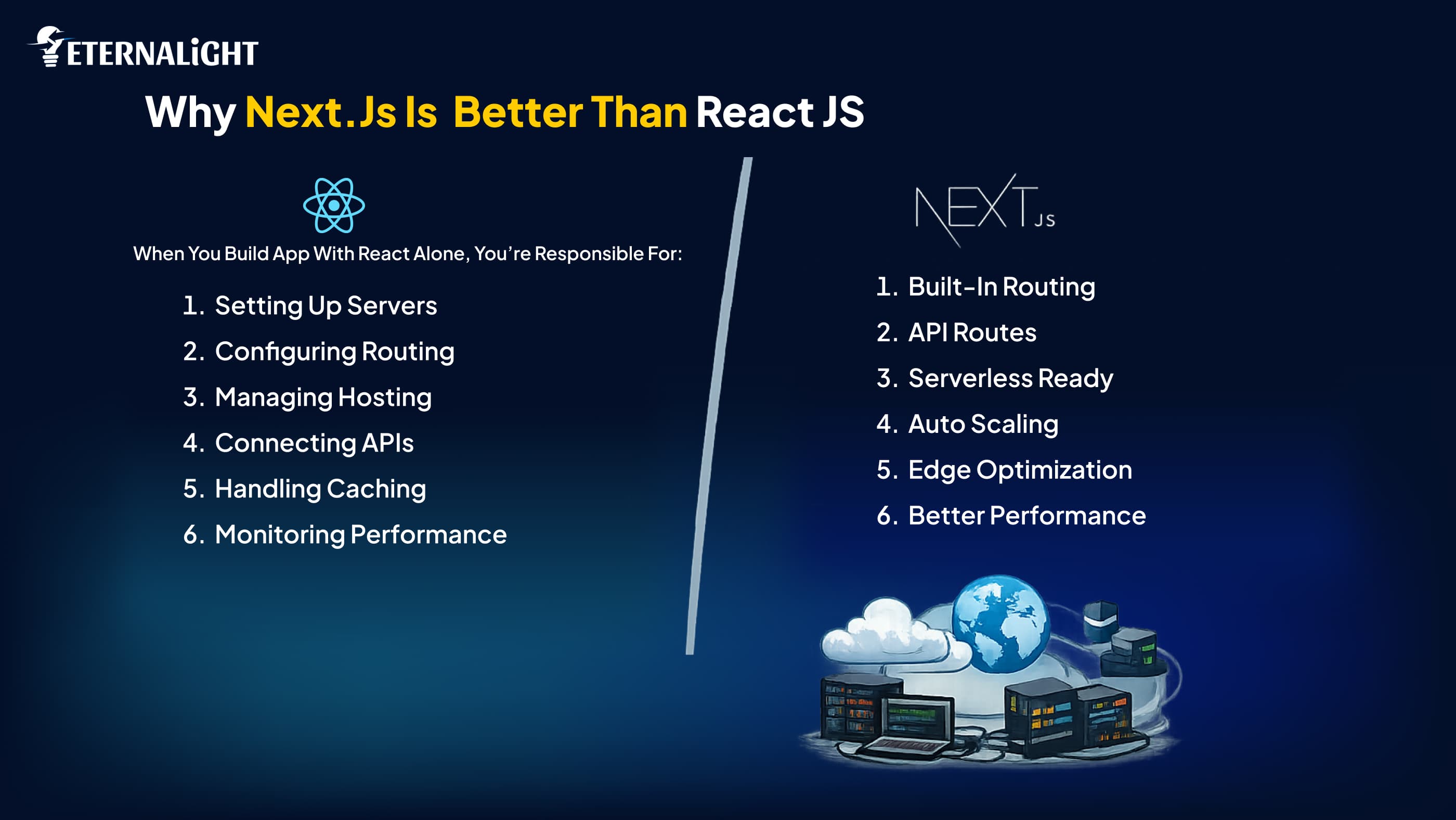
React is a UI Library, not an infrastructure Strategy. It is designed to build user interfaces. That’s it.
It doesn’t care:
- Where your app runs
- How it scales
- How it deploys
- How APIs are handled
- How performance is optimized at the edge
When you build an app with React alone, you’re responsible for the following:
- Setting up servers
- Configuring routing
- Managing rendering strategy
- Handling build pipelines
- Choosing hosting
- Designing caching layers
- Connecting backend APIs
- Monitoring performance
In other words, React gives you freedom but also responsibility.
That’s fine for large engineering teams with DevOps resources. But for startups and lean teams, infrastructure complexity becomes a tax. Explore our NextJS development services for future projects.
Develop App with Next.js : Built for the Cloud from Day One
Next.js isn’t just React with routing. It’s an opinionated cloud-native application development framework designed to run optimally in modern cloud environments.
It assumes:
- You’re deploying to serverless
- You care about global performance
- You want hybrid rendering
- You want zero-config scaling
It integrates frontend and infrastructure thinking.
That’s what “cloud-native” really means.
Reasons to Use NextJS for Cloud native Application Development

1. Edge Functions: Performance Where Users Are
Modern users aren’t sitting in one city. They’re everywhere.
Next.js supports Edge Functions, meaning your code can run closer to the users rather than on a single centralized server.
Why this matters:
- Lower latency
- Faster TTFB (time to first byte)
- Better SEO
- Better user experience
For example:
- An e-commerce site showing localized pricing
- A SaaS dashboard verifying sessions
- A content platform personalizing feeds
Instead of sending every request to one server in Mumbai or Frankfurt, your logic runs at the network edge.
React alone doesn’t provide this model. You’d need custom cloud native architecture to replicate it.
2. Serverless by Default
Next.js development services are designed to work seamlessly with serverless architecture.
That means:
- Functions spin up only when needed
- You don’t manage servers
- Scaling happens automatically
- You pay based on usage
Compare that to a traditional React app deployed on:
- A custom Node server
- A VM
- A container cluster
Now you’re managing:
- Memory
- CPU scaling
- Load balancers
- Downtime risk
- DevOps engineers
Serverless reduces operational overhead dramatically. For early-stage startups, this is huge.
Less infra work = more product building.
3. Vercel vs Custom Infrastructure
Vercel created Next.js, and the integration is extremely tight.
With Vercel:
- Git push → instant deployment
- Automatic global CDN
- Built-in image optimization
- Edge function support
- Preview deployments per branch
- Rollbacks in seconds
You don’t think about infrastructure. Now compare that with a typical React deployment on:
- AWS EC2
- Kubernetes
- Custom CI/CD pipelines
It works — but requires:
- DevOps time
- Configuration effort
- Monitoring setup
- Security management
For enterprises with dedicated platform teams, custom infra makes sense.
But for 80% of digital businesses? Operational simplicity wins.
4. Operational Simplicity = Business Leverage
Infrastructure decisions aren’t technical details. They are business decisions.
Here’s what cloud-native architecture simplicity gives you:
Faster Time to Market
Developers focus on features, not configuration.
Lower Hiring Pressure
You need fewer DevOps specialists early on.
Predictable Scaling
Traffic spike? The platform absorbs it.
Reduced Failure Risk
Managed infrastructure reduces outage probability.
Faster Experimentation
Spin up new landing pages, features, and APIs quickly.
Real Business Use Cases of Next.js Vs React.js
SaaS Startup
You’re launching a B2B analytics tool.
With React:
- Build frontend
- Build backend separately
- Configure hosting
- Manage scaling
With Next.js:
- API routes built-in
- Server-side rendering for dashboards
- Edge middleware for auth
- Deploy instantly
You reduce system complexity by 30–50%.
E-commerce Platform
SEO matters. Performance matters. Conversions depend on speed.
Next.js provides:
- Static generation for product pages
- Incremental static regeneration
- Edge personalization
- Built-in image optimization
Better performance = higher conversion rate. Even a 0.5-second improvement can significantly impact revenue.
Content & Media Companies
Publishing platforms need:
- SEO
- Fast page loads
- Global reach
- Dynamic personalization
Next.js blends static and dynamic rendering intelligently. React alone requires stitching together multiple tools. If you're planning to build a backend application with Next.jss ask us.
When React Alone Makes Sense
Let’s be balanced.
React works great when:
- You’re building internal tools
- SEO doesn’t matter
- You already have a strong backend infra
- You want full architectural control
Large enterprises often prefer React + custom architecture because they have the team to support it. But that’s a different stage of business maturity.
The Strategic Difference of React JS vs Next JS
React says:
“Here’s a UI library. Build whatever you want.”
Next.js says:
“Here’s how modern web apps should run in the cloud.”
That opinionated guidance is valuable. Because in business, constraints reduce mistakes.
Cloud-native Infrastructure Is a Competitive Advantage

In 2026, user experience is table stakes.
Speed, reliability, and global performance are not optional.
Cloud-native frameworks like Next.js align:
- Frontend
- Backend
- Deployment
- Performance
- Scaling
- Into one cohesive system. React doesn’t aim to solve that problem. Next.js does.
Final Thoughts
If you’re building:
Whether it's a startup, a SaaS platform, a product that needs SEO, or a global consumer app, Next.js offers top-notch cloud-native development infrastructure that matters as much as the UI.
React builds interfaces. Next.js builds cloud-ready products.
And in today’s market, the companies that reduce operational complexity move faster and win faster with cloud-native application development.
.jpeg&w=3840&q=75)
Anish Singh
Senior Software Developer
I'm a backend developer with over 5 years of experience building scalable, reliable, and performance-driven systems. Currently, I work as a Senior Software Developer at Eternalight, where I focus on backend architecture, APIs, and system optimization. I enjoy solving real-world engineering problems and simplifying complex concepts. Through my writing, I share practical backend learnings, system design insights, and experiences from my day-to-day work in the industry.
Related Blogs
 Cloud & DevOps9 Mins
Cloud Migration Strategy 2026: A Complete Guide to Process, Plans, and Costs
Learn the various types of strategies used for cloud migration in 2026. This guide covers everything from process to the right migration plan.
- Software Development11 Mins
Website Security Checklist: What to Check Before It's Too Late
Worried about website security? Use this practical website security checklist to spot common risks and protect your website, data, and users.
- Software Development7 Mins
From Off Track to Success: Custom Software Development Challenges to Fix Early
Custom software projects don’t always go as planned. Learn which challenges to catch early before they become costly problems for your budget, scope, and product.