Fintech
8
Mins
Why Enterprises Are Investing in Custom AI Solutions
Explore why enterprises are shifting from generic AI tools to custom-built AI systems. Learn the key business drivers, ROI benefits, and how to choose the right development partner.
AI has changed how enterprises work, and it is now changing how they view solutions itself.
Enterprise generative AI spending reached $37 billion in 2025, more than three times what it was the year before, according to Menlo Ventures. The enterprise AI market as a whole now sits at $97.2 billion. AI solutions for enterprises are a growing market expected to rise steadily.
These are huge numbers reflecting the drive that the AI boom has brought. A market directly growing with this is the custom AI development market, bringing up new opportunities for businesses. Enterprises are now choosing to use custom made AI systems for their needs. A generic AI can only do a few things, but building a custom AI for your business will streamline things and bring in efficiency. Small startups and businesses are now pivoting to making their products AI native from day one.
Generic tools get you started, but custom AI is what gets you ahead.
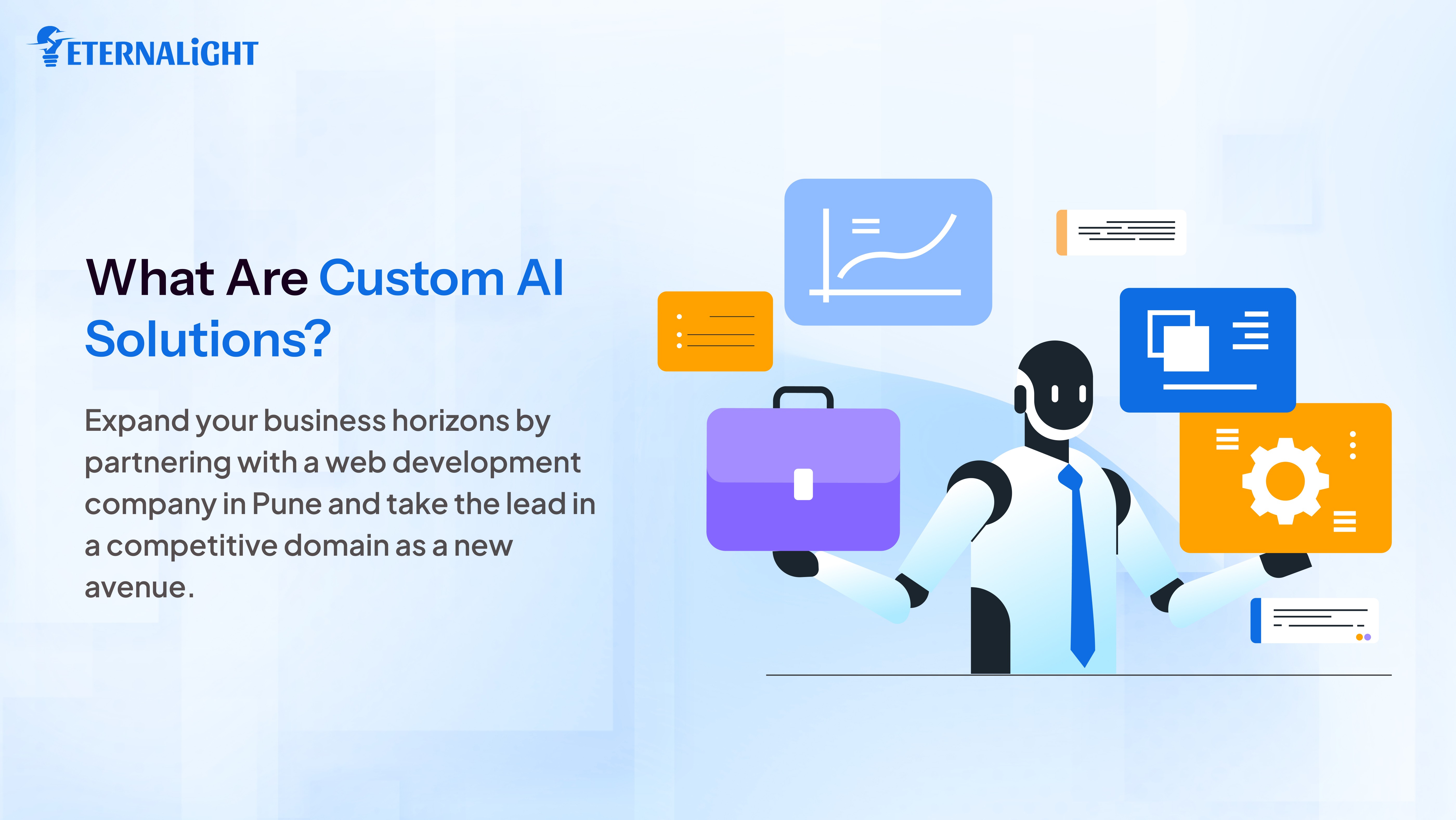
Custom AI solutions are AI systems that are built specifically with certain parameters and data in mind. A custom AI solution is made to your needs and goals, fixing problems and coming up with solutions that you or your business specifically need.
For an enterprise, what this means is an AI built for the organization. Trained on that organization's data, the AI gets integrated into its existing infrastructure and workflows.
This is very different from switching on an AI feature inside a SaaS platform or plugging a generic chatbot into your website. A custom solution reflects how your business actually works. It can understand and speak your industry's language. It understands your data structures, your compliance constraints, and your operational logic.
Vertical AI solutions or AI built for specific industries and use cases reached $3.5 billion in spending in 2025. Enterprises have moved on from experimenting with AI to building AI that is custom-made for them. Generic tools are discarded and no longer considered an asset.
Generic AI tools are built to appeal to the widest possible market. That is their business model, and it works. But it also creates hard limits that any enterprise can run into quickly.
Most generic AI tools handle simple, horizontal tasks well. They can write drafts, summarise documents, and answer common questions. Performance continues to stay reasonable as long as the use case stays generic enough. The moment your workflows get specific, the returns drop off.
A financial services company cannot feed client data into a publicly available large language model. A legal team operating under strict regulatory obligations cannot use a model over which they have zero control. These are not edge cases. They are the norm for any serious enterprise deployment.
Most enterprises run on a complex mix of legacy infrastructure, modern SaaS platforms, and proprietary internal tools. Getting a third party AI product to connect across all of that is a complex task to pull off easily. It usually involves extra middleware, manual workarounds, and data silos that are hard to manage.
Custom generative AI for enterprises is designed around your existing stack from the start. AI agents are one way to make it customized and to build applications with AI agents.
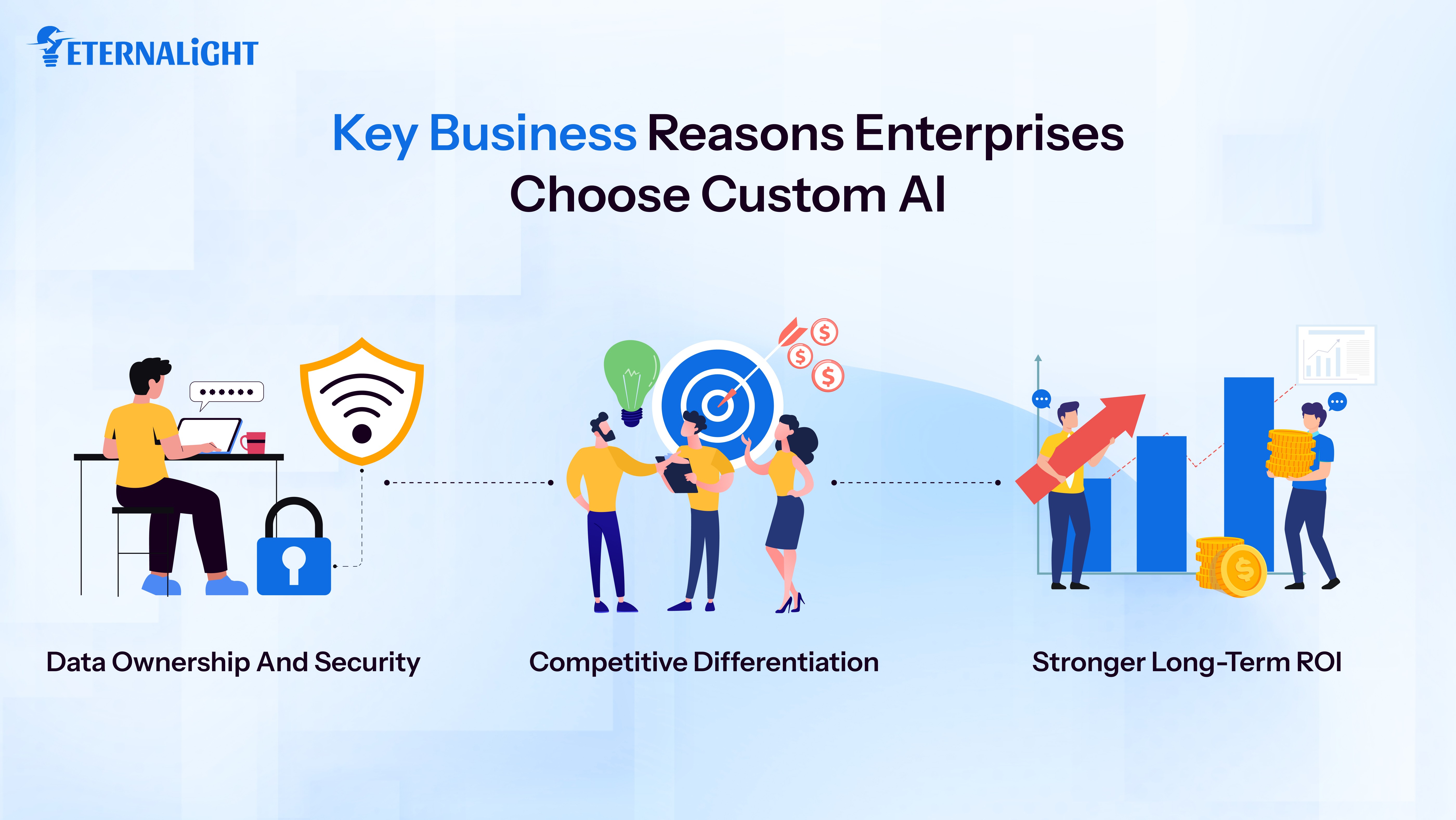
Here are some of the reasons why enterprises are now choosing to make custom built AI products for their companies:
When you build your own AI, your data stays in your system. You decide what the AI gets trained on, what information gets stored, and what never leaves the environment. Healthcare, finance, and legal sectors operate under strict data governance rules. Running AI on private infrastructure reduces that exposure. It also eliminates the risk of your data being used to improve a vendor's model.
If every company in your market uses the same AI tools, then no one has an advantage. Amazon's recommendation engine and Netflix's content algorithm are not generic tools that they bought from the same vendor. They are purposely built systems that have been trained on years of proprietary data. They are also central to why those companies lead their markets. When you build something similar, your competitors cannot just buy the same thing. It gives you an upper hand in the market and something that becomes a differentiator between you and your competitors.
Custom AI costs more to build upfront. But the long-term financial picture makes the effort and cost worth it. You are not subject to vendor pricing changes or feature removals. And you can modify the system as your business evolves. A custom built AI that understands your needs and is built for the problems you require solutions to, will always bring in more ROI than a generic AI chatbot or a third-party vendor’s AI that only fulfills half your functions.
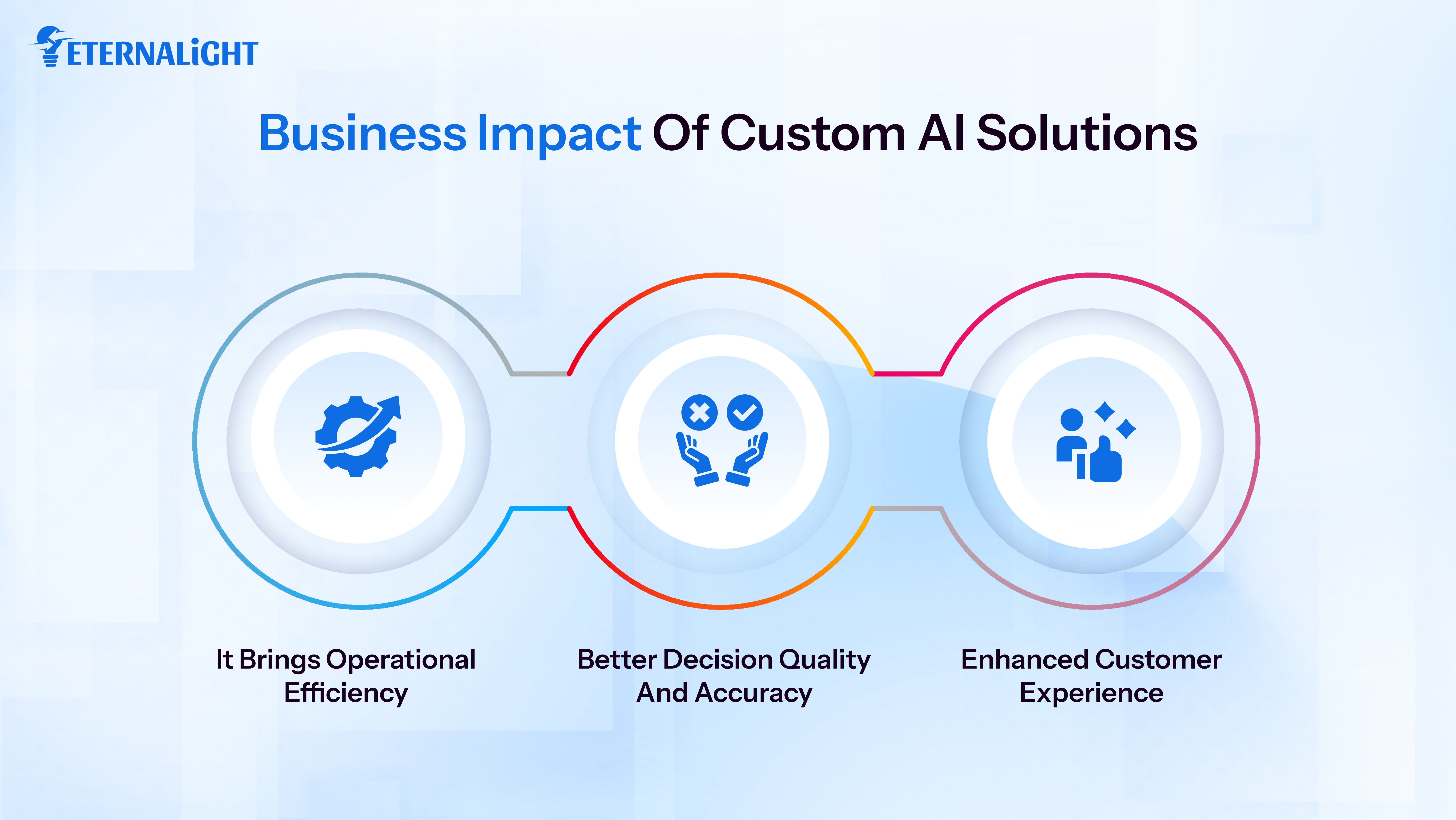
The difference between companies using AI for isolated tasks and those with AI embedded across their core operations is significant and outwardly visible.
Deloitte's 2025 survey found that twice as many leaders as the year before are now reporting transformative business impact from AI. Worker access to AI has risen to 50% in 2025. The number of companies with 40% or more of their AI projects in production is set to double within six months. These are organizations that moved past experimentation and started building systems that actually run their business differently.
Below are the parts where this impact shows up clearly.
Operational efficiency. AI automation solutions handle repetitive, rules-based tasks at scale. Document processing, compliance checks, data extraction, and invoice handling. Tasks that took hours can take seconds to finish, and a lot of repetitive tasks are just automated and reviewed by the people in charge.
Decision quality. Custom AI models trained on your historical data surface patterns that no analyst would find manually. It gives you more accurate churn prediction and better inventory forecasting. The model improves the more data it sees, so the advantage compounds over time.
Customer experience. Custom AI built for customer interactions knows your products, your policies, and your customers' history. That is why enterprises using purpose built AI for support and engagement see faster resolution times and meaningfully higher satisfaction scores.
One thing worth knowing is how fast the underlying technology is moving. What a modern custom AI build looks like today is very different from what it was two years ago.
Most enterprises do not build custom AI entirely in-house. They work with a development partner that can deliver it to them.
Research from MIT and RAND Corporation shows that 70 to 85% of AI initiatives fail to meet their expected outcomes. The failures are almost never caused by the model itself. They happen because of poor data quality, unclear objectives, the wrong partner, or no support after deployment. Your choice of partner will directly affect whether your AI fails or succeeds.
Here is what to look for:
Industry experience: Has the team built AI solutions in your sector before? Technical competence matters, but understanding your regulatory environment and business context matters just as much. A team that has never worked in financial services will spend your budget learning things a specialist already knows.
End-to-end capability: You need a partner who handles data engineering, model development, and production deployment together. Not a team that can build a model in isolation, but hands off integration as someone else's problem. You need a team that can deliver more value than your expectations and come up with ideas and solutions that are innovative.
Transparency about limitations: Any partner who tells you AI will solve all your problems is not being honest. Look for teams that talk openly about failures and what AI cannot do well. That kind of honesty at the start of a project saves money later.
Post-deployment support: Custom AI is not a one-time build. The systems need monitoring, retraining, and constant maintenance. Ask your partner how they handle model performance after going live, and only choose one that guarantees support after it goes live.
Choosing to make a custom AI solution is the right decision if we see where the data is pointing. Enterprise AI spending is growing at over 30% annually. Vertical AI investment nearly tripled in a single year. Companies with AI built into their core operations are outperforming those that are not. In the future, we will only see more and more of these investments, and AI will be more deeply integrated than ever.
The enterprises investing in custom AI development today are making a long-term infrastructure decision. They are building systems that improve over time, that their competitors cannot purchase. It is an advantage and a gift that keeps on giving. If you are evaluating this decision right now, the right starting point is clarity on your use case and your data. From there, the build versus buy question becomes much easier to answer. And if building is the right path, the quality of your development partner will determine most of the outcome.

Gauri Pandey
(Author)
Technical Content Writer
Frequently Asked Questions
Contact us
Send us a message, and we'll promptly discuss your project with you.