Fintech
10
Mins
Every Type of AI Agent and When to Use Them
Learn every type of AI agent, how they work, and which one fits your business needs.
AI agents are everywhere. The next big thing in technology, they’re integrated in most applications, of every sector right from healthcare to technology.
According to McKinsey's 2025 State of AI report, 23% of organizations are already scaling AI agents in at least one business function. The global market for AI agents is forecast to hit $52.62 billion by 2030. It is one of the fastest growing technologies that most businesses find themselves adapting to. A subsection of the AI world are the AI agents, and you can find agents embedded in applications everywhere.
With so many AI agents and types, it becomes hard to distinguish between them and choose the right one for your enterprise, business or personal needs. In this article we will discuss all the types of AI agents and understand where to use them.
An AI agent is a software system that perceives its environment, and processes what it finds. It then takes action toward a goal. The word agent comes from the Latin word agere, which means "to do." These systems do not just analyze and wait, they take action.
What separates one type from another is how much reasoning, memory, and learning is used behind each action. A thermostat is technically an agent. So is the model powering your customer support tool. There is a huge gap in the sophistication of those two.
Dr. Stuart Russell, professor at UC Berkeley, puts it plainly. He says the issue is not whether a machine can think but if the machine's design fits the task it is being asked to perform. That question should guide every decision you make about AI agents.
Below are some types of AI agents as well as their use cases and challenges.
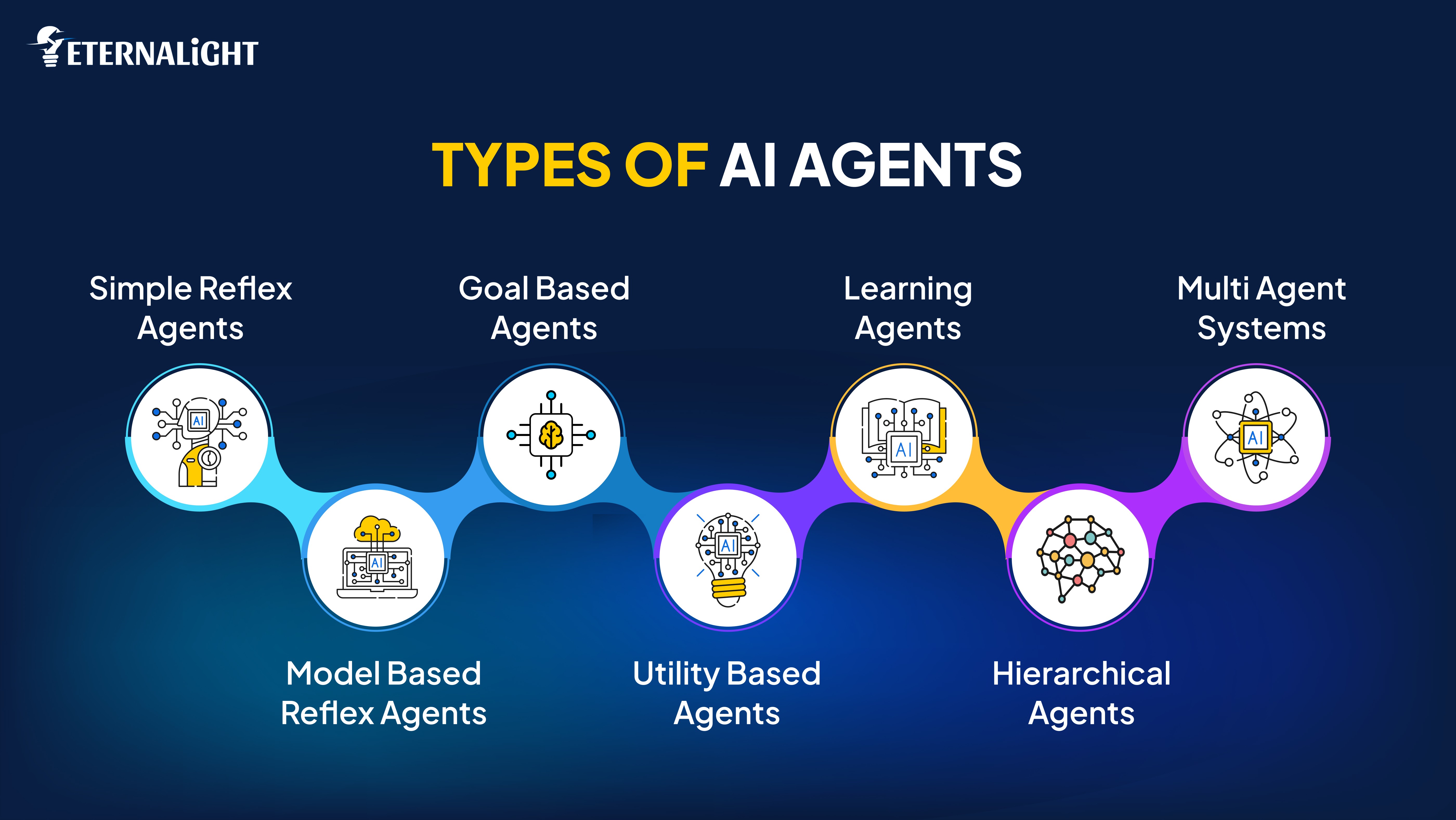
A simple reflex agent looks at its environment and responds based on a fixed set of rules. If condition A appears, take action B. There is no memory and no future reasoning available. No learning from what went wrong last time. The agent sees what is in front of it, matches it to a rule, and fires the action.
An example of a simple reflex agent is a basic spam filter. It blocks emails containing specific phrases and words. If it sees the words "click here to claim your prize", it will take the action of automatically moving it to spam. It does not remember the sender. It does not consider your history with them. It matches a condition and acts. A home thermostat does the same thing.
Use simple reflex agents in stable, controlled environments where rules are well defined and unlikely to change. You can use it for things like quality control checks on a production line, basic alarm systems, and rule based content filters are natural fits. Do not reach for this type when your environment shifts constantly.
The moment your environment becomes unpredictable, this type will fail. These agents cannot handle situations outside their predefined rules. They cannot adapt over time. If spammers change their wording, the filter misses the emails until a human updates the rules manually. And because there is no memory, context is completely invisible.
Model based reflex agents maintain an internal model of the world. That one addition changes a lot. They can account for things they cannot currently observe. These agents combine input from their environment with stored information about how the world typically works. They update that internal model as new data arrives and make better decisions because of it.
A standard example is the robotic vacuum cleaner. A Roomba builds a map of your home as it moves through all the rooms. It knows which rooms it has already cleaned. It tracks where furniture sits even when sensors cannot detect it right now.
Industrial robots work the same way. On manufacturing lines, they model the position of parts, the state of the assembly process, and the behavior of nearby machines. They act on that model, not only on what their sensors detect.
Model based reflex agents belong in partially observable environments. Places where context matters but the core decision rules do not change at all and remain fixed. Warehouse robots, automated cleaning systems, and basic process control tools are some examples. Use them when your agent needs to track state over time without needing to reason about it.
Building and maintaining an accurate model of the world is hard. In rapidly changing environments, the model becomes useless as its core decision rules stay fixed. If a situation arises that those rules do not cover, the agent has no way forward.
Goal based agents reason about what they are trying to achieve. Every decision gets evaluated against a set target or a goal.
The reasoning of these agents can be simply put as: Does this action move me closer to the final output? If yes, take it. If not, consider another option. These agents use search and planning algorithms to find a path through the problem that leads to the correct outcome.
The most known example is Google Maps. You input a destination and the system evaluates multiple routes before selecting the fastest one given current conditions. When traffic increases, it recalculates and finds another route. The goal stays fixed; the path is adaptable. Chess engines also work similarly but with greater complexity to them.
Goal based agents fit well in navigation, logistics, scheduling tools, and game systems. Anywhere a clear end state exists, anywhere the agent needs to find its own path is where this type fits in.
When multiple valid paths exist and no clear criteria separate them, these agents can struggle. They are also resource intensive. The more complex the problem space, the more computing power is needed to find a path through it.
Utility based agents are similar to goal based agents but differ with choosing the action that gets them the best possible path to the desired outcome. These agents assign a numerical value called utility to different states of the world. They evaluate potential actions by the utility of the states that performing those actions would produce, then choose the one that maximizes the score.
Recommendation engines at Netflix and Spotify are utility based agents in practice. They are weighing dozens of signals including your viewing history, completion rates, time of day, and genre patterns to maximize the chance you stay engaged.
A utility based recommendation finds the best match for you, right now, given everything the system knows about your preferences.
Designing the right utility function is a complex and difficult job. If it does not capture what you actually care about, the agent will optimize for the wrong thing. Researchers call this reward hacking. A recommendation agent told to maximize watch time will surface provocative content because it keeps people watching, even if that is not what anyone wanted. Getting the function right requires thinking carefully about the full range of outcomes you want to produce, not just the obvious ones.
Use utility based agents anywhere that quality of outcome matters alongside whether the goal gets reached. Recommendation systems, resource allocation tools, financial portfolio management, and autonomous vehicles are all real deployment areas.
Learning agents do exactly as their name suggests. They learn and improve through experience. They observe the results of their actions, compare those results to a standard, and adjust their behavior. They get better and better as they learn.
A learning agent has four working components. A performance element handles what it does. A learning element controls how it improves and then a critic evaluates results against a set standard. A problem generator identifies new situations worth exploring. Over time, the agent gets better without anyone writing new instructions for it.
DeepMind's AlphaGo is one of the most documented examples of a learning agent. It learned to play Go by playing millions of games against itself and eventually beat every human player.
Learning agents need data and a lot of it. Without enough quality training data, they do not perform well. They also absorb biases from whatever data they train on. This has caused documented problems in hiring tools, lending decisions, and medical diagnostics.
Use learning agents when your environment is highly dynamic and constantly changes over time. Customer service automation, fraud detection, diagnostic support tools, and natural language processing are some examples.
Hierarchical agents organize decisions across multiple levels. A top level agent will handle the broader strategy and goals. Lower level agents get to execute specific tasks within that structure. Each layer focuses on what it does best, and the overall outcome is dependent on all the layers.
Modern AI coding tools follow the same logic. A top level agent interprets what you want to build. A middle level agent breaks that into specific coding tasks. A ground level agent writes the actual code for each task. The result comes together at the end combining all the tasks and layers.
Communication between levels will create delays. A poor strategic decision at the top wi;; affect every agent under it. The more layers you add, the more points exist where coordination breaks down. Debugging hierarchical systems is also more complex than debugging a single agent because a failure at one level may only show up as an error two levels below.
Hierarchical agents fit complex workflows that can be cleanly separated into distinct levels of responsibility. Software development pipelines, logistics networks, and multi step agentic systems are some examples.
Multi agent AI systems involve multiple types of agents working in the same environment. Each one operates independently but can communicate and coordinate with each other. They tackle problems that a single agent working alone could not handle, and are great for complex tasks and workflows.
Financial trading platforms are among the most advanced deployments of multi agent AI systems today. Separate agents monitor different asset classes, assess risk, execute trades, and manage portfolio rebalancing at the same time. They process millions of signals and make decisions in fractions of a second that no human team could replicate.
Coordination between agents can be difficult. When agents have conflicting objectives or incomplete information about their fellow teammates, the system produces unexpected results . Security matters here too. A compromised agent can send bad instructions to every other agent it communicates with.
Multi agent systems belong in large scale, distributed problems that no single agent can handle alone. Financial markets, logistics networks, air traffic management research, and complex enterprise automation are all proven deployment areas.
Understanding the different types of AI agents is not just useful for engineers but for anyone making decisions related to AI.
Three things are worth keeping in mind.
Agent type should match task complexity. The most sophisticated option is not always the right one. Overbuilding creates maintenance overhead and governance risk without proportional return.
Learning and multi-agent systems are where most enterprise investment is heading. But they require more data, more oversight, and more mature infrastructure to deliver reliably. A 2025 Google Cloud study showed that 88% of early adopters achieved positive ROI when they committed to the right agent architecture for their use case.
The shift from AI tools to AI agents is already underway. Getting the fundamentals right now puts you in a much stronger position as the technology matures. If you need help with picking the right AI agents for your business or with their deployment, our team is here to help.

Gauri Pandey
(Author)
Technical Content Writer
Contact us
Send us a message, and we'll promptly discuss your project with you.