Fintech
7
Mins
Why Securing Funding is Critical for Software Startups
Know about strategies software startup adapt
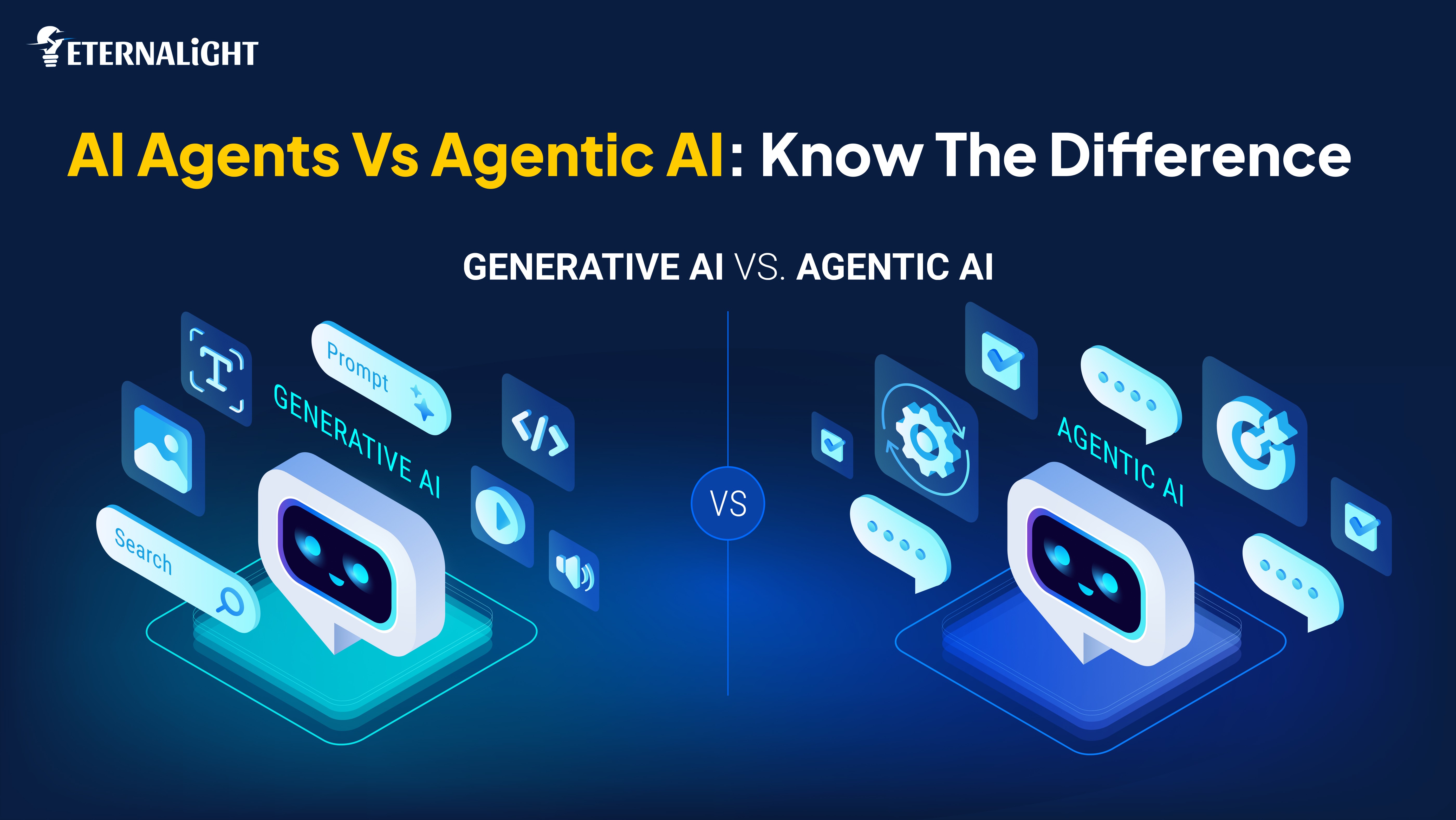
The technology sector has been booming since the world got introduced to artificial intelligence. We now have different types of artificial intelligence like generative AI, agentic AI, and even AI agents.
You have probably seen phrases like: “We use AI agents." "or Our platform is fully agentic."
If you’re feeling confused, that’s normal. All these phrases may seem like synonyms but they represent different arenas of artificial intelligence that everyone should know.
These technologies overlap in places, and the vendors have no incentive to make the distinction clear. A company invests in an "agentic AI solution" expecting autonomous, multi-step workflow automation. What they get is a well built chatbot. Useful? Yes. But not what they paid for.
So let us do that here.
This article breaks down what AI agents and agentic AI are, how both compare to generative AI, when to use each one, and which industries are already putting them to work.
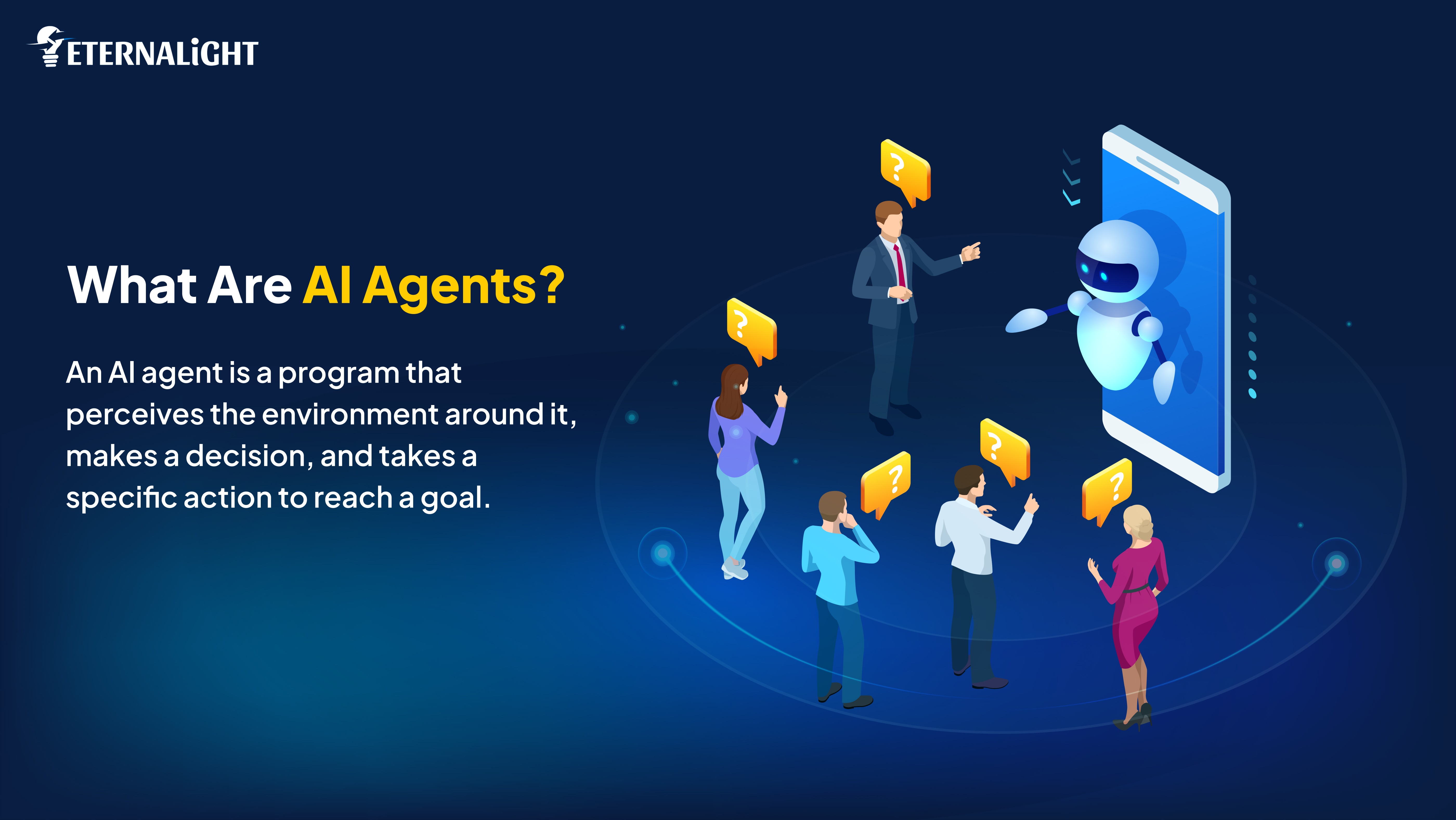
An AI agent is a program that perceives the environment around it, makes a decision, and takes a specific action to reach a goal.
MIT Sloan researchers describe AI agents as systems that "can execute multi-step plans, use external tools, and interact with digital environments to function as powerful components within larger workflows." AI agents are capable but bounded.
Some examples of what AI agents are used for today include:
Customer support bots: Customer support has evolved with AI. Instead of connecting you to a customer support personnel, companies now use AI agents to answer user queries. In a food delivery app, this may look like you typing or choosing the option ‘Where is my order?’ and the AI agent finding it and reporting back. These agents read your query, understand the intent, and accordingly come up with the correct answer.
Algorithmic trading systems: These AI agents are trained to watch live market data and buy or sell orders based on pre-set rules. When the conditions are met, the agent will take the required action.
Email assistants. Google Smart Reply scans your inbox and suggests short responses. It reads input, acts on it, and moves on. We have more advanced assistants coming into the market now that summarise your email and help you draft answers.
The agent sees something, processes it, and responds. Most AI agents are task specific by design. They are meant to do small tasks, they do not plan ahead or chain tasks together. All they do is react to the input.
AI agents are built for reliability and consistency at scale. They do one thing correctly, repeatedly, without human involvement every step of the way.
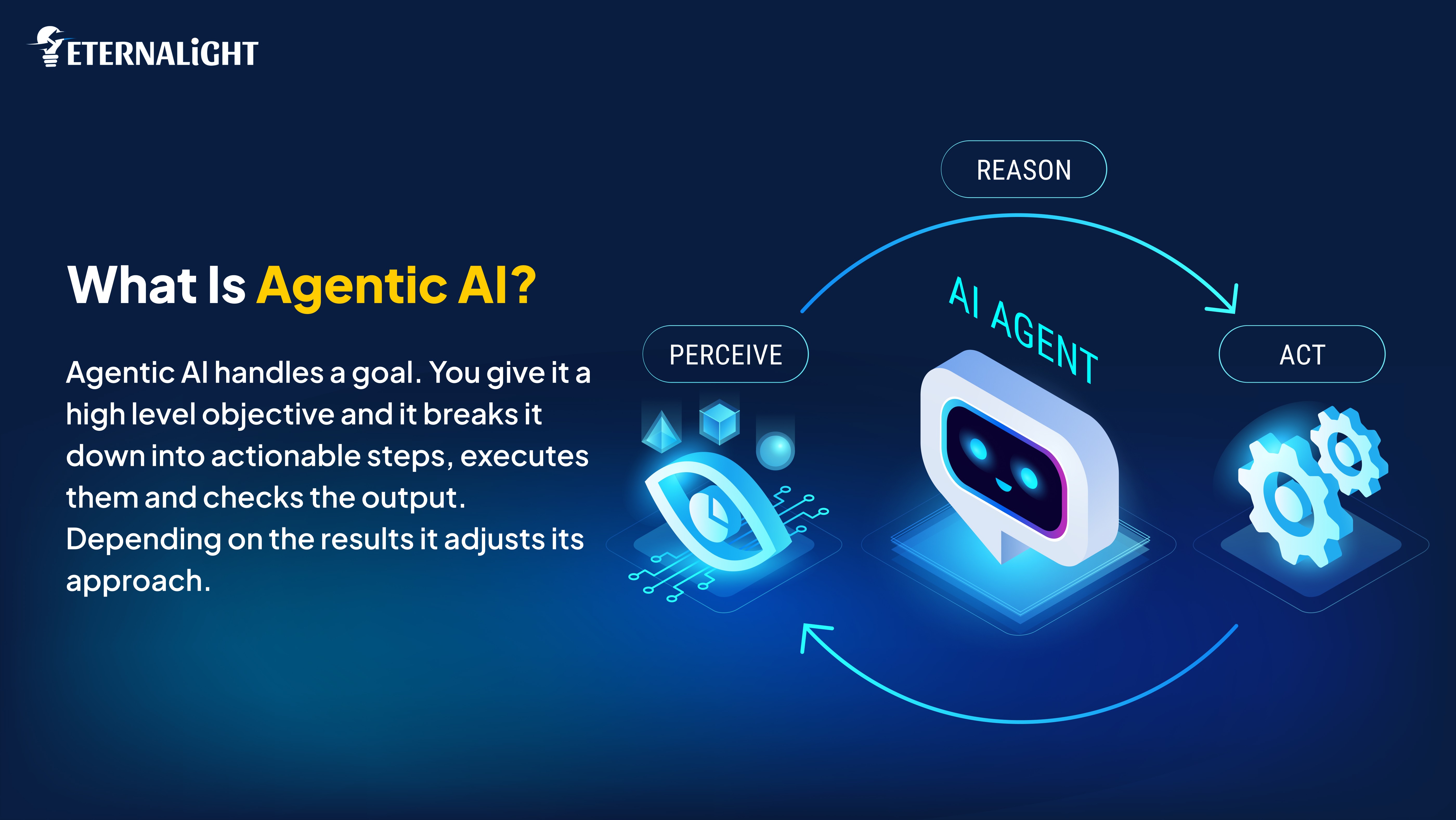
Agentic AI may sound similar to AI Agents, but this is a completely different category.
An AI agent handles a task but agentic AI handles a goal. You give it a high level objective and it breaks it down into actionable steps, executes them and checks the output. Depending on the results it adjusts its approach. You are not walking it through the process. It figures the process out on its own. All you need to do is give it a clear objective, a goal.
What actually makes AI agentic? If the AI can break complex goals into smaller steps on its own, it has the capacity to know which tools or agents to use and when. It holds memory across sessions, so it learns from what happened before. It adapts mid-workflow if something unexpected happens.
Some example of agentic AI that show the range:
Autonomous software development: Cognition AI's Devin is one of the most talked about agentic AI right now. You describe a feature you need and Devin writes the code, runs tests, identifies errors, and fixes them. GitHub Copilot Workspace is moving in the same direction. A lot more players will be entering this space.
Supply chain management. An agentic system here can monitor inventory levels, forecast demand based on historical and real time data. It can then contact suppliers, adjust purchase orders, and flags anomalies. It does not wait to be told. It acts on what it observes.
According to Gartner's 2025 predictions, agentic AI will autonomously handle at least 15% of daily business decisions by 2028. That number will grow significantly as the technology matures.
The difference between agentic AI and AI agents is not small. Agentic AI plans, adapts, uses multiple tools, and operates across extended time horizons. AI agents react, execute, and stop.
Here is a detailed breakdown of all three:
Feature | Generative AI | AI Agent | Agentic AI |
What it is | A model that generates content from a prompt | A program that perceives, decides, and acts on a specific task | A system that autonomously plans and executes multi step goals |
Primary function | Create text, images, code, or other content | Automate a defined, repeatable task | Pursue a goal through self directed reasoning and action |
Autonomy level | None. Responds only when prompted | Low to moderate. Acts within predefined rules | High. Plans, adapts, and executes without step by step instructions |
Can it plan ahead? | No | No | Yes |
Does it take action? | No. Produces output only | Yes, within a narrow defined scope | Yes, across multiple steps and tools |
Uses external tools? | Occasionally via plugins | Sometimes, depending on setup | Yes. Browsers, APIs, databases, code environments |
Human input required | Every interaction | At task definition | At goal setting only |
Task scope | Single prompt, single output | One task, one outcome | Multi step workflows with branching decisions |
Adapts mid process? | No | No | Yes |
Session memory | Limited context window | Usually none | Yes. Tracks its own progress across steps |
Decision making | Pattern based content generation | Rule based execution | Reasoning based planning and adaptation |
Real world example | ChatGPT drafting a blog post | Zendesk AI handling a support ticket | Devin writing, testing, and fixing code from a brief |
Best suited for | Content creation, summarisation, Q&A | Repetitive, high volume task automation | Complex workflows that require judgment and planning |
Error risk | Low. Errors are contained to the output | Low to moderate. Predictable failure modes | Higher. Errors can compound across steps without oversight |
Knowing the difference between agentic AI and AI agents matters. Knowing which to deploy for your specific situation is what actually moves things forward.
AI agents perform best when the task has a consistent structure, a clear input, and an expected output every time. Since they depend heavily on their pre-set rules, it is important that AI agents be used for tasks where the results can be replicated.
Customer service automation, invoice processing, lead qualification, appointment scheduling, and social media monitoring are all some of the use cases where AI agents can be best used. These tasks repeat constantly, follow the same pattern, and do not need judgment calls. An AI agent handles them faster, more cheaply, and more consistently than any manual process.
If your team spends significant time every day on work that looks exactly the same each time, that is where AI agents deliver the clearest return.
Use agentic AI when the goal is clear but the steps are unclear. When the work requires or needs you to pull from multiple sources, make decisions along the way, and adapt based on what the system finds. This is where Agentic AI becomes most useful.
Competitive research, autonomous software development, personalised customer journeys, and complex logistics management are all goals, not tasks. They require careful planning, use of tools, and the ability to respond and change based on the system’s findings.
Most AI operations use both. AI agents can cover the high volume, predictable work. Agentic AI can cover the goals that require reasoning.
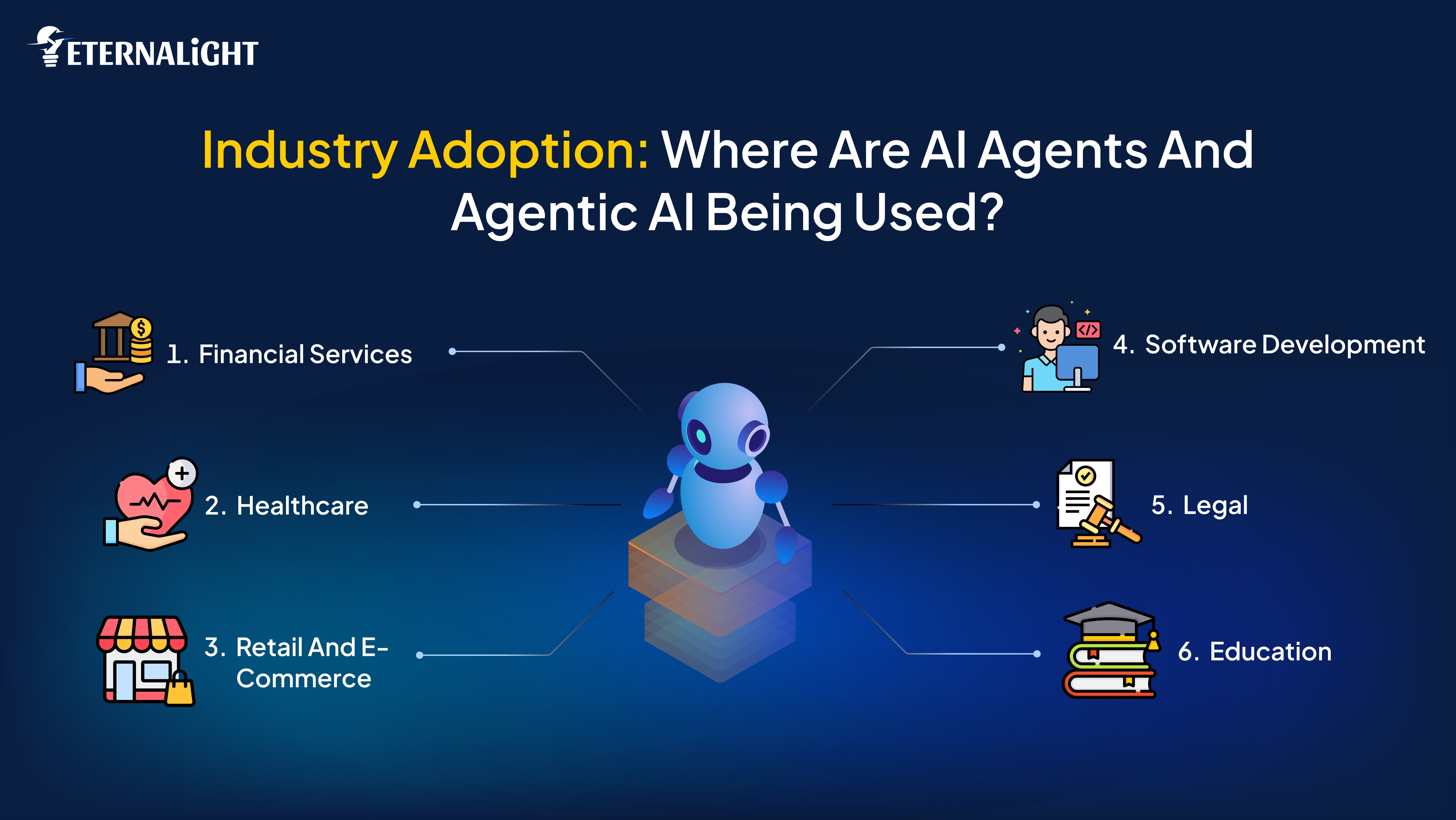
Both technologies have moved well past the pilot stage. Here is where real adoption is happening across industries right now.
Financial Services
AI agents are being used for contract review, document analysis, and fraud detection at scale. JPMorgan Chase's COiN platform uses AI agents to review legal documents that previously required hundreds of manual work hours per year. It completes the same task in seconds. The bank now has over 200,000 employees using its LLM Suite platform daily for drafting, analysis, and research.
On the agentic side, JPMorgan began deploying agentic AI in 2025 to handle complex multi step tasks for employees internally, with the goal of becoming what it describes as a fully AI connected enterprise. Investment firms are also testing agentic systems for portfolio monitoring that surface risk recommendations.
Healthcare
Hospitals use AI agents for patient scheduling, insurance verification, and triage at scale. These are the kind of tasks that are both high volume and repeatable tasks. AI agents fit perfectly here.
Agentic AI is doing more complex work in the healthcare industry. Companies like Insilico Medicine use agentic systems in drug discovery pipelines, independently designing and modelling molecular structures.
Retail and E-Commerce
AI agents run product recommendations, inventory checks, and customer support across platforms like Amazon and Walmart. Agentic AI is entering dynamic pricing and supply chain management, where systems adjust prices and reorder stock in real time based on market conditions.
Software Development
This is where agentic AI is arguably making the biggest impact right now. Cognition AI's Devin is in active commercial use at companies including Goldman Sachs, Microsoft, and Nubank. You describe what you need and it reads the codebase, writes the code, tests it, finds bugs, and iterates until it works. GitHub Copilot Workspace is moving in the same direction.
More players will enter this space soon. AI will see its biggest growth and use in the technology sector but specifically Agentic AI will be the most useful in the future. AI agents are also active here in smaller, more defined tasks like code completion, test generation, and automated pull request reviews.
Legal
Law firms use AI agents for high volume document processing, contract summarisation, and clause extraction. These tasks repeat constantly and follow predictable patterns. Agentic AI is being piloted for workflows where the system identifies relevant filings, flags risks, and builds structured reports across thousands of documents.
Education
Khan Academy's Khanmigo uses an AI agent model to answer learner questions in real time. Clear input, clear output, at scale. Agentic systems are going further, rebuilding full curriculum pathways based on individual student performance. They adapt what each student sees next based on what that student has actually understood, not just what they have been assigned.
The debate around agentic AI vs AI agents is not really about terminology. It is about understanding what a system can actually do before you commit to building on it.
AI agents are reliable, focused tools for predictable work at scale. Agentic AI is for goals that need planning, judgment, and execution across multiple steps. Generative AI is the foundation that both of these were built on. Knowing where each fits stops you from buying either of these simply based on buzzwords and helps you buy based on what actually solves your problem.
That distinction, between a task and a goal, between reacting and planning, is where most AI strategies either deliver or fall apart. If you are still in the early stages of figuring out where AI agents and agentic AI fit in your business, start there. Get that distinction right and everything else becomes easier to decide.

Gauri Pandey
(Author)
Technical Content Writer
Contact us
Send us a message, and we'll promptly discuss your project with you.