Fintech
10
Mins
The Rise of AI Agents with Gemini: A New Chapter in Intelligent Automation
Discover how Gemini enables AI agents to think, plan, and act in real-world scenarios.
Nowadays, we interact daily with AI assistants and tools for different purposes.
We ask questions, get instant answers, generate emails, write captions, fix code, and summarize documents. It feels helpful, fast, and efficient.
But what if AI could do more than just respond?
What if instead of asking it step by step, you could simply say, “Handle this for me,” - and it actually understands what “this” means?
Imagine telling your AI assistant:
“Prepare a competitor analysis, summarize the findings, create a presentation draft, and schedule a meeting with the team next week.”
And instead of replying with a paragraph of suggestions, it actually performs those tasks.
That shift - from responding to acting - is what defines AI agents.
And this is exactly where Gemini enters the picture.
However, Gemini is not another AI model. It can reason, understand context deeply, process different kinds of information, and interact with tools. But when these abilities are paired with agent technologies, something interesting happens. AI is no longer a chatbot but a collaborator.
We are no longer just interacting with AI. We are beginning to delegate to it.
In this blog, we will explore what AI agents truly are, how Gemini powers them, how their architecture works, where they are already being utilized, and what the future might hold in a world where AI doesn’t just assist - it acts.
To understand AI agents, we need to move beyond the idea of chatbots.
A chatbot waits for you to type something. It responds. Conversation ends. You prompt again.
An AI agent, however, operates with purpose. It is given a goal and figures out how to achieve it.
To illustrate this, think of a chatbot like an intern in a company, where the AI agent is like the project manager, aware of the goal, breaking it down into steps, executing them, and monitoring the outcomes, making changes when necessary.
From a technical perspective, an AI agent can be defined as "an entity that can perceive information, reason about it, make decisions, and act on those decisions to accomplish a given objective." But to put it simply, an AI agent is "AI that thinks step by step and acts on its own within certain boundaries."
For example, if you say, “Plan a weekend trip to Goa within a ₹20,000 budget,” a traditional AI might suggest places and hotels. An AI agent could compare flight prices, check hotel availability, evaluate reviews, optimize your budget, and present a structured itinerary - possibly even booking everything if given access.
What makes this possible is the combination of large language models, memory systems, tool integration, and workflow orchestration.
AI agents are not a single technology. They are an ecosystem built around intelligent models capable of reasoning and inference.
And that brings us to Gemini.
Gemini, developed by Google DeepMind, represents one of the most advanced families of AI models currently available.
Unlike other AI systems that were text-centric in nature, Gemini was built as a multi-modal model from scratch. This means that it can process text, images, code, audio, and even video.
That design choice is important.
The world is not text-centric in nature. Business reports are not sent in text format alone. They are sent with charts and graphs. Similarly, emails are sent with attachments. Presentations are not sent with text alone. They are sent with images and videos. Therefore, a truly capable AI agent needs to be able to process all these formats seamlessly.
The architecture of Gemini allows it to reason with different forms of data. It can process a spreadsheet, an image, a PDF document, code, and more - all in a single context.
Another important strength of Gemini is the long context window. Memory is important in AI agents. Without memory, they would not be able to keep up with the flow. The long context window ensures this.
Gemini is just a model. The combination of Gemini with planners, tools, and memory is what would make it the brain of an AI agent.
This is where things become interesting.
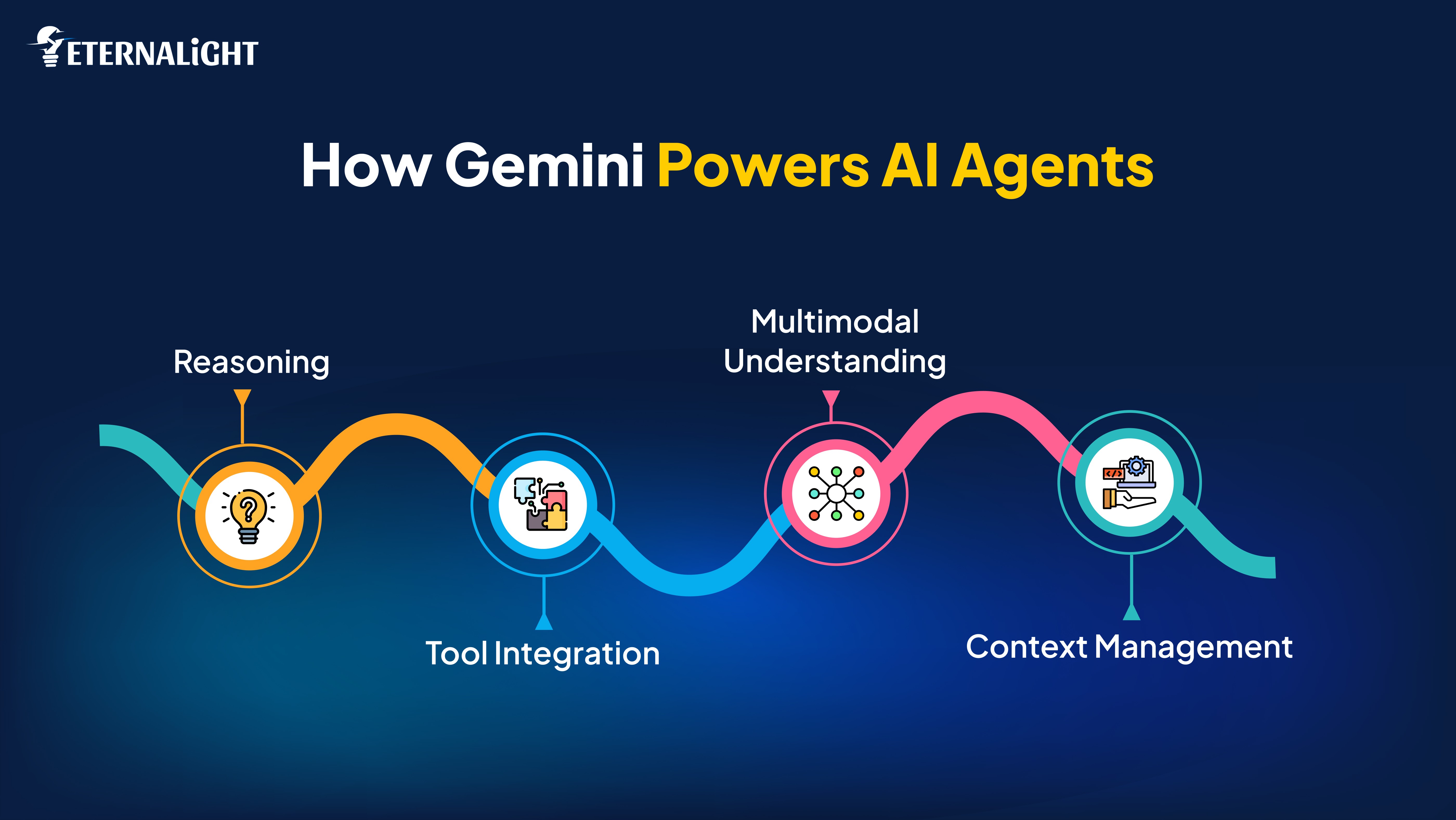
An AI agent requires several core abilities to function effectively, including reasoning, planning, memory management, and tool interaction. Gemini supports all of these in powerful ways.
The AI agent needs to break down goals into manageable steps. In your case, if you give an AI agent a task to prepare a market analysis report, it needs to think about what data to collect, in what form to present it, what tools to use to perform the task, and so on. The advanced reasoning ability of Gemini allows it to simulate its thinking process internally before producing an output or performing an action.
The modern AI agents are not isolated entities. They are connected to calendars, CRMs, databases, browsers, analytics tools, etc. In addition to this, Gemini can also handle structured outputs that can be interpreted directly as API calls. Instead of providing “You should schedule a meeting,” it can provide instructions to schedule a meeting in an appropriate format.
Consider a scenario where an agent must analyze a product presentation. The slides include text explanations, charts, embedded images, and financial tables. A multimodal model like Gemini can process all of this content cohesively. It doesn’t treat visuals as separate from text. It understands them as part of a unified narrative.
AI agents often operate over extended sessions. They need to remember previous instructions, decisions made, constraints provided, and partial results generated. Gemini’s long context capability ensures that agents remain consistent throughout complex, multi-step workflows.
In simple terms, Gemini gives AI agents the cognitive foundation they need to think more like humans - not in emotions, but in structured reasoning.
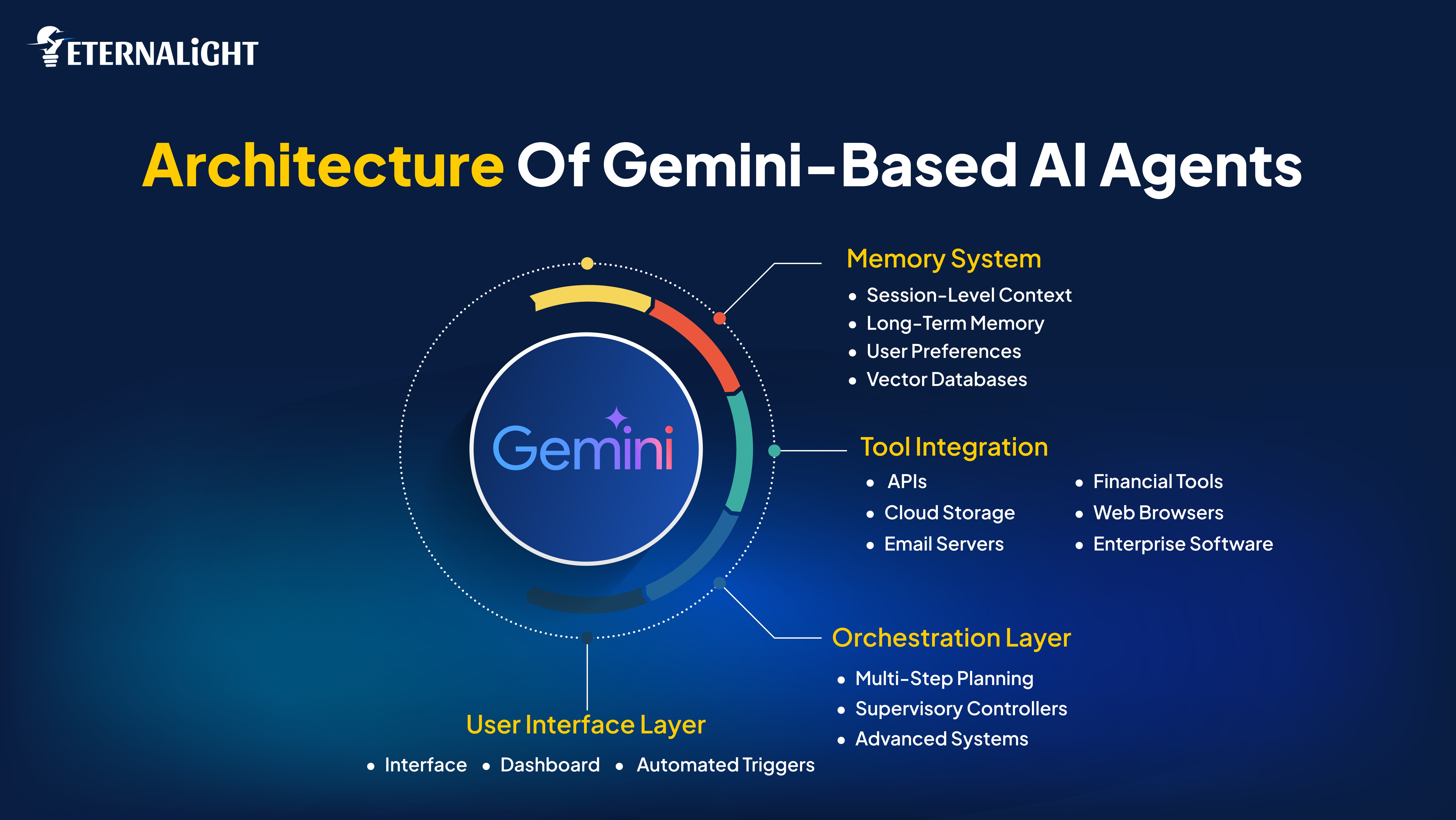
Gemini-based AI agents have a typical structure, which is often represented in a layered form.
The central component is the Gemini model, which acts as the reasoning engine. The Gemini model is used to process inputs, plan actions, and decide on the next steps.
Surrounding this is a memory system. This typically includes short-term memory, which manages session-level context, and long-term memory, which stores information such as user preferences. Many systems also use vector databases to implement semantic recall. This allows the agent to recall information in a meaningful way.
Then comes the tool integration layer. This is where the API and service integration come in. This agent may interact with cloud storage services, email services, financial tools, web browser services, and enterprise browser services.
Above that is the orchestration layer. This layer handles workflow coordination, as well as multi-step planning. This ensures that output from one step is input to another. In some advanced systems, there are multiple agents working under a supervisory controller.
Finally, the user interface layer provides interaction. This might be a chat interface, a dashboard, or automated triggers running in the background.
When all of these layers come together, the agent works as a whole system, able to accept goals, plan execution, engage with tools, and produce results.
Gemini-powered AI agents are no longer experimental ideas. They are gradually being implemented across industries.
In enterprises, agents can help in boosting productivity. They can help in writing reports, summarizing meeting minutes, tracking critical metrics, and helping teams stay on top. The managers would not have to keep an eye on the progress through different applications. This would be done by artificial intelligence agents.
In customer support, AI agents can answer customer inquiries, access account information, process routine requests, and escalate complex requests. Because Gemini can understand context so deeply, conversations feel more natural and coherent.
In software development, AI agents can scan code repositories to identify bugs and suggest optimizations. Instead of answering coding prompts, AI agents can analyze entire projects.
Research settings are another area where AI agents can be incredibly helpful. They can scan large amounts of documents, compare results, and create organized findings.
A very interesting piece of research with regards to AI is Project Mariner. Project Mariner is a project that focuses on autonomous web navigation and task execution.
These examples illustrate a broader shift: AI is moving from passive assistance to proactive execution.
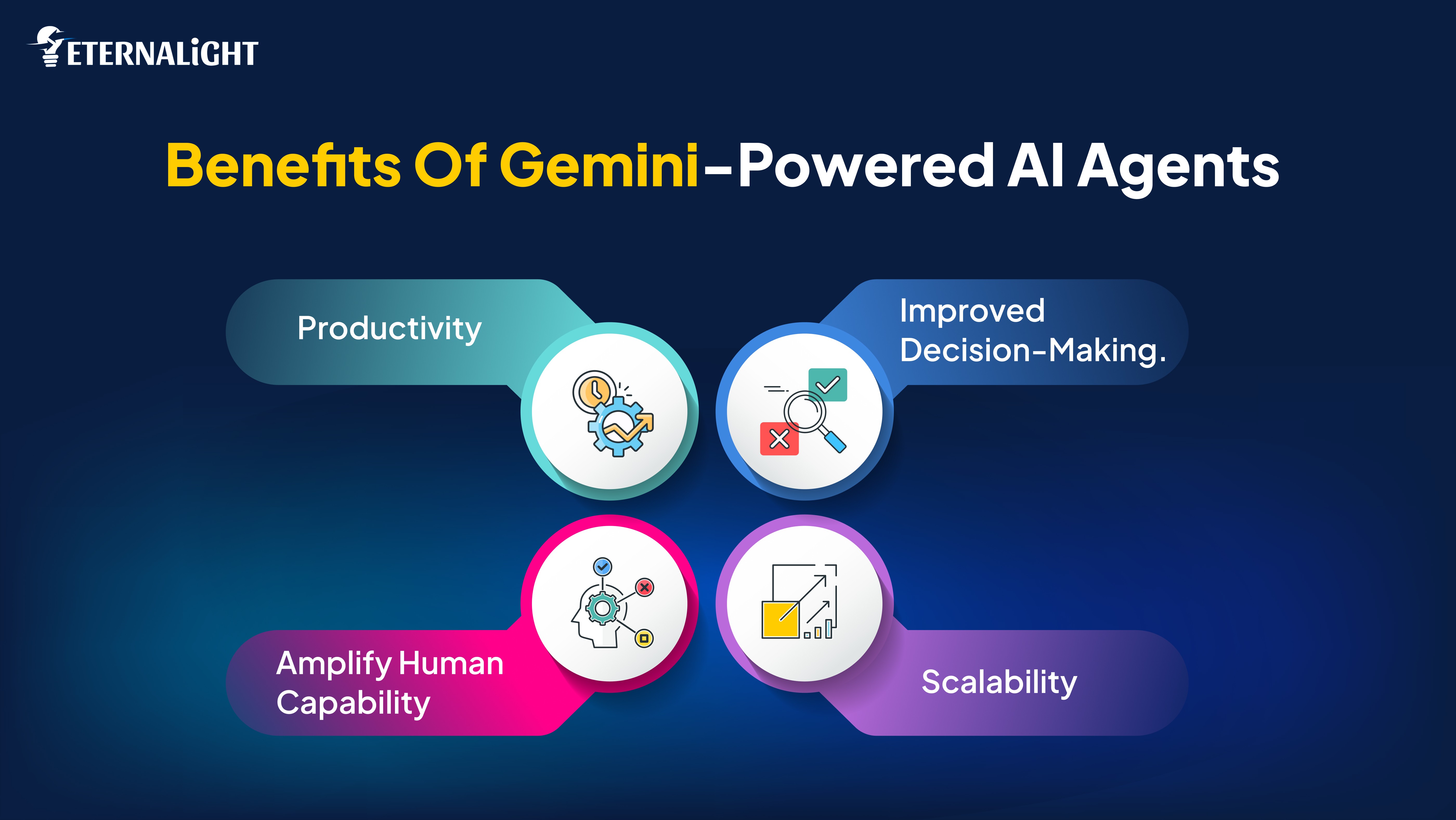
There are various advantages of using AI Agents, which are powered by Gemini, as they can bring efficiency, better decision-making, and workflow automation. The AI Agents, which are powered by Gemini, help organizations complete complex tasks more efficiently, thus enabling humans to focus on more creative tasks.
The most obvious benefit is productivity. Tasks that once required hours of coordination and manual effort can now be completed more quickly.
There is also improved decision-making. Because Gemini can analyze multiple data formats simultaneously, agents can synthesize insights more comprehensively.
Scalability is another major advantage. AI agents can operate continuously without fatigue, allowing organizations to handle higher workloads without proportional increases in staffing.
Additionally, intelligent automation reduces repetitive work, freeing humans to focus on strategy and creativity rather than routine execution.
However, the real benefit may be cognitive extension. Gemini-powered agents amplify human capability by handling complexity at scale.
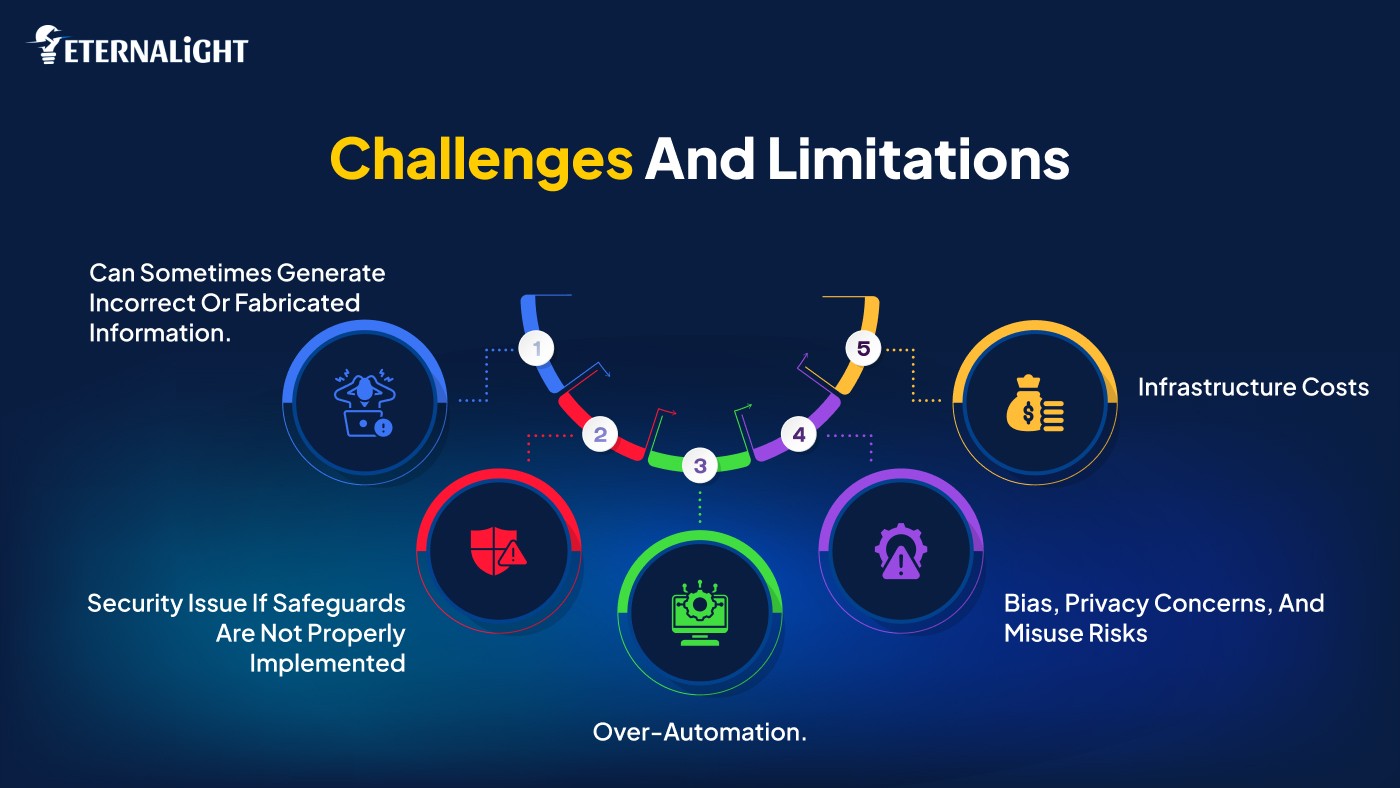
Despite the promise, AI agents are not flawless.
One major concern is reliability. Large language models can sometimes generate incorrect or fabricated information. When agents act autonomously, small errors can have larger consequences.
Security is another issue. Integrating agents with external systems creates potential vulnerabilities if safeguards are not properly implemented.
Ethical considerations also matter. Bias, privacy concerns, and misuse risks must be addressed carefully.
There is also a challenge of over-automation. While delegating tasks to AI is efficient, human oversight remains essential to ensure quality and accountability.
Finally, infrastructure costs can be high, especially when deploying large-scale multimodal systems.
Balancing innovation with responsibility is critical.
The future of AI agents powered by Gemini appears transformative.
We may also witness the development of multi-agent ecosystems in which specialized agents interact in collaboration with supervisory systems. The personal AI assistant may become a digital chief of staff.
Enterprises may also employ department-level AI agents to deal with analytics, compliance, and operational optimization.
Gemini's reasoning depth, context, and multimodal capabilities may also become more advanced. This would enable agents to act more independently.
However, the most successful future with regards to AI is not going to be an autonomous AI system replacing humans. Instead, it is going to be an AI system where humans provide the vision and AI provides precision in executing tasks.
AI agents represent a fundamental shift in how we think about artificial intelligence.
They are not simply advanced chatbots. They are goal-driven systems capable of planning, reasoning, and acting.
At the heart of this evaluation is Gemini, providing the intelligence necessary for agents to operate effectively in complex, multimodal environments.
When working with an organization as they explore the possibilities of a Gemini-powered AI agent, it’s important that adoption of this technology comes with careful consideration of its technical, moral, and human aspects.
We are at the beginning of a new chapter of intelligent automation.
The question is no longer whether AI can respond.
The real question is: how far can it act?
And with Gemini at the core, that boundary continues to expand.

Kusum Sethiya
(Author)
Software Engineer
Contact us
Send us a message, and we'll promptly discuss your project with you.