AI & ML
8
Mins
Why Enterprises Are Investing in Custom AI Solutions
Explore why enterprises are shifting from generic AI tools to custom-built AI systems. Learn the key business drivers, ROI benefits, and how to choose the right development partner.
The past few years have been a whirlwind in the world of Artificial Intelligence. We watched Artificial Intelligence go from an emerging technology to dominating the tech industry. From generative AI to agentic systems, AI technology is evolving faster than predicted. Companies that existed for decades as well as startups have integrated AI into their workflows and products.
To state the obvious: AI is here to stay.
As the transition continues, using AI powered solutions is going to become a tale of the past. Companies are now moving from AI powered solutions to AI native systems.
For a new startup, this is the perfect time to use AI to their advantage and ensure they build AI native solutions to outlast and outgrow their competitors.
This isn’t another blog about why AI matters; you already know it does. This is about using AI as an advantage and making lasting decisions that help your business grow.
People think ‘AI native’ means chatbots or recommendation engine. That's not it. Native AI uses AI as its foundation. AI native products and systems are designed with Artificial Intelligence as the core component, rather than fitting AI into existing, traditional software
An AI first product has intelligence woven through every layer. The AI isn't something you can disable. Intelligence is a foundation, not a feature.
Take Netflix as an example. You could remove their recommendation engine and still have a working video streaming service. The product can still function without the recommendation engine. Now think about Claude or Perplexity. If you remove the intelligence, you’re left with nothing. The product is now useless. An AI native product cannot function without its core component.
Here's how to know if something qualifies as truly AI native:
Intelligence runs through the entire stack: The AI models aren't sitting in a separate microservice that you call when needed. They're integrated right into your data layer, your business logic, your entire architecture.
The product learns from every interaction: Every single thing a user does feeds back into the system. The product gets smarter continuously, automatically. It keeps on evolving based on user interaction.
No predetermined paths: Traditional softwares use if-then logic and fixed workflows. On the other hand, AI embedded systems generate unique responses every time based on context, user history, and real time data.
When Notion added AI features in 2023, they made their platform more useful. But when Mem launched as an AI native CRM for personal knowledge, they designed everything around language models and AI from the beginning. Completely different foundations, and multiple possibilities. In the long run, the architecture you choose matters more than the features you ship.
A few things have happened that changed everything in the tech industry.
Firstly, foundation models became more accessible for early age startups to build on. Then computing costs dropped enough to ensure intelligent products could actually make money. Finally, user expectations increased and users now started to expect every piece of software to understand context like ChatGPT does.
Back when GPT 4 had just launched, running every user request on it would have bankrupted most startups or companies before they could reach a few thousand users. It was expensive. Today, however, you can deliver intelligent responses with models like Claude Haiku and GPT-4o mini for fractions of a cent per request. Some models cost as little as $0.15 to $0.60 per million tokens. The unit economics work now and are in your favour.
When someone uses your product, they're not comparing it to the software it used to be last year or last month. They're comparing it to ChatGPT, to Claude, to every AI product they’ve grown to use daily. The baseline has moved. Products that use a lot of manual workaround from users to specify parameters and click through rigid workflows feel hard to use now. Users notice the difference immediately.
Traditional software companies had built moats through network effects or high switching costs. AI first companies build moats through the data loops. Every interaction improves the model and better models attract and bring in more users. With more users, you generate better data. This cycle compounds faster than you’d expect.
Take a look at legal tech. Harvey didn't add AI features to their existing legal research tools. They rebuilt their legal workflows from scratch assuming AI would handle document review, contract analysis, and case law research. Within a few months they signed enterprise clients who had spent decades with traditional legal software providers.
Almost every legacy SaaS company now uses AI in products and operations. Bessemer Venture Partners found that 100% of 62 global VCs believed generative AI will transform work by the end of the decade.
There’s still a gap between what companies claim and what they actually built. And that gap is the perfect opportunity.
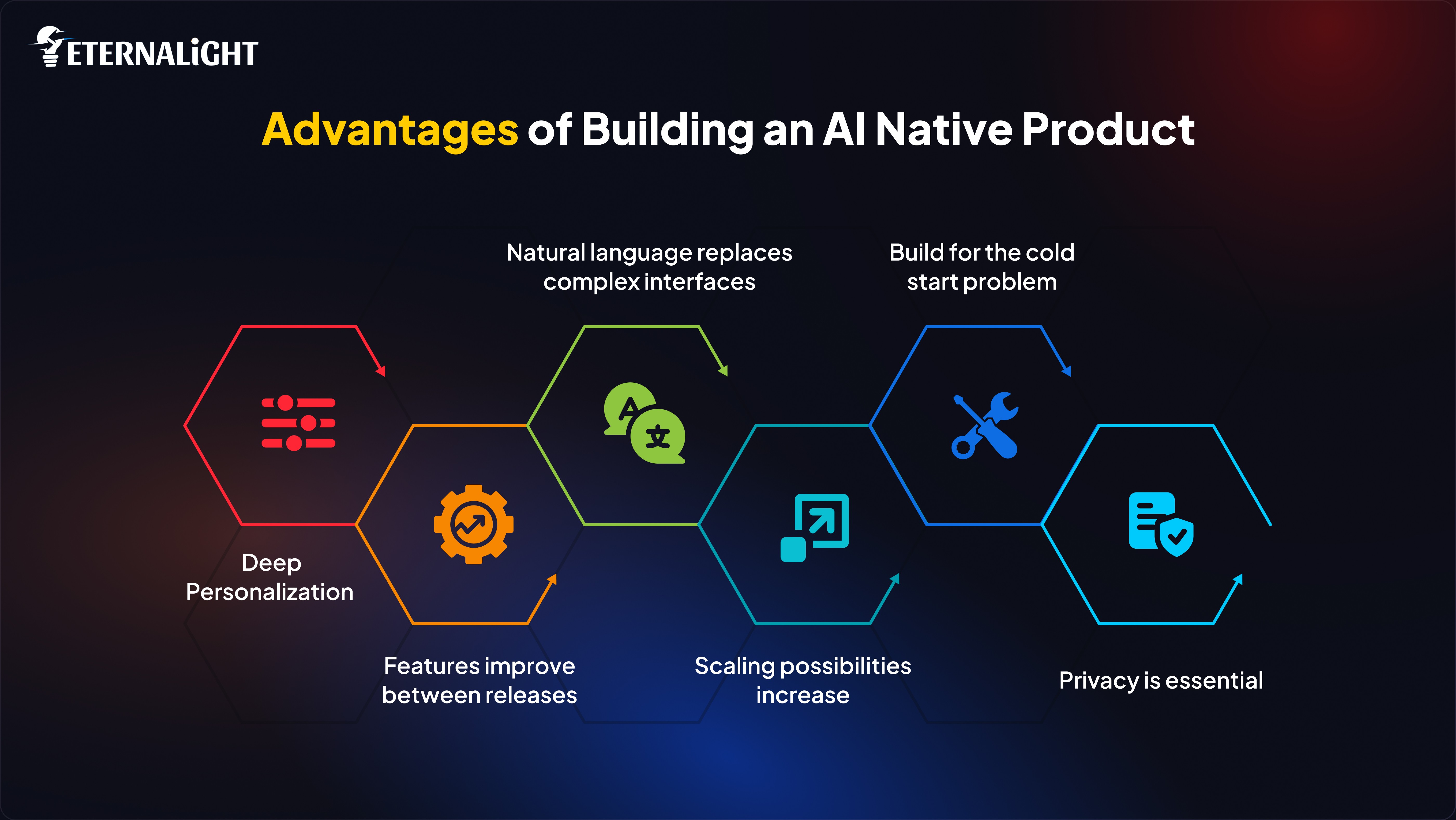
We’ve understood what native AI is, now let’s talk about what native AI architecture actually does for your business.
Traditional personalization requires building rules engines, managing user segments, and manually coding for different kinds of experiences. Native AI products learn preferences automatically and adapt continuously. Your AI team builds the learning system once instead of coding individual rules forever. The personalization is accurate and keeps evolving on its own. The ongoing maintenance costs will drop significantly.
When a user reports your product misunderstood their request, you add that example to training data and the model improves for everyone else. The product gets better constantly, not just when your team ship updates. This is a huge advantage over traditional feature improvements.
You can eliminate huge portions of your UI and make it easier and simpler for the average user to use. Instead of building forms and dropdowns for every possible input, you build interfaces that accept natural language and interpret intent. This reduces the complexity and maintenance burden of AI products.
Traditional software scales by handling more requests with the same features. AI native products scale by becoming more capable and adept. A model trained on ten thousand user interactions understands nuances that a model trained on one thousand simply cannot. The quality gap widens over time.
Companies that rebuild themselves as AI first see many improvements. Their support tickets drop, conversion rates increase because onboarding flows are more personalized automatically. Retention also improves because the product gets better at solving each user's problems over time. The impact shows up in the metrics.
Most startups build features first and figure out data collection later, but your data strategy determines everything for an AI Native Product.
AI native startups need data right from the start. This data has to be structured feedback loops that make the product smarter with every interaction.
Every AI product faces the same challenge at the beginning: you have no user data yet. Your models have nothing to learn from. Some companies might try to wait until they have enough users to make data useful. They lose months of potential improvement.
Smart startups solve this problem differently. They use synthetic data to train initial models. They partner with early users who know that they're helping shape the product. They build feedback mechanisms into every interaction, even if there are only ten users. The companies that win this challenge start collecting useful data right from day one.
Traditional software collects analytics whereas AI native products collect training data. There is a huge difference between both.
Analytics will tell you what happened. Training data will tell you what happened, and predict what should happen next. It makes your product better at predicting and planning for the future. Most companies need both these features, but you shouldn’t be treating them the same way at all.
Your architecture should capture:
User intent, more important than user clicks
Success signals, not just completion rates
Context around every interaction with the user
Corrections when the AI gets something wrong
Most importantly, this data needs to flow back into your models automatically. If improving your product requires you to manually export data, multiple SQL queries, and engineering sprints, you're not AI native. You're just collecting data logs.
AI data integration creates a lot of privacy risks. Your models learn from user behavior. Every interaction is captured and analyzed. You're processing potentially sensitive information in ways that traditional software never did.
GDPR and CCPA already apply, but many AI specific regulations are coming fast. The EU AI Act went into effect in 2024. Similar laws are spreading globally. Companies that treat user data casually will be facing legal problems and lose user trust.
Build privacy into your data strategy from the beginning:
Collect only what your models need
Make data deletion possible, including from training sets
Let users see what data you're using to personalize their experience
Be transparent about how AI uses their information
Every user wants to know their data and information is safe. The startups that nail privacy early on will gain the most trust from their uses.
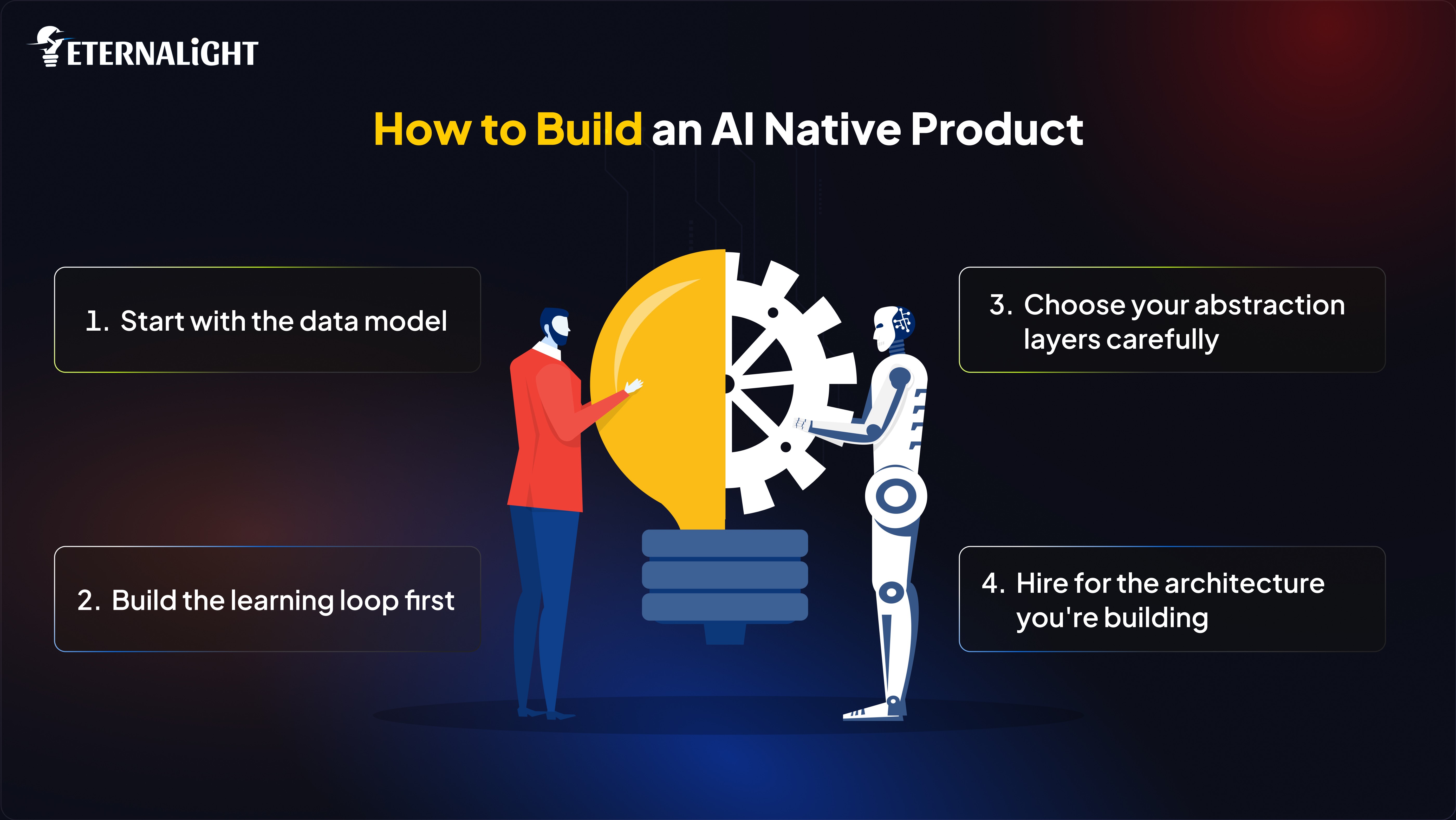
You don't need to have everything figured out before you begin building your product. But you do need to make certain architectural decisions early on. These decisions are hard to change later and impact your product completely. Here are some basic steps to help you build your AI native startup:
Design your database assuming models will need to understand relationships, context, and how things change over time. Traditional normalized schemas that are optimized for transactional integrity often clash with the access patterns that AI systems need. Think about what the AI needs to learn from, not just what you need to store and save. Your database is more than a collection of data, it’s your training manual.
Before you add too many features, build infrastructure for collecting user feedback, retraining models, and measuring improvements. Companies that skip this step will end up with a static AI model that never improves itself. It is highly important that you build your learning loop immediately.
You want to have the flexibility to swap out models as the better ones launch. But you also need tight integration for good performance. The companies succeeding with AI product development build abstraction layers that balance both of these needs. Too much abstraction kills performance, but too little locks you into models that might go obsolete.
You need people who understand modern software engineering and how to build systems around AI models, how to build software with AI as its core component. This is different from traditional full stack development. Your AI team should include people who have shipped production ML systems.
Your error handling, your UI, your entire product logic needs to account for AI not returning identical answers to identical inputs. Products have to be designed around deterministic logic break in subtle ways when you add intelligence. Plan for variability from the start.
The companies getting AI data integration right aren't doing anything exotic. They're making different baseline assumptions about how software works.
The next three years will see two types of companies.
Companies that see AI as infrastructure. They will build products that feel effortless and are easy to use for the users. Their unit economics improve with scale because models get better with more data.
Companies that use AI as a feature will run a tiring race. Every new capability requires integration work across all systems. Every improvement demands coordination across codebases. Competitors with better architectures will undercut them on price while delivering superior experiences. This difference is huge. It determines who dominates the market and who doesn’t. Your competitors are making these architectural decisions today.
The window for building AI embedded systems from scratch is wide open right now. But this window won't stay open forever. As native AI architectures become standard, the advantages they provide become baseline expectations. The differentiation opportunity exists right now. You have a choice that will define your company's trajectory.
At Eternalight Infotech, we've seen what works and what doesn't. We know how to determine the best AI strategy for your specific market and constraints. Our team handles the complexity of architecting for intelligence so you can focus on building features your users actually want.

Gauri Pandey
(Author)
Technical Content Writer
Frequently Asked Questions
Contact us
Send us a message, and we'll promptly discuss your project with you.