AI & ML
8
Mins
Why Enterprises Are Investing in Custom AI Solutions
Explore why enterprises are shifting from generic AI tools to custom-built AI systems. Learn the key business drivers, ROI benefits, and how to choose the right development partner.
AI tools have quietly become part of daily work, from writing code to drafting strategies. But every time a team pastes data into an AI tool, they may also be exposing something valuable. Along with its innovation, AI has also raised concerns about privacy and the protection of IP and other valuable assets. This blog covers the risks and strategies for managing the challenges of maintaining privacy compliance to secure IP when using AI tools.
Nowadays, using AI is a double-edged sword if you're not careful about what and how you access information; this can put your privacy at risk.
Initially, people were very interested in AI adoption in business, but they soon raised concerns about privacy violations. Now, it's the trending topic across all startups, AI meetups, and social platforms.
We can’t ignore AI's use, given the privacy risks, as it's now an essential norm that needs to be integrated into core organizational workflows.
By learning security strategies and capabilities to navigate challenging scenarios, we can address these problems.
Before we cover best practices for protecting IP, let's first understand the risk impact of using AI tools in real life scenarios.
Teams now use tools like ChatGPT for research, coding, and planning. If you’re first time using ChatGPT, typing the directions as a prompt; it will generate the output. But there’s risk of data persistence, training, or logging depending on tool policies.
When teams use AI tools, they often share internal ideas, code, or documents without realizing how that data is stored or processed. Without proper policies or enterprise-grade controls, organizations may lose visibility over how sensitive information is handled.
While any organization may be testing AI tools on third-party tools or open-source platforms to save a little bit, this practice can weaken security and lead to a data breach.
In some cases, models can unintentionally expose patterns or insights derived from sensitive data, creating transparency and ownership concerns.
If the tool doesn’t comply with the security standards and protocols, it can put the business at risk, compromising their brand reputation in the public domain.
Organizations must be cautious about any data shared with AI systems, especially when it involves proprietary information.
First and foremost, the key practice is to revisit the organization's core processes, how AI tools are integrated, and the amount and type of data that can be shared across distinct product development phases.
For founders, this isn’t just a technical issue, it's a business risk. Intellectual property includes ideas, algorithms, product designs, customer data, and internal strategies. Once exposed, recovering ownership or exclusivity becomes extremely difficult.
As we know, AI and LLM have become the centre of attraction. These tools and models can be trained on historical and real-time data. However, as they lack emotional intelligence, the information can be misused and misinterpreted for further uses.
To avoid conflicts, many top organizations are installing access control and audit tools, encryption mechanisms, and data masking and anonymization tools to reduce the risk of unauthorized access and of sensitive data being transmitted or lost across unknown sources.
Sometimes a little negligence can lead to legal issues. As a startup founder, you should know the following.
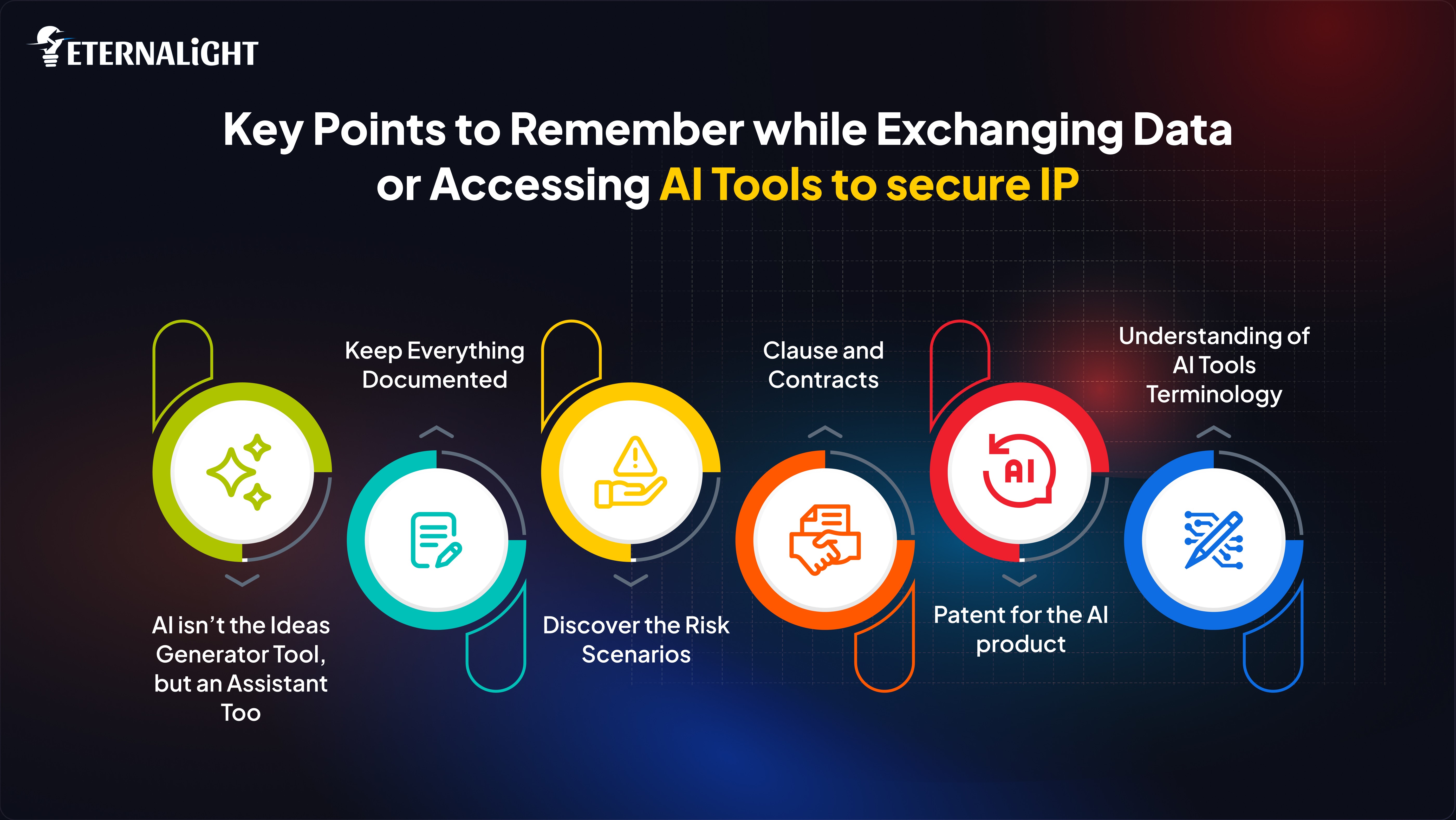
AI tools don’t create or suggest anything on their own; they take user input as prompts and then propose content, strategies, and other outputs. AI alone isn’t intelligent enough to identify or analyze without human intervention; it doesn’t understand what constitutes copyright infringement or how its creation can trigger copyright issues.
If you ever get stuck in a legal compliance matter whom you call first? The lawyer. In any legal situation, decisions and judgments are based on evidence and proper documentation.
To avoid any serious legal battle it's better to document every process and approach while using or working with an AI tool to develop any software product, to know how data privacy is protected, where the data is stored, and how things are controlled and managed through AI.
AI-generated outputs may contain inaccuracies, unverified sources, or similarities to existing material. Whether it's a startup or an enterprise-grade business, maintaining brand visibility and credibility requires creating content that is ethical and original.
To ensure everything is perfect, run regular IP audits for clearance and check content for AI and plagiarism.
Contracts should clearly define ownership of AI-assisted work, data usage rights, and confidentiality obligations. Before signing any deal or project with agencies, freelancers, or other consultants, ensure you have signed the contracts to avoid conflicts.
Mention the clause to maintain transparency of all the resources, tools, and IP rights assigned to the organization.
Having a clause like this in contract documentation will reduce the risk of unethical practices, ambiguity, and violation of ownership policies and norms.
Whenever a startup has an idea they want to protect, they focus on obtaining a patent or access to trade secret legislation as soon as possible. However, if the startup is closely involved in developing the algorithm or model that will be used at scale by others, retaining an attorney is more advantageous.
If the data is confidential or involves legal review, lawyers should draft NDAs and employee agreements to safeguard systems, data, and internal controls.
To develop and launch AI-driven products, startup founders rely on third-party tools, many of which are not accessible for long-term commercial use. For each tool, terms and services vary; therefore, be mindful when using any AI-generated content or media in your app or website to help protect you from potential legal claims.
To balance innovation with protection, founders need structured practices while using AI tools. Below are key measures that help reduce IP risks.
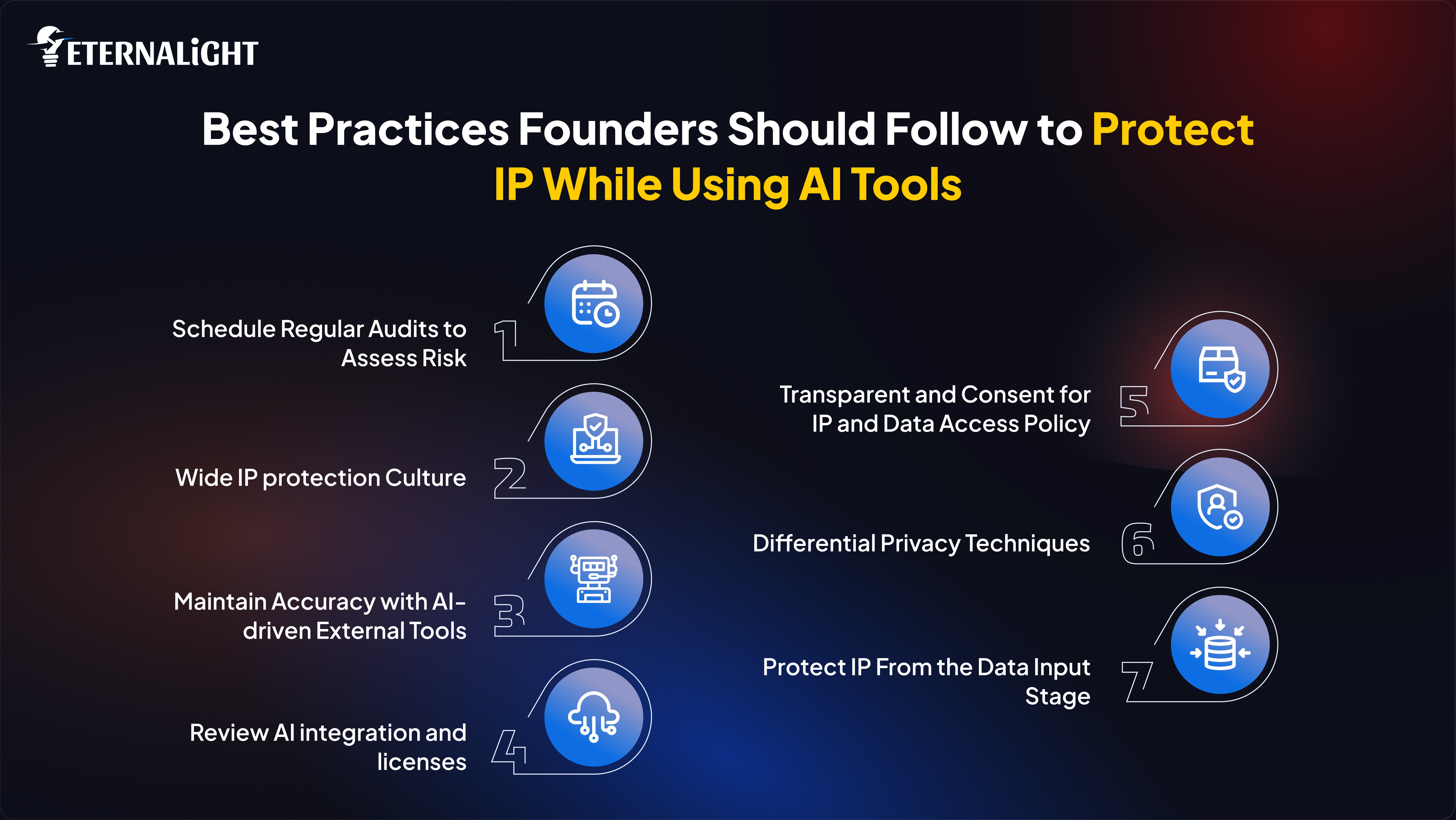
AI tools vary in their intricacies, approaches, and norms across industry domains. To drive the business without compromising IP security, a carefully defined approach should be followed from start to finish.
Given evolving market dynamics, it's essential to regularly scan for potential risks through scheduled audit journeys.
To that end, the organization can deploy automated monitoring tools that detect unethical and unauthenticated patterns, behaviours, and movements, and alert them to take action before the threat is encountered.
Circulating the risk assessment is also a wise step to determine whether the integrations are outdated or require replacement to avoid IP vulnerabilities.
Every organization has a different way of working; not all organizations use the same tools and platforms. An employee may install third-party software and tools to streamline their work, but the organization doesn’t support it.
An organization can enforce guidelines and policies to prevent access to third-party tools or pirated versions. They can circulate IP ownership agreements defining the list of verified software and set rules on how and when the software tools are acceptable. They can ensure that all data is stored, deleted, and encrypted in compliance with data and IP security standards.
Furthermore, organizations can conduct regular virtual or in-person training to educate employees on the nuances of AI and ensure accountability for their initiatives and AI development practices to safeguard IP.
Ensure that the tools employees use in the organization are used only to fulfil their purpose, as needed. All datasets and information should be accurate, unbiased, and filtered in a visually representative format, without compromising the quality of the AI model's processing and algorithms.
Installing and integrating third-party vendor programs may reduce financial debt and improve efficiency and operational capabilities, but if they are not developed in accordance with security compliance standards and policies, they can lead to data breaches or cyber lawsuits.
Before entering into any collaboration or partnership, review licensing terms, data usage policies, and security compliance requirements.
Ensure that while developing AI-integrated systems, all data that feeds is stored, accessed and transferred, taking user consent. Enable the user to have full control over which data can be used to generate responses and to enable the system to make decisions.
Strengthen the privacy of customer-facing AI models and systems to prevent exploitation in the public domain. It is essential that systems access geographic location data to generate meaningful outputs from real-time information.
This can be sensitive; to balance privacy with data utility, differential privacy techniques should be used, although they require expert-level expertise and are worth it for peace of mind.
AI models and tools function on processed data that’s fed in before launch. To manage which data is accessible to the public, data needs to be segmented and classified accordingly. If we feed all available data without filtering, it will create confusion and information overload.
To improve the efficiency of AI tools and models, adopt data minimization techniques to avoid unnecessary data transmission across AI software development companies, and integrate access control systems to enable role-based access and restrict unauthorized access.
AI can accelerate innovation but only if companies protect what makes them unique. For founders, AI is not just a productivity tool, it is also a legal and security responsibility. The businesses that build AI usage policies early will innovate faster without putting their intellectual assets at risk. At Eternalight Infotech, we use AI tools, but we comply with applicable norms, policies, and security protocols. Data privacy and IP protection are essential.

Ayushi Shrivastava
(Author)
Senior Content Writer
Contact us
Send us a message, and we'll promptly discuss your project with you.