
AI & ML
10
Mins
The Rise of AI Agents with Gemini: A New Chapter in Intelligent Automation
Discover how Gemini enables AI agents to think, plan, and act in real-world scenarios.
If you've spent any time around AI tools lately, chances are you’ve heard the name Claude thrown around a lot.
Anthropic’s Claude is a global competitor and a dominant force in the AI industry, rivalling OpenAI’s ChatGPT and Google’s Gemini.
Claude goes beyond the normal chatbot features by handling complex tasks and solving them efficiently.
Anthropic released Claude Opus 4.6 on February 5, 2026. A few weeks before that, it also released Claude Cowork. Both have caused commotion in the world of AI.
This article explains Opus, its features and differences with other models, how Cowork fits in, and how this becomes worth your time.
Opus is the most powerful model in Anthropic's Claude catalog. Founded in 2021 by OpenAI’s researchers, Anthropic structures its models in three tiers: Haiku at the lowest tier for fast, quick tasks. Sonnet is in the middle for everyday use, and Opus at the top for demanding and complex work.
Opus differs from Haiku and Sonnet models with its depth of reasoning. It can handle tasks with more steps, more nuance, and more difficult parts. It is slower and takes more time than the others and costs significantly more. However the difference in output quality is significantly visible too.
What tasks does Claude Opus do? It can write and debug code across entire codebases. It can analyse lengthy contracts and regulatory filings. It can synthesise research from dozens of academic papers and it manages workflows that take hours without making mistakes.
According to Anthropic's Head of Product Scott White, in a recent interview, Claude went from a model that ‘you can sort of talk to, to something that you can actually hand real work to’.
The difference and shift from a chatbot to a coworker is the reason behind the hype and commotion to Anthropic’s AI tools lately.
You pay for that capability too. Claude Opus 4.6 costs $5 per million input tokens and $25 per million output tokens.
The practical question people have is when to use Claude Opus vs Sonnet vs Haiku. The answer comes down to the stakes and complexity.
Sonnet handles writing, summarising, answering questions, and simple coding tasks well. It is faster and cheaper, and for most tasks the output is well done and satisfactory.
You use Claude Opus when the task involves advanced steps, when documents are long and need to be read and compared against each other, or when a wrong answer can have consequences. Think of legal work, financial modelling, complex software projects. These are where Opus should be your first priority.
What makes Opus technically different is that it allocates more reasoning capacity before answering. It tracks and remembers longer context without losing accuracy.
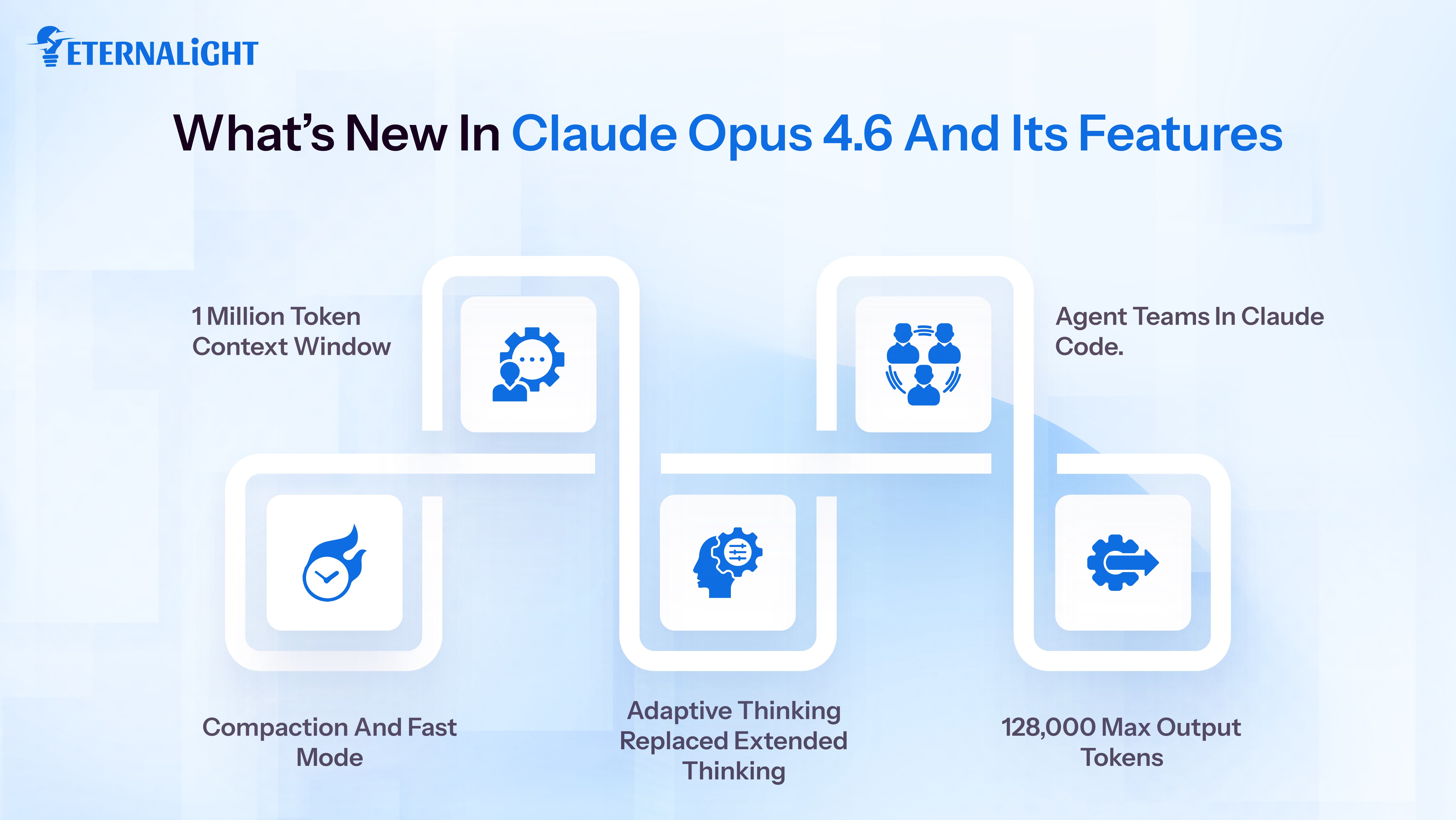
This is the biggest change from its previous version. Opus 4.5 had a 200,000 token window. Opus 4.6 expands that to 1 million tokens in beta mode. That translates to roughly 750,000 words or about 30,000 lines of code in a single session.
Previous models were able to accept large inputs but their accuracy was off and would grow worse as context increased.
On the MRCR v2 benchmark, which tests whether a model can find information across very long documents, Opus 4.6 has scored 76% at 1 million tokens. Sonnet 4.5 scored only 18.5% on the same test. That’s a massive upgrade.
Instead of a single AI agent working through multiple tasks one by one, Claude Opus 4.6 can split work across multiple agents running parallelly. One agent might research while another writes while a third agent checks facts, all can coordinate automatically. This is currently under the research preview for API users using the model string claude-opus-4-6.
Opus 4.5 allowed you to toggle extended thinking on or off. Opus 4.6 lets the model itself decide how much reasoning to apply based on task complexity.
There are four effort levels: low, medium, high, and max. The default is high. On simple tasks and low effort levels, the model skips deep reasoning to save time and cost. At higher settings, it applies more reasoning. This replaces the binary thinking toggle with smarter, automatic resource allocation.
Claude Opus 4.5 capped responses at 64,000 tokens. Opus 4.6 doubles it. This means longer code generation, fuller documents, more complete responses without hitting the truncation limit mid output.
A new speed option also generates output up to 2.5 times faster at premium pricing of $30 input and $150 output per million tokens. When conversations approach the context limit, the API will automatically summarize earlier parts to extend the session.
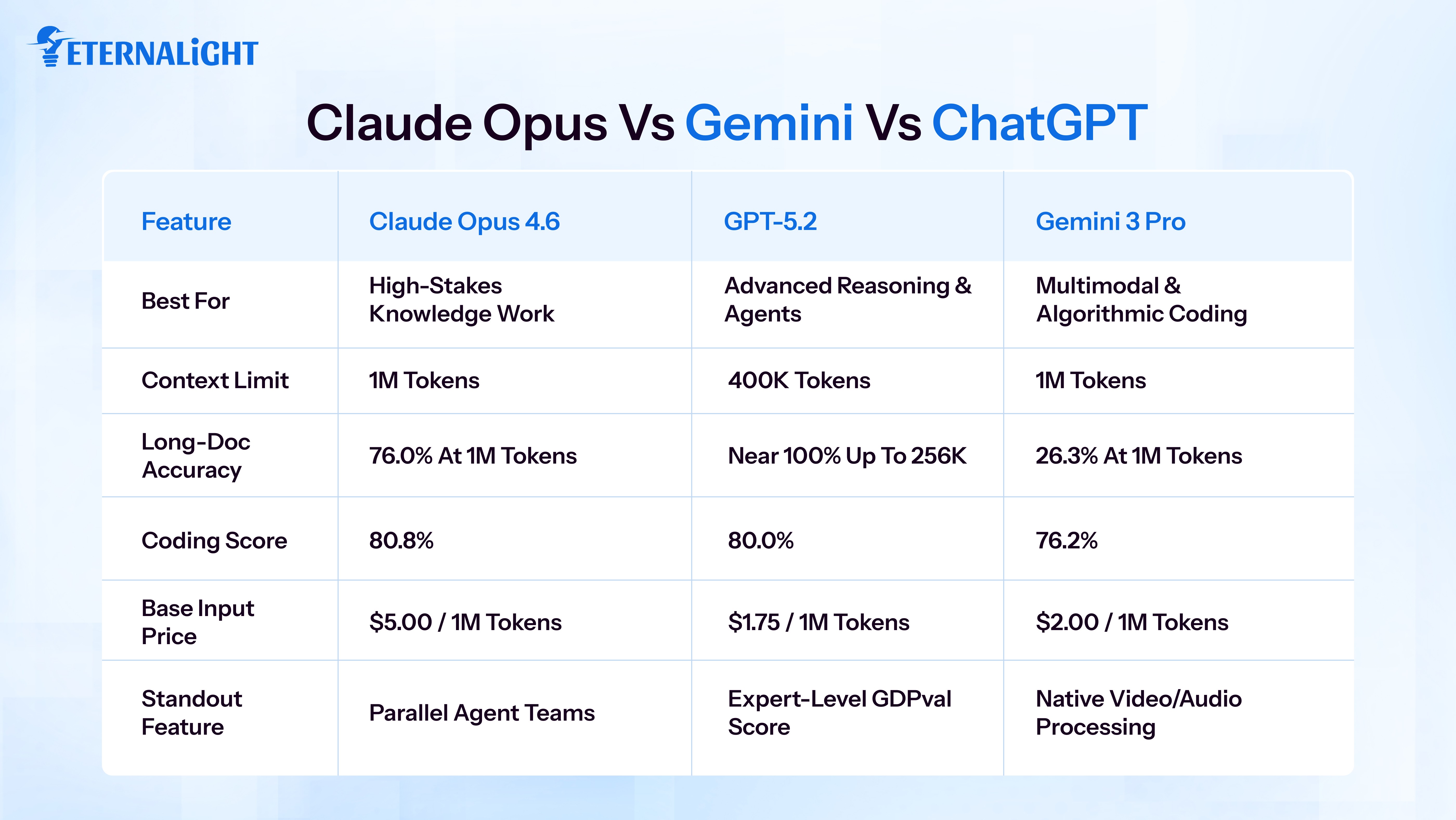
For casual tasks, both tools are capable and the gap between them is not dramatic. But on professional and agentic work, Claude pulls ahead. On GDPval AA, which tests finance and legal reasoning, Claude Opus 4.6 model outperforms the GPT 5.2 model roughly 70% of the time. ChatGPT has a wider installed base. As of January 2026, 77% of enterprises use OpenAI in their production compared to 44% for Anthropic. This gap is shrinking as more companies test both models and choose the better one based on performance.
Gemini 3 Pro has an advantage over Claude with its context windows that go up to 2 million tokens. But having a large context window and using it accurately are two very different things. Opus 4.6 scores 76% on the long document accuracy test meanwhile Gemini 3 Pro scores 26.3% on the same test. Having more space available does not help if the model is not accurate with the length increase. For professional work where you need to reason across long documents accurately, Opus holds up better.
Claude Cowork launched on January 12, 2026 as a research preview inside the Claude Desktop app.
Anthropic describes it as Claude Code but for the rest of your work. That framing makes complete sense when you understand the usefulness of Claude Code. It is a terminal tool for developers that lets developers hand off coding tasks from the command line and get working code back.
People from other fields saw that capability too and wanted it for their own work. Claude Cowork is what Anthropic built for them.
Cowork can do multiple things. It can organise a scattered folder accumulated over months, turn a pile of receipt photos into a formatted expense spreadsheet, and produce a draft report from multiple research notes. The product runs in a sandboxed container. Only folders you explicitly share with Claude are accessible to it. Your other files stay on your device.
The model powering Cowork is Claude Opus 4.6.
On January 30, Anthropic added a plugin system. Eleven open source plugins now exist covering sales, legal, finance, marketing, and customer support. Each plugin bundles workflows, tools, and slash commands specific to a department. A sales plugin connects to your CRM, learns your sales process, and gives you commands for prospect research and follow ups.
With the help of Cowork and Opus, Anthropic has seen rising demand for its products lately.
Claude Opus 4.6 is the most capable version of Anthropic's model yet.
The jump from Claude Opus 4.5 to 4.6 is immense. A context window that grew from 200K to 1 million tokens with real accuracy at that scale, and additional capabilities that make us excited for the future versions of Claude and what they might achieve.
For developers, those capabilities are live in Claude Code right now. For everyone else, Claude Cowork brings the same power without needing a terminal.
The shift Anthropic is pushing towards is clear. AI that doesn't just assist but becomes part of your team and completes your work accurately. As the Anthropic community grows, expect to see AI become a part of your daily workforce, your assistant and a helpful hand whenever needed.

Gauri Pandey
(Author)
Technical Content Writer
Frequently Asked Questions
Contact us
Send us a message, and we'll promptly discuss your project with you.