Software Development
9
Mins
Top Mobile App Development Trends to Watch in 2026
Learn about the latest mobile add development trends that are taking over the world in 2026 and beyond.
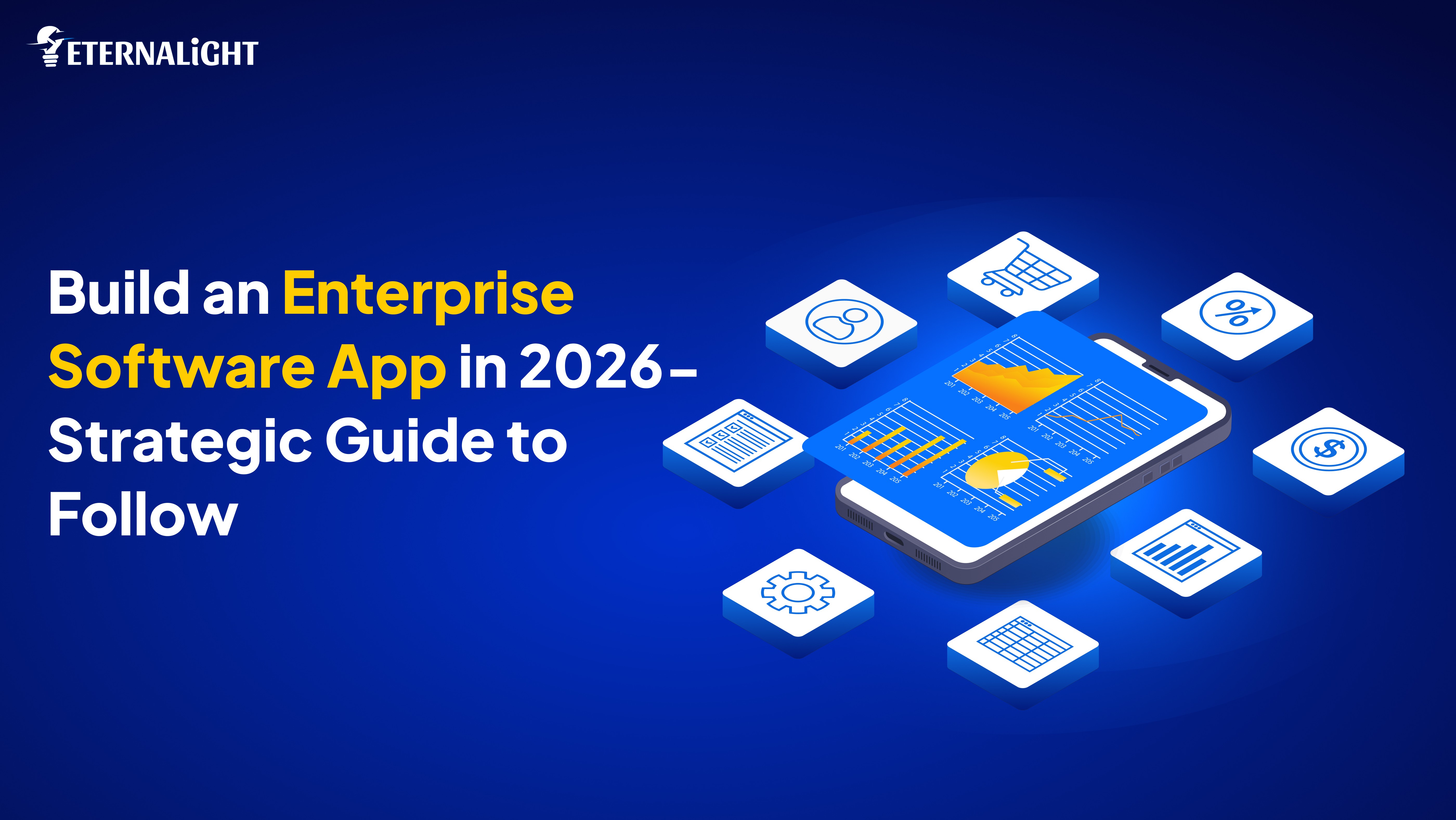
Building enterprise software is a big task. One small mistake can lead to over-budget costs, delayed release, and inconsistent features and workflows.
This happens when we don’t do the groundwork and lose direction midway. Before setting up the production environment for enterprise software, it's better to have a plan so you land in the right strategic place.
This blog covers the roadmap for building an enterprise software app without losing key strategies and avoiding common mistakes.
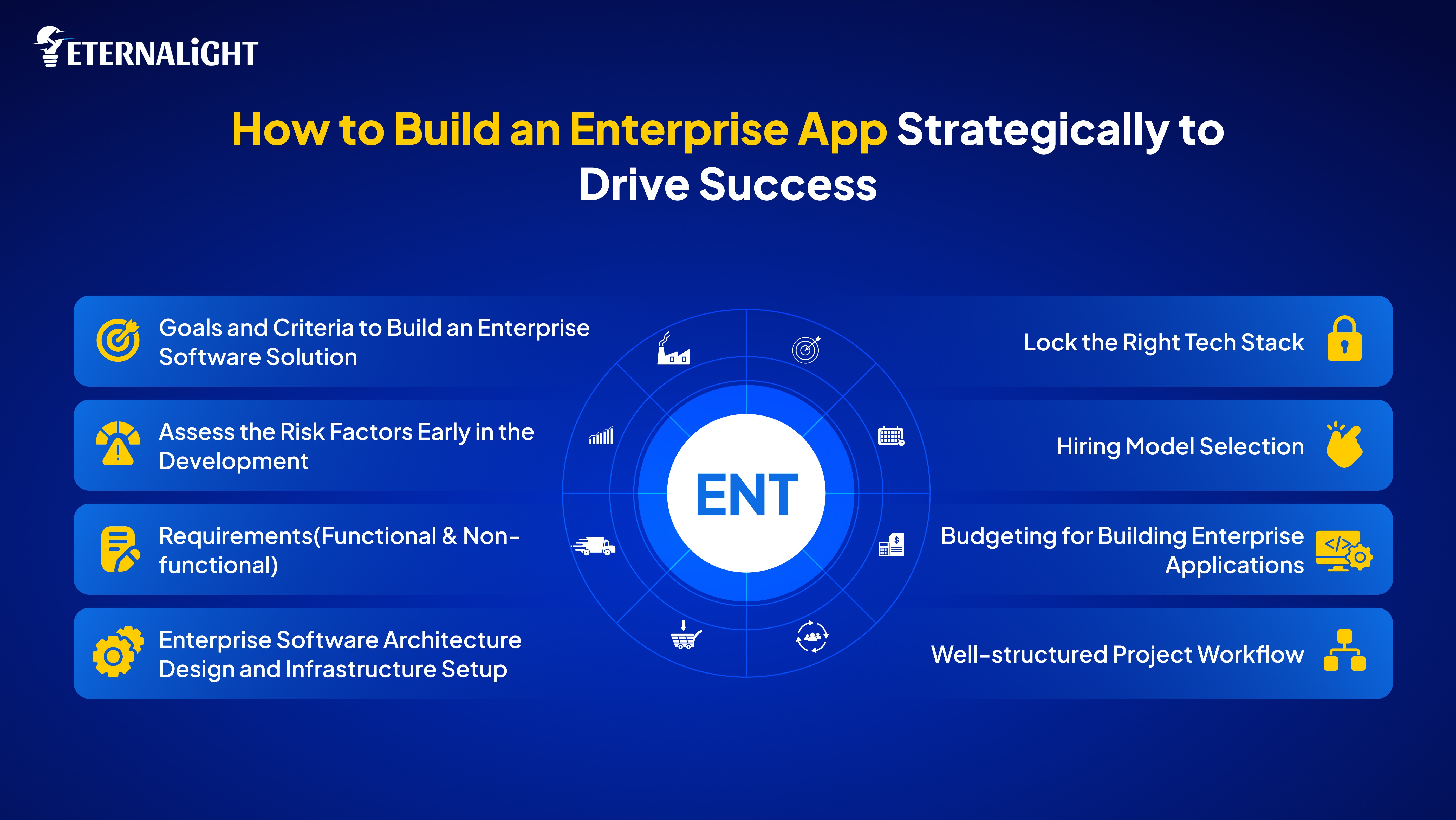
No one starts a project just to fail, but if your plan is wrong or doesn't fit the idea, it won't be worth it. A plan leads the planning, and a plan that seems to fail in the first instance will definitely fail the software.
To solidify the success of an enterprise software development project, build a solid plan first.
Whether it’s a pilot project or a customized version, enterprise software of either type usually takes 4 to 12 months to complete.
How can you measure the success of any project if you are not clear what you want to achieve?
Only the milestones and goals help to understand how far you’ve come and what is left to accomplish.
Collaborate with your software development team to outline the plan and strategy, and notify and document all angles from the development team, end users, and CTO and CFO levels. To set a plan, three metrics need to be considered.
Identify the problem that will be solved after developing this enterprise software
Track the project's success and how each phase yields the outcome
You initiated the process to build software to clarify the KPIs, but all your efforts will wasted until the user benefits.
Once you define business KPIs, don’t forget to define technical success metrics as well to evaluate performance benchmarks, user load, data volume, estimate uptime, and other compliance measures to validate software reliability.
If you’re clear about your vision, it will get easier to visualize the project's success. But some stakeholders get mistaken in defining them.
Using modern, fancy terms looks good on the page, but can be meaningless if it lacks the criteria.
Users understand the problem, the development team knows what technical work is needed to solve it, and other stakeholders discuss time, budget, and other performance criteria to select the best team. If they all move in different directions, following a different track, this will surely lead to failure.
So just avoid them.
Be it an MVP project of short-term duration for a startup or an enterprise-grade large project, both carry some risk. Technical glitches, deficiencies, inconsistent vision, and a lack of planning often cause project failure. It's better to identify and measure the risk factor first to avoid costly mistakes.
If you’re not sure about the project scope, the actual hours to work on a project, or who will take responsibility for the task, it creates a risk to project success; it's better to schedule everything.
When a project's build phase starts, it can happen that you couldn't finish a certain phase on the given date few days' fluctuation in dates is pretty much common, but that delay and extended time efforts come with financial strain if the project is not assigned to the right person or if there is a lack of tools, then it will impact the project.
Unavailable skilled resources, lack of a mode of communication, and slow outcome process often lead to failure
Unsecure connection, integrations, and inefficient tools add to the technical debt, leading to technical vulnerabilities
As the customer demands evolved and market dynamics transformed, that impacted the business vision too. Any changes and upgrades will also modify the development process.
If you identify the risk before starting the UI/ UX and coding part, it would make things under control, or it will lead to rework. If the risk is addressed earlier, at the first stage, using risk mitigation strategies, your project will not go into the bin.
Don’t be fooled by the assumption that the risk won’t occur; accept the situation no matter what.
Discover the list of best-case scenarios of failure and worst-case scenarios, along with the initiative you would like to take on if it turns into reality.
How to fallback on those risk events?
If you have blindfolded it, that doesn’t mean risk doesn’t exist to keep everything in sync and under control, and to have a proactive, strategic contingency plan. Delays or any negligence may cause your software to break down, leading to costly failure.
When enterprise software companies begin developing a business idea, they first ask about the requirements. Like, what are the complications that businesses want to overcome to engage their end users? Business logic and vision are different, but if you are unsure of the user’s expectations, it can create an imbalance.
This lack of requirements information will affect development costs. Research also indicates that more than 37% of enterprise software drove because of unclear requirements.
Thus, to resolve this issue, companies prefer to incorporate all stakeholders' opinions and end-user input. Then prepare the documentation listing all functional and non-functional features, requirements, scope, top-priority tasks, and phase-wise execution and timeline.
These SRS documents describe how the software will function and be utilised by end users, as well as the key features for each accessibility level.
Non-functional requirements are one of the success drivers for enterprise software. Don’t neglect response time, SLA, data protection metrics, the disaster recovery roadmap, and the scope of scalability.
Before initiating development, call everyone to discuss this SRS. If anything is left to be included, it can be mentioned. After that, the team can start working on the prototype and wireframing test cases.
This SRS is useful as KT if a new member joins the team or leaves the project midway, so new members can go through it and know what needs to be built and how many milestones remain to be achieved.
You can’t skip either the functional or the non-functional; both are essential to claim success. If anything is unclear, this will be a waste of time, effort, and money, frustrating the end-user experience.
Monolithic and Microservices are the two common architectural design terms that come to mind during development. Both have unique pros and cons. Monolithic architecture is simpler to develop and manage initially, while microservices offer better long-term scalability and independent service deployment.
If the project scope is low and end-user usability is specific and limited, with moderate need to manage user data, then a monolithic architecture is the best choice. It's simple, unified, and takes less time to build.
These architectures are composed of an array of services that work independently. It somehow drops the chances of blast radius events but can’t ignore resilience patterns. If the project scope or traffic volume increases, it enables scalability; however, it takes time and is also complex to manage as multiple services are deployed for unique accessibility.
Nowadays, in 2026, modular monolithic is adopted by organisations to keep a balance of scalability with simplicity; you should follow any trend or be rigid on a specific. Determine the system architecture and align it with the project requirements.
Read more on monolithic to modular architecture in this blog.
https://eternalight.in/blogs/from-monoliths-to-modular-driving-agility-with-composable-architecture
Beyond following trends, make the system design decision based on system load, development expertise, frequency level, and maintenance effort.
While developing enterprise software, you need to add a few external integrations and architectural dependencies, mismanagement will encounter scope creep.
Ensure that whatever you’re designing enables flexibility with legacy tools and allows you to engineer an innovative solution that's manageable and low-maintenance.
The next thing that needs your strict attention is the deployment source. It could be cloud-based, on-premises, or a hybrid model.
Cloud-computing Deployment:
Any small or large startup, business, or enterprise looking to shed the burden of additional resources at low maintenance and low cost can access this for the initial days, specifically to cut costs.
On Premises:
Enables strong ownership, robustness, and privacy, but is expensive, making it best suited for BFSI, healthcare, defence, public sector domain or where user data security is a priority.
Hybrid Cloud:
Access flexibility and scalability, enabling services for the cloud and on-premises, and keep the software reliable and flexible from the initial stage. You can go for a hybrid model.
An enterprise software development company should consider data residency requirements, latency constraints, and other strategies to manage any type of disaster before choosing a deployment model.
Whatever your accessing infrastructure and architectural design of enterprise software, it should function in the long term.
Emerging technologies and trends, every day and every week, drive innovation and enable us to experiment. However, it doesn’t mean your chosen techstack is wrong..
Each project has its own vision and business logic, so it's up to us to decide what works for our project, considering budget and requirements, and especially the end users.
If you are ignoring a tech stack or technology tool due to budget constraints or because team members are incapable, it doesn’t make sense. If you think the project can drive more clients and partnerships in the future, you can subscribe to the resources on demand or on-premises.
Onboard the heads to scale your team outside the organization at a low cost from other geographical regions.
Applications and software run both the server and the client; it's crucial to keep the balance by aligning all the dependencies.
On server side: web server, operating system, local server, Web framework, programming language, database,
On Client Side: frontend language (HTML, CSS, JS, Native app), user browser, user device
For each project, you can’t rely on the same language or framework; you need to decide on the tools based on the requirements and business goals.
Programming Languages | Java, C#, Python, Rust, Dart |
Backend Tool | Spring Boot, Ruby on Rails, Node.js, NextJS, .Net |
Frontend Tool | Angular, React, Vue.js |
UI/ UX | Figma, Illustrator, Adobe Photoshop |
QA Tools | Selenium, Postman, Cypress, Jest |
DevOps Task | Jenkins, GitHub Actions, Bitbucket Pipelines |
Cloud Support | AWS, Microsoft Azure, Google Cloud |
Database | Redis, PostgreSQL, MySQL, MongoDB |
While choosing any tech stack for your organization, keep performance, efficiency, scalability, growth, and market dynamics in mind. Also, make sure you can access the right enterprise software developers for dev tasks.
Furthermore, that tech stack should also address community support, vendor lock-in, and complex scenarios, and scale resources with a sustainable and stable framework.
Your team is the key driver of the business; they're responsible for the entire project cycle, from initial discussion to final execution and release.
Thus, each member should have the right skill set to take ownership of every move. If your internal team is lacking bandwidth or skills at any point, don’t hesitate to use team augmentation services to outsource resources.
If you think, in future projects, you need to take work from the same resources using similar tech stacks, then go for onboarding new full-time candidates.
While the benefit of hiring an in-house team is full control, it is strategically and process-wise difficult to increase, considering the budget.
You can pick the next option, a hybrid model, to balance core tasks and secondary important tasks between in-house teams and outsourced team members.
To avoid any conflicts, or choose to outline the ownership clauses and responsibilities before the development work gets started.
If roles and responsibilities are not clearly identified and discussed first, it leads to unclear communication gaps, delays, and other glitches.
Instead of quantity, go for quality-driven, skilled professionals who can take on the responsibility. Hiring 2 4 juniors instead hires experienced 2 people to share the load. Having senior-level professionals will support long-term project management and decision-making.
Initiate timely cross-team sync-up meetings to bring everyone together, understand each other's roles, responsibilities, and workflows, and accomplish the business goal vision on time without hampering the schedule.
Without finance, it's harder to turn the idea into a functional product, and in software development, budget planning isn’t just about development costs. Think about a scenario where you have just begun the discussion, and the initial setup and half of your budget have been spent. It's not easy to get immediate funding on demand.
We need to look over the:
Assigned team members, tech stack(framework and other tools, integrations), project scope, and its functional complexity.
How will you deploy your application, like accessing cloud services, on-demand servers, or other license agreements, and a subscription for the application setup
To ensure everything is well synced and aligned with the enterprise vision, the team needs to perform various types of testing and obtain certifications, conduct tech audits, and use quality assurance tools.
Once the application gets released, bugs and technical mishaps can occur. To optimize the app/software to protect privacy and security, and to ensure data transmission, you need to invest some amount.
If you do not plan in advance for all the above-mentioned factors, it will be harder to manage. These sudden expenses will overwhelm business owners and create stressful situations.
Don’t exaggerate, but be accurate about enterprise app development costs. A realistic budget looks as follows:
Divide the budget for every phase systematically
Keep the stock of 10% to 25% finance
Choose the infrastructure, tools, and resources models as per your business requirements, not what others are doing
Regularly audit the market, latest tools, and trends to align the business with ongoing evolution to make the transformation seamless and adjust the budget
Ticking all the important things one by one:
Identified risk that blocks the development, causing delay,
Discussion is done to understand the goal and requirements, both in terms of technical and non-technical
Architecture for successful and seamless deployment,
Techstack,
Hiring additional employees is required to scale the team for the project.
Budget planning
Mapping all the dots from one to another, it’s time to define the proper flow of project development. It includes all your questions: what, why, how, whom, where, etc.
Until they clear doubts and queries that are roaming in their mind, you can’t process the faultproof plan. To avoid any struggling circumstances, the process is simple and straightforward.
You know the total count of phases or steps, so just do the following:
Prepare the listing of milestones
Realistic ETAs, considering all the uncertainties or immediate roadblocks
Allocation of resources: who will look after what
In short, set a standard agile development scenario in which the team resolves issues in every sprint, aligning with evolving requirements and preventing the project from failing.
While preparing the workflow, collaborate with all cross-functional stakeholders to gather their feedback and suggestions. Maybe you’re missing or forgetting something, so they can share their concerns and suggestions. This open discussion and collaboration will help your project avoid unexpected delays and technical glitches.
If you set the timeline in a hurry just to show off that the project will be completed early, the plan will collapse midway, as you can’t predict when it might fall in the way and delay the project, increasing unnecessary stress on backlogs.
So just keep things simple, realistic, dynamic, and flexible for every phase.
When your team starts working on low-fidelity design, high-fidelity design will drive the UI/UX for the next phase.
Once coding, QA, UAT is complete, production will be completed for the scheduled release.
What if any team member goes on leave, or any quality checkup or dependency hampers the project?
How will you push forward?
Allocate sufficient time and resources aligning the goals, avoiding scope creep. That's the formula for launching the enterprise app on time and within budget.
When things are done with careful brainstorming and planning of architecture and all, everything falls in the ground at the right place.
Get the right partner who can consult you to build an enterprise app and navigate the marketplace confidently. They will strategically turn the vision into functional enterprise software, eliminating technical and financial trade-offs.
It's been only 3+ years since Eternalight Infotech started in Pune, yet in that short time, they have demonstrated a strong ability to deliver projects on time. We don’t make false promises, but the ETAs align the market dependencies, circumstance and business.
Working with a mindset to deliver exceptional and innovative solutions, avoiding the pitfalls for various industries like Fintech, Sportstech, Foodtech, Traveltech, Edtech, etc.
Associated with top brands such as Razorpay, Navan, eMeals, and GoRally, with our talented team to eliminate the business complications with functional enterprise-grade software.

Ayushi Shrivastava
(Author)
Senior Content Writer
Frequently Asked Questions
Contact us
Send us a message, and we'll promptly discuss your project with you.