

Software Development
9
Mins
Top Mobile App Development Trends to Watch in 2026
Learn about the latest mobile add development trends that are taking over the world in 2026 and beyond.

You had the idea. The kickoff meeting was done. The roadmap was broken into sprints with a confident release date.
On paper, everything looked right.
Multiple features.
Layered integrations.
A scalable architecture designed to support future growth.
Months later, the product entered production. And that’s when the realisation hit: The problem still wasn’t solved.
Not because the team failed. Not because the technology didn’t work. But the product was built before the pain point was deeply understood.
The result?
A powerful application filled with advanced capabilities that nobody urgently needed. At the same time, a competitor launched a much smaller offering that appeared underwhelming at first glance.
No massive platform. No long feature list.
Just a focused micro-app solving one specific, high-frequency problem. And that was enough to gain traction. While your all-in-one product was waiting for adoption, their lightweight solution was already part of users’ daily workflow.
Months of effort versus weeks of clarity. That’s the shift defining how startups win in 2026.
Micro apps are a solution for addressing real-world personal needs and serving specific user bases. These differ from conventional mobile apps: smaller in size and focused on essential functionality to target a specific niche. The trend came to the forefront with the rise of LLMs, which remove stereotypes and technical barriers to building apps via prompts.
Initially, the development team conducted extensive brainstorming to build a scalable, long-term solution. But if it takes longer than expected to add advanced functionality, the delay directly affects runway and market timing.
Startups can no longer afford to wait, or set up sprints for 12 to 18 months to complete a full-fledged product. Users adopt the product that solves their problem first, not the one with the most features. With tight deadlines, limited resources, and small teams, today's startups aim to release a market-fit product.
Competition is high, and customer needs shift faster than traditional release cycles. If a startup takes longer to develop its product, competitors may launch first, creating liability. Only ambition and a large team don’t guarantee a successful launch, nor does a sophisticated sprint plan. Micro-apps shift the advantage back to speed and clarity.
Micro apps don’t require complex setup or a stake of functional integration. It reduces dependence on cross-functional professionals and enables a faster, focused build cycle to launch a high-impact, revenue-generating product.
Beyond size, it can reach the target niche audience within a limited time frame, measure adoption, identify churn early, and optimise onboarding from day one.
A large platform comprises multiple modules, which extend the development timeline and slow the release. For each module, QA needs to be more rigorous in validating functionality, security, and performance.
On such platforms, certain features are not yet needed but are still integrated even when PMF signals are absent, undermining the release.
Micro apps are a future-driven trend that extends accessibility beyond generic features. It gives the SaaS app development company the flexibility to tailor hyper personalized apps through subscription based services.
AI models can generate production-ready code and assist in real-time debugging.
Teams can understand domain problems faster through AI-assisted research.
Modest cloud hosting services enable easy deployment
Generic tools are losing relevance because of feature bloat and slow adaptability. Nowadays, the development curve has transformed with the emergence of AI. Companies no longer start by buying software. Their product manager can build an internal workflow tool, the digital marketing manager can launch a campaign performance dashboard, and the founder can build a customer onboarding tracker. Micro-apps are adopted faster because they are built inside real workflows.
Startups are reducing heavy hiring cycles; instead, they are using team augmentation services or adopting emerging technologies.
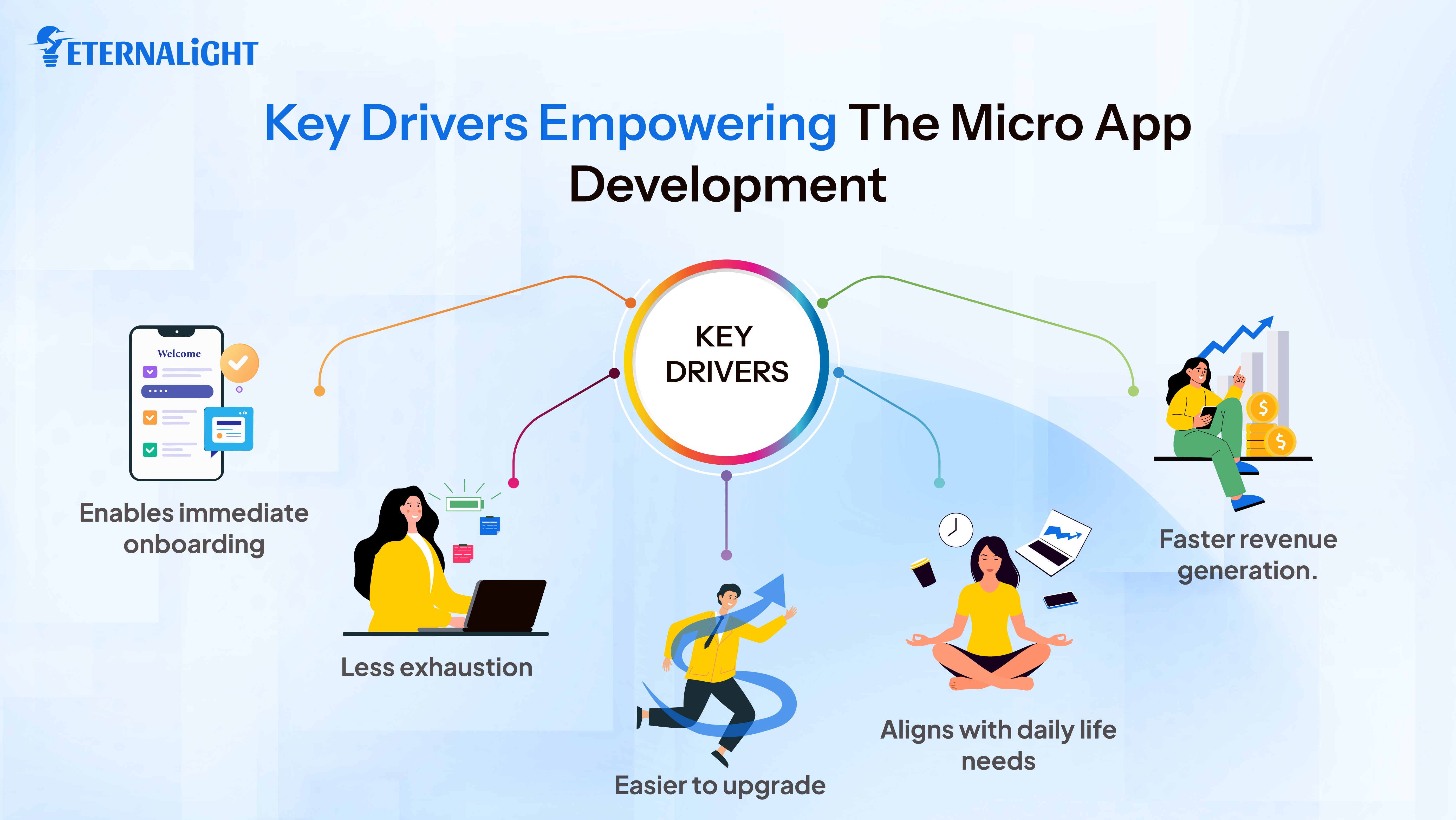
Micro apps are affordable to deploy enables immediate onboarding
Less exhaustion, avoiding feature overload
They remove vendor lock-in and are easier to upgrade.
Beyond assumptions or hypothetical conversations, micro apps are a real example of experimentation that aligns with daily life needs.
Micro Apps are a strategic move: they act as a lead magnet for a niche audience, capture niche users, and enable faster revenue generation.
Startups launch and build a micro app to solve an existing problem for a specific user persona and identify pain points.
These micro-apps operate across three layers: acquisition, monetization, and workflow integration.
Beyond theory, micro apps are a functional product that can’t be overlooked in the digital domain; they deliver faster ROI through usage-driven monetization, enabling faster brand identity establishment. From sales and marketing to operations, everything is manageable and drives consistent, daily workflow usage.
Despite their many benefits, micro apps can lose their spark if not developed strategically. If the problem is not high-frequency or the niche is poorly defined, unnecessary integrations start creeping in.
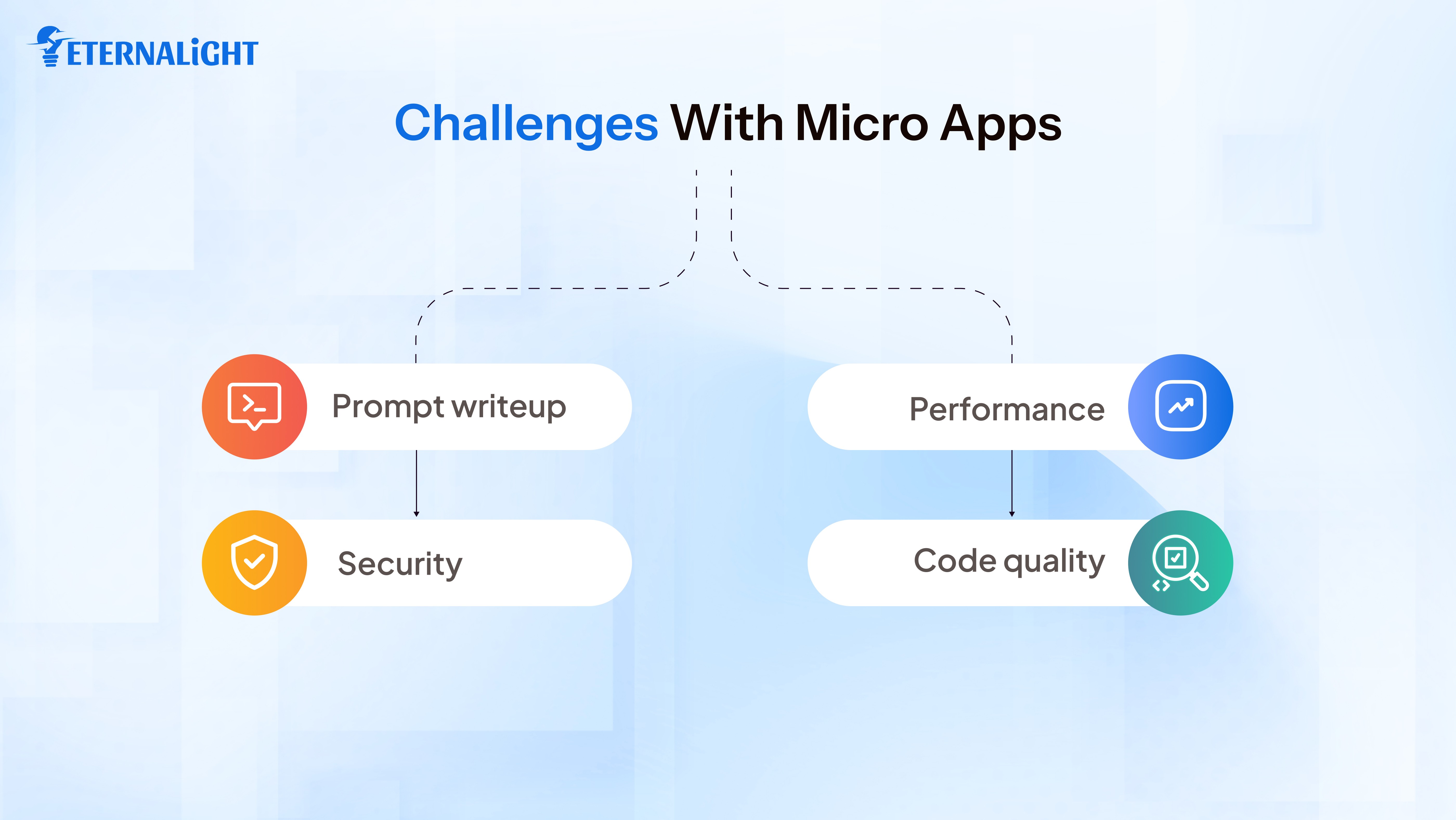
Building production-ready apps remains complex, but developers now receive guidance from AI coding assistants such as Claude, Cursor, ChatGPT, Gemini, and Lovable. It reduces time and effort, giving them the right direction without much brainstorming.
The real requirement is knowing how to translate product logic into the right prompts. This enables teams to produce the required output for building personal micro-apps.
It seems so easy, but many senior developers have reported that when it doesn’t align with their logic, they encounter issues with code quality, architectural accuracy, and security. We can’t launch apps that contain bugs, technical glitches, or bottlenecks.
If you are interested to know how much does it cost from idea to budget to develop an app consult with us!
Micro-apps are not just smaller products, micro app development is a small, strategic initiative to seize opportunities and stabilize workflows and operations.
There's no need to bet on big platforms; instead, pick a problem and develop solutions to deliver value-driven outcomes. Where startups can measure daily usage, monetize faster, and scale only after daily usage is proven.
If your business is struggling with specific issues, set up a discussion with the Eternalight Infotech team. We will apply our technical expertise to build a niche-oriented app.

Ayushi Shrivastava
(Author)
Senior Content Writer
Contact us
Send us a message, and we'll promptly discuss your project with you.