

Software Development
9
Mins
Top Mobile App Development Trends to Watch in 2026
Learn about the latest mobile add development trends that are taking over the world in 2026 and beyond.
Every successful startup reaches the same architectural crossroads.
Most founders don’t see it coming. The monolithic application that once powered your initial success transforms overnight from enabler to constraint. Feature development becomes sluggish. Scaling becomes excessively costly.
This isn’t just a sudden technical problem. It’s the predictable result of architectural decisions made when speed to market mattered more than longterm scalability. The good news? Companies worldwide have navigated this very same transition successfully, emerging with systems that scale elegantly and adapt quickly to market demands.
Recent studies show that 73% of scaling companies struggle with monolithic architectures after their initial growth phase. The solution is not to pull things apart at random, but to develop a planned and consistent approach to composable design that aligns with business objectives and growth trajectories.
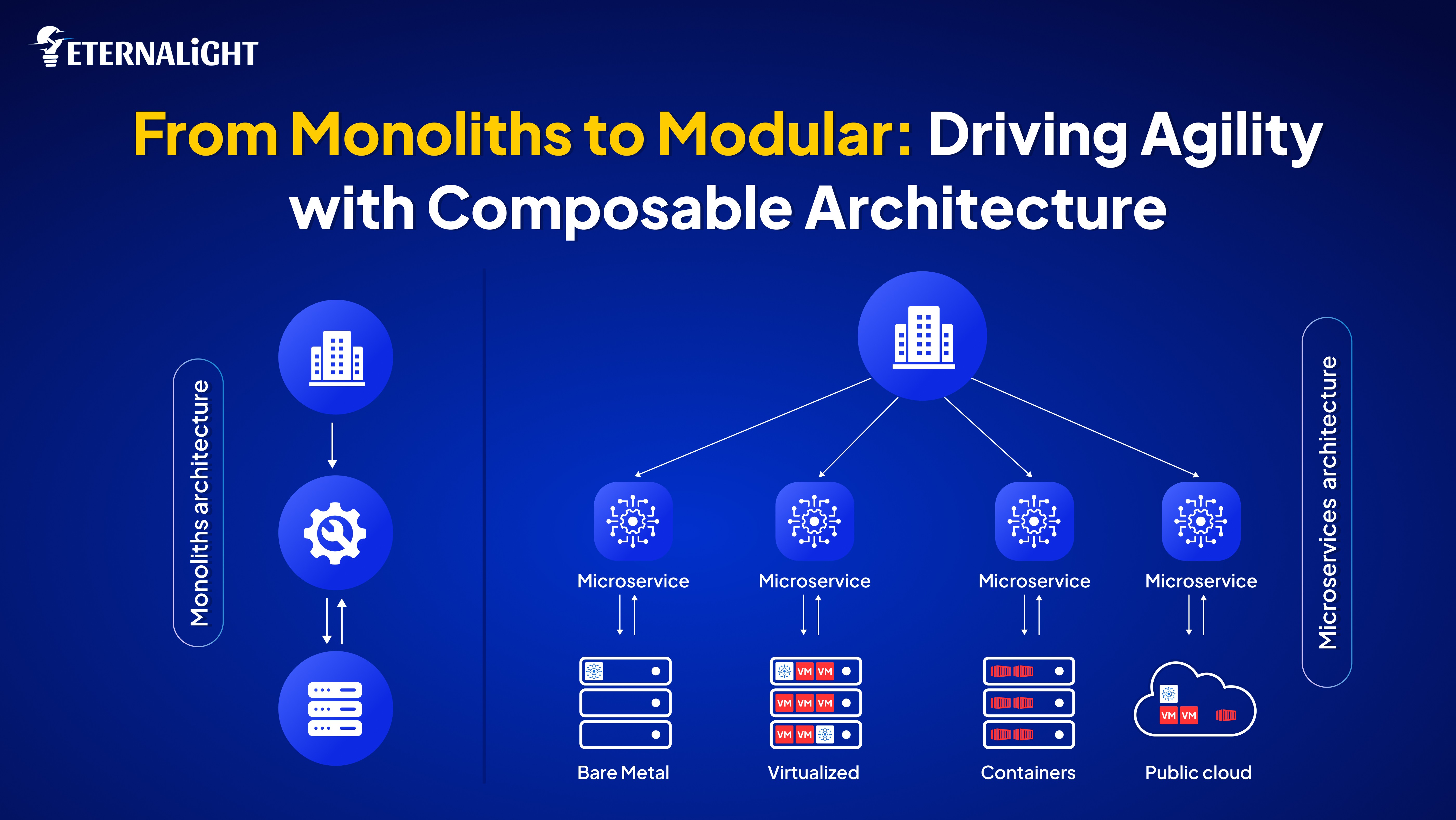
Composable architecture represents an essential shift from building single, interconnected applications to creating ecosystems of independent, specialised components that communicate through well-defined interfaces.
Think of traditional monolithic architecture as a Swiss army knife. Every tool is permanently attached, sharing the same handle and mechanical structure. Meanwhile, composable architecture is similar to a professional toolbox where each instrument serves a different purpose, can be upgraded separately, and works together through standardised connections.
Each component in a composable system possesses a distinct business capability. Your authentication service is responsible for managing user identity and access control. Payment processing manages all transaction-related functionality. Inventory management tracks product availability and fulfilment. These components work separately while collaborating via APIs to provide a cohesive user experience.
The core principle behind this approach is loose coupling. Components can evolve, scale, and fail separately without affecting the overall functionality of the system. This architectural insurance becomes increasingly useful as businesses grow and market conditions shift.
Most startups begin with monolithic architectures for compelling reasons. Single codebases speed up initial development, simplify deployment processes, and reduce infrastructure complexity when resources are limited. This strategy makes sense for determining product-market fit and meeting early growth targets.
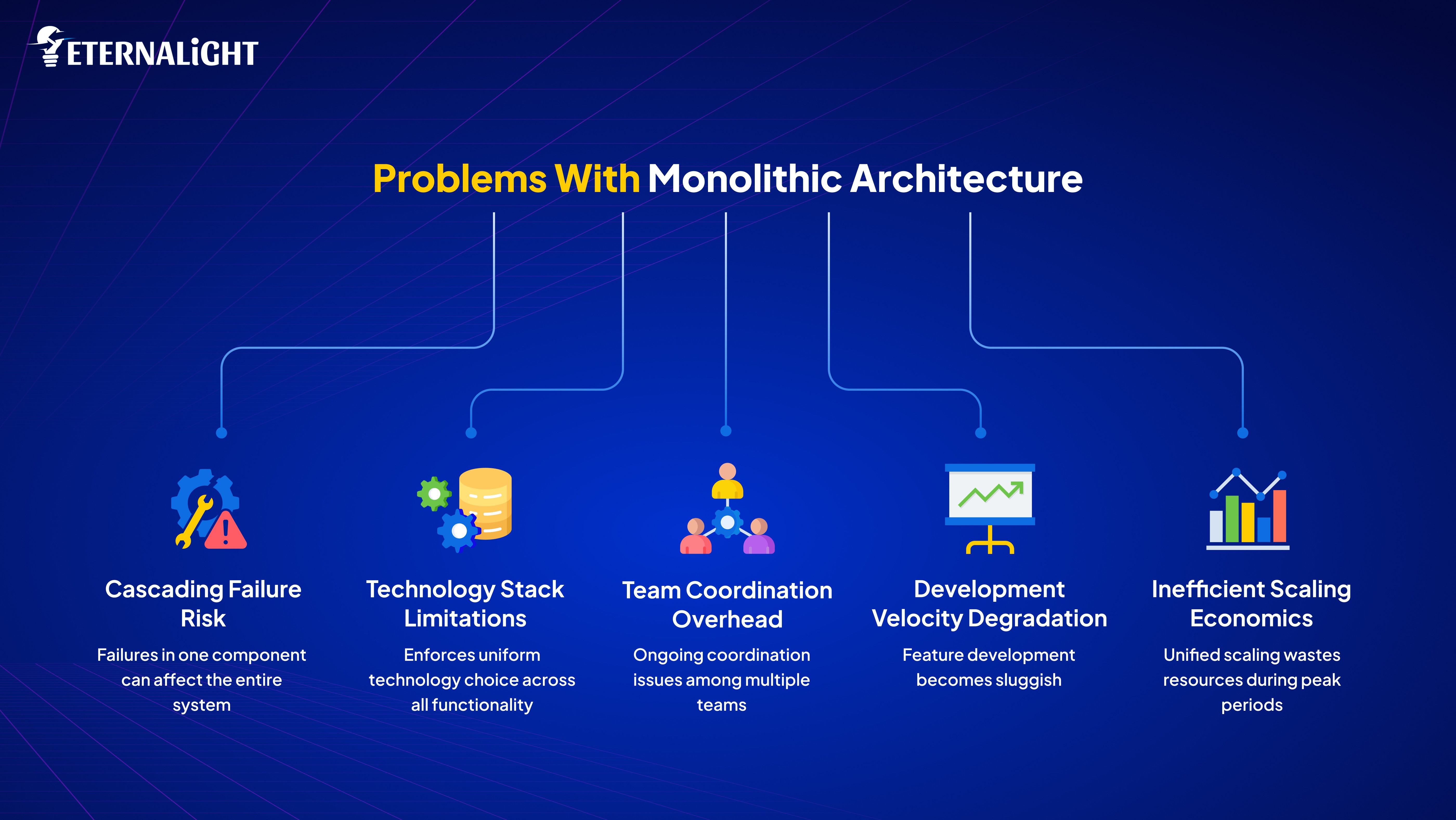
However, success will inevitably breed complexity. As user bases grow and feature requirements multiply, that elegant monolith transforms into a coordination nightmare. Some of the problems that become visible are:
Development Velocity Degradation: Adding new features requires a good understanding of the codebase’s interdependencies. What once took days now takes weeks of analysis and collaboration. Engineering teams spend a disproportionate amount of time navigating current code rather than developing new features that deliver business value.
Inefficient Scaling Economics: Monolithic applications scale as unified entities. When checkout processing requires increased capacity during peak traffic periods, the entire application, including components with normal load levels, must be scaled. This technique wastes computational resources and increases infrastructure expenses.
Team Coordination Overhead: Multiple development teams working on the same codebase present ongoing coordination issues. Code conflicts become more common. Release plans need complex coordination among the teams. Testing cycle lengthens as modifications in one area may affect unrelated functionality.
Technology Stack Limitations: Monolithic architectures enforce uniform technology choices across all functionality. Want to use Python for machine learning while keeping your core application on Node.js? The monolithic structure prevents optimisation, imposing inferior technology choices or costly rewrites.
Cascading Failure Risks: Component failures can spread throughout monolithic systems. Memory leaks in administrative functionality can cause customer-facing services to crash. Performance difficulties in one area can impair the whole application.
Composable design handles immediate scalability concerns while also generating platforms that can be adapted and innovated over time.
Independent Development and Deployment: Development teams can work on multiple components at the same time without needing to coordinate. Your payments team deploys security patches while your product team ships new features. Release schedules become team-specific rather than organisational restrictions.
Granular Resource Management: Individual components scale based on specific demand patterns. Marketing campaigns trigger increased capacity for user registration services. Sales events boost inventory and checkout processing. Resource allocation becomes precise and cost-effective rather than broadly applied across unused functionality.
Technology Optimisation: Each component can utilise the most appropriate technology stack for its specific requirements. PostgreSQL for transactional integrity, MongoDB for content management, and Redis for fast caching.
Accelerated Innovation Cycles: New features can be developed independently and tested against current functionality using A/B testing or incremental rollouts. Failures are removed from fundamental company processes, making experimentation less risky.
Graceful Degradation: When components fail, the system degrades gracefully rather than completely. Search functionality might become unavailable but customers can still complete purchases. This resilience translates directly into improved customer experiences and lower financial impact during incidents.
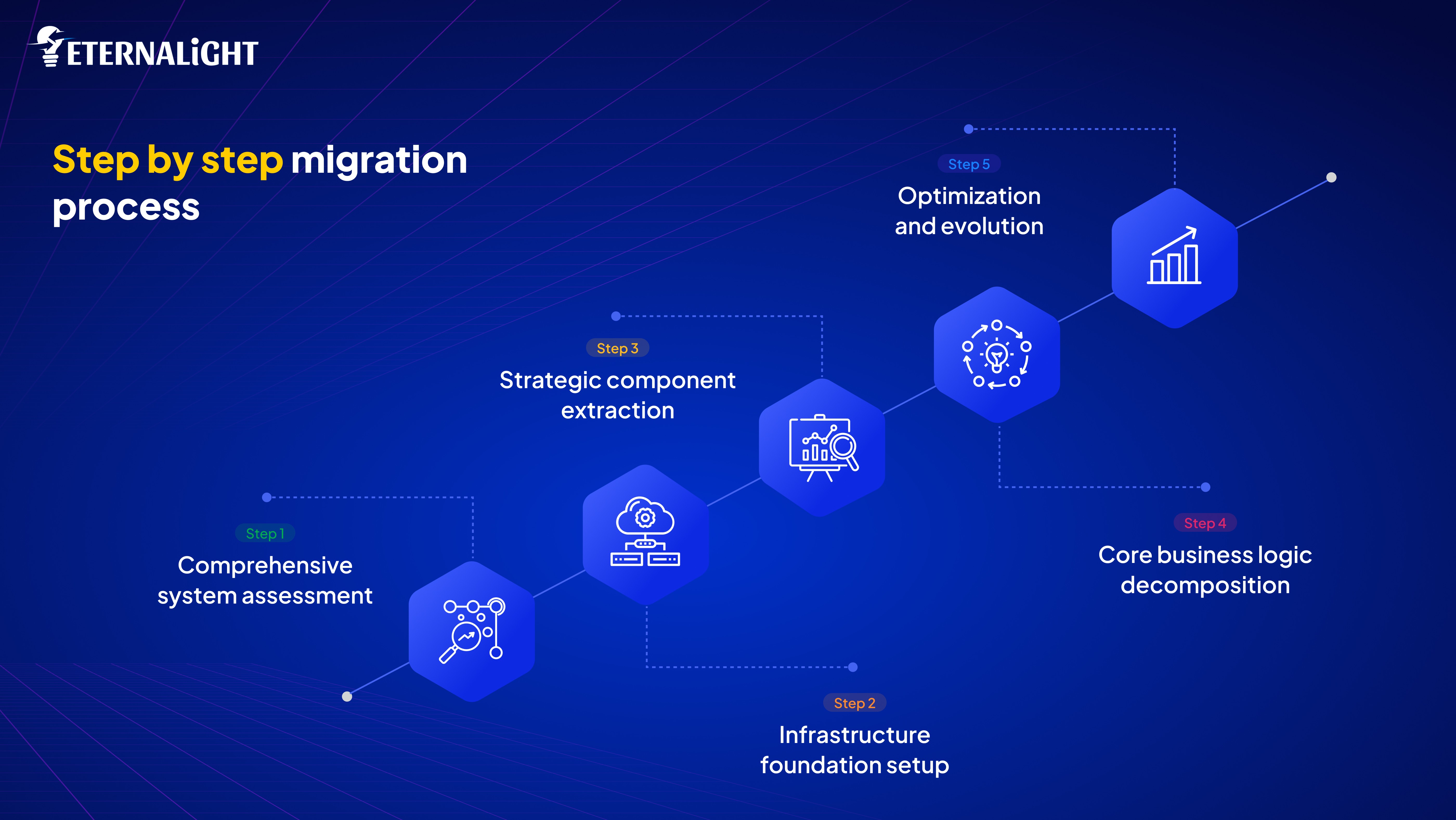
Transitioning from monolithic to composable architecture requires systematic planning and execution. The following steps will help your business shift from monolithic to modular:
Begin by thoroughly analysing your present monolithic application. Map out present business capabilities and determine logical component boundaries based on functionality, data ownership, and team roles.
Create detailed dependency maps showing how different application areas interact. These visualisations will reveal complexity patterns and help prioritise which components to be extracted first based on coupling levels and business impact.
Document current performance baselines such as deployment frequency, feature development time, system reliability measurements, and resource usage trends. These measurements offer objective validation criteria for architectural enhancements.
Before separating any components from your monolith, build the operational foundation required for distributed systems. Implement service discovery, load balancing, and an extensive monitoring architecture.
Deploy centralised logging and observability tools that enable end-to-end transaction tracing across service boundaries. Distributed system debugging requires different approaches than monolithic troubleshooting, so invest early in tools that provide visibility into cross-service interactions.
Set up automated deployment pipelines and environment management capabilities. Managing many independent components necessitates sophisticated operating processes, which must be defined before increasing system complexity.
Start with peripheral services that have clear boundaries and minimal dependencies on core business logic. Authentication services, notification systems, file upload handling, and reporting capabilities are frequently suitable initial extraction candidates.
Implement the strangler fig pattern by building new components alongside your existing monolith while gradually routing traffic to the new services. This method allows for secure rollbacks and parallel validation of your composable architecture approach.
Set up rigorous integration testing at component boundaries. As your system’s complexity grows, contract testing becomes increasingly important for assuring dependable communication among independent services.
After you’ve validated your strategy with basic components, start extracting important business functionality. This phase requires careful planning around data consistency, transaction boundaries, and complex business process coordination.
Consider implementing event-driven architectures for workflows that span multiple components. Asynchronous messaging patterns are generally more resilient and scalable than synchronous API requests for complicated business operations.
Use circuit breaker patterns and retry methods to manage temporary communication failures sympathetically. Distributed systems present novel failure modes, necessitating different resilience solutions than monolithic programs.
Monitor system behaviour under realistic load conditions to identify optimisation opportunities and performance bottlenecks. Composable architectures provide fresh insights into traffic patterns and resource utilisation across a variety of business capabilities.
As your company grows, it is critical to constantly assess component boundaries. Some components may need to be combined for greater efficiency, while others may require additional deconstruction to enable expansion. Architecture should adapt to meet evolving business needs.
Develop organisational capabilities to manage dispersed system complexity, such as automated deployment, monitoring, incident response, and capacity planning across several independent services.
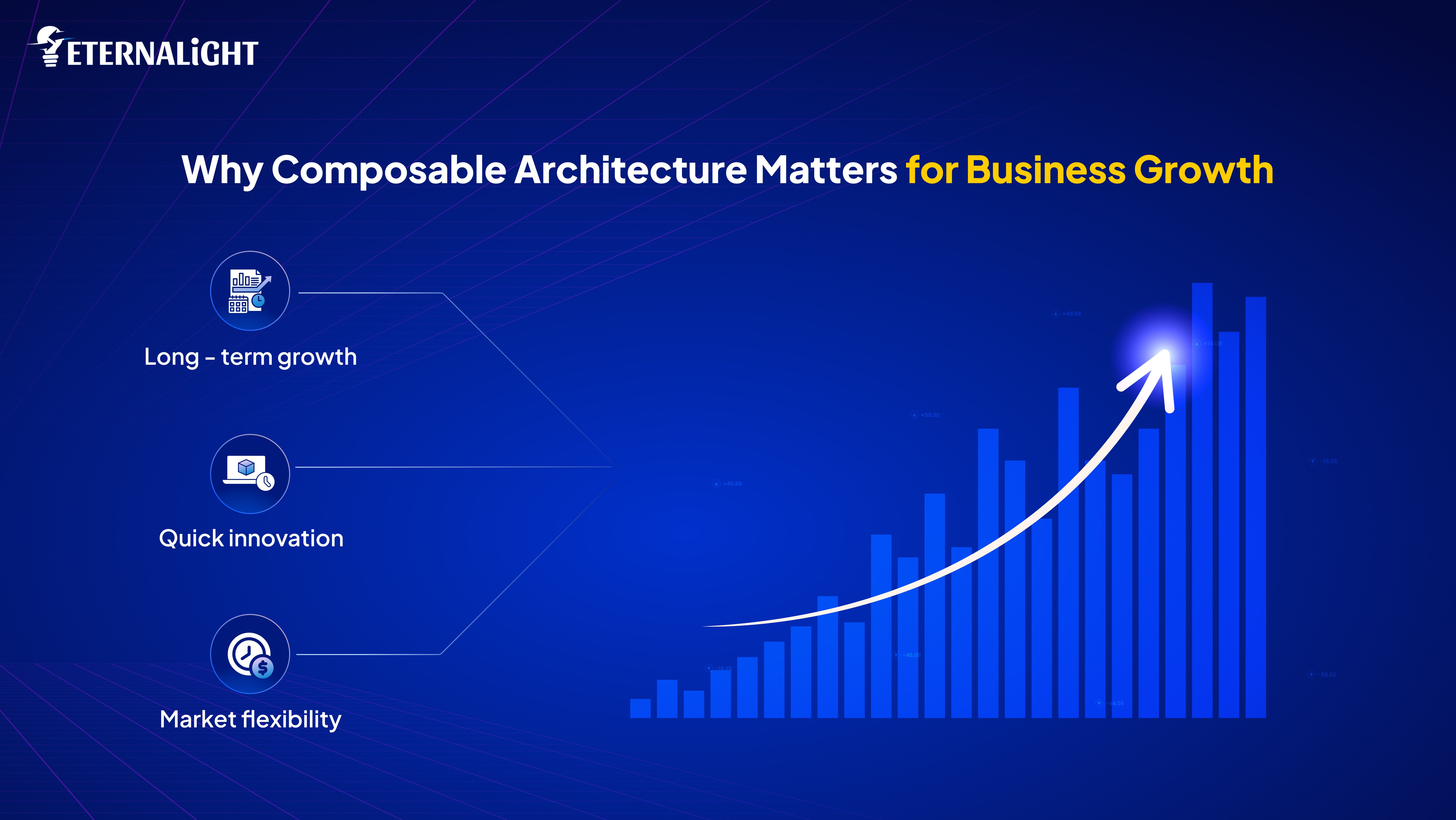
The transition from monolithic to composable architecture represents more than technical evolution. It is a strategic change that prepares organisations for long-term growth, quick innovation, and market flexibility.
Companies embracing composable architecture don’t just solve immediate scaling challenges. They develop technology platforms to assist business model innovation, effective resource utilisation, and resilient operations. These architectural choices become competitive advantages in marketplaces where technological adaptation is critical to long-term success.
Amazon’s early 2000s transition from monolithic to service-oriented architecture enabled its evolution from online bookstore to global technology platform. Their architectural foundation built the technical capabilities that enabled AWS, which now generates billions of dollars in revenue and transforms entire sectors.
The journey requires significant investment in both technology and organisational capabilities. However, for founders who want to develop longterm, scalable enterprises, composable design provides the technical basis required for success in dynamic technology landscapes.
Success in today’s technology landscape increasingly depends on architectural flexibility rather than initial feature completeness. As business needs and market prospects change, forward-thinking companies develop flexible, modular platforms rather than inflexible, integrated apps that are more difficult to change over time.
The organisations that will thrive in the long term build systems capable of continuous adaptation. This allows them to capitalise on emerging opportunities while maintaining operational stability and customer satisfaction.
Transform your architecture from a growth constraint to a competitive advantage by starting with a clear understanding of your current system limitations and strategic business objectives.
Connect with Eternalight Infotech to develop your modular architecture strategy. Our team specialises in helping growing companies navigate complex architectural transitions while maintaining business momentum and customer satisfaction. Let’s build systems that scale with your success.

Ketan Somani
(Author)
CEO, Founder
Contact us
Send us a message, and we'll promptly discuss your project with you.