
Building a startup is hard, especially when you're trying to gain visibility in a highly competitive market with limited resources. While Big enterprises can invest heavily in advertising and brand campaigns, early-stage startups usually require more cost-effective ways to reach their audience and build trust.
Social media becomes an amazing opportunity for startup owners to tell their story, interact with prospective customers, receive feedback, and build their brand among the right people. But having accounts on social networks and posting there from time to time is hardly sufficient to produce any tangible results.
Effective startups always have a well-defined strategy when it comes to their use of social media. The key elements of their strategies include establishing genuine relationships, adding value through content creation, and continuously improving their strategies based on performance metrics.
In this blog post, you will discover five practical strategies for using social media effectively, which can be very useful for new entrepreneurs looking to grow their businesses.
Adopt Social Media Marketing Strategies to Overcome Startup Growth Hurdles

Startups face numerous challenges like developing products, recruitment, sales, financing, and others. This is why it becomes necessary for entrepreneurs to follow a realistic and sustainable social media marketing plan.
Rather than being active everywhere online, entrepreneurs need to make sure that they make genuine connections and share content that they can relate to the target audience.
1. Turn Your Founder Story Into a Brand Asset
More often than not, humans form a connection with other humans before forming one with any business. By sharing the backstory of your startup, you will be giving an authentic touch to your brand.
The founders can talk about their experiences and lessons that have come their way while building their products and business. It does not mean talking about everything about the business, but sharing their real point of view.
Sharing content by founders can give early-stage startups an identifiable voice.
2. Focus on One or Two Platforms First
Being active on all the social marketing platforms could be quite a complex task, particularly for a start-up firm that has very limited resources. Instead, choose the social media platforms that are frequented by your target consumers.
For instance, a business-to-business start-up may need to be active on LinkedIn, whereas a consumer-based start-up may want to focus more on Instagram or TikTok.
Once you figure out the kind of content that works for you and you can post consistently, you can consider being active on other platforms as well.
3. Create Educational and Value-Driven Content
However, every social media post does not need to be a sales pitch for your product. Overpitching makes it hard to develop genuine interest in your audience.
Therefore, create posts that help solve issues, answer questions, and address the interests of your target customers. You may provide advice, industry knowledge, tutorials, experience developing your startup, issues faced by the customers, or any other interesting angle about trends.
The objective is to provide people with reasons to follow your startup, whether or not they are interested in buying.
4. Engage Consistently With Your Community
Social media is not just a publishing channel. It is a platform for discussion.
Engage in responses and answer queries. Take part in the discussions in your industry. And interact with material on social media from your potential customers and partners, as well as other members of your industry.
Discussions on social media also allow founders to identify issues that their target audience might be facing and topics that they are passionate about.
For an emerging business venture, even a relatively small audience can become quite significant when there is genuine interest in the product or industry among them.
5. Measure Performance and Optimize Regularly
It is recommended that the social media marketing strategy be adjusted in accordance with what is working. In other words, the number of followers cannot be the only metric worth tracking.
The metrics to analyze will depend on the goals pursued. Thus, the number of engagements, reach, website traffic, leads, signups, questions, and conversions can be among the key metrics.
Analyze what topics, formats, and channels are effective for the target audience. This will help you optimize your content strategy. For instance, if educational content is generating more engagement than promotion-related content, you can produce more educational content.
The objective is not to have all posts go viral. The aim is to develop a social media marketing strategy that is scalable and that will eventually enhance the visibility and success of the startup.
Building a Simple Social Media Plan for Your Startup
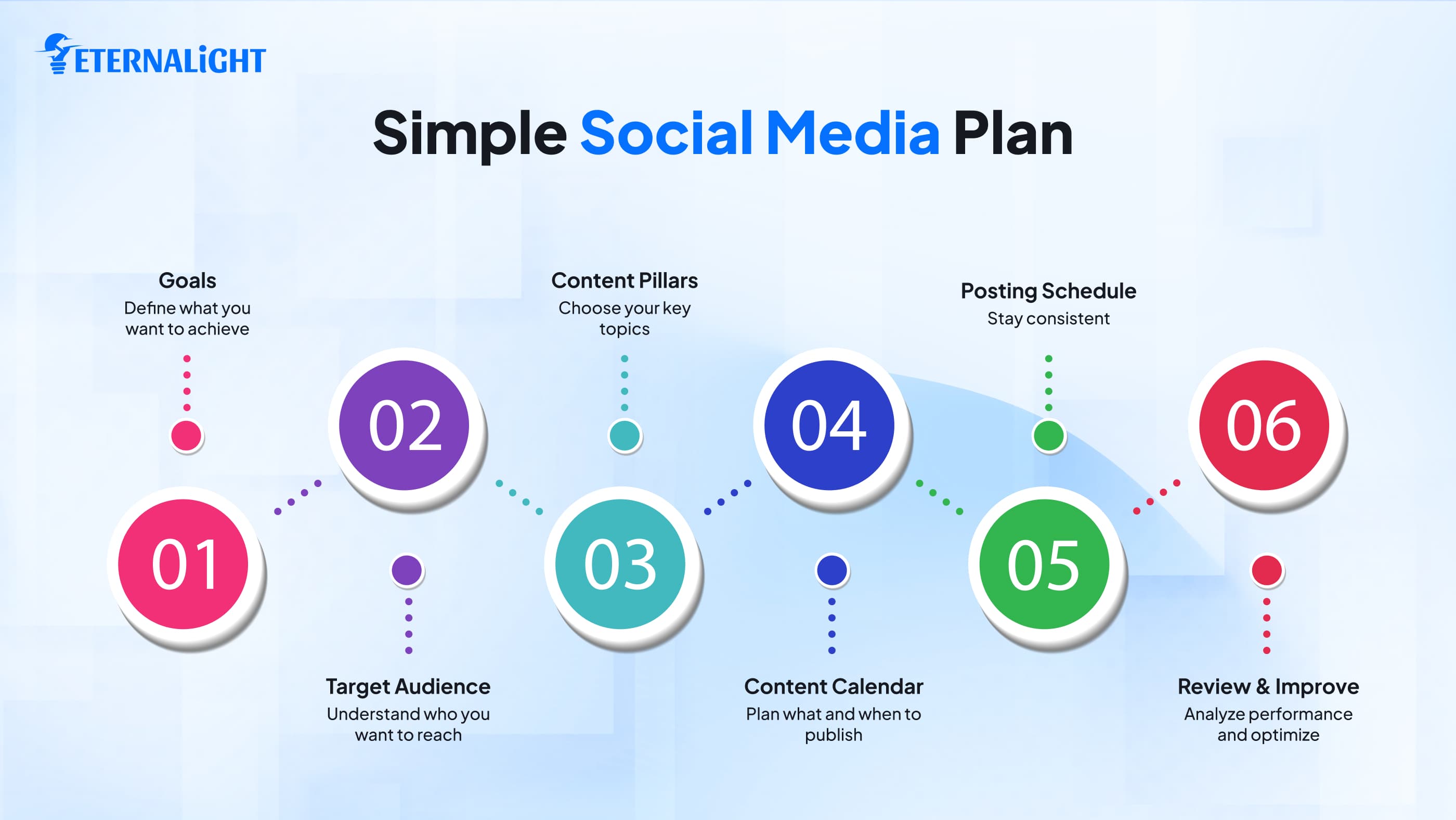
The social media strategy does not need to be too complex. For an early-stage startup, simplicity and consistency will help you to better manage content and align your efforts with business objectives.
Define Your Social Media Goals
Firstly, you must figure out your social media objectives. They could be as varied as raising brand awareness, creating leads, bringing traffic to your site, establishing a founder-based brand, or creating a community around your startup.
With clear objectives, you can easily determine whether or not your efforts are paying off. You will be able to focus not just on growing followers but on other metrics.
Determine Your Target Audience
In order to produce effective content on social media, it is important to know your target audience. You need to determine who your potential clients are, their problems, what they like, and the social media platforms they use.
There are many ways to get to know your target audience, such as feedback from customers, statistics from websites and social media, and industry analysis. The more information you have about your target audience, the easier it is to attract them.
Select Your Content Pillars
Content pillars are some of the important topics that the start-up will repeatedly discuss on its social marketing platforms. They can be industry insights, educational information, personal experience of the founders, customer testimonials, product developments, or corporate culture.
Defining the content pillars ensures that the social media stream of the company does not become redundant or too promotional.
Create a Manageable Content Calendar
A content calendar can assist you in planning what to write about, when to publish your content, and on what platform. Preparing content can help you reduce last-minute stress and keep a steady pace of posting.
This can be a very simple process, as the calendar only needs to cover the topic of the post, the form of content, date, platform, and purpose of the post.
Set a Realistic Posting Schedule
Frequency is less critical than consistency. Establish a frequency that aligns with the availability of your team, along with providing enough valuable information for the audience to remain interested.
As the performance data accumulates, the team will be able to determine when and at what frequency the audience is responding well. Adjust the posting frequency accordingly instead of using it just because it is a trend.
Review and Improve Your Strategy
Regularly evaluate your social media efforts to gain knowledge of what is and isn’t working. Metrics to consider include engagement, reach, web traffic, leads, and conversions according to the objectives set.
Based on this information, improve the content and platform selection as well as the frequency of posts. A good social media marketing strategy will adapt as your business grows, as your target market develops, and as you learn from the experience.
Conclusion
Creating a solid social media footprint doesn’t take a big marketing department and a substantial budget. If you are an early-stage startup, then the main point of creating a successful social media marketing strategy is to target the right audience, pick the right platforms, post useful content, and interact with the community.
Social media can be a useful tool for increasing brand awareness, building trust, learning about the audience, and creating business opportunities. Nonetheless, social media isn’t the only thing your startup should focus on when establishing a solid online footprint. You need a solid website, scalable digital products, and technology to support the global growth of your company.
Ready to turn your startup idea into a working product? Partner with Eternalight to build, launch, and scale your digital solution.

Kusum Sethiya
Software Engineer
Kusum Sethiya is a Software Engineer at Eternalight Infotech, focused on building clean and intuitive. She enjoys turning ideas into reliable applications using modern technologies like Javascript, React, Node.js , and MongoDB.
Related Blogs
 Software Development9 Mins
Why Choose Python for Fintech App Development?
Learn how Python helps fintech businesses build scalable, data-driven applications with powerful support for analytics, AI, APIs, and automation.
- Software Development8 Mins
Is It Time to Build Off the Self vs Custom Software for Your Business?
When should you build custom software? Learn the key signs, costs, limitations, and factors to consider before choosing custom software for your business.
- Software Development11 Mins
Website Security Checklist: What to Check Before It's Too Late
Worried about website security? Use this practical website security checklist to spot common risks and protect your website, data, and users.