For founders expanding across borders, the challenge isn't limited to product launches or choosing the best country or demographic region.
Funding and support from co-founders/investors are also concerns. Technological evolution, social media platforms, vibe coding and AI tools have reduced barriers to global expansion. It's easy to reach out to peers, entrepreneurs, and founders building beyond borders and pitch them on partnering. Much more needs attention.
Founders also need to understand conventional and economic factors such as trade, investment regulations, tariffs and taxation, and bureaucracy. The world is evolving, and business drivers need to be ready to adapt to any paradigm shift to sustain cross-border operations.
Understand the Global Market Before You Cross the Border
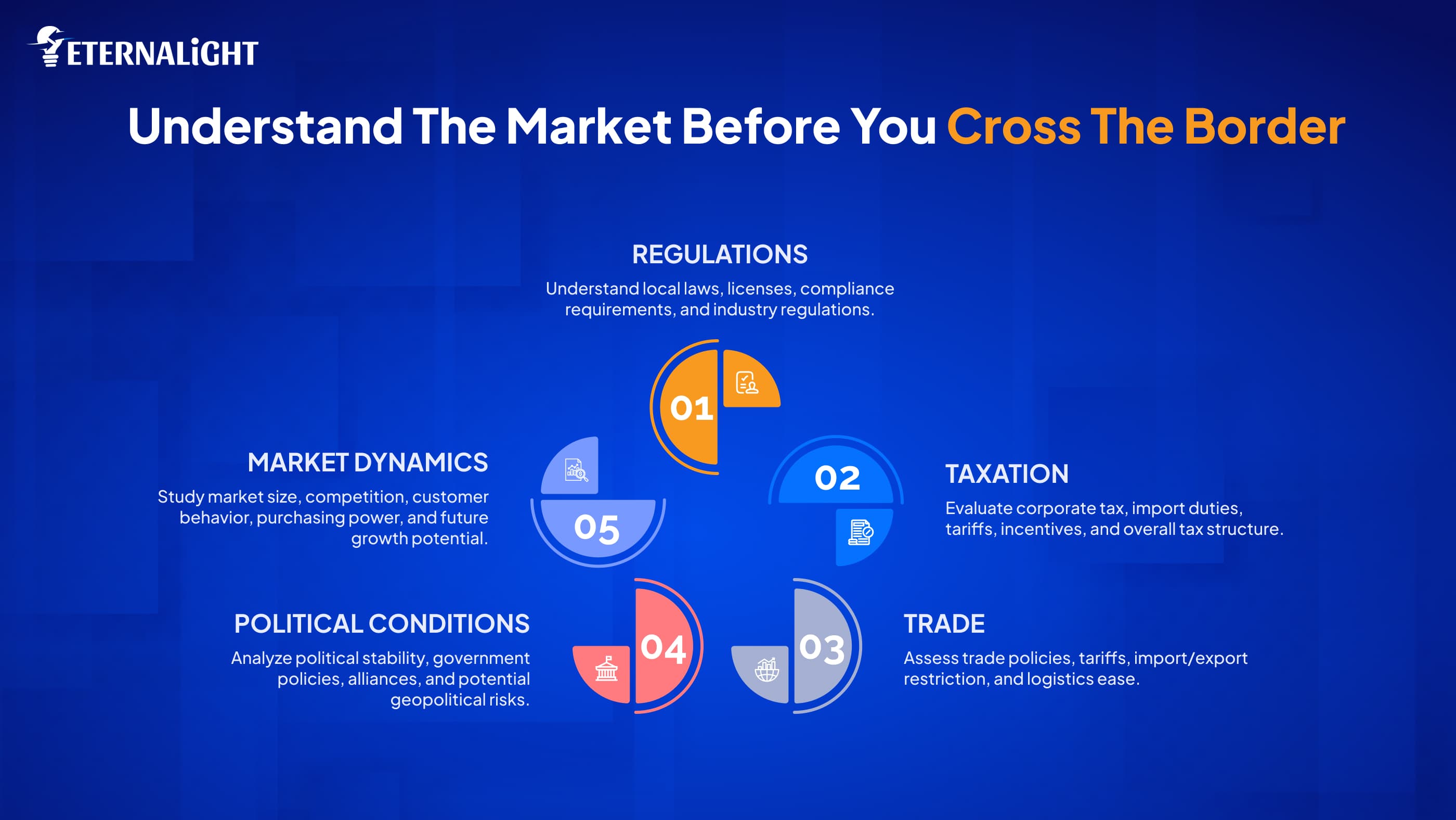
Whenever war or a bureaucratic crisis sets in, it directly spikes economic crisis and stress across businesses. Whether it’s small, mid-, or large-sized businesses, all got screwed.
Policies, regulations, constraints, and alliances never stay the same; ideological remarks and beliefs also create barriers.
Businesses that want to excel in global markets must have a strategic, structured plan to overcome these challenges and vulnerabilities.
Regardless of a business's location, it must not abandon its vision or operational efficiency and must maintain workflows amid political, legal, and financial burdens.
They want people from all over the world to find their business, and for that, the founder is ready to take risks. They analyze the broader market landscape using tools and international capital-flow markets, and understand ground-level and global dynamics.
Founders should be good at analyzing market trends and potential geographical and economic crises so they can prepare in advance for those that can influence their business.
Going Global is No Longer Just About Entering New Markets
To be successful at the global forefront, a founder doesn’t need to put their hands in a new domain or business genre. They can grow confidently with their existing signature product. They just need to brainstorm how they can do it better in an evolving form and raise the bar. So, founders can proceed by:
- Expand the network and participate in events, webinars, and seminars
- Know more about your industry's key leaders, their insights and recent ventures, what they’ve launched, and whether there is any scope to discover opportunities
- Continue to learn, adapt, practice, and evolve to make wiser decisions to stay consistent and competitive across market dynamics
Market Theory: Growth Doesn't Always Mean Entering a New Business
Suppose brothers had an agreement for about 10 years that prevented them from entering another business the other was doing, except their family business.
When the agreement tenure ended, one expanded their business across multiple domains and industries to countless assets they have taken over the globe with their exceptional launches and operations.
On the other hand, the second brother has tried 5 to 10 different businesses at the same time, but none were profitable. Consequently, they have millions in financial debt.
Capital Alone Can't Make a Business Resilient
Funding is an important asset for running a business in this fragmented world, but without intelligence, it's hard to sustain and overcome barriers. Even if you are connected through commercial platforms, they can’t serve you for long if you can’t think, strategize, or take strategic moves.
Know Where Your Capital Goes
Having wealth isn't enough as a founder; you must know how to allocate it across resources, keeping your financial flow modest and balanced.
Don't Confuse Visibility With Growth
A founder doesn’t need to attend every corporate event or make fake announcements just to grab the spotlight.
A Strong Local Product Doesn't Automatically Become a Global Product

When the world wasn't digitally connected, this path was straightforward, but now things have changed. If a product performed better than local competitors, it doesn’t guarantee it will work across international domains.
Aspiration and ambition are different, but we can’t launch an idea based only on assumptions or local market graphs.
To build a global reputation, a founder must think about product infrastructure, governance laws and compliance, digital sovereignty, and flexible models.
Technical and business literacy is not enough; founders need to assess AI capabilities, the data layer, digital ecosystems, and how they align with regulatory requirements.
No need to build exclusive, tech-driven experiences, but business goals must align with customer needs.
Ground Level Scenario
A street shop owner is also a business driver, and an IT domain startup founder is also a business driver. But you have seen that a street shop sells its products only in that area; they don’t take the risk of shifting their business to another city, thinking it will add an extra burden on their shoulders.
A small government rule or regulation may stop a street shop owner from operating if they don’t have special permission. Instead, a founder must stay alert to federal and local laws, market competition, trends, innovation, new resources, and investors to unlock new ventures.
What Investors Look for When Markets Become Uncertain
Investors who collaborate with founders focus not only on how quickly the company establishes its presence on the global stage, but also on innovation, effort, ROI, product resilience, and stability amid unstable conditions. When the market was down, how did the founders manage supply, meet customer needs, and stay flexible amid regulatory constraints?
Building Beyond Borders Requires Adaptability
Becoming a startup founder is not easy; though it’s not impossible, sustaining and building across borders without losing your roots and core business values takes consistent effort, resilience, and perseverance.
Founders must improve their versatility by trying their hand in different businesses and accommodating customer needs, but they shouldn’t overlook policy, federal laws, and Agentic AI governance & compliance.
Develop a strong strategy that supports customer acquisition, competitiveness, and cash flow.
Conclusion
Risks and opportunities come from the same place, but if you make decisions blindly by following trends or with a fragmented, unfocused mindset, it will be tough to build startup growth beyond borders.
No need to discover, plan, and build everything from day one. First, research your competitors and the relevant domain, determine where you can make changes and outperform your peers, and comply with global market standards to unlock new opportunities.

Ayushi Shrivastava
Senior Content Writer
Ayushi is a Content Strategist at Eternalight Infotech with 4 years of experience in transforming complex ideas into clear, engaging, and SEO optimized narratives. She specializes in crafting impactful content strategies that enhance brand visibility and drive meaningful engagement across digital platforms.
Related Blogs
 Software Development9 Mins
Why Choose Python for Fintech App Development?
Learn how Python helps fintech businesses build scalable, data-driven applications with powerful support for analytics, AI, APIs, and automation.
- Software Development8 Mins
Is It Time to Build Off the Self vs Custom Software for Your Business?
When should you build custom software? Learn the key signs, costs, limitations, and factors to consider before choosing custom software for your business.
- Software Development11 Mins
Website Security Checklist: What to Check Before It's Too Late
Worried about website security? Use this practical website security checklist to spot common risks and protect your website, data, and users.