What if the biggest competitive advantage for your business isn't in your office, but somewhere across the world?
To build and digitally scale products with better speed and efficiency, businesses are increasingly interested in outsourcing software development. The competitive marketplace has shifted businesses’ requirements from primarily cost savings to innovation, advanced skills, and rapid development that meet high standards. Businesses have had to expand their search for software development outside of local borders.
Technological advancements in collaboration, computing, and artificial intelligence influence the way software is developed. Traditionally, offshore teams were considered a third-party vendor to fill development gaps; however, the changing landscape promotes collaboration and partnership. Companies of all sizes are now employing offshore teams to gain a competitive edge with the best talent while minimizing development time.
Changes in the offshore software development industry are only going to continue. Companies that recognize these changes will gain a competitive edge with their technology investments. There are several factors that influence how companies choose to develop their software products, including artificial intelligence, cloud technology, outcome-based partnerships, and first-principles design thinking for security.
What does this mean to you?
This guide identifies the trends of 2026, the reasons why companies are utilizing offshore development services, and guides on selecting a development partner that aligns with their business needs and helps achieve their long-term goals.
What is Offshore Software Development?
Offshore software development employs a software development team in a different country for any of the multiple stages in the software development life cycle, such as design, development, testing, maintenance, and support. Instead of only relying on their developer staff, companies use offshore teams to gain the necessary technical skills and experience for their industry.
One of the incentives for companies to use offshore development is to gain a wider pool of skills and expertise. In many local areas, it can be difficult to recruit competent and experienced developers with the skills in the new and emerging technologies. Development work can be performed more cost-effectively with the skilled workforce available worldwide.
Something that aids the recruitment of offshore development teams is the cost of in-house development stakeholders and the overheads and costs that come with an internal team. Offshore development presents an opportunity to recruit participants in the development process and reduce costs.
The concept of offshore development has drastically changed and improved over the years from outsourcing. Now, the offshore teams are positioned as equivalents to internal teams and take part in development processes and decisions. With the use of the right collaboration tools, teams, irrespective of location, can work effectively.
Offshore software development can be employed for a wide range of purposes. These include web and mobile software applications and enterprise software, as well as AI projects, SaaS, and other products and services. Offshore development, over the years, has become an integral part of the global delivery of software services.
Why Offshore Software Development is Growing in 2026
Several factors are contributing to the rapid adoption of offshore software development in 2026:
- Need for competent software developers in various industries.
- The necessity to keep costs low and high-quality standards at the same time.
- Demand for quicker delivery of products in competitive environments.
- High usage of AI, cloud computing, and other technologies.
- A specialized workforce that can be unavailable locally.
- Increased tolerance towards remote and distributed working models.
- Better collaboration tools facilitate communications.
- Scalability and operational agility are priorities for organizations.
- Increasing demand for 24/7 development and support capabilities.
- Increased trust in offshore software development because of successful experiences in various industries.
These factors have transformed offshore development from a cost-saving initiative into a strategic business advantage.
Top Offshore Software Development Trends in 2026
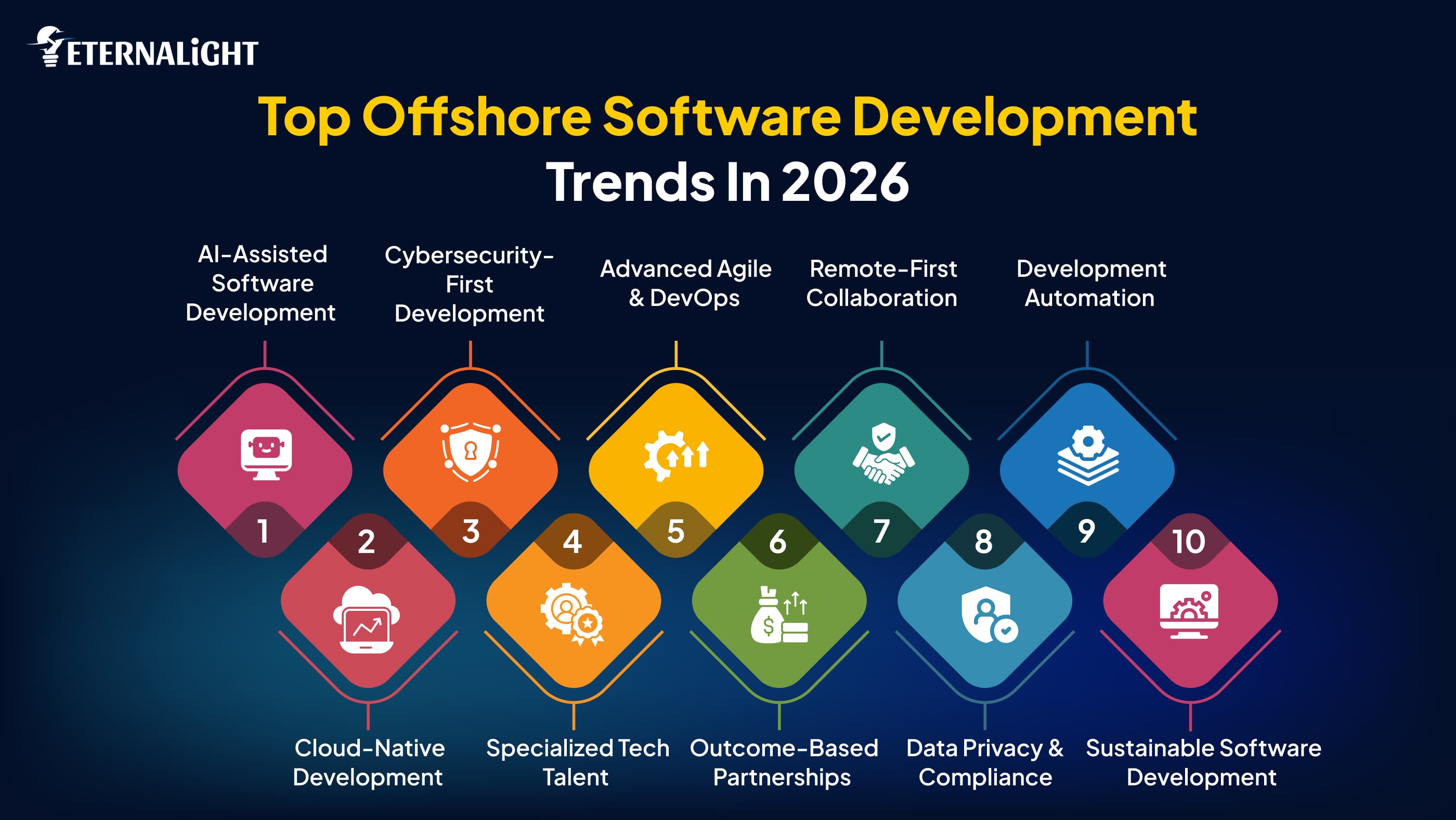
As technology continues to evolve, businesses are adopting modern offshore development practices to improve agility, scalability, and innovation. Let’s explore the top offshore software development trends shaping 2026.
AI-Assisted Software Development
The advent of artificial intelligence technology has had a profound impact on software development. Teams are turning to AI-based tools to automate mundane activities, suggest code snippets, detect errors, and increase efficiency.
Instead of substituting developers, artificial intelligence ensures that specialists can dedicate their time to solving complex tasks and engaging in creative work. Teams working offshore have been integrating AI into their workflows to speed up the development process and keep code quality.
Intelligent automation has made some tasks that required hours of work possible to perform in a shorter period of time.
AI is also contributing to the improvement of the testing process with automated testing and the prediction of errors.
With the ongoing investments in the digital transformation, AI-based development will become a common competence of offshore teams in the future. Companies looking for a competitive advantage will choose to cooperate with offshore companies, knowing how to make use of artificial intelligence in software development.
Organizations looking into new software development trends realize that AI-based development is not just an experiment anymore but a necessity.
Cloud-Native Development
The current trend in application development is cloud-native. Instead of developing applications that would work on the classic infrastructure, developers now create cloud-optimized applications.
Cloud development teams are assisting companies in creating highly available, scalable, and resilient applications based on cloud-native technologies. Containers, microservices, serverless computing, and orchestration platforms are becoming an integral part of software architecture.
Cloud-native development allows organizations to roll out updates often, to scale their applications easily, and to achieve higher system performance. This way, businesses can react faster to customers' needs and avoid difficulties in managing infrastructure.
Also, cloud-native applications allow for increased flexibility. Organizations can enter new markets, get additional users, and apply various technologies to their systems without much limitation in terms of architecture.
As organizations continue to update their legacy systems, cloud-native expertise will be one of the most sought-after skills provided by offshore software development in 2026.
Cybersecurity-First Development
Cybersecurity is not viewed anymore as a separate stage of software development; it is incorporated into all stages of the process.
Companies face growing risks associated with cyberattacks, ransomware attacks, breaches, and compliance issues. Therefore, the need for cybersecurity during software development arises in the initial planning stages.
Teams working offshore are applying a variety of security-oriented approaches, which include such components as secure coding, vulnerability assessment, automatic security testing, and constant monitoring. Security analysis is becoming an essential element of development processes.
DevSecOps practices are contributing to better integration of security measures. Developers, security experts, and operations teams work together in order to eliminate possible vulnerabilities at early stages.
Firms collaborating with a professional offshore software development company pay special attention to their security experience in case they develop applications for processing personal information of their customers.
Cybersecurity-first development will continue to play an important role in technology and vendor selection decisions throughout 2026.
Specialized Tech Talent
The rapid development of the software market leads to the necessity for specialists who have expertise in new technologies. The general development skills are not enough for some projects in today's world.
There is an urgent demand for specialists who are familiar with such areas as artificial intelligence, machine learning, cloud engineering, cybersecurity, blockchain, data analysis, IoT, and other advanced mobile development.
But sometimes it is hard and costly to find these specialists nearby. Offshore development gives companies access to various specialist pools all around the world.
Moreover, organizations can form teams from specialists who possess certain skills and knowledge in a matter of minutes.
That is crucial for startuppers and growing companies that need specific technical knowledge but do not have the money to employ various specialists.
Instead of spending a lot of time looking for specialists, it is easier to cooperate with offshore specialists who possess the necessary knowledge and have work experience in these spheres.
And with the further expansion of technology implementation, offshore development will become more widespread.
Advanced Agile & DevOps
Despite being in use for many years now, agile methodology, as well as DevOps principles, are always improving and developing in terms of implementation. Nowadays, offshore development teams are advancing in implementing more complex versions of the framework, which emphasize agility, efficiency, and continuous improvement.
Modern offshore software development teams employ techniques such as automated delivery pipelines, continuous integration and delivery, automation of the infrastructure, and monitoring systems. This ensures less involvement of manual work and increases software quality.
The benefits include shorter release cycles, faster feedback process, and better insights into projects' progress. It is also possible to be more flexible in relation to business needs while preserving the high quality of the products.
Combining the two practices results in more effective software production by offshore teams and allows companies to react promptly to changes in the market.
The most advanced companies tend to cooperate with a professional software development company, which is able to provide a fully developed and advanced agile/DevOps approach.
Outcome-Based Partnerships
Business relations with offshore teams are drastically evolving in 2026. Today, organizations choose developers not based on their hourly rates, but based on tangible business results, including rapid time-to-market, better user experience, increased customer loyalty, and profitability.
As a result, offshore development becomes not just a process of cooperation, but a true partnership. Offshore specialists must take part in product planning, technology consultation, architecting, and long-term business growth.
A good offshore software development company cooperates with its clients to comprehend their needs and offer an appropriate technology stack, development approach, and composition of the team. It is not only about fulfilling tasks, but also about helping to solve business issues and come up with new ideas.
Partnerships that operate through results enhance transparency and accountability. Progress reviews, milestones, and performance metrics assist businesses in controlling project outcomes while maintaining harmony in the development process.
As companies will continue investing in digital transformation, strategic partnerships will be much more profitable than outsourcing aimed at cheapening the development.
Remote-First Collaboration
Working from home is not a one-off phenomenon anymore; it has become a long-term trend in modern software development. The offshore software development model has managed to prove that the distance is not an obstacle anymore when talking about producing excellent software.
With advancements in collaboration tools, cloud-based project management systems, video conferencing, and real-time communication, offshore development teams can be as productive as possible nowadays. Stand-up meetings, sprint planning, code reviews, and project discussions can now happen seamlessly, regardless of where developers are located.
There are also new asynchronous communication practices implemented by business owners, making it possible for development teams from different time zones to cooperate effectively without putting off project timelines. Such practice enables continuous development, which makes it possible for the project to move forward almost 24/7.
The remote-first collaboration model also provides companies with an opportunity to employ developers not by their location but by skills. There are no limits to where the company can find its developers, and companies are able to use their whole global market as a resource for talented employees.
With the evolution of hybrid and remote work, offshore software development services are going to be used even more frequently.
Data Privacy & Compliance
As businesses begin collecting and processing huge amounts of customer data, compliance with international privacy laws has become a key issue. Clients expect that businesses will keep their data confidential, and governments keep creating new requirements.
The modern approach to offshore software development involves taking care of compliance with these laws at every single stage of the development process. Encryption, security checks, regular vulnerability assessments, and audits have become common practice now.
Companies working in fields like health care, finance, insurance, or e-commerce have to comply with laws like GDPR, HIPAA, PCI DSS, or others, depending on the region. Compliance has now become an area of growing interest for offshore software developers.
The focus on protecting clients' privacy and keeping track of the regulations helps businesses to minimize security risks, to earn their customers' trust, and to avoid penalties for breaking the law.
In 2026, data protection will not be an additional service anymore, but rather an obligatory element of every successful software project.
Development Automation
Automation will soon become one of the key factors behind increased productivity in offshore software development. Modern software developers are automating all repetitive processes in coding, testing, deployment, monitoring, and infrastructure management.
The CI/CD pipelines help automate the building, testing, and release of software updates with minimal human effort. Automated quality assurance detects flaws early in the process, avoiding production problems and increasing software reliability.
Infrastructure automation also allows software developers to set up a scalable cloud environment in a few minutes instead of days. The automation provides for greater consistency and lower configuration mistakes.
The role of artificial intelligence in automation includes helping in conducting code review, bug detection, documentation creation, and project estimation. This leaves more time for developers to innovate.
Companies that adopt automation using offshore software development have shorter development cycles, better software quality, lower operating expenses, and faster releases of new features.
Sustainable Software Development
Sustainability is also making an impact on the approaches companies are adopting in terms of technology, and software development is not an exception. Businesses are becoming more concerned about the ecological consequences of digital goods while scaling up their applications.
Offshore teams in recent times have been practicing sustainability engineering methods that involve the reduction of excessive use of computing resources, optimization of applications' performance, and increased efficiency of infrastructure.
Cloud providers are also putting substantial effort into using renewable sources of energy and environmentally friendly data centers, which allows businesses to reduce their carbon footprint.
Efficient coding, database optimization, lightweight applications, and smart resource management allow for reducing energy usage while increasing the performance of applications.
The notion of sustainability also fits into the wider concept of ESG (Environmental, Social, and Governance), which many companies incorporate into their business strategy.
Green software engineering is still under development, but it will gain importance among businesses in the future.
How to Choose the Right Offshore Software Development Company in 2026
Selecting an appropriate offshore software development company is important to obtain quality software, work productively with your development team, and achieve successful business outcomes.
Look Beyond Pricing
Selecting an offshore software development company is not just about considering the pricing model but evaluating potential partners on the basis of their technical skills, industry expertise, communication approach, and commitment to project success.
Evaluate Technical Expertise and Experience
A good development partner should have relevant experience in working on projects like yours, having knowledge of new technologies like artificial intelligence, cloud computing, DevOps, cybersecurity, mobile development, etc.
Clear Communication
Communication is also an essential aspect in offshore collaboration. The partner you choose should offer transparent reporting, frequent progress reporting, and a well-established development process.
Access Security and Compliance
Security is yet another criterion that should be considered while choosing an offshore partner. Companies that deal with sensitive information about customers need to ensure that their partner follows secure coding standards, is compliant with regulations, and use appropriate security measures.
Choose a Scalable Development Partner
Scalability is also an essential factor. It will be necessary to scale the development team as needs change.
Finally, consider whether the company focuses on building long-term relationships rather than simply delivering short-term projects. An experienced software development company will understand your business objectives, recommend the most suitable technologies, and provide ongoing support even after the product has been launched.
Conclusion
Offshore software development is developing beyond being a mere cost-cutting approach. In 2026, it is a strategy that helps businesses accelerate innovations, tap into rare talent, optimize operations, and develop premium digital products for international markets.
The use of innovative technologies such as artificial intelligence, cloud-native development, automation, cybersecurity, and remote collaboration has significantly changed offshore software development approaches. Meanwhile, businesses have started giving preference to strategic collaboration with offshore development providers who know the business and help it grow.
Those businesses that are using offshore software development trends mentioned above will be much more ready for changes and innovation in the future.
Choosing an offshore software development provider has changed its meaning. It is now not only about saving money but about partnering up with a tech company that will help you succeed in the rapidly growing digital world.

Kusum Sethiya
Software Engineer
Kusum Sethiya is a Software Engineer at Eternalight Infotech, focused on building clean and intuitive. She enjoys turning ideas into reliable applications using modern technologies like Javascript, React, Node.js , and MongoDB.
Frequently Asked Questions
Offshore software development involves hiring a software development team based in another country that is responsible for designing, developing, testing, and maintaining software applications.
Companies resort to offshore development as a means of tapping into a worldwide talent pool, reducing development costs, speeding up software delivery, and utilizing expertise in novel technologies such as artificial intelligence, cloud computing, and cybersecurity.
Some of the biggest trends include AI-assisted development, cloud-native engineering, cybersecurity-first practices, automation, outcome-based partnerships, remote collaboration, and sustainable software development.
Offshore software development services assist businesses in cutting down their operational expenses, obtaining specialist developers, enhancing scalability, accelerating software delivery, and implementing their digital transformation strategies.
Make sure you choose a company that offers technical know-how, communication expertise, experience in your industry, compliance with security requirements, scalable software development teams, and successful software projects delivery history.
Related Blogs
 Software Development9 Mins
Why Choose Python for Fintech App Development?
Learn how Python helps fintech businesses build scalable, data-driven applications with powerful support for analytics, AI, APIs, and automation.
- Software Development8 Mins
Is It Time to Build Off the Self vs Custom Software for Your Business?
When should you build custom software? Learn the key signs, costs, limitations, and factors to consider before choosing custom software for your business.
- Software Development11 Mins
Website Security Checklist: What to Check Before It's Too Late
Worried about website security? Use this practical website security checklist to spot common risks and protect your website, data, and users.