It can be stated with certainty that Artificial Intelligence has become one of the most innovative technologies of our time. Regardless of whether we speak about voice assistants that help us find answers to our questions or recommendation systems, the influence of AI on our lives cannot be underestimated. With an increasing number of enterprises turning to the solutions offered by Artificial Intelligence, the discussion of ANI vs AGI vs ASI becomes relevant.
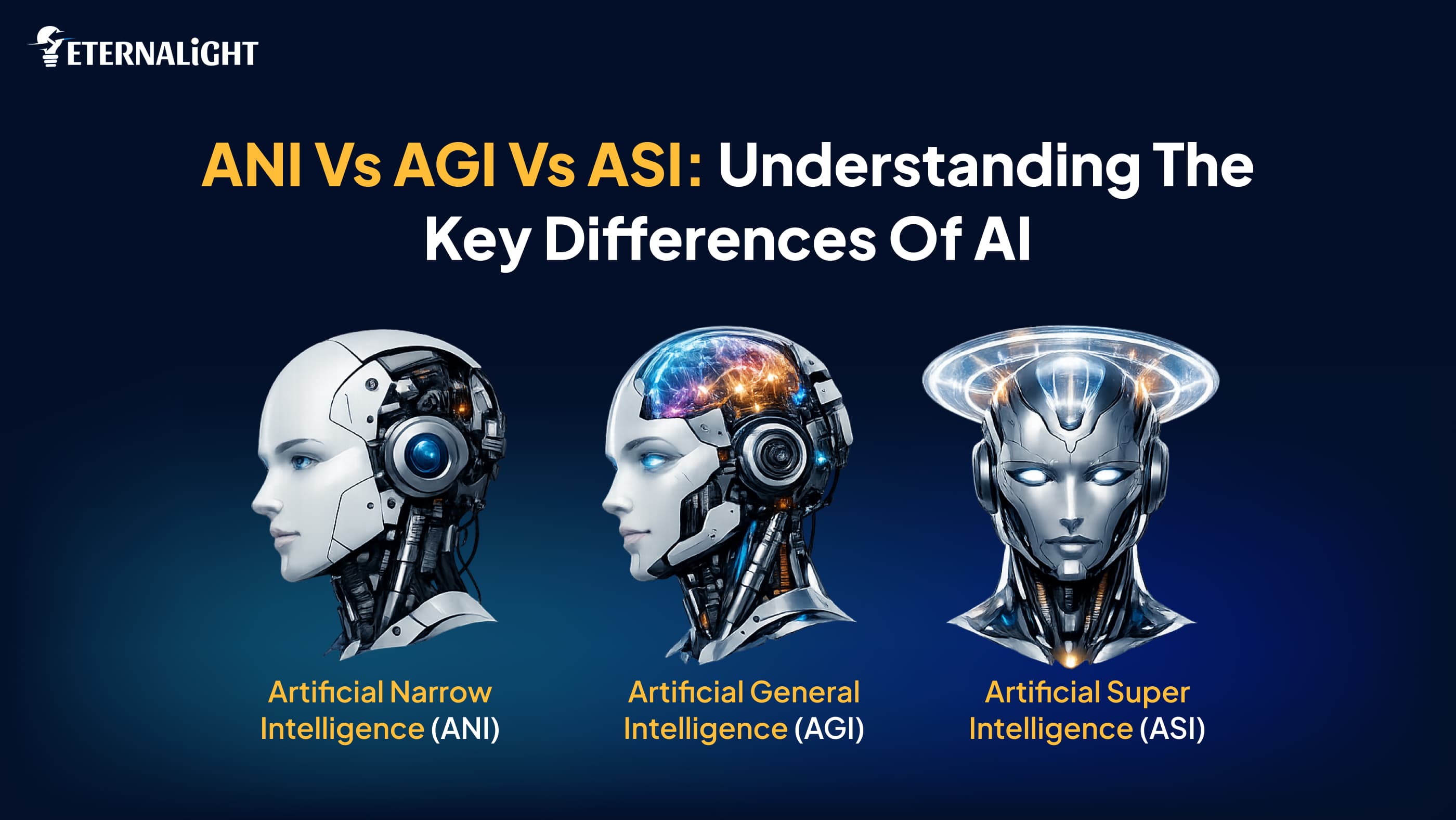
Although these three notions are often mentioned together, they denote entirely different levels of development of artificial intelligence. ANI provides us with all the existing AI technologies at the moment. AGI represents the future when machines will be able to think and learn just like we do, while ASI denotes the concept of superhuman AI on all fronts.
Knowledge of the differences between these three concepts is essential for any enterprise willing to implement Artificial Intelligence into its operations.
The information will definitely be useful for anyone who researches the possibilities of implementation of Artificial Intelligence into the process of automation or analysis.
What is Artificial Intelligence (AI)
AI can be described as the ability of machines and computers to conduct tasks requiring human intelligence. These include learning from massive amounts of data, recognizing patterns, language processing, decision-making, problem-solving, and improvement with time.
Unlike normal software that operates based on pre-set codes, AI analyzes vast quantities of data to make predictions. Modern AI uses advanced technologies such as machine learning, deep learning, natural language processing, and computer vision to increase efficiency in complex tasks.
At present, AI technology is changing industries such as healthcare, finance, retail, manufacturing, education, transport, and customer services. Businesses use AI for automating repetitive tasks, personalizing customer experiences, fraud prevention, process optimization, and gaining an edge through data insights through AI development services tailored to their business needs.
While artificial intelligence is progressing at an incredible pace, not all AI algorithms have equal levels of intelligence. Artificial intelligence can be classified into three main types by researchers depending on its capabilities:
- Artificial Narrow Intelligence (ANI)
- Artificial General Intelligence (AGI)
- Artificial Superintelligence (ASI)
What is Artificial Narrow Intelligence (ANI)
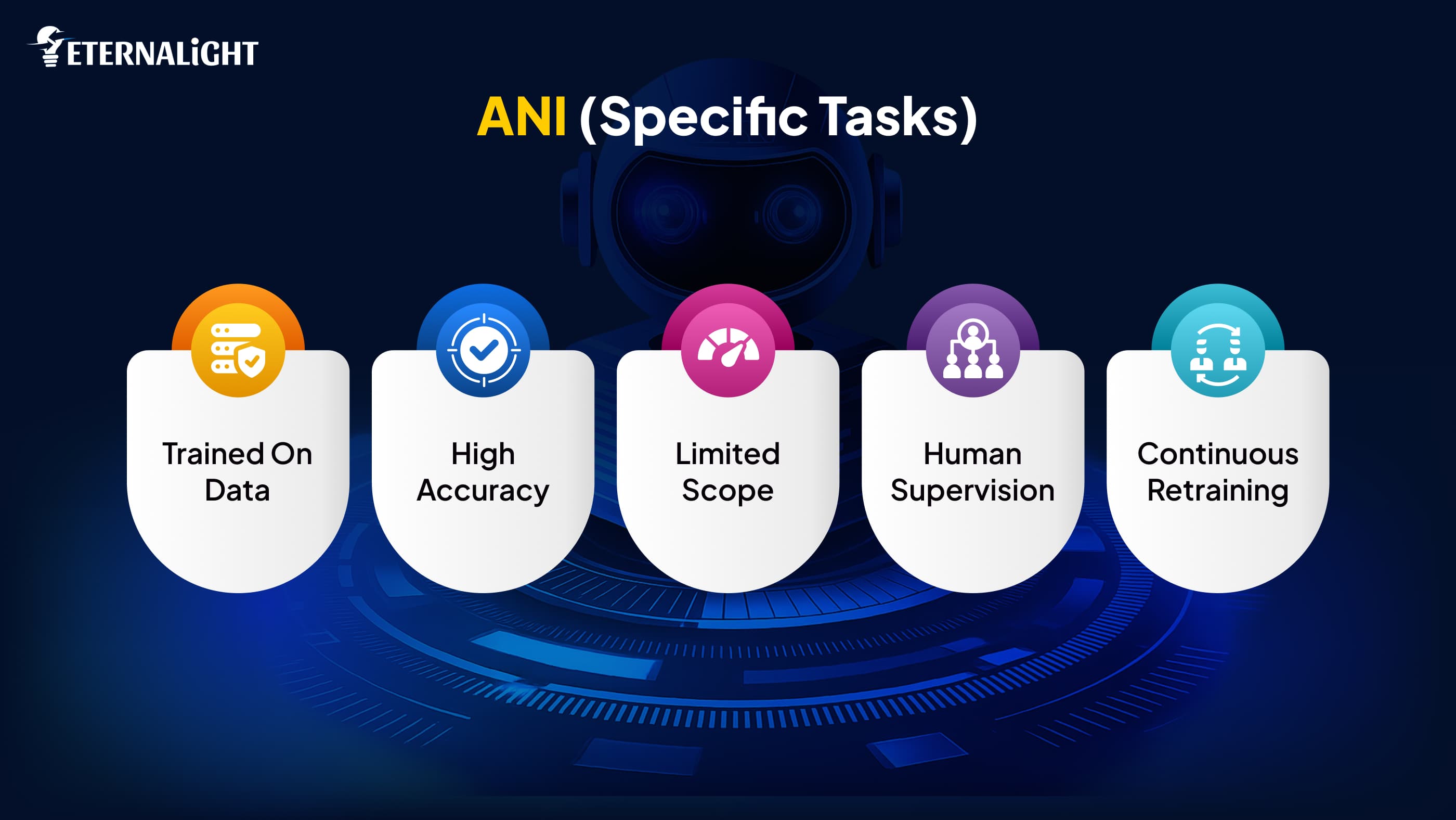
Artificial Narrow Intelligence (ANI) or Weak AI is the only form of artificial intelligence that currently exists and is widely employed by many organizations. ANI is programmed to excel in a particular function; however, it is unable to go beyond its domain of application.
Unlike a human being, an AI lacks reasoning skills, emotions, consciousness, and common sense. ANI is capable of dealing with huge volumes of information and making accurate predictions based on recognizable patterns.
An AI model designed to detect fraudulent financial transactions would not be able to make a medical diagnosis or drive a car unless it were reprogrammed to do that.
Key Characteristics of ANI
- Performs specific functions
- Is taught using past data and models
- Is accurate in a limited domain
- Unable to learn human reasoning skills
- Human assistance in its development and improvement
- Improves due to additional training data
Real-World Examples of ANI
The majority of AI systems that we use on a day-to-day basis are Artificial Narrow Intelligence.
Examples of Artificial Narrow Intelligence include:
- Virtual assistants such as Siri and Google Assistant
- Chatbots based on AI for customer service
- Recommendation systems of Netflix and Spotify
- Google Translate
- Face recognition software
- Spam filters for emails
- Prediction-based text generation
- AI-assisted fraud detection in the banking sector
- Software used for analyzing medical images
- Programming assistants using AI
Though very intelligent, even generative AI is categorized as ANI due to its specialization in certain abilities.
How Does ANI Work?
Artificial Narrow Intelligence primarily relies on machine learning algorithms. These algorithms analyze large datasets to identify patterns and improve prediction accuracy over time.
For instance:
- A recommendation system learns about user behavior to make personalized recommendations for products or movies.
- A fraud detection system identifies any odd transaction patterns.
- A customer support chatbot is aware of common queries and automatically responds.
- A diagnostic system that uses AI helps in analyzing medical images.
ANI does not comprehend data as humans do; rather, ANI identifies patterns within data statistically and makes output predictions based on learning.
Advantages of ANI
ANI has significantly impacted business operations by bringing about improvements in efficiency and productivity.
Some benefits of artificial narrow intelligence include:
- ANI helps automate boring and laborious activities, allowing employees to focus on more important tasks.
- Unlike humans, artificial narrow intelligence does not get fatigued; it executes repetitive tasks with accuracy all the time.
- Mega volumes of information can be processed in seconds, allowing quick decision-making.
- Cost-cutting is facilitated through automation, making processes more cost-effective.
- Recommendation systems, chatbots, and personalized engines are useful in creating improved customer interaction.
Limitations of ANI
Despite its impressive capabilities, ANI has several limitations:
- ANI is capable of performing only those tasks that it is programmed to do.
- It does not possess emotions, intuition, creativity, or common sense.
- The bad quality of data used for training results in wrong conclusions.
- ANI cannot learn any new skill on its own.
Why ANI Matters Today
Despite the regular references to AGI and ASI, the fact of the matter is that Artificial Narrow Intelligence is the basis for the current revolution in artificial intelligence. It powers virtually all commercial AI software in use today, including search engines, virtual assistants, and automated business processes.
Organizations implementing AI solutions are mostly utilizing ANI technologies due to their immediate benefits and business value, as well as return on investment (ROI).
With further developments in AI, ANI will most probably be responsible for enterprise automation as well as acting as the transition point towards other types of artificial intelligence.
What is Artificial General Intelligence (AGI)
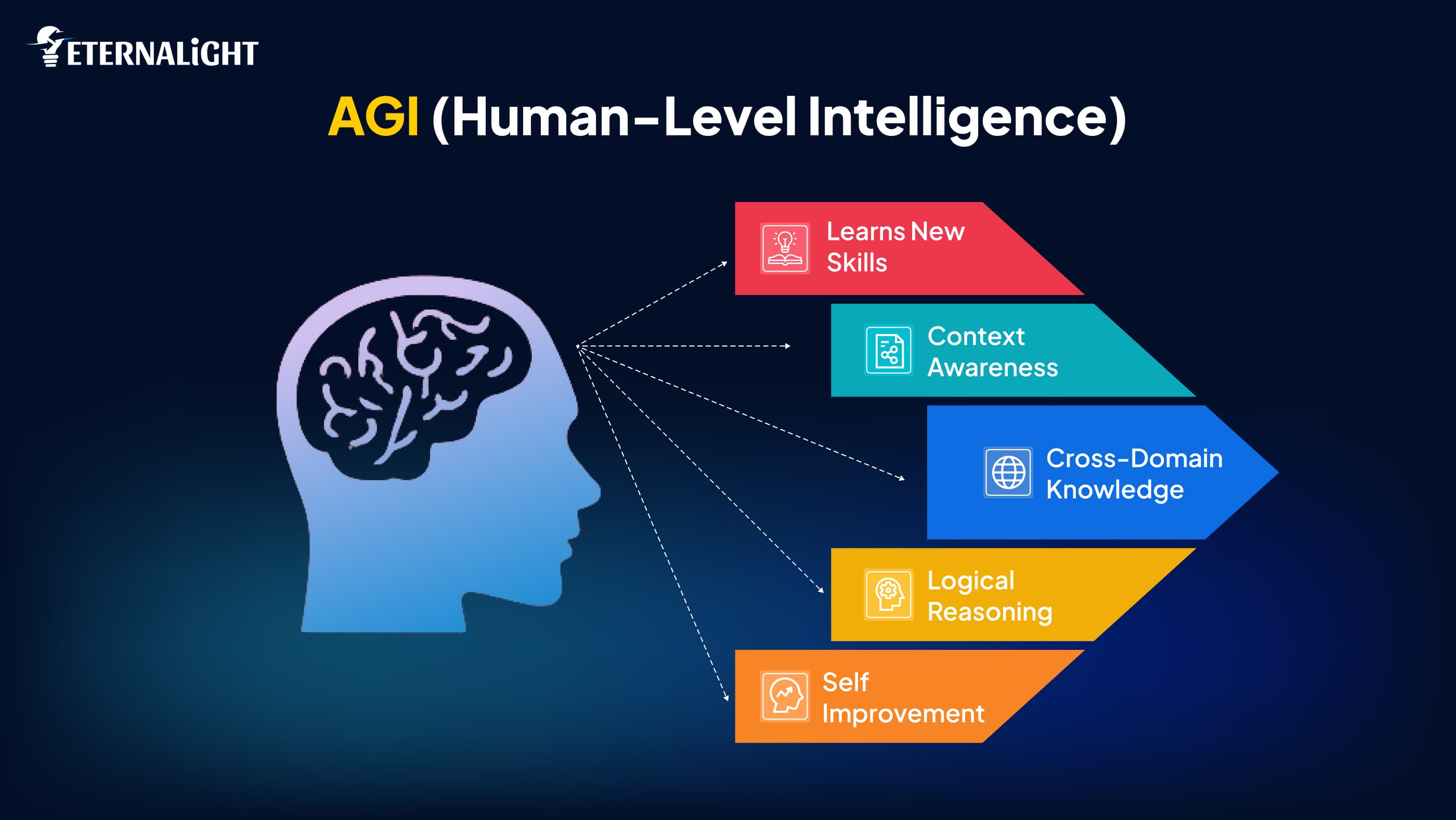
While ANI drives the AI-powered tools currently used by us, the development of AGI can be seen as the future step in the development of artificial intelligence technology. AGI is defined as a computer that can think, learn, reason, and solve problems as flexibly as a person does.
Unlike ANI, which is programmed to do a particular job, AGI would be able to understand, learn, and apply information related to various fields of activity and wouldn't require any extra programming for each particular task. Such an AI system would be able to comprehend new situations, adjust to new environments and make decisions using logic, rather than a set of rules.
Imagine such a kind of AI that would be able to diagnose illnesses in the morning, write software in the afternoon, learn a new language in the evening, and develop a business strategy the next day without further programming. This is what AGI means.
Despite the efforts of researchers and prominent AI companies, AGI has not been developed yet. The most sophisticated AI systems available at the moment, however advanced they might seem, are still considered as ANI because of the specialization of these algorithms.
Key Characteristics of AGI
- It can perform various intellectual tasks as performed by humans.
- It learns new skills without being programmed for that particular task.
- It can understand the situation.
- It can apply its knowledge in different areas.
- It makes logical decisions through reasoning and not programming.
- It constantly improves itself through learning.
Potential Applications of AGI
Though AGI is not yet developed, there is the capability for it to revolutionize virtually all industries.
Healthcare
An AGI could read medical files, interpret results, suggest courses of treatment, and aid doctors in making decisions related to complicated diagnoses while constantly learning from updated research.
Scientific Research
AGI could be used by scientists in helping to make discoveries through the analysis of large sets of data and solving problems that normally would take many years of trial and error.
Education
An AGI-based tutor could tailor lessons according to the individual needs of each student.
Business Operations
AGI can be used by companies to streamline their business operations, predict market trends, automate strategic planning, and make informed decisions.
Robotics
AGI-based robots will be able to change their environment, work with humans, and perform more than one task at a time without having to undergo reprogramming.
Challenges of AGI
Despite its potential, developing AGI presents significant challenges.
- Making machines think like human beings is a great scientific challenge.
- It is very important that the AGI acts safely and according to the moral values of human beings.
- Questions related to ethics regarding privacy, responsibility, and decision-making should be thought about carefully.
- Creating AGI would take enormous computing capacity and quality data.
This is why scientists believe that AGI is years, or even decades, away from realization.
What is Artificial Superintelligence (ASI)?
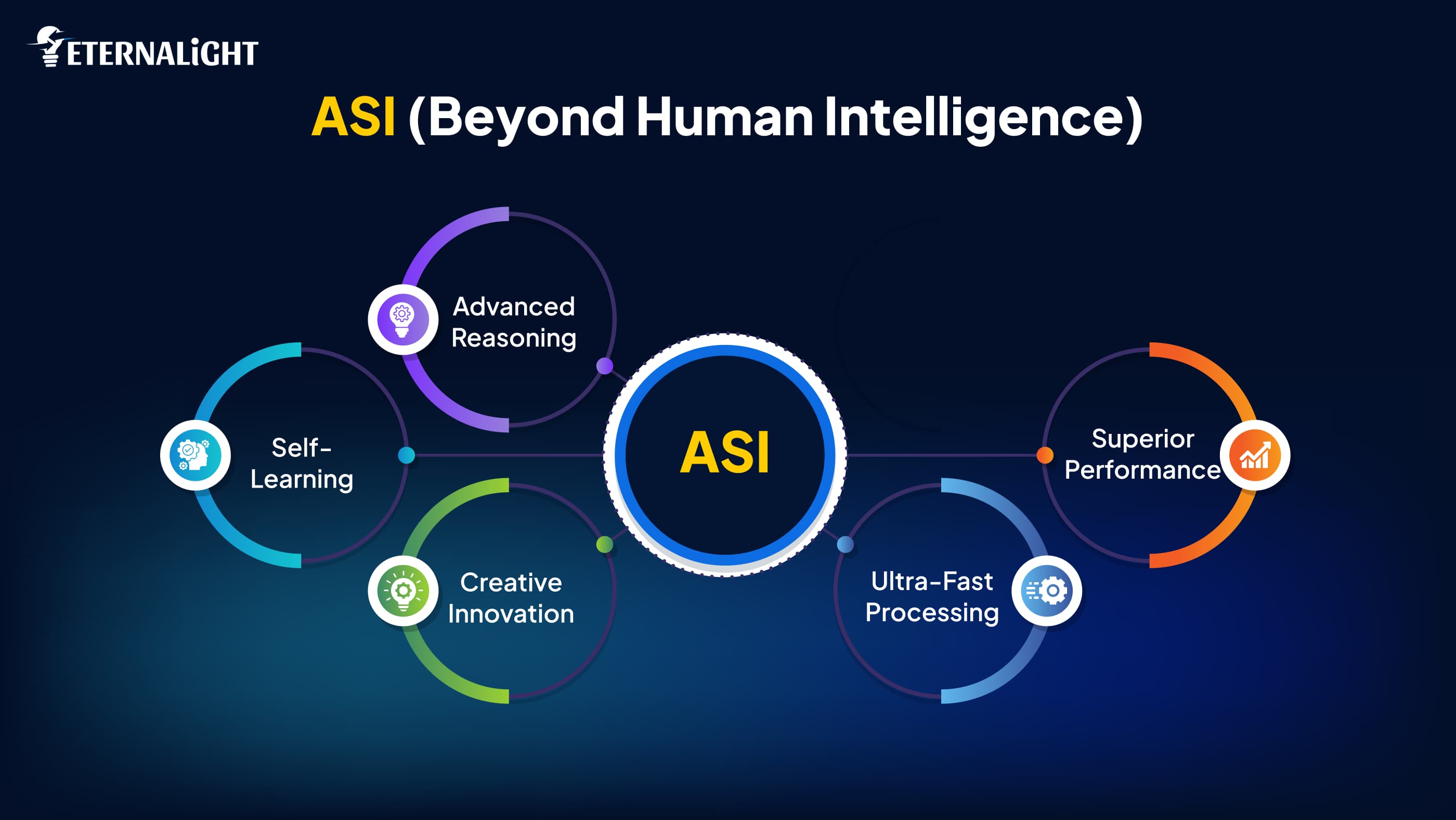
The Artificial Superintelligence (ASI) is the highest form and most theoretical level of artificial intelligence. It implies the development of an AI system that surpasses human intelligence in all respects, such as reasoning, creativity, problem-solving, emotional intelligence, and scientific discoveries.
It should be noted that ASI will differ from AGI in that while AGI is designed to achieve the same level of intelligence as humans, ASI will go far beyond that level. The superintelligent system will work faster, solve tasks that cannot be solved by humans, and constantly develop by itself.
So far, ASI is purely theoretical.
Key Characteristics of ASI:
- Unmatched intelligence beyond human capacity
- High level of reasoning and problem-solving
- Self-learning and improvement capability
- Innovative solutions without any help
- Superior processing speed of complicated data
- Outperforming humans in all fields
Potential Applications of ASI
A proper use of ASI can transform humanity.
Medical Breakthroughs
ASI could expedite medical discoveries, design personalized therapies, and combat some deadly diseases.
Climate Change Solutions
Based on environmental data collected around the world, ASI could develop sustainable energy solutions, resource management plans, and climate change solutions.
Space Exploration
ASI could aid scientists in organizing space missions, working with astronomical data, and solving engineering problems not accessible to humans.
Advanced Scientific Discoveries
Starting from quantum computing to material sciences, ASI could solve complex problems that it would take decades for humans to solve.
Risks and Ethical Concerns
The abilities that make ASI revolutionary are also connected with numerous risks.
- Loss of control over autonomous systems
- Misalignment between the goals of AI and humans
- Cybersecurity risks if ASI is used incorrectly
- Economic impact through automation
- Ethical concerns about accountability and regulation
ANI vs AGI vs ASI: Detailed Comparison
Features | ANI (Artificial Narrow Intelligence) | AGI (Artificial General Intelligence) | ASI (Artificial Superintelligence) |
Definition | AI is designed for specific tasks | AI with human-level intelligence | AI surpassing human intelligence |
Intelligence Level | Limited | Human-level | Beyond human |
Learning Ability | Task-specific learning | Learns across multiple domains | Continuously self-improves |
Problem Solving | Limited to trained tasks | Solves unfamiliar problems | Solves highly complex global challenges |
Adaptability | Low | High | Extremely high |
Creativity | Minimal | Comparable to human | Far exceeds humans |
Decision Making | Based on training data | Based on reasoning and learning | Independent and highly advanced |
Self-awareness | No | Theoretical | Possible (hypothetical) |
Current Status | Widely available | Under research | Theoretical |
Evolution of Artificial Intelligence
Artificial intelligence is expected to evolve through three major stages: ANI → AGI → ASI. Each stage represents a significant leap in machine capabilities and intelligence.
Stage 1: Artificial Narrow Intelligence (Present)
In today’s world, we live in the era of ANI. Corporations employ the use of AI in customer service, fraud prevention, predictions, recommendations, image processing, translations, and many other specialized areas. These AI systems are very efficient but still restricted to their programmed functions.
Stage 2: Artificial General Intelligence (Future)
The next step would be the development of AGI, wherein the machines will have the capability to understand, learn, and reason about a broad range of tasks. This would mean that there will no longer be a need to develop different models for different tasks because the knowledge acquired through one can be applied to another task, just as humans do.
Despite the great strides achieved through AI research, AGI is still a lofty goal to achieve.
Stage 3: Artificial Superintelligence (Theoretical Future)
There is ASI beyond AGI that represents an era when artificial intelligence would be more intelligent than human beings in all possible fields. The achievement of this goal might help make some amazing discoveries and innovations, but it is associated with certain issues related to ethics and governance.
Instead of considering this development as a current reality, we should regard it as a path that can be taken by artificial intelligence in future years. Businesses use the ANI, scientists try to create the AGI, and ASI still exists only as a theory.
The Future of Artificial Intelligence
Artificial intelligence continues to develop fast, yet at present, it remains in the times of Artificial Narrow Intelligence. Companies apply this technology to optimize production, automate routine tasks, and provide customers with better experiences. As ANI models become smarter, scientists keep working on the development of Artificial General Intelligence in the distant future.
Even though AGI can change the industry with its ability to think and adapt like humans, at present, it is only an objective of research. ASI remains a theoretical concept, which causes a lot of enthusiasm and discussions about the future of mankind.
In the future, the development of AI will not just be about creating more intelligent models. Responsible approach to AI and ethical governance, as well as transparency and human control, will play a significant role.
In terms of business, the future belongs to smart use of artificial intelligence in order to solve existing problems, not to AGI and ASI. The future belongs to ANI.
Conclusion
Differences between ANI vs AGI, and ASI offer great insights into the current standing and future potential of artificial intelligence.
Artificial Narrow Intelligence (ANI) is the artificial intelligence used to develop the applications we use daily to automate work processes, analyze big volumes of data, personalize customer experience, etc. AGI is an idea of a machine capable of thinking and learning like a human being, while ASI is a theoretical concept that implies superhuman intelligence.
Despite the fact that both AGI and ASI attract attention all around the world, companies do not have to wait until tomorrow to implement artificial intelligence solutions. Modern ANI is already changing our world, providing higher efficiency, smarter decision-making, and innovation.

Kusum Sethiya
Software Engineer
Kusum Sethiya is a Software Engineer at Eternalight Infotech, focused on building clean and intuitive. She enjoys turning ideas into reliable applications using modern technologies like Javascript, React, Node.js , and MongoDB.
Frequently Asked Questions
ANI is designed for specific tasks and powers today's AI applications. AGI refers to human-level intelligence capable of learning across multiple domains, while ASI describes a hypothetical AI that surpasses human intelligence in every aspect.
ChatGPT is considered Artificial Narrow Intelligence (ANI) because it is designed for specific language-related tasks, even though it can perform a wide variety of them.
ANI is practical, reliable, and designed to solve specific business problems, making it suitable for industries such as healthcare, finance, retail, education, and manufacturing.
Businesses can begin by implementing ANI-powered solutions such as intelligent chatbots, predictive analytics, recommendation systems, workflow automation, and custom AI applications to improve operational efficiency and customer experiences.
Healthcare, banking, eCommerce, manufacturing, logistics, education, customer service, cybersecurity, and marketing are among the industries that benefit significantly from ANI-powered solutions.
Related Blogs
- AI & ML10 Mins
AI Doesn't Forget. It Loses Context: How Context Graphs Can Help
Learn how context graphs help AI agents connect information, retain context, and make better decisions with AI memory tools and retrieval systems.
- AI & ML10 Mins
How to Test Generative AI Applications: A Practical Guide to Reliable AI Systems
Learn how to test generative AI applications for accuracy, hallucinations, performance, security, RAG workflows, and reliability.
- AI & ML10 Mins
AI Data Security Strategies: 8 Ways to Protect Data in AI Systems
Explore 8 AI data security strategies to protect sensitive data across prompts, AI models, RAG systems, APIs, access controls, storage, and outputs.