Most enterprises and startups have integrated AI in some form into their business processes.
AI is here to stay. It offers a multitude of advantages if used correctly. Most companies are pivoting to integrating AI into their daily operations.
If you’re a small scale startup or a major enterprise, you should consider using AI for business automation processes.
This article covers the biggest use cases, what the data actually says, and how to get started without wasting six months on the wrong thing.
What Is AI Business Process Automation?
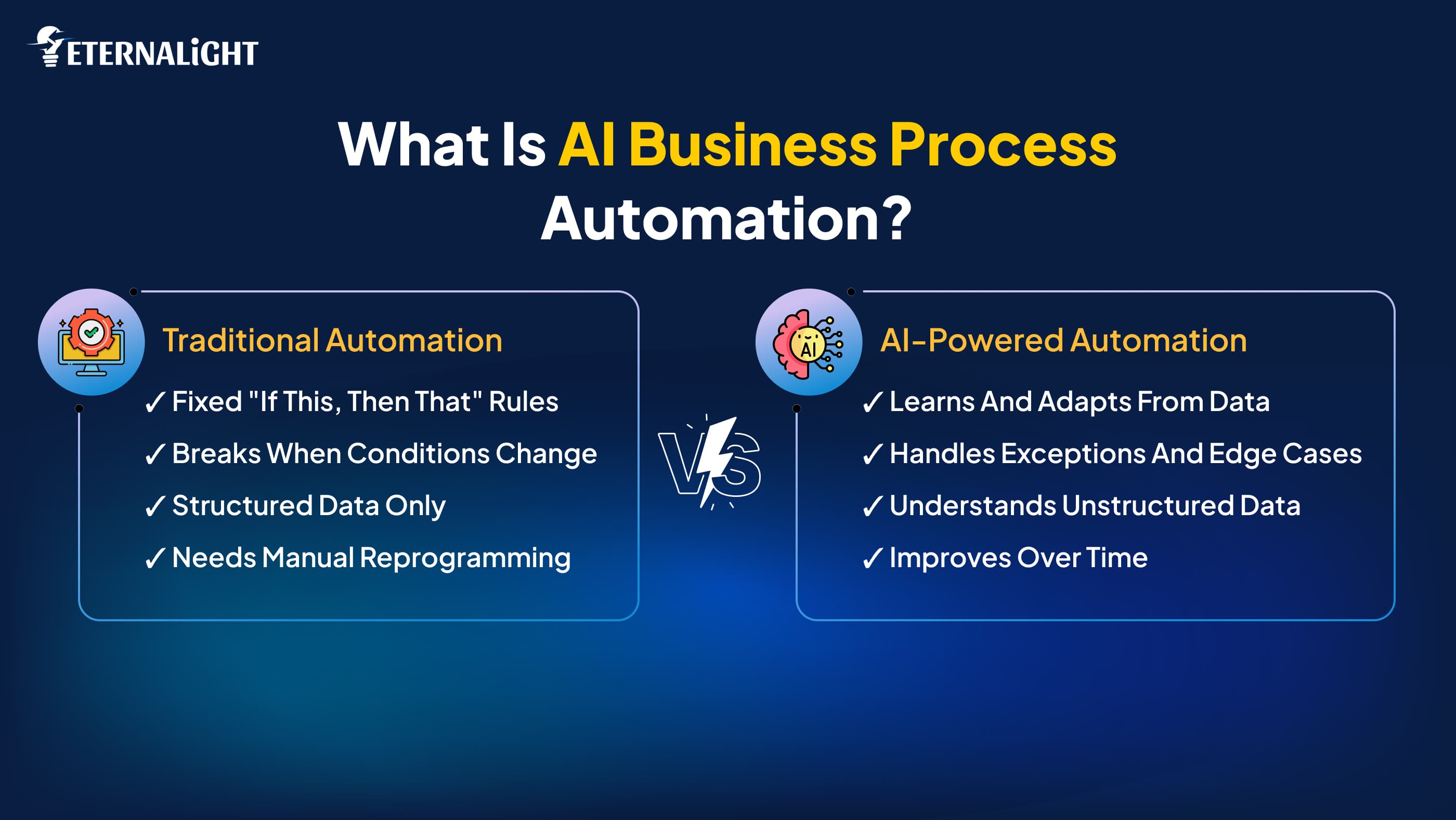
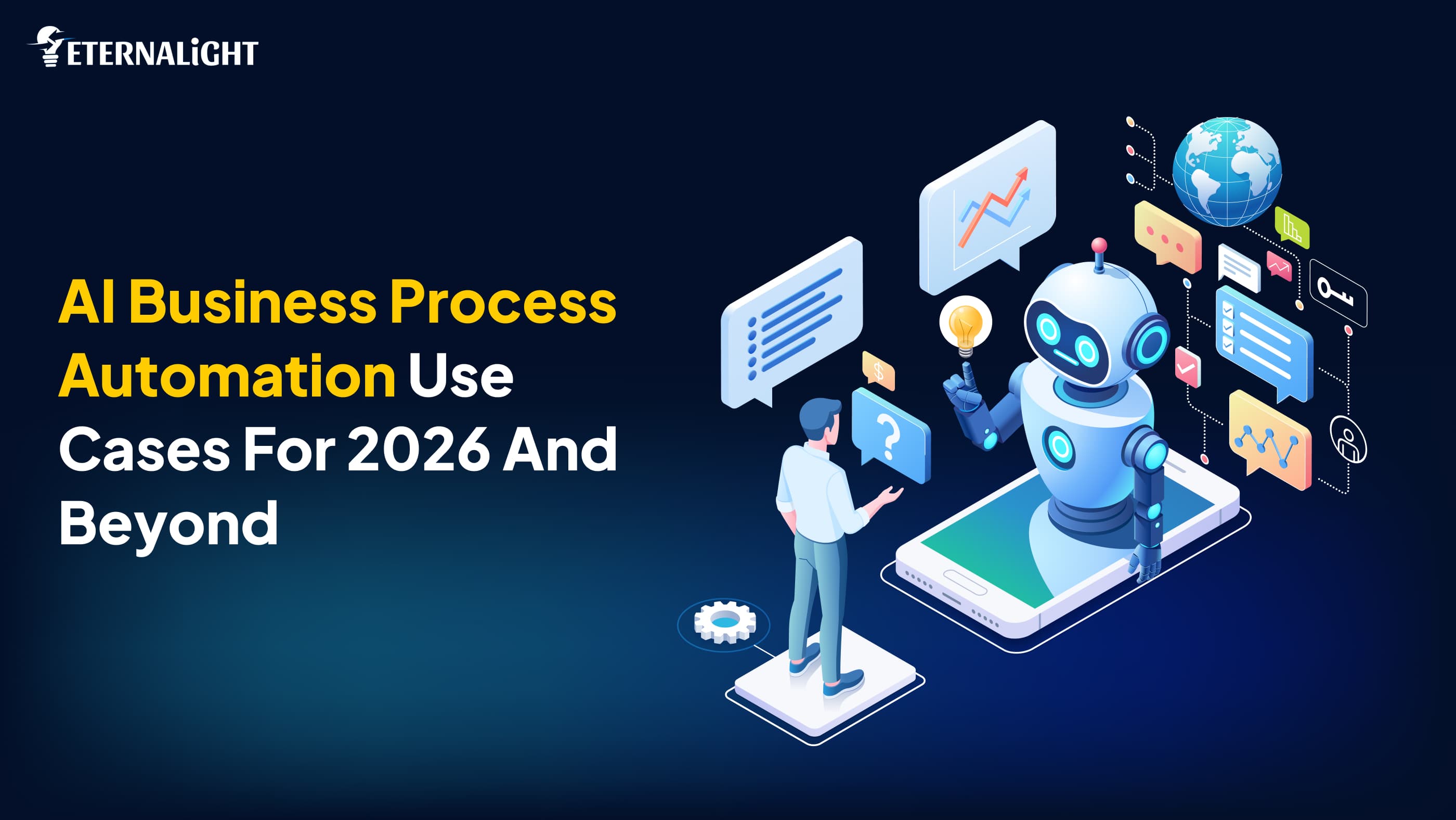
AI business process automation is the use of artificial intelligence to handle repetitive, manual, or data heavy tasks with the help of automation. Tasks that previously required human effort but are repetitive enough to be done by AI come under this automation.
It goes beyond traditional automation. Standard rule based automation follows a fixed script but any changes in the rules will cause the automation to break. It follows the standard ‘if this, then that’ logic.
AI powered automation can learn, adapt, and make decisions based on the data patterns. It can understand the intent and context behind most decisions as well as correct itself and improve over time. AI automation can map out dynamic decisions, as well as interpret unstructured data really well.
Think invoice processing, customer query handling, HR onboarding, and content generation.These tasks require a lot of human effort and consume thousands of hours annually. AI business process automation helps automate the boring repetitive tasks so your team can put more effort into the processes that require the most human input.
Why Businesses Are Investing in AI BPA in 2026
Automation is now viewed as a way to increase productivity as much as possible in organizations. The numbers paint the picture better than any words can.
According to a 2025 McKinsey Global Institute report, between 60 and 70 percent of business tasks across industries could be automated using existing AI technology.
According to Ringly.io's 2026 AI automation statistics, 73 percent of enterprise decision makers plan to increase their AI automation budget this year, up from 58 percent in 2025.
For startups and enterprises alike, the ROI is unignorable. With global AI spending projected to hit trillions in upcoming years, investing in agentic business process automation (BPA) is the right move for your company.
The 10 Biggest AI Business Process Automation Use Cases in 2026
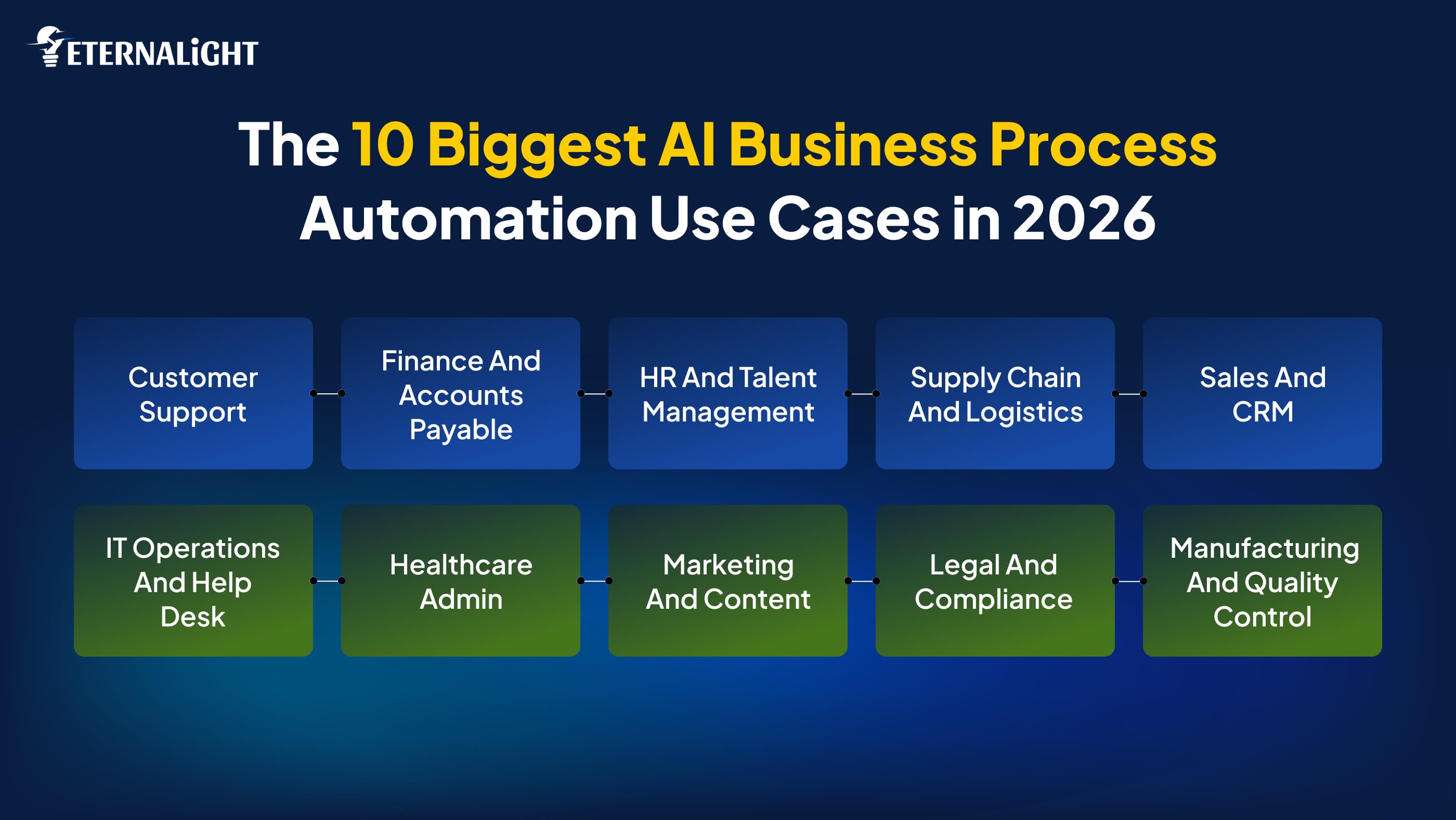
1. Customer Support and Service Automation
The impact of AI chatbots and automation has been visible the most in the customer support industry. AI powered chatbots are able to handle simple user queries while higher level questions are redirected to human agents. One of the biggest factors is availability. With the help of AI automation, your customers get help all around the clock.
Open AI is the pioneer in these automation services. If you're looking to build AI support workflows, OpenAI integration and automation services are a good place to start for custom implementations.
The biggest benefit of this use case is the better customer experience achieved as well as the cost reduction.
2. Finance and Accounts Payable Automation
Finance teams spend a lot of time on invoice matching, expense approvals and reconciliation. These are some highly repetitive tasks that AI handles well.
AI tools extract data from invoices then match them against purchase orders, flag discrepancies, and route approvals. The important factor here is accuracy. AI ensures that it's accurate and the data is not erroneous.
AI BPA in this use case ensures faster close cycles, less errors, and saving of time and energy.
3. HR and Talent Management Automation
If you work in HR, you know that hiring is slow and expensive. HR teams at growing companies spend weeks screening resumes and scheduling interviews. By using AI business process automation they can compress that timeline.
Modern AI tools screen and rank applicants based on job requirements, send automated communications, and can even conduct initial assessments.
Using automated AI processes in HR ensures faster hiring cycles and consistent onboarding experiences.
4. Supply Chain and Logistics Automation
Supply chains generate enormous volumes of data. It is hard to act on that data fast enough.
AI models help to predict demand fluctuations, automate decisions, and flag any risks. Companies like Amazon and Walmart have been using AI for years to optimize routing in real time. The difference is that this technology is now available to all, small startups to large enterprises.
Cost effective alternatives for supply chain intelligence do exist. Open source LLM development services enable you to make custom model deployments at a fraction of the cost.
The benefit of this automation use case are that there are fewer stockouts and lower inventory carrying costs.
5. Sales and CRM Automation
Sales teams spend a lot of time updating CRM records, drafting emails, and qualifying leads manually. This takes a chunk of their time away from actually working on selling their products.
AI business automation also comes in handy here. Tools like Salesforce Einstein and HubSpot's AI feature can autolog call notes, suggest next steps, score leads and generate personalized outreach. According to Salesforce's State of Sales report, AI augmented sales reps close 26 percent more deals compared to those without AI tools.
Doing manual repetitive work can be frustrating, so using automated services also ensures you boost morale and productivity. The benefits from automation are immense: more time selling, better lead prioritization, and higher close rates.
6. IT Operations and Help Desk Automation
IT help desks deal with a lot. A constant stream of password resets, software access requests as well as troubleshooting tickets. Most of these can be resolved without needing a human technician.
AI tools work best in the IT industry. They can route complex issues to engineers while resolving common ones on their own. AIOps platforms monitor infrastructure, detect anomalies, and trigger remediation scripts entirely on their own.
Using AI BPA for IT operations ensures that systems stay up and engineers focus on higher and complex problems.
7. Healthcare Administration Automation
Healthcare organizations lose billions annually to administrative inefficiency. Prior authorizations, claims processing, patient scheduling, and documentation are among the biggest drains.
AI automation in healthcare reduces documentation time. It can handle note taking on its own and free up time for the medical staff. It processes insurance claims faster and with fewer errors. Intelligent scheduling tools send reminders to patients about upcoming appointments and manage waitlists dynamically.
Using automation, clinical staff spend more time with patients and less time on repetitive paperwork, which improves outcomes for everyone involved.
8. Marketing and Content Automation
Marketing teams are under constant pressure to produce more content and run more campaigns. AI makes this feasible.
AI tools handle content drafting, SEO optimization, A/B test generation, ad copy creation, and campaign performance analysis. Platforms built on AI platforms can now generate brand consistent content at lightning speed. With some human oversight, content creation has become much easier for most marketing teams.
For your content strategists, it gives them leverage. Instead of spending three days writing five blog posts, they spend one day reviewing and refining them all.
9. Legal and Compliance Automation
Contract review, policy monitoring, and regulatory compliance are high stakes tasks and highly time consuming.
AI tools can scan contracts and flag risks, compare documents against internal policies. Compliance monitoring tools track the regulatory changes across jurisdictions and alert teams if something changes.
AI assisted legal document review gives growing companies an advantage. Using automation here ensures that you get faster deal cycles and lower legal costs.
10. Manufacturing and Quality Control Automation
Quality control in manufacturing has traditionally meant human inspectors reviewing products on a production line. It's slow, inconsistent, and expensive.
AI powered computer vision systems detect defects in real time with greater accuracy than human inspectors. Predictive maintenance tools analyze sensor data from equipment to predict failures before they happen.
Autonomous systems are also being used for production scheduling, optimizing line output and material availability.
The benefits here are the higher quality at lower cost, and optimized maintenance schedules that prevent problems. You can also explore the business process automation with AI in Education, AI in food industry, and Ai in sports industry as well.
How to Implement AI Business Process Automation
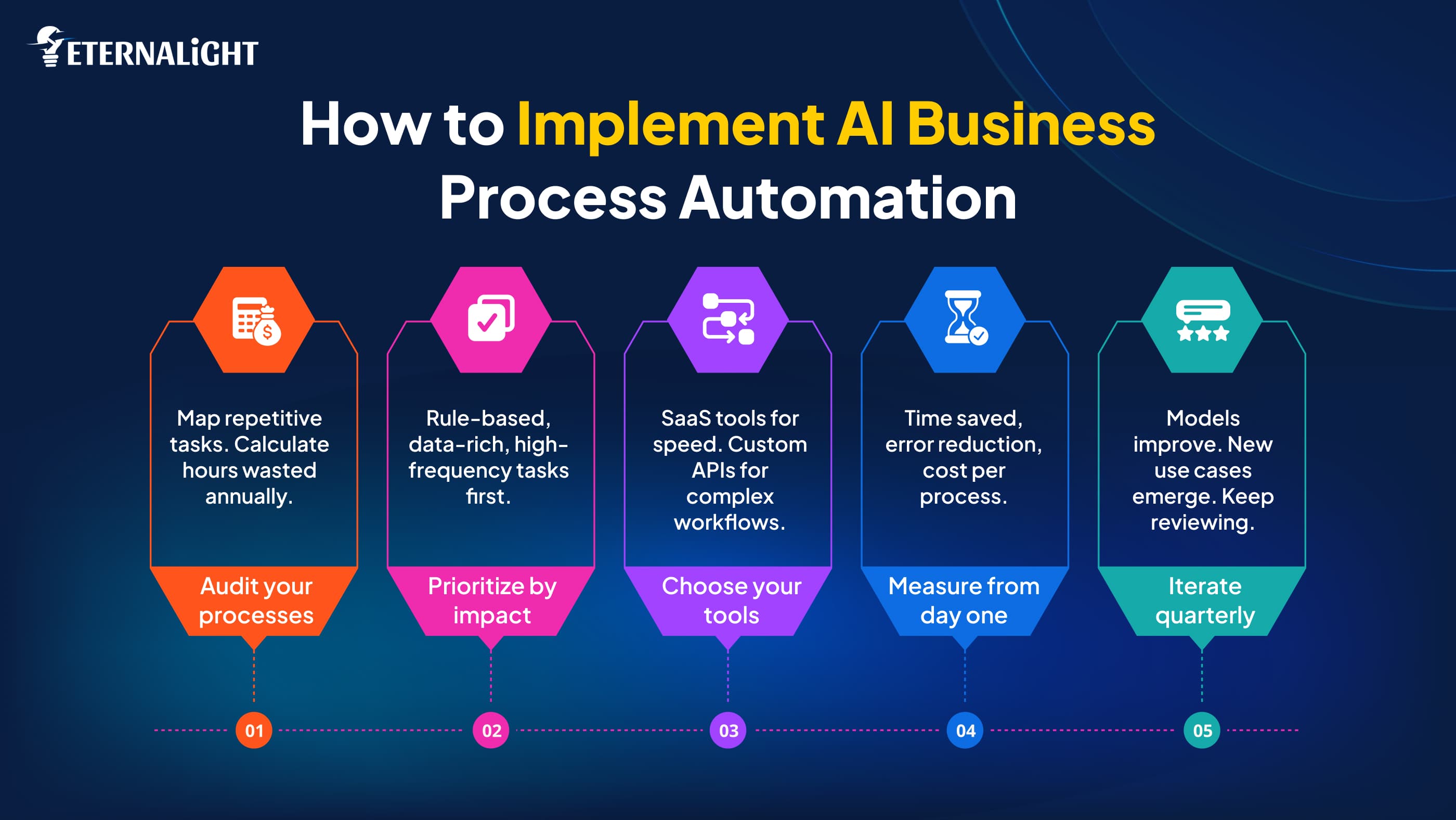
When integrating AI automation into your business, it is important to take the right approach.
Here's an approach that actually works:
Start with an honest audit. Map out your most repetitive processes. Calculate the time and money they consume annually. These go into your to-be-automated list.
Prioritize by impact and feasibility. Not every process is ready for automation. Focus first on tasks that are rule based, data rich, and high frequency. Customer query classification, invoice processing, and lead scoring are solid starting points.
Pick the right tools. Decide whether you need SaaS tools or custom solutions built on APIs and LLMs. For complex or proprietary workflows, custom builds deliver better results. This guide on AI tools for software development startups helps you choose the right tools for your organization.
Measure from day one. Define what success looks like right from the beginning. Time saved per task, error rate reduction, cost per process are good baseline metrics.
Build in iteration. AI automation isn't a one-time thing. Models improve, workflows change, and new use cases emerge. A quarterly review cycle keeps things from going stale.
With the right approach and tools, you can use automation to its best.
Conclusion
AI business process automation is not a future investment.
The use cases here span every department and every industry. The common thread is the same: repetitive work that consumes human time without producing strategic value. If you let AI handle those then your people do the work that actually moves things forward.
Automation is here to stay, and it is best to adapt and grow with it. Companies with this outlook will outperform their competitors.

Gauri Pandey
Technical Content Writer
Gauri Pandey is a Technical Content Writer at Eternalight Infotech. She uses her expertise to break down complex topics into simple, value-driven narratives, bridging the gap between technology and real-world applications.
Frequently Asked Questions
AI business process automation uses artificial intelligence to handle repetitive, or data intensive tasks that previously required human effort. It goes beyond traditional scripted automation by learning from data and adapting over time without being manually reprogrammed.
Traditional automation follows fixed rules and breaks when conditions change. AI powered automation handles unstructured data, understands natural language, and improves without human intervention. It can make judgment calls within defined parameters, not just follow a script.
Finance, healthcare, retail, manufacturing, legal, and customer-facing industries see the highest impact. That said, any organization can benefit regardless of sector or company size.
The main benefits are lower operational costs, faster processing times, fewer errors, high availability, and the ability to scale output without proportionally increasing headcount. The compounding effect over 12 to 24 months is where the real ROI shows up.
Related Blogs
- AI & ML10 Mins
AI Doesn't Forget. It Loses Context: How Context Graphs Can Help
Learn how context graphs help AI agents connect information, retain context, and make better decisions with AI memory tools and retrieval systems.
- AI & ML10 Mins
How to Test Generative AI Applications: A Practical Guide to Reliable AI Systems
Learn how to test generative AI applications for accuracy, hallucinations, performance, security, RAG workflows, and reliability.
- AI & ML10 Mins
AI Data Security Strategies: 8 Ways to Protect Data in AI Systems
Explore 8 AI data security strategies to protect sensitive data across prompts, AI models, RAG systems, APIs, access controls, storage, and outputs.