You had an idea that turned into a digital product, and you invested everything you had.
- Time
- Efforts
- Budget
Months passed, and finally, when the MVP was ready to launch and the time came to deliver to the client, the requirements changed midway; more additions were requested. You’ve probably seen this in the development world. With clients' changing priorities, driven by trend revolutions and requirements, these chaotic scenarios are nothing less than a roller coaster ride.
The client shared a problem; you invested hours in discovering the root cause and a realistic, practical solution for building custom software. So basically, the risk isn’t that the product takes time to develop or deliver for the final release. The problem is that the solution is based on the client's assumptions, unclear objectives, and an unclear sense of what they want.
Each idea we consider building has a risk factor and uncertainty that need to be identified at the right time. For that, we must have a structured plan to de-risk building software. The blog covers common reasons why custom software development projects fail and the best practices to avoid costly mistakes.
The Glitch: Why Custom Software Projects Fail
Whenever an idea goes off track, we assume that it’s a technical glitch due to outdated software, a bug, or the lack of proper staff. But that’s not always true. Failure can occur at any moment due to silly steps we have taken in the past that we can’t even imagine.
A failure not only wastes time, effort, or budget, but also hurts our sentiments and the trust our customers place in us.
Regardless of who builds that software startups, SMEs, or large brands a small failure can hurt the business reputation.
I remember an incident at Infosys where they built software for taxation that began lagging, and many users were unable to submit their details on time.
If you’re building an in-house project to launch for a customer later, that's fine, but if it's for your business client, it will invite unnecessary trolls.
SaaS companies follow a well-structured sprint plan to complete projects; they collaborate with CTOs. If they feel the need to hire full-stack consultants and full-stack developers to manage the bandwidth and efficiency, they do so.
Each one has a distinct set of responsibilities to manage, from discovery and design to marketing, to shape what was on mind and on paper into a functional product.
Common Risks in Custom Software Development

We have tried to categorize common custom software development risks that interrupt the proejct release.
Product Risks
Whenever software starts lagging for whatever reason, they think of redesigning the idea; sometimes it works, optimizing business processes. However, it won’t work for all problems; it can bring benefits and trade-offs in equal measure.
Business Risks
Prioritizing only market trends and neglecting the core issues of end users, user experience, financial returns, and the current-scenario necessity is also a matter.
Stakeholder Alignment Risk
Whatever is built, if the stakeholders are not aligned on the same points, it can spark politics because they may think the organization is favoring one group over another.
Technical Risk
If you have faith in a specific integration library implementation that will add competitive advantage to your software, but it may cost dollars if it doesn’t meet your expectations.
Things to Consider Before Building Custom Software
Disruption and development should be in the right direction; otherwise, startups face common challenges and software development risks.
- Do you have a clear understanding of pain points from both the business and end-user perspectives, as well as market dynamics?
- Are you sure that the custom software solutions you are building will drive progress?
- Are you just aggressively moving ahead with the evolution, or are you actually aware of the financial burdens and outcomes?
- Do you have skilled professionals to implement that technology?
- Is the chosen tech stack feasible?
- Is it necessary to build that software?
- Is the software being built with viable core features
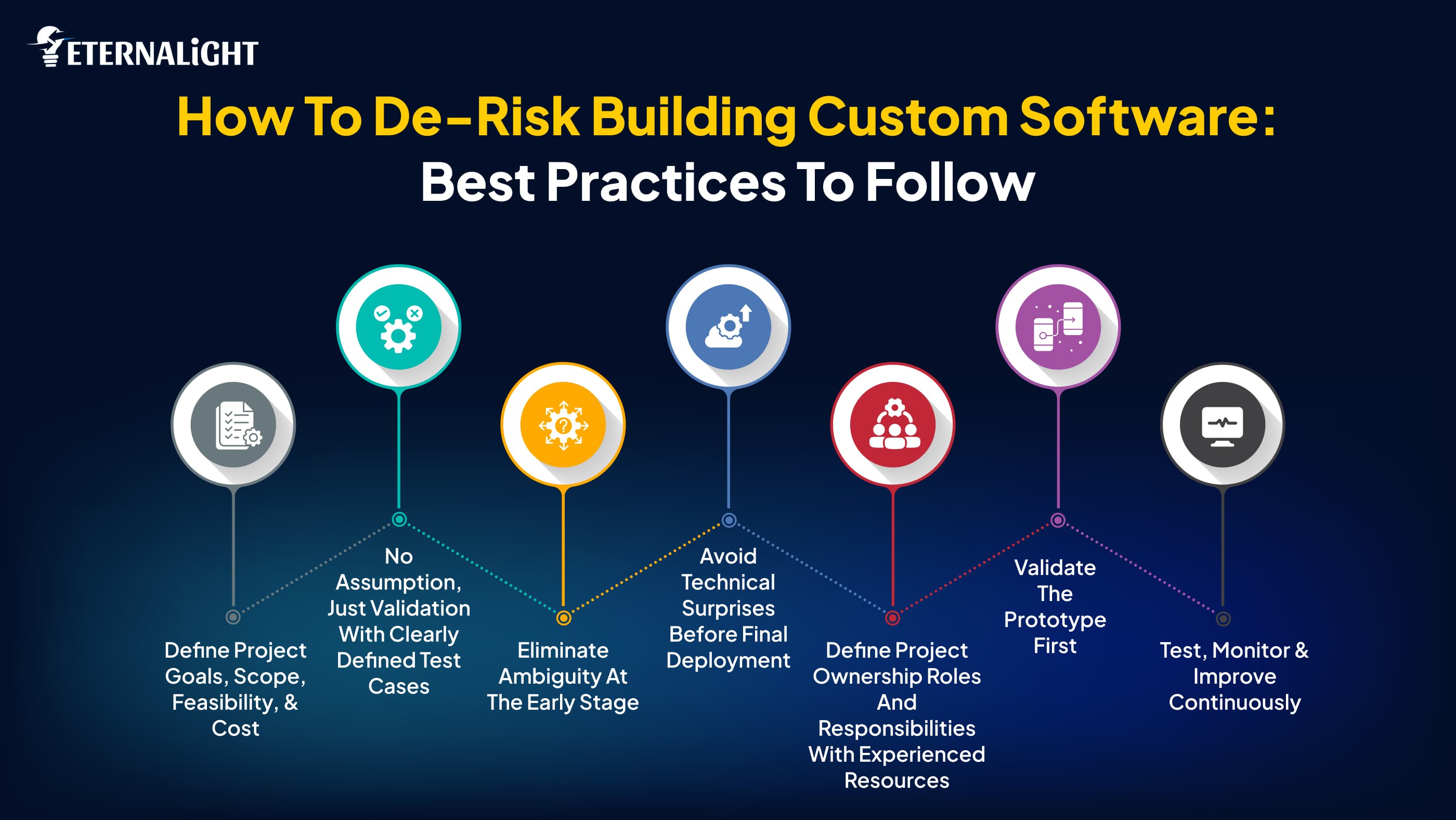
How to De-Risk Building Custom Software: Best Practices to Follow
After working in the industry for several years, both full-stack developers can recognize the signs long before the product reaches its final launch date.
If someone is wise, they can identify red flags of project failure and recovery strategy earlier. If those risks and signs are ignored and the issues are not rectified and resolved at the right time, using the right strategy and technical implementation, there’s no doubt the project will be at risk even after launch, requiring frequent maintenance.
Here is the step-by-step process to de-risk software building with strategic planning and complete the project more efficiently.
Define Project Goals, Scope, Feasibility, & Cost
Knowing what you want to build and what will not change after reaching the prototype stage, eliminates risk. You know how much time you need, the resources, and the project's complexity and scope; you can also estimate expenses.
Your primary focus will be on developing a successful MVP to validate the core features in dynamic marketplace, so you can add additional functionality without wasting effort.
You define the clear sprint plan with milestones and rules, and once it is achieved, it will be marked as done.
Set a frequent review call for each phase to check whether you should stop, reframe, or take immediate action to troubleshoot the existing plan, or whether you’re on track.
Keep a buffer of time, money, and also an additional developer or designer to complete the project in case any team member is absent. Uncertainty can occur at any moment in any aspect.
No Assumptions, Just Validation with Clearly Defined Test Cases
Would you actually like to walk in the dark, assuming the facts that drive uncertainty and put the project at stake?
We are asking you to launch the MVP in 21 days, or as soon as you can, validate whether the product is practically fit for real-life scenarios. If your prototype stage is completed without any malfunctions, you can map the user experience for other stages as well.
Eliminate Ambiguity at the Early Stage
Prepare clear test scenarios for each feature you’re integrating and perform E2E testing with Cypress to avoid any ambiguity. Once it is clear that the feature is responding properly, this will eliminate the risk of project failure or delayed release.
Avoid Technical Surprises Before Final Deployment
From C and C# to Go, Java, Python, and other AI-driven technological trends, all are essential. We select each programming language and tool as per the project requirements, domain area, and operational workflows.
If we don’t choose them wisely, it will lead to project failure. To avoid any technical risk, it's better to perform proof of concepts for load balancing, storage, processing, low latency, and rendering.
Test the product across all non-technical and technical scenarios, regardless of whether they comply with security standards and AI rules. Check whether you have access to third-party tools or not so the product stays stable and reliable even after launch.
Define Project Ownership Roles and Responsibilities with Experienced Resources
Establish a communication channel to facilitate cross-functional collaboration and reduce the risk of project delays. If the team and its members have no idea who is responsible for what, and they are not synced well on how they will take ownership of their mistakes and wins.
If any team member is less experienced and/or needs access to tools or resources to complete the project, clear communication is a must-have. When they feel heard and involved in the planning, and have the freedom to take initiative, they will deliver better than expected.
Timely calls, virtual meetings, and product demos at each stage will help to achieve milestones more efficiently,
Validate the Prototype First
Every project that builds in-house software development company is proof of their product engineering skills and execution strategy.
The development phase follows the same steps and curve, which include requirements gathering, feasibility analysis, UI/UX design (prototyping/wireframing), coding, testing, maintenance, and launch.
In 2 to 3 months, we get a prototype of the idea, and the development team can decide, with guidance from a full-stack consultant, whether the idea is a fit and can be forwarded for development and deployment.
Often, the prototype doesn't receive verification for final deployment, and it's quite favorable in terms of budget, time, and resources. We may save hours of time and effort and, of course, help secure startup funding from being wasted on an infeasible idea.
If any organization has hired a CTO or full-stack consultant, they can save you from such mistakes and common challenges that lead to project failure, and help you rescue projects that may be going to fail.
Test, Monitor & Improve Continuously
Even when the product is deployed, the work isn’t done. You need to track the application performance, user behavior,all the technical and security breaches, system logs, or more. It needs to be identified first to understand how it influences users. Take notes after every release; make improvements to optimize the product. It is required to keep the system stable, secure, and business-aligned.
Checklist for Building De-risk Software
The checklist we’ve prepared to answer all the questions to know if everything is perfect:
- Do you know the exact core problem for which you are initiating the development plan?
- Have you identified the end users that will adopt this solution?
- Have you finalized the essential features for the MVP version ?
- Are all stakeholders involved and agreed on the project goals, essential features, and end results?
- Do you know how much budget, resources, or time will be required to complete the project?
- Does this project involve any type of risks related to technical, security, compliance, and integrations?
- Is your tech stack reliable and secure for future expansion and technical maintenance?
- Have you assigned the responsibility and role and finalized the communication mode, like who will take the accountability and how you will keep things in sync?
- Have you prepared for post-release ?
If all answers are positive, you can confidently initiate the project and reduce the risk of delays and rework.
Final Words
Identifying the risk early reduces the chances of project failure. Because when you overlook them, it is encountered as product risk, unavailability of resources, uncertainty of timeline, or any other natural disaster. If you address these essential things from the beginning, de-risking software development becomes easier, and you'll be prepared for unexpected technical gaps. Making assumptions doesn't guarantee your project will be released on time; it only increases the chances of project risks.
If you need any consultation for a successful project release, get connected with the top software development company.

Ayushi Shrivastava
Senior Content Writer
Ayushi is a Content Strategist at Eternalight Infotech with 4 years of experience in transforming complex ideas into clear, engaging, and SEO optimized narratives. She specializes in crafting impactful content strategies that enhance brand visibility and drive meaningful engagement across digital platforms.
Related Blogs
 Software Development9 Mins
Why Choose Python for Fintech App Development?
Learn how Python helps fintech businesses build scalable, data-driven applications with powerful support for analytics, AI, APIs, and automation.
- Software Development8 Mins
Is It Time to Build Off the Self vs Custom Software for Your Business?
When should you build custom software? Learn the key signs, costs, limitations, and factors to consider before choosing custom software for your business.
- Software Development11 Mins
Website Security Checklist: What to Check Before It's Too Late
Worried about website security? Use this practical website security checklist to spot common risks and protect your website, data, and users.