Software Development
9
Mins
Top Mobile App Development Trends to Watch in 2026
Learn about the latest mobile add development trends that are taking over the world in 2026 and beyond.
Top Software Development Trends That Are Raising the Bar of Industry in 2025
Measuring the new interests that will drive impact is a never ending process. It matters to be in the limelight.
In the software industry in 2025, rather than just writing code to develop apps and software, it’s about building self learning intelligent systems. That thinks, makes decisions, analyzes data, and user behavior, without human intervention.
The future is already rolled, so software development companies cannot afford to ignore these software trends. They will need to proactively integrate the latest technologies and trends into their organizations to be frontliners.
In this blog, we’re going to explore the top software development trends to keep an eye on in 2025–26.
Decades back, development meant writing thousands of lines of code, manually managing servers, and testing every single feature yourself.
But in 2025, things flipped:
AI assistants support coding,
Applications are built with drag-and-drop platforms,
Testing is automated,
Cloud-native systems effortlessly scale without downtime.
Today, businesses aren’t just looking for developers; they’re searching for problem solvers. They want people and tools that can build more innovative applications, reduce development time, cut costs, protect sensitive data, and deliver deeply personalized digital experiences.
“In fact, recent industry reports from Statista show that companies using automated and AI-assisted software cut their project timelines by up to 40% and boost user satisfaction by more than 30%.”
Confused!!
What are the software development industry trends taking the lead and driving a new storm to defeat competitors and align with end-user expectations?
Let’s break down the top software development trends:
AI is not just a term; now it's a real coding partner. Today, AI assists developers in an array of tasks:
Code writeup,
Debugging and reviewing code
Test cases generation,
Functioning features documentation,
Optimizing performance before anything goes live.
It actually speeds up development by reducing errors and enabling developers to solve real problems rather than getting stuck in manual processes.
“Many teams have reported that using AI tools has helped them cut development time by nearly 35% and reduce manual bugs by up to 25%.”
Utilize AI tools GitHub Copilot or ChatGPT.
Ask team members to enroll in courses and training on using AI tools.
Always review code to validate security, accuracy, and quality.
Modern apps no longer run on old-school servers that make scaling and updating costly and tricky.
To scale globally, it is mandatory to adopt a cloud native development architecture. It enables scalability, failure recovery, zero downtime, and the handling of millions of users.
According to reports, it’s evident that software development companies that integrate cloud-native systems have achieved:
60% faster deployment cycles
40% reduction in infrastructure costs
Break large apps into microservices.
Use Docker and Kubernetes for deployment.
Automate pipelines for seamless and rapid releases.
Monitor your systems constantly to catch problems early.
There was a time when, if we needed software, we would ask software developers.
However, with low code/no-code development tools, the line is flipped a bit. Now, team members can experiment and ideate, launching workflows and apps with drag-and-drop accessibility.
Adopting these trends, software development companies can reduce financial burdens and innovate faster. In contrast, it adds a skill for non-technical team members to learn.
Enable teams to build internal apps.
Power Apps, AppSheet, and Zoho Creator are worth trying.
Take support from the department's security and privacy rules.
Beyond the top software development trends, it's mandatory to embed from day one. Security can’t be tracked on at the end; it needs to be woven through the entire software development process.
With threats evolving daily, companies now use Zero Trust Architecture, verifying every access point rather than unquestioningly trusting anything.
Security mistakes can cost millions and break customer trust.
Stick to verifying first before trusting a third party
End to end encryption, periodic identity verification, and prioritising multi-factor authentication are mandatory.
Inspect security vulnerabilities at every phase.
Train teams on secure coding and data handling.
Breaking down silos and enabling collaboration among developers, testers, and operations teams to work more closely.
Troubleshoot issues early and mitigate launch delays.
Companies that integrate DevOps practices have reported:
3X faster delivery cycles
50% fewer deployment failures
Build automated pipelines for testing and deployment
Ditch manual deployments wherever possible
Encourage tight collaboration between development and IT
Continuously monitor apps for issues
Apps today are serving you and paying attention to you. Tools powered by AI can analyze, predict, and offer customized suggestions based on user activity, behaviour, patterns, and historical data choices. It can be in any format: videos, products, travel routes, or fitness tips.
Hyper personalization leverages user experiences, builds trust, and drives engagement.
Analyze how users interact with apps
Use chatbots for instant, personalized help
Predict what users will want next, and keep refining these recommendations
Instead of processing data in distant clouds, teams are moving some logic closer to users, right on their devices or local servers.
This means faster responses, smoother experiences, and better privacy, especially for smart devices.
Recent studies show that edge computing:
Reduce latency by up to 75%,
Improve data processing speeds
Implement it in wearable devices, autonomous systems, and IoT.
In the section below, we discuss the daily challenges in software development and why adopting modern software development trends and tools is essential.
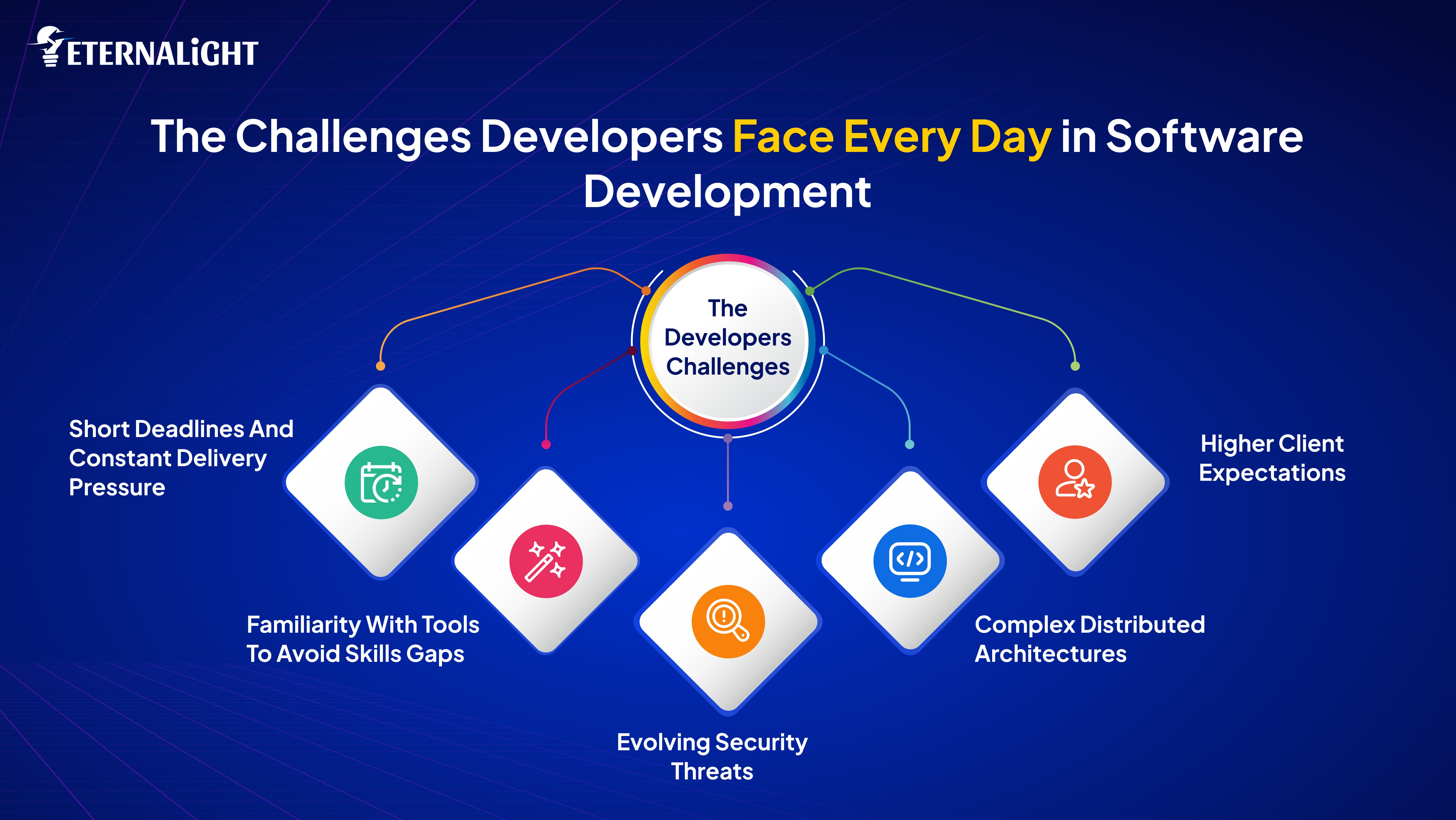
Software development isn’t a walk in the park. Every day throws new hurdles from security headaches to sky-high client expectations. Developers find themselves navigating real pressure, tight deadlines, and a nonstop need to learn new things.
Tight schedules often force developers to work late into the night, which can lead to frequent burnout, shortcuts, and a decline in app stability and quality.
There are many AI tools and frameworks, so it's hard to find one like a needle in a haystack. Also, teams are unaware of the functionality and how to work with it, so to keep productivity balanced, we need to upgrade.
Every new feature developed under limited time crunches and resources is not verified, which leads to cyber threats; thus, developers stay vigilant with modern security standards and practices.
Modern, distributed systems offer flexibility but are way more complicated to manage and debug.
Users expect fast, flawless, and customized experiences, and meeting these standards is not merely a matter of modesty; it is essential.
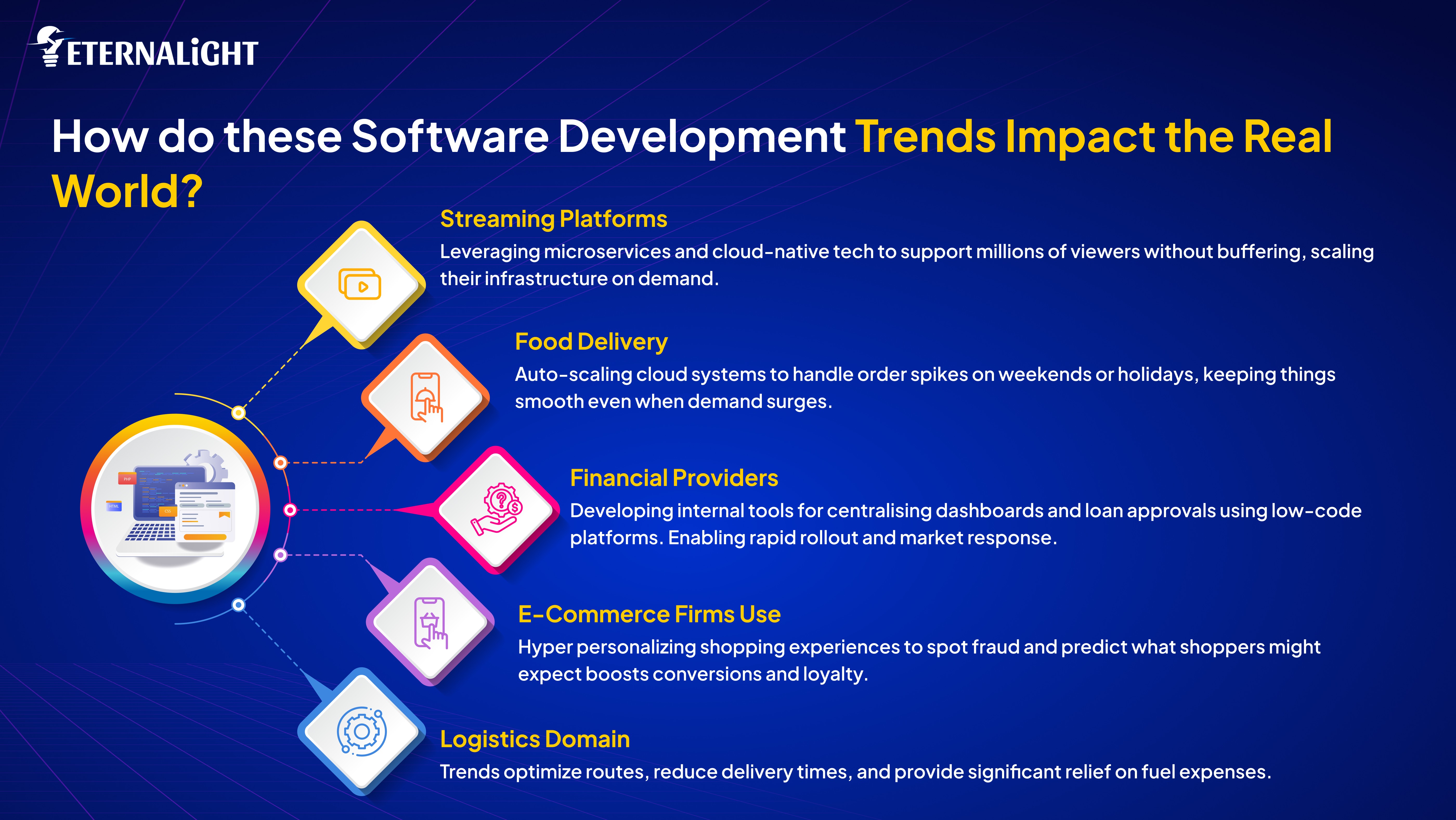
Beyond the theories, these stop software app development trends actively shaping how modern businesses operate to compete.
Streaming platforms:
Leveraging microservices and cloud-native tech to support millions of viewers without buffering, scaling their infrastructure on demand.
Food delivery:
Auto-scaling cloud systems to handle order spikes on weekends or holidays, keeping things smooth even when demand surges.
Financial Providers
Developing internal tools for centralising dashboards and loan approvals using low-code platforms. Enabling rapid rollout and market response.
E-commerce firms use
Hyper personalizing shopping experiences to spot fraud and predict what shoppers might expect boosts conversions and loyalty.
Logistics Domain
Trends optimize routes, reduce delivery times, and provide significant relief on fuel expenses.
Let's wrap for now!
True advantage won’t come from simply using new technology. It will come from how thoughtfully teams combine the evolving trends in software development to build solutions that are not just functional, but impactful.
And we at Eternalight Infotech are evolving by adopting these trends across our software solutions.
“The future will belong to teams that don’t just adopt tools but adapt their mindset, embrace continuous learning, and build with purpose.”

Kusum Sethiya
(Author)
Software Engineer
Contact us
Send us a message, and we'll promptly discuss your project with you.