

AI & ML
8
Mins
Why Enterprises Are Investing in Custom AI Solutions
Explore why enterprises are shifting from generic AI tools to custom-built AI systems. Learn the key business drivers, ROI benefits, and how to choose the right development partner.

Do you feel your startup is building in survival mode?
Low code platforms promise to survive and emerge in the competitive landscape with fewer technical gaps, thereby accelerating release cycles.
From brainstorming ideas and conducting ground-level research for development to seeking assistance with coding functionality or designing the prototype, every step can be completed in the minimum time.
Even when the idea needs to start from scratch for a different niche or domain, it reduces the burden by streamlining the workflow. However, such a rapid low code platform entails risks to accuracy and quality.
No matter how efficient these platforms are, they can introduce technical debt that requires additional effort. However, what appears smooth in the early stages often becomes complex when the product is scaled to a real-world setting.
For decades, developers have followed the same path from ideation through research, design, coding, deployment, and market release. Automation is now a priority. Product managers are assigned project ideas to streamline workflows and reduce sprint durations, thereby accelerating delivery without delaying the release.
It's easier to track and monitor backlogs, in progress, and maintenance. If the project has any issue that needs immediate attention to resolve, a small ticket can be raised. Teams are integrating third-party tools & APIs to manage pipelines and workflows.
To keep pace with competitors and trends, startups are adopting low-code approaches; however, if not implemented with a structured, disciplined approach, the application/ software can become fragile, disrupting functionality.
As founders, we’re constantly balancing speed with stability. Founders and their internal teams who extend their work hours accelerate release cycles and close deals through innovative strategies.
Low-code platforms facilitate the transition, but sometimes, in a hurry, the development team can make hasty decisions and moves.
Initially, low-code platforms have generated intense interest among early-stage developers and freelancers for enabling faster product development. But that shift didn’t happen overnight. It was developed in response to the need to prioritize innovation and speed-to-launch to build the brand identity across digital platforms with minimal effort.
At that time, nobody had stretched on the other side. They were only concerned with the pockets, not with the drawbacks.
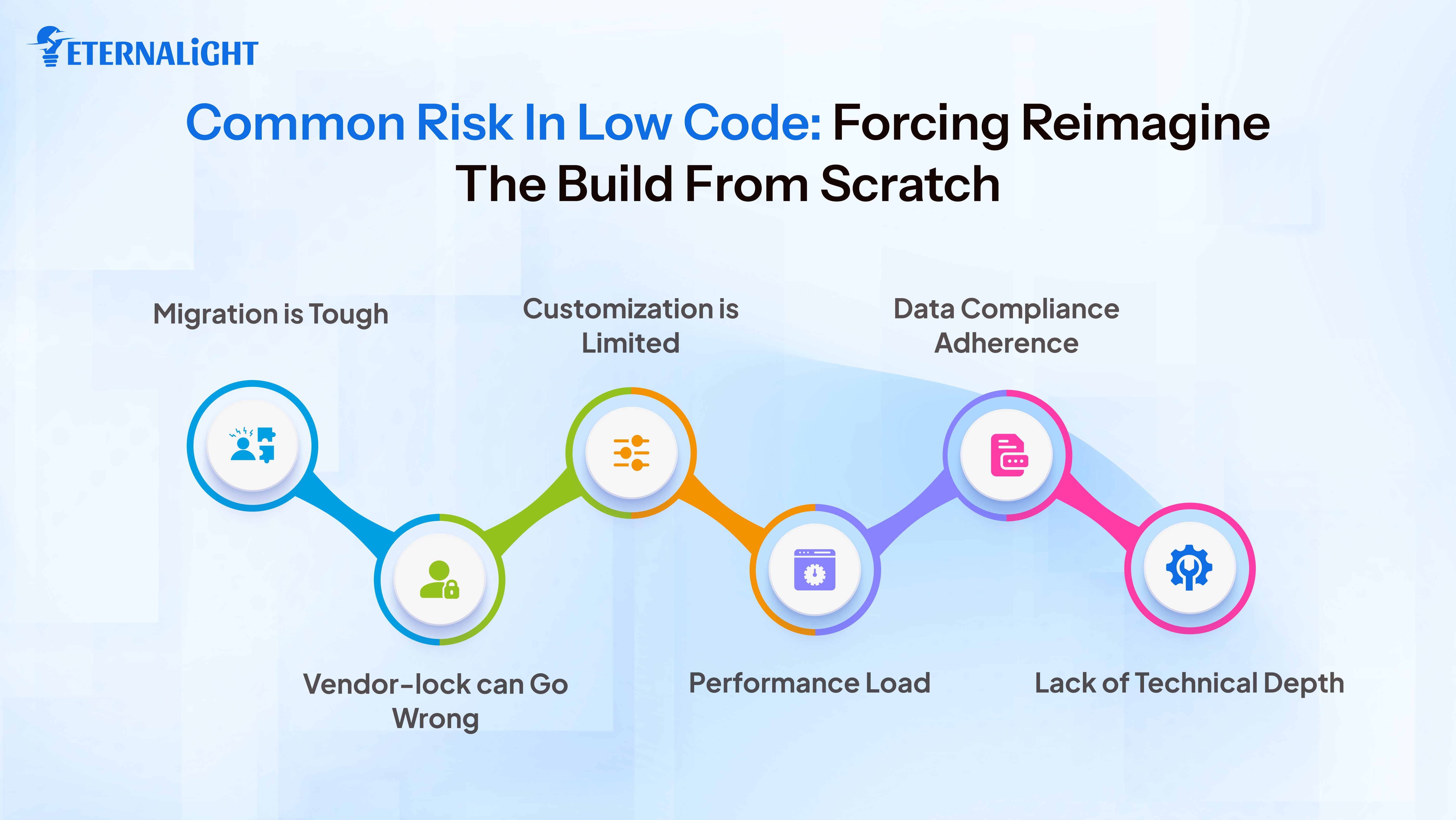
Let’s explore the spots where low-code starts to strain under scale.
Developers use low-code platforms for their modest, prebuilt functionality. This approach is effective for MVP development; however, as the project scope expands to accommodate a large user base and the integration of new features, custom code becomes necessary.
Low-code platforms limit that flexibility and make the migration complex. In that case, developers need to code from the start.
To secure data and IP, developers prefer vendor lock in, so, from structured logic to workflows, everything can prevent exposure.
If a switch to another high performing platform is necessary, it would require building from scratch because everything is proprietary.
If you attempt to modify the existing ecosystem, the fixes would be costly.
Low code platforms provide limited access to customize the structure or add features or sections. No code tools are inappropriate for projects that lack future scope or require frequent updates.
The goal is innovation, not constant structural restrictions. Every time you attempt to modify the functionality, you’ll receive an alert regarding restrictions to prevent unauthorized access.
A hasty plan can lead to unnecessary headaches from performance breaches; suppose that the app, when tested with 100 or 500 users, functioned without disturbance. However, when traffic exceeds that threshold, the app takes longer to respond.
At that moment, developers realize that they have no control over the backend workflow, thereby undermining users' trust in the app. The moment traction finally arrives, the mask falls.
You can preview the product and operate it more quickly through drag-and-drop accessibility. However, the structure will break if it serves thousands or even lakhs of users. Soon, the illusion of low code and low maintenance will fade, as it's difficult to customize features or allocate CPU, GPU, and memory.
During the prototype phase, a low-code-based deployed product will perform with computational power, but at scale, architectural control matters more than development speed. Due to limited and inconsistent monitoring, it is hard to identify the technical glitch or debug it.
Regardless of the domain or platform, app data is expensive and sensitive; it doesn’t need to be exposed.
Startups shouldn’t neglect security standards. If any third-party integration indicates that data may be shared, it must be carefully evaluated.
To ensure legal compliance and win the customer's trust, eliminating security loopholes is essential.
If you are completely unfamiliar with the terminology or application structure, planning a strategy for a production build becomes difficult. Without technical proficiency, scaling decisions can quickly turn risky.
When using low-code platforms, individuals require some technical proficiency.
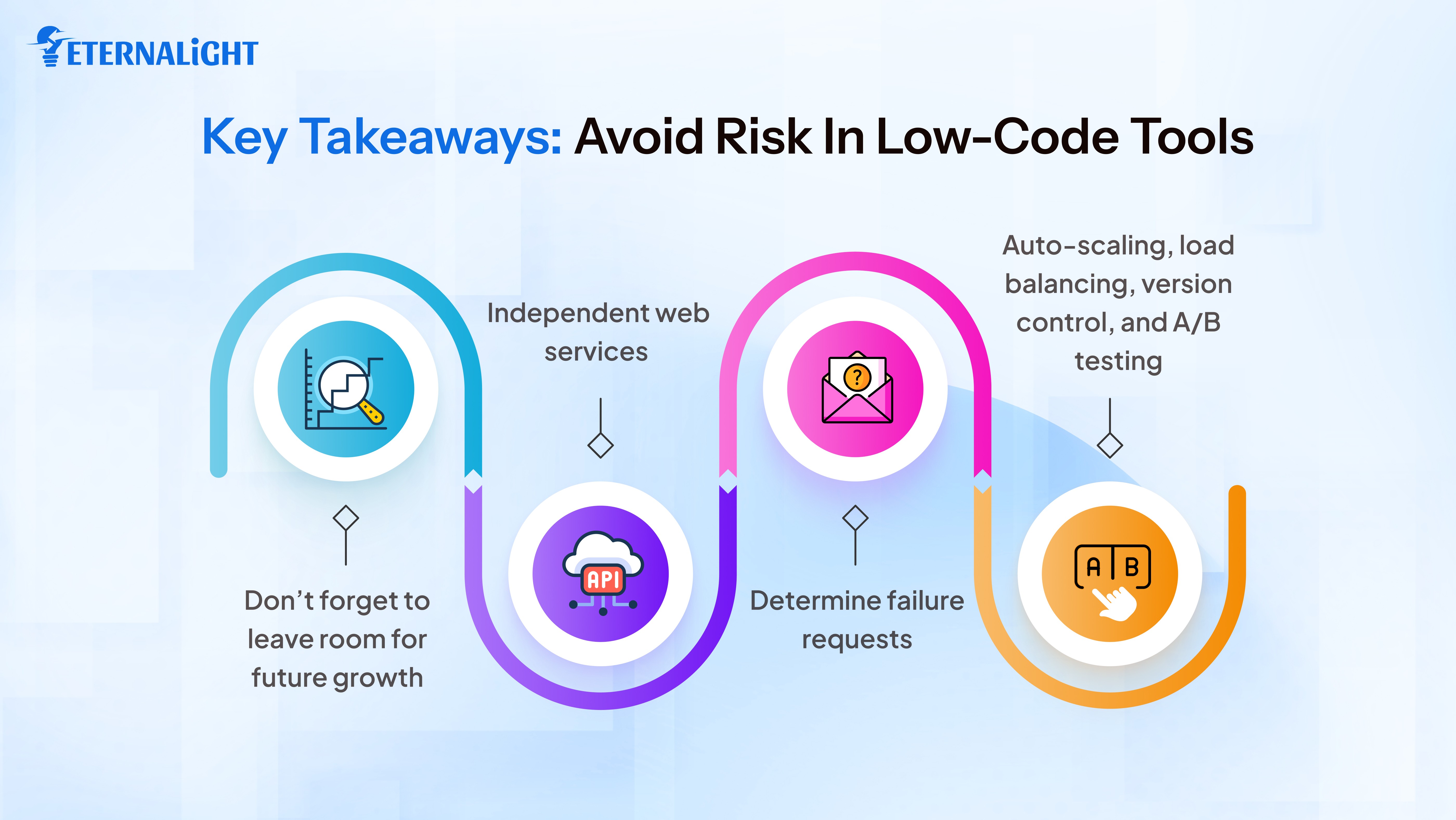
While planning any building project, don’t forget to leave room for future growth. It seems hard to predict at the infant stage, but having an instance will keep the doors open.
Navigate web services independently, and keep the state isolated for every session. There must be a proper session closure to prevent information from being leaked.
Monitor the PSI, KS score, and API response score to determine conversion rates, failure rates, and their impact on sales.
Auto scaling, load balancing, version control, and A/B testing are key strategies for ensuring a seamless release.
We don’t restrict ourselves to low-code tools; we must also understand the flaws in our ideas and the platform's unpredictable scenarios.
Read more on what happens when any idea scales using low code development tools from prototype to product.
Low code is a smart approach to launch ideas rapidly, through which you can establish the product identity across the digital ecosystem. However, haste can lead to erroneous decisions.
Undoubtedly, low code saves you from early, complex setup and from setting the stage. However, when the business scales, trade-offs begin to appear. What once felt efficient may become difficult to sustain.
Before committing to building in a low-code ecosystem, evaluate ownership, migration access, and scalability. Consulting an experienced software development partner such as Eternalight Infotech can help avoid costly architectural errors.

Ayushi Shrivastava
(Author)
Senior Content Writer
Contact us
Send us a message, and we'll promptly discuss your project with you.