Software Development
9
Mins
Top Mobile App Development Trends to Watch in 2026
Learn about the latest mobile add development trends that are taking over the world in 2026 and beyond.
When you work with airline APIs long enough, you start noticing a pattern:
Everything is stable until it suddenly isn’t.
A minor schema update, an authentication change, or a temporary airline outage can break an entire search-to-booking flow in seconds. And when the airline is a Low-Cost Carrier (LCC), the challenges multiply, as these carriers often operate on legacy or highly customized Navitaire systems.
To solve this recurring chaos, modern travel platforms are now building Reusable LCC Integration Frameworks, modular packages that standardize and speed up airline integrations.
Let’s break down what this means and why it matters.
Think of an LCC framework as a reusable software engine designed to integrate any low-cost carrier with minimal custom code.
It includes:
Prebuilt Navitaire workflows (search, book, hold, cancel, seat-map, SSR)
Request/response builders
Authentication handlers
Error normalizers
Airline configuration management
XML/JSON format adapters
It’s not a “single integration” for airlines only; it’s a plug-and-play architecture that lets you onboard new LCCs rapidly with zero duplication.
Conventionally, airline-based systems often have scattered code. With a framework like LCC, edges can be configured systematically.
Because every LCC exposes Navitaire differently
Even though airlines use the same underlying PSS (Navitaire), their APIs vary drastically:
IndiGo → XML
SpiceJet → XML
Akasa → JSON
Air India Express → JSON
Same system, four different API patterns.
Without a reusable framework, every integration becomes a new custom project. This adds additional workload to the expanding development timeline, making integration inconsistent.
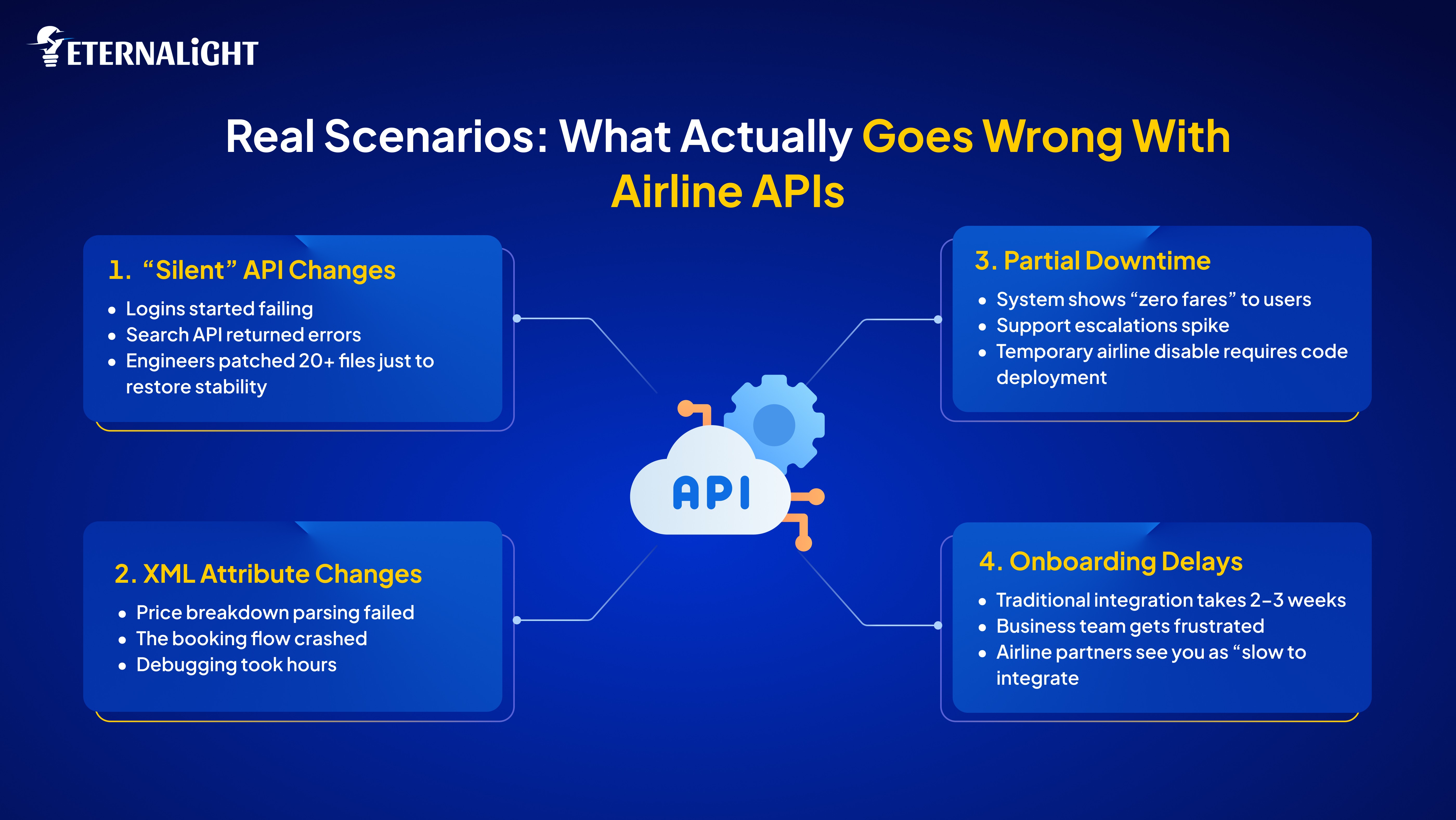
It takes time to identify the cause of API failures, as they often occur unexpectedly. Here are real failures that travel-tech teams face regularly:
Akasa Air once rolled out a new authentication version overnight.
Logins started failing
Search API returned errors
Engineers patched 20+ files just to restore stability
IndiGo slightly renamed an XML field in their pricing response.
Price breakdown parsing failed
The booking flow crashed
Debugging took hours
Air India Express sometimes returns a 200 OK response, but with empty data.
System shows “zero fares” to users
Support escalations spike
Temporary airline disable requires code deployment
A new LCC partner wants to go live fast.
Traditional integration takes 2–3 weeks
The business team gets frustrated
Airline partners see you as “slow to a integrate”
These are not rare cases; they happen every month.
A reusable framework shifts your architecture from hardcoded airline-by-airline logic to modular, configuration-driven packages.
It's frustrating to encounter the same failure repeatedly; software development teams often address the issue directly at the framework level. This drives consistency, reducing development time and the need for frequent maintenance sprints.
In other words, a reusable LCC framework in traveltech enables platform-level fixes, freeing them to focus on frequent airline-specific issues.
Here’s precisely how it helps:
When 90% of the logic is already built, adding a new airline means:
Add config (URLs, endpoints, version, rules)
Select the format (XML/JSON)
Map any airline-specific quirks.
No new code.
No new microservice.
No redeployment.
Instead of patching code to disable a broken airline:
Just flip:
isActive = false
The system instantly:
Stops sending requests
Avoids failing searches
Prevents a broken booking pipeline
Ops handles it, engineering sleeps peacefully.
If an airline changes:
Endpoints
Authentication
Version numbers
Timeout rules
Fare mapping
…just update the configuration.
No hotfixes.
No regressions.
No emergency calls.
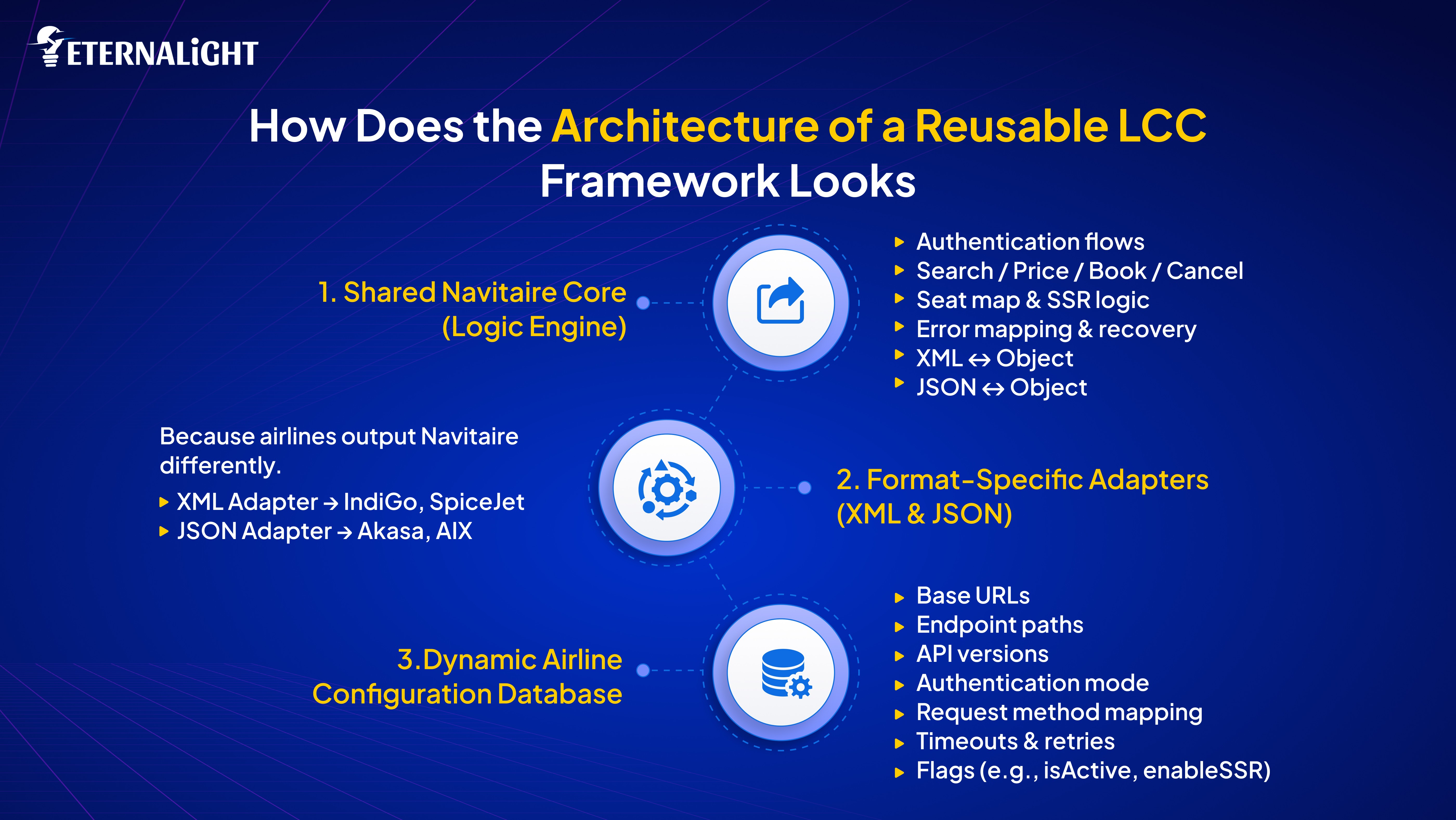
A future-ready LCC package architecture has three key layers. All are responsible for ensuring the platform is stable and consistent, managing airline complexity in a separate environment. The primary focus of this architecture is managing the airline edge integration, assuming that pricing, payments, and ticketing orchestration are already handled.
Let's go through the layers one by one:
Handles:
Authentication flows
Search / Price / Book / Cancel
Seat map & SSR logic
Error mapping & recovery
XML ↔ Object
JSON ↔ Object
90–95% reusable across all LCCs integration. If we say it's the skeleton of the framework, there’s nothing wrong in that.
Because airlines output Navitaire differently.
XML Adapter → IndiGo, SpiceJet
JSON Adapter → Akasa, AIX
These adapters translate airline-specific formatting into a unified internal model.
Analogy:
Instead of hiring four translators, you just hire one English translator and one Spanish translator.
Stores:
Base URLs
Endpoint paths
API versions
Authentication mode
Request method mapping
Timeouts & retries
Flags (e.g., isActive, enableSSR)
No logic resides in code; only in configuration.
This makes your platform adaptable instead of fragile.
A reusable LCC framework is valuable not only on a technical level; it delivers significant business value. Whenever an airline plans to scale up its operations in new regions, onboarding becomes easier than ever.
Adopting this approach drives accuracy, efficiency, and flexibility to airline platforms. Promptly responds to specific events, removes high-level engineering headaches, and enables the
Here’s what companies gain after adopting a reusable LCC framework:
New airlines go live in hours, not weeks.
One change benefits every LCC integration.
Teams stop firefighting API changes.
Downtime from one airline no longer breaks the full search flow.
The same architecture supports new international LCCs instantly.
In travel tech, airline APIs are inherently unpredictable.
A reusable LCC framework transforms this chaos into order by providing:
A shared logic core
Format-based XML/JSON adapters
A live configuration-driven engine
The result is a platform that:
Onboards faster
Responds instantly to airline changes
Avoids outages
Costs less to maintain
Scales globally
This is not just better engineering, it’s better business.

Ketan Somani
(Author)
CEO, Founder
Contact us
Send us a message, and we'll promptly discuss your project with you.