

Software Development
10
Mins
Top 10 Android App Development Companies in Pune 2026
Discover the most reliable Android app development companies in Pune that help businesses build scalable mobile solutions.

As a founder, you have a great product idea and a skilled team of developers who can shape the initial version, scale the scope, and launch with advanced features for a broad user base. Investors won’t commit until their technical and business questions are answered with clarity. If you’ve tried hard to impress investors but deals still stall, something critical is missing.
Many top-tier companies rely on a CTO to handle this without disrupting development. If you’re considering adding one to your team, do you really need a full-time CTO yet? How will they add value to your organization, or will you wait a while? Let’s break it down.
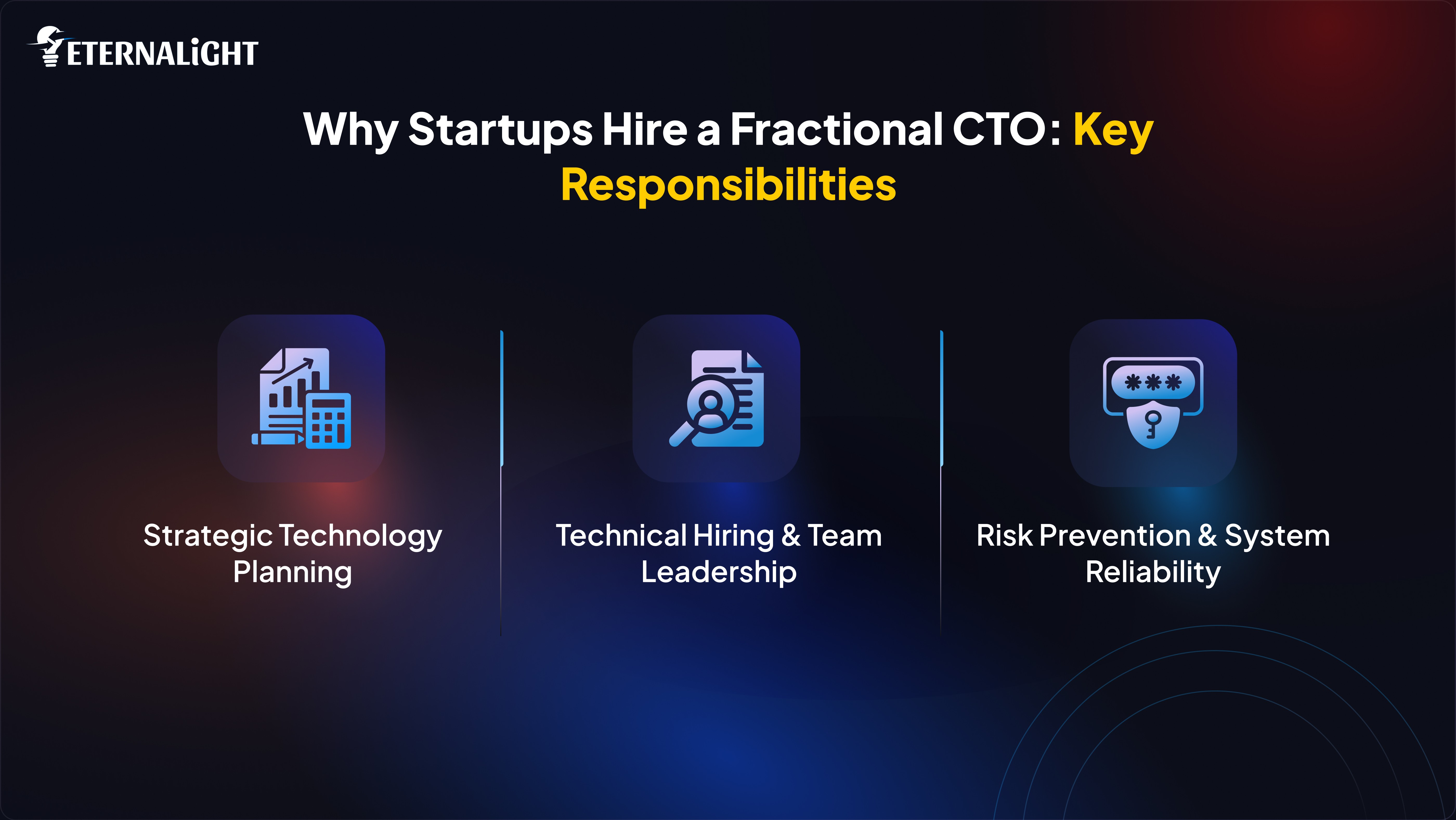
Whether it's a startup, enterprise, or bootstrapped business, you need someone who understands architecture, code quality, and engineering team accountability to ensure everything is aligned and under control. Their strategic, part-time involvement can make a significant difference.
Suppose an app is in production and the dev team requests support with technical integration. They assess whether better technical alternatives exist, or, if needed, which technical integration will add value. How will it affect finances, investor confidence, and users? Without technical depth and business understanding, decisions become expensive guesses.
A CTO is a senior technology executive well-versed in systems, architecture, and engineering leadership. They leverage their time and effort to make strategic decisions that help the business get ahead of competitors.
A founder knows how to drive the business and make tough decisions, but they still need to consult with the right person to analyze the tech stack and tools before purchasing any subscriptions or outsourcing development services. A fractional CTO does that by aligning technical real-world scenarios with the business rhythm and investing in the right things through a structured blueprint.
When hiring for the tech team, we need someone on the panel to evaluate technical aspects to help you avoid missteps during interviews. They can manage outsourced agencies and ensure code quality standards are maintained as the team grows.
Building the app is not the end of the job; it must be reliable and robust. If the tech suit can perform in pre-market testing, it can reduce the risk of system failures as the user base scales. A technically proficient CTO can support practices that enable encryption, authentication, secure IP, and system design at each phase of development.
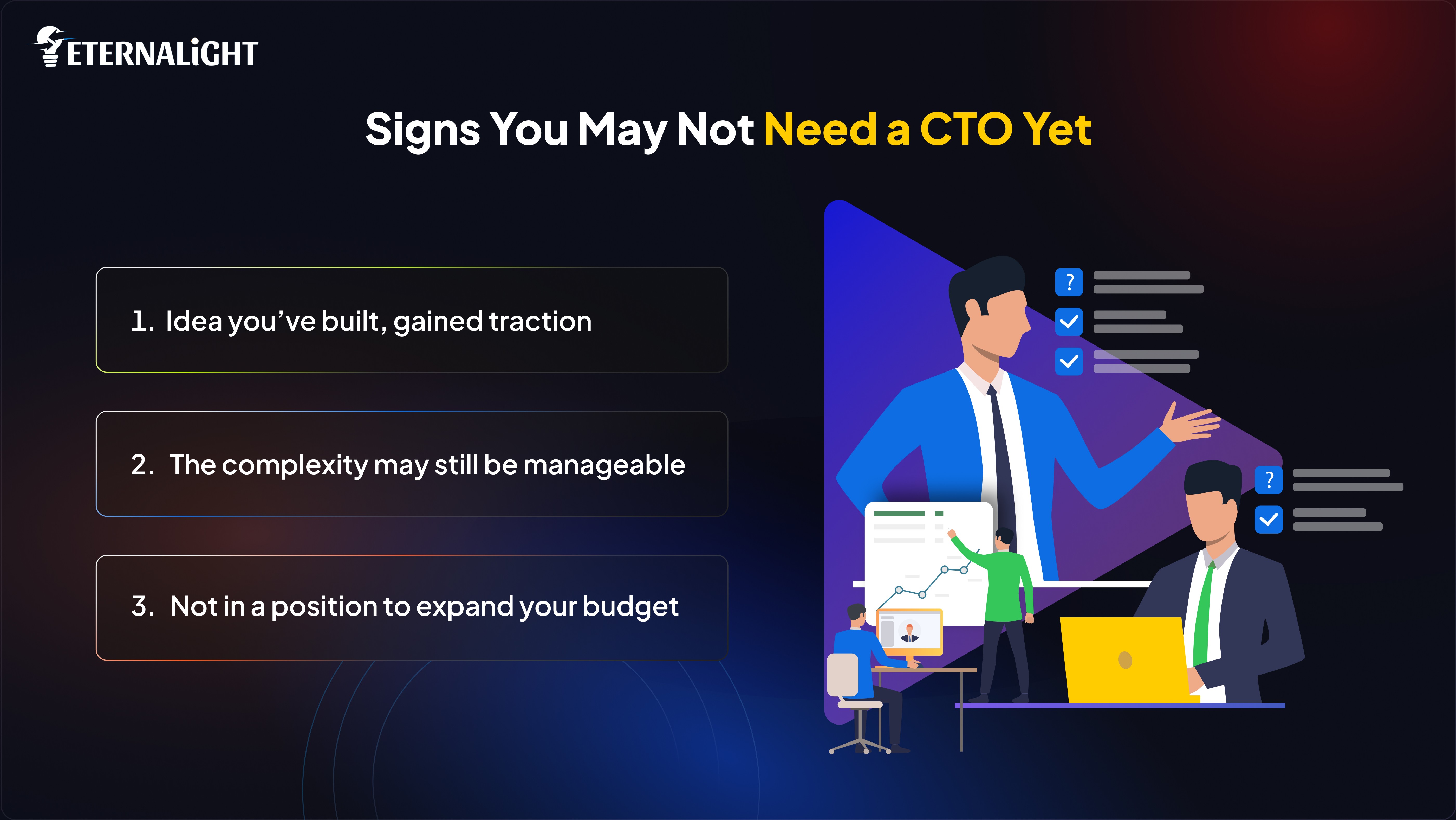
Hiring a CTO just because competitors have one is a costly mistake. First, check whether the idea you’ve built and gained traction with can scale without external advice. If scaling isn’t a priority, the complexity may still be manageable with your existing tech team.
You’re not in a position to expand your budget for a few months, but if it really requires you to wait to manage it on your own, then hold on to your decision.
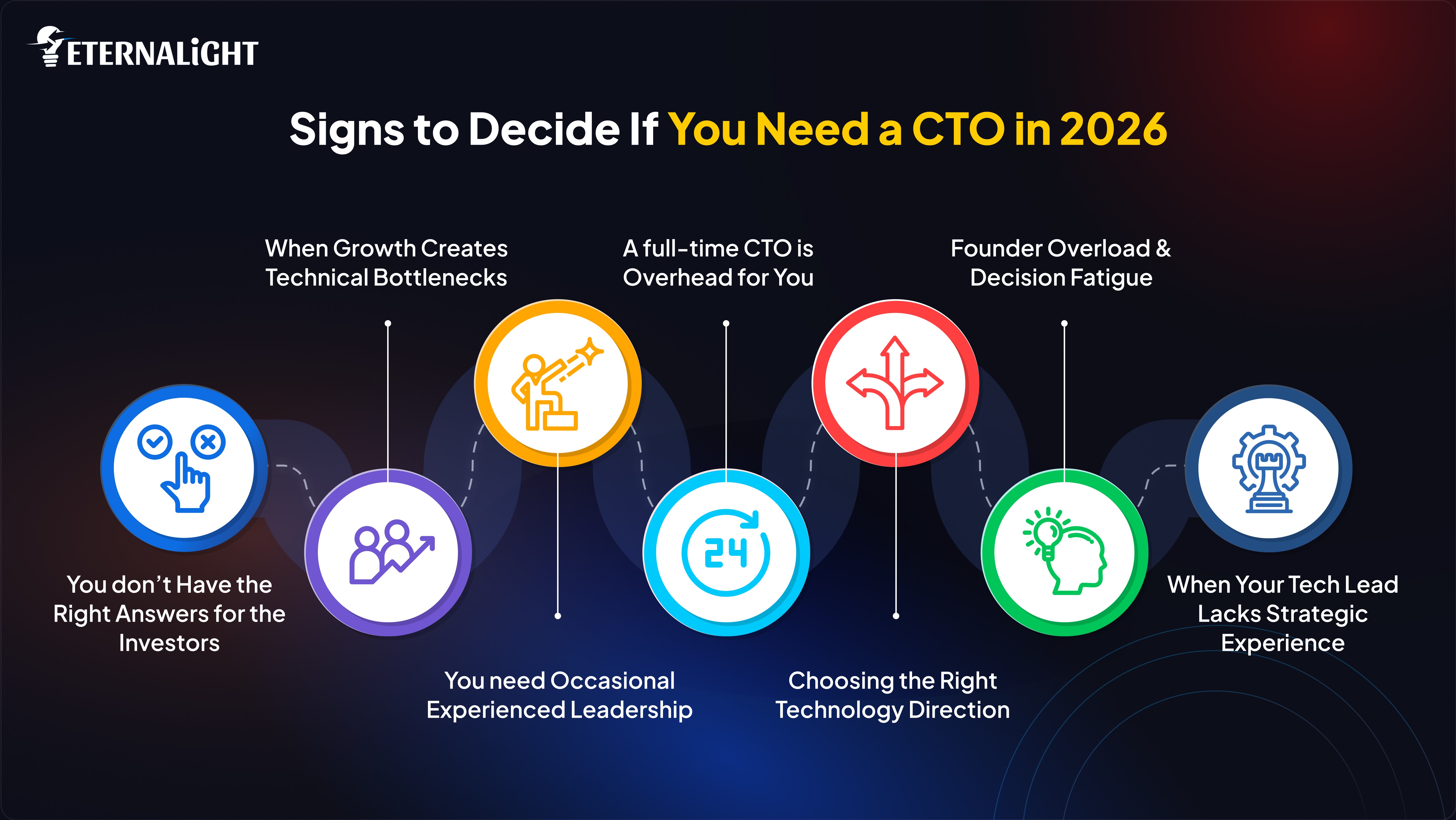
Is your idea to leverage AI-powered, technologically advanced versions that extend beyond CRUD operations in a cloud architecture? If you want to pitch to and communicate with the client in their language to persuade them, you definitely need a CTO.
Investors look for growth, traction, retention, and revenue patterns before committing.
How many users returned to make another purchase, and how long they stayed with the product? Do the businesses understand their markets and user bases, and can they plan for future expansion? The level of competition also influences the investors' decision. Beyond that, ideas remain abstract to investors.
If you have a lead-level technical expert, they will recognize the red flags and hard questions first and plan the strategy so that, when investors ask tough questions, the answers are ready. They can plan the roadmap, identify risks, and provide input when the senior developer isn’t available, while maintaining team productivity. Investors focus on numbers and patterns, as well as strategies to navigate complex situations.
Given how much you have on your plate, even the dev team is fully occupied finishing the sprint. You need to invest your time in meeting new people to grab the projects. In short, your business is expanding and opening new opportunities. T
hat’s the sign you need someone to swiftly manage the technical side. If your development team is working on a new functionality, they’re good at coding, but are taking time to adjust to the new techstack.
A task undertaken by 3 people in a previous project has failed due to a traffic spike. You’re considering scaling your team to manage future ideas and handle multiple clients, but technical glitches are slowing down the release.
It’s not that your team lacks coding skills; perhaps the architectural design isn't strong enough.
You need help getting out of this challenging situation to scale your business and avoid technical, organizational, and financial debt. Teams often struggle to identify and communicate these gaps clearly.
At that time, a fractional CTO can strategize well. Diagnosing the factors that worsen the situation and discovering new methods to resolve them.
A fractional CTO brings experienced leadership exactly when needed. Someone with entry-level technical skills may take hours to complete the task.
You already have a development team that can handle coding for every issue and monitor all resolved tickets. A tech lead can do that.
A CTO’s impact begins long before production. They define architectural direction, clarify product value, anticipate risks early, and make fast, informed decisions that prevent costly mistakes. You know how a small mistake can have a big impact on your project.
By zone and country, CTO hiring costs vary, as do their equity and responsibilities. You need someone to take the lead and occasionally help you navigate complex business pitch scenarios.
A full-time CTO adds significant financial overhead. Instead of burning through the budget, it's better to hire someone for a few months providing technical input as needed on a weekly basis.
Once your business is in good condition and growing, you need someone who can commit full-time. If your finances and the right full-time CTO candidate are aligned, then finalise your decision on whether you need a full-time CTO in 2026.
Feeling stuck in the technological evolution and unsure which tech stack is right for long-term success?
Which features are worth integrating? Which tools should be feasible in the long term?
Given how rapidly technology and trends are emerging, and how AI and its ecosystem have created significant hype, it can be confusing to choose one.
Company founders are feeling significant pressure, which is driving them to follow trends and justify client expectations.
Having a fractional CTO will resolve this dilemma. They know the right path to achieve the goal by selecting the right models, integrations, and trends.
Founders can’t manage everything alone. They might be good at hiring the right people to give direction and initially lead the team, but they are unable to evaluate the technically built product.
You may hire skilled developers, but once the product launches, users may still face glitches and performance issues. Suppose the founder outsources the software development to an agency for an AI-driven solution and pays the fee, but user dissatisfaction and technical debt have drained the founder's energy.
The product design may lack scalability and efficiency. No matter how much it costs to fix the bugs, you can't deny that it reduces the burden of rework and maintenance. It becomes mentally exhausting: the founder doesn’t want to face it or waste money.
If you have a technologically literate person, you can avoid embarrassing situations and delays in launch. The fractional CTO can plan, estimate, release, and prepare pitches and support in documentation to drive the business forward.
You have a small team of experienced developers focused on delivery, and you promoted one based on strong architectural skills and the projects they’ve handled. Yet they still have knowledge gaps and lack the leadership or negotiation skills to close deals or manage client meetings and investor conferences. Your tech lead is strong at analyzing bugs and scaling the architecture, but lacks the soft skills required to stay engaged as a manager.
If, instead of a technical lead, there is a fractional CTO who can monitor managerial and surface-level technical work, they will eliminate the pressure.
Depending on geography and company stage (startup, bootstrap, enterprise), the cost to hire a CTO varies, so you can engage leadership suited to your stage and complexity.
Full Time CTO | Fractional CTO | |
Equity | 1%-5% | 0%-1% |
Salary | $220000 | $8000-$15000 |
Cash for First year | $260,000+ Equity | $96000-$120,000 |
If an organization hires a fractional CTO instead of a full-time CTO, it can reallocate the hiring budget to two senior developers to support the project.
Instead of hiring, if the project is long-term, like MVP or needs to scale in the future, that includes multiple responsibilities from planning to release, hire an individual at an advisory or executive level. On an hourly basis, hiring a fractional CTO typically costs $200–$600 per hour.
Fractional CTO | |
Monthly Basis | |
Advisory | If the business doesn’t have investors or only has those who can afford a $4K–$6K budget, taking the expertise for 4 hours/week. |
Standard | If the business has a small team of developers and fewer than 2 investors, or can afford a $15K budget, taking the expertise for 7-12 hours/week. |
Executive | If the organization has experienced developers and investors, or can afford a budget of more than $20K, it can take on the expertise for 18-20 hours/week. |
The business works with top-tier clients, ensuring on-time delivery, managing technical debt, and conducting technical audits to meet specific project requirements. The organization needs to be prepared for the hiring cost of a fractional CTO, ranging from $ 10K to $50K.
Considering sprints, codebase audits, claim reviews, and fixes, as well as technical due diligence.
Businesses operate across different domains, yet they can’t deny that business success depends on the combined effort of technical and non-technical teams. In early stages, founders may lead technical decisions, but as complexity grows, experienced technical leadership becomes essential. The right time to bring in a CTO depends on your growth stage, complexity, and risk level.
Hiring a fractional CTO can be one of the smartest early-stage decisions. Allocate a few hours a week to technical decision-making, including architecture, design, technology, and project deadlines, to ensure on-time release. They can help you avoid costly mistakes when pitching the idea to investors, saving time and effort.

Ayushi Shrivastava
(Author)
Senior Content Writer
Contact us
Send us a message, and we'll promptly discuss your project with you.