AI & ML
10
Mins
The Rise of AI Agents with Gemini: A New Chapter in Intelligent Automation
Discover how Gemini enables AI agents to think, plan, and act in real-world scenarios.
What started with a fringe idea is now the trending topic across the tech world. It is an integral part of the tech discussion and news stories as a headline. It is not just a vision or goal; it's a milestone that all tech leaders are trying to win first before their competitors.
It seems like a riddle to be solved.
Although OpenAI Inc. founder has defined it as a system that can access information beyond the already trained data, the vocabulary will enhance over time, enabling it to acquire new skills to manage the work more efficiently. Let's uncover the AGI and stage of AI evolution in the blog.
Nowadays, systems lack emotional intelligence and need to define the situation and context to get the desired response, and AGI will make that a reality.
AGI is not entered in 2023, at the time of the ChatGPT launch. No, it has first introduced in the tech world since 1950. Although that was not very popular, the pace and momentum rose later in the mid-2000s, as someone has published a book in 2007.
Scientist Ben Goertzel has used it on the front page of a book, Artificial General Intelligence.
Google’s Blaise Aguera y Arcas has stated about AGI in a conversation with Hindustan Times, and the story is live.
AGI is already rolled up and has launched a new venture using LLMs. These models are not based on artificial intelligence but acquire recognition of identities and entities through face, fingerprint, handwriting, voice or speech, and image synthesis. These are all general forms of training models with data.
NVIDIA CEO Jensen Huang has also set a goal to achieve it by 2029.
Like AI, AGI was always under the hood growing up, so was AGI. We have never felt that when AI is embedded at every phase of our lives across every territory.
The same thing is happening with AGI; we don’t exactly know when the shift occurred or when we should mark it as the tech transition.
There are many context and structure-related issues that marketers and tech enthusiasts struggle with in the real world. Even narrow AI and other AI subfields can't resolve it. Here, we list the problematic real-world scenarios and flag the disturbances associated with them.
In the logistics industry, AI systems are integrated to manage georouting, analyze inventory to fulfill demand, and schedule drivers/pilots to manage transportation and delivery.
Now, to make the operation more effortless, the owner wants to develop additional technical aspects.
Something that can take charge of end-to-end supply chain management and logistics, and trigger proactive vehicle maintenance when potential issues arise.
Furthermore, it can handle communication with vendors and other customers without human intervention.
However, due to limited information and domain expertise, structural misalignment and ERP related issues are complex.
Instead of crossing the ocean there is a need to establish the essential bricks for AGI so it can manage the tasks more efficiently and serve the benefits as mentioned below:
Worth it in areas of required in-depth research related to personalized scientific affairs or medical treatment, referring to the complex and massive dataset and simulations.
Gives a broader view to innovate and initiate through automation. Accelerate problem-solving skills, tackling global or geopolitical challenges.
Help in optimizing workflows/ operations and assist with artwork, skills, and the industry's need for proactive moves based on insights.
AGI helps mitigate the burden of repetitive tasks, errors, and computational costs.
It can forecast real time feedback, reports, and learning methods, infusing hyper-personalization.
Thus, AGI is capable of developing systems that infuse self learning and cognitive abilities across multifaceted domains. Let’s move on to why it is not achieved in the section below.
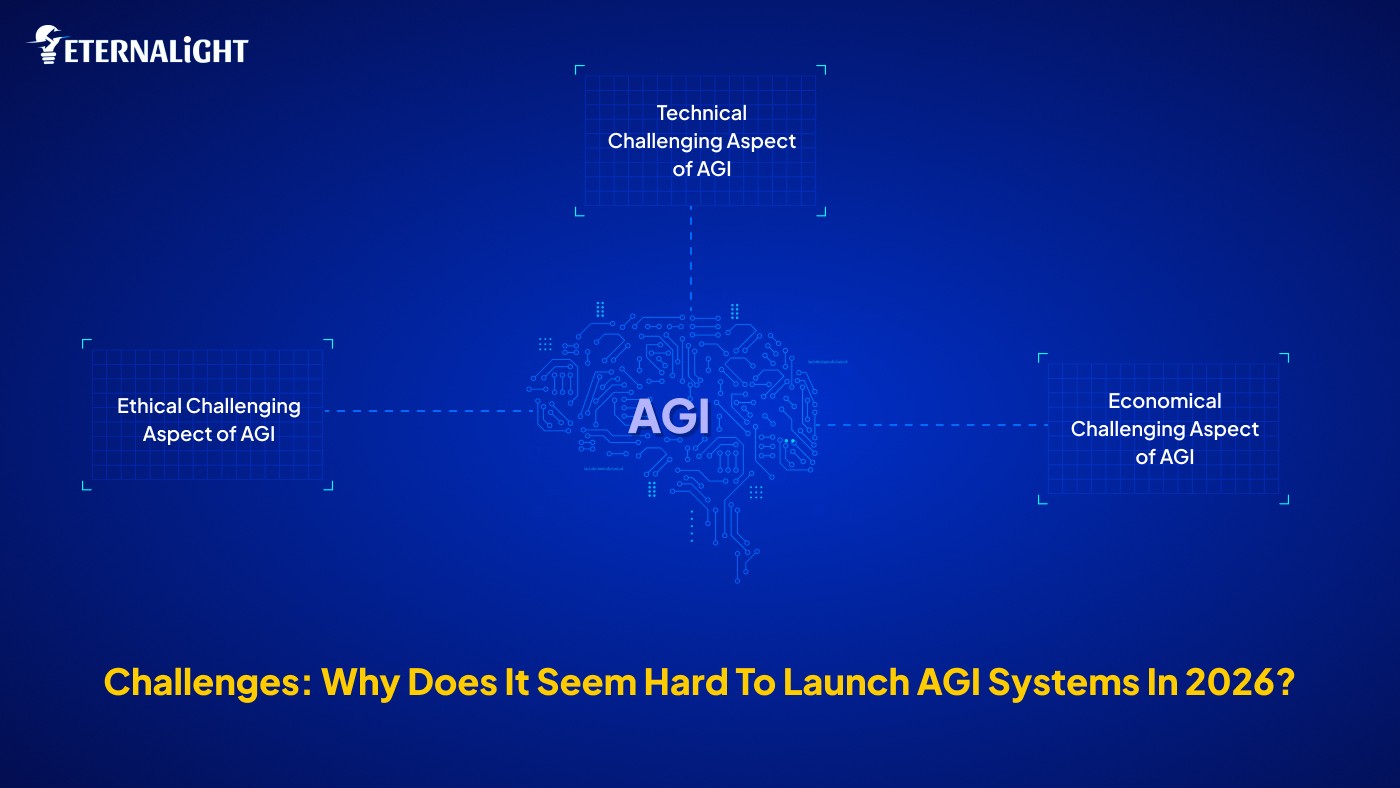
To launch AGI systems, several roadblocks exist related to economic investment, technical implementation, and ethical considerations. Let's uncover them through bullet points below:
An AI system is struggling to maintain an extensive knowledge base that retains historical details that affect decisions and to respond appropriately. They compute and analyse through abstract information, reasoning, and experiences that can be retrieved if specific rules are followed.
Humans can assume and understand knowledge, intent, norms, and incomplete resource information.
Formalizing intuition in AGI systems is hard to implement, as they can’t reflect on themselves internally. Humans adapt from historical and current intuitions and experiences, while AI lacks this and forgets what inputs we need to mention in previous prompts; if we don't give a hint, it will generate false responses.
Not all humans have the same values; thus, personal beliefs are ambiguous, as it is complex to determine what is appropriate as per societal norms or contexts, and free from intruders. There is a risk of moral uncertainty regarding safety and accessibility, technical barriers, and internal misalignment that could prevent it from being transformed into achievable operational goals.
Translating everything into a computational language format is quite complex because Artificial General Intelligence Systems need to be well trained and optimized to handle unexpected behaviours, and to understand the intent and behaviour of new inputs without being aggressive.
AGI is a smart move to establish a global identity, but the tech giants are already struggling with many issues. They are discovering new strategies to dominate the marketplace, taking ownership as a monoplayer of specific tech stacks and adopting a geopolitical perspective.
Winning the AGI race seems complicated, yet it lacks human-like reasoning and analytical abilities. Because it needs storage access for input and responses through data centers.
Already, federal and state governments have taken the initiative to invest, yet development progress hinges on massive energy consumption and the computational scalability of data centers.
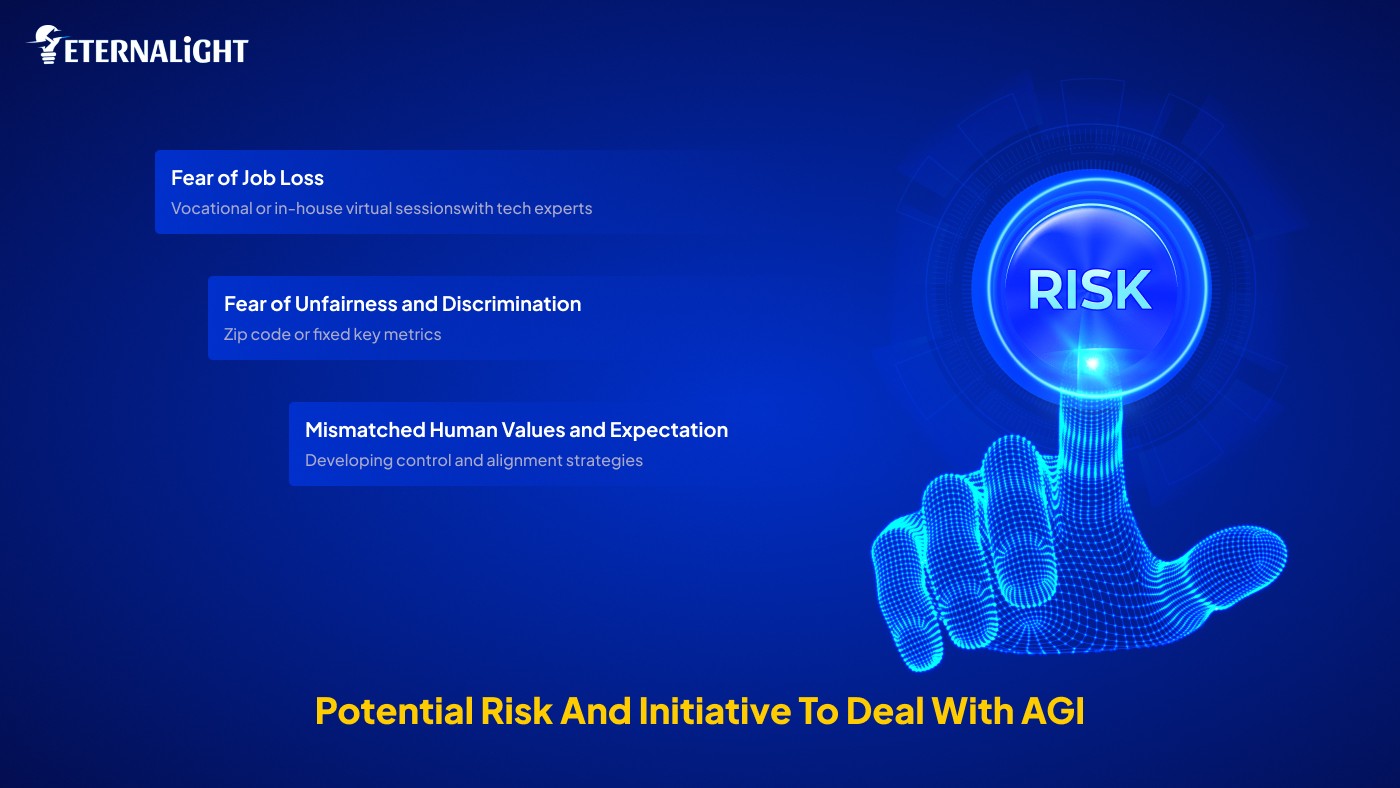
AGI can drive significant disruption across every industry domain, as it is far stronger and capable of taking on the responsibility when humans are in the loop. Below, I mention the potential risks of AGI with implementations, so give it a read:
Whenever a new technology enters the marketplace, some speculation spirals through our minds, and so with AGI. Likewise, AI professionals are concerned about AGI's role in social and political instability.
Initiative to Manage: Training the professionals through vocational or in-house virtual sessions would make it easy to manage this scenario. Instant collaboration with tech experts will also help to address the consequences.
Something for individuals to get insecure with this FOMO. Suppose the tools and models are not well trained. In that case, the algorithm may take advantage of this and become biased toward a particular individual group, such as a minority group, gender, or stereotypes.
Initiative to Manage: Having a zip code or fixed key metrics may resolve the issue of fairness gerrymandering. However, individuals may not get the response they want.
As AGI systems are an evolved version of AI models and systems, they don’t require much intervention. Thus, they can get full ownership of the events, sidelining human values.
These are super intelligent models and also a matter of concern. It may enforce totalitarian rule, prioritize resource acquisition, and create pathogens, all of which will generate frictional scenarios.
Initiative to Manage: Developing control and alignment strategies may take over the concern of scary sci-fi events. One of the things to do is to set a limit on AGI's autonomy or box it in to the territory.
Furthermore, investing in research to ensure proper alignment and decentralized AGI may reduce the monopoly's impact and establish security and fairness for all.
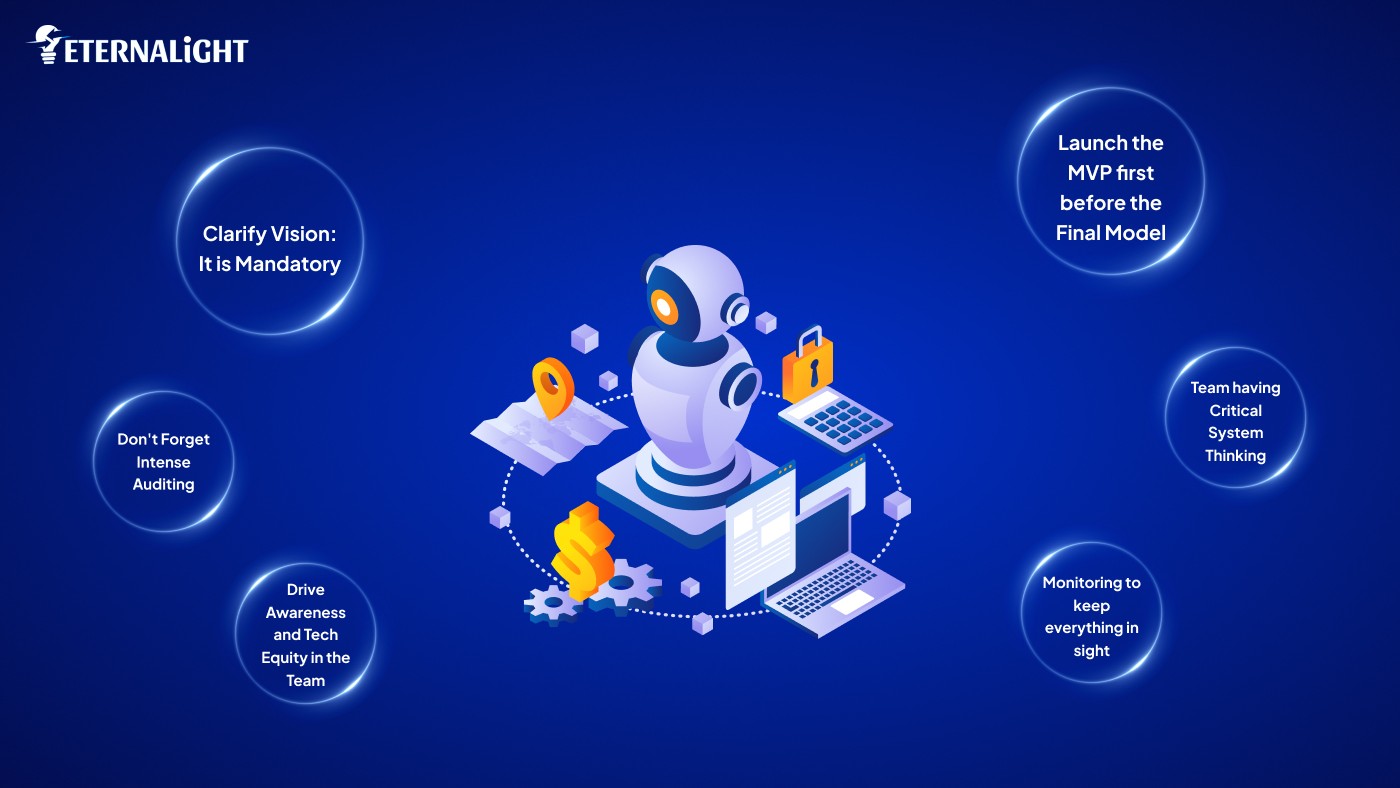
Whether you are in any enterprise, if you want to leverage AGI in your organization, here are the crucial points to consider to stay competitive in the industry.
While building an AI app, we always gather the client's requirements and implementation to avoid any misconceptions. Similarly, we need to set realistic expectations to turn the vision into reality.
Perform an end to end audit to assess areas for optimizing data architecture, silos, and legacy systems. Ensure that everything is uncluttered and available in a structured format within rich data sets, as poor data hampers the legacy system's processes.
Training the models and system is not enough; you need a team that is expert in mining, structuring, and transporting data, and that complies with government and tech ethics. You need domain experts, data scientists, cognitive experts, infrastructure, and DevOps engineers.
Keep the scope to scale the ideas, but don’t apply or buffer all the features at once. Launch the pilot version in the market first to evaluate the features' functionality with real users and gather feedback. Now apply all your AGI lessons to take it to an advanced level.
Set triggers to alert on unpredictable events, scan logs and goal alignment, and ensure the system isn't biased. Embed ethics wisely to integrate the security layer across every implementation.
Empower the Team with the latest tools and technology to achieve realistic, strategic goals. Infusing readiness and expertise will support AGI development. Develop the activities discussion session to connect with cross-functional teams.
Let's see what future holds about Artificial General Intelligence.
AGI is a theoretical or hypothetical goal; it faces many challenges and technical bottlenecks. Well, all the tech pioneers and industry experts have given their opinion.
Sam Altman(OpenAI CEO) has predicted it will be in full swing by 2028 as Artificial Intelligence systems are autonomous and functional, serving better economic value than human intervention.
Andrew Ng (Google Brain) considers it beyond a technical problem and views it as a replica of human intelligence blended with scientific principles.
The discussion is still ongoing, and news is circulating across the web and dev forums. It will break down into complex computation, neurosymbolic Artificial Intelligence, and self-learning architectures.
Folding all sections here and moving on!
AGI is a progression backed by AI and other technological evolution, unfolding the new aspects to launch systems. To launch Artificial General Intelligence Systems, it needs to collect and enforce adaptive and reinforcement learning, cognitive architectures, and computational Neuroscience. These systems are the future, with significant potential to boost automation, efficiency, and productivity, and to address the risks and errors in existing AI systems.
At Eternalight Infotech, we are also taking notes from experts and exploring developer communities to build something innovative that fits real-life scenarios.

Ayushi Shrivastava
(Author)
Senior Content Writer
Contact us
Send us a message, and we'll promptly discuss your project with you.