AI & ML
10
Mins
The Rise of AI Agents with Gemini: A New Chapter in Intelligent Automation
Discover how Gemini enables AI agents to think, plan, and act in real-world scenarios.
Last week, I received a message with a credit score limit, which looks like a source but an unverified link, and a message asking for money triggered my mind, saving me from a significant financial threat.
Telegram, Facebook, and WhatsApp are among the top social media platforms where criminals try to trap innocent people.
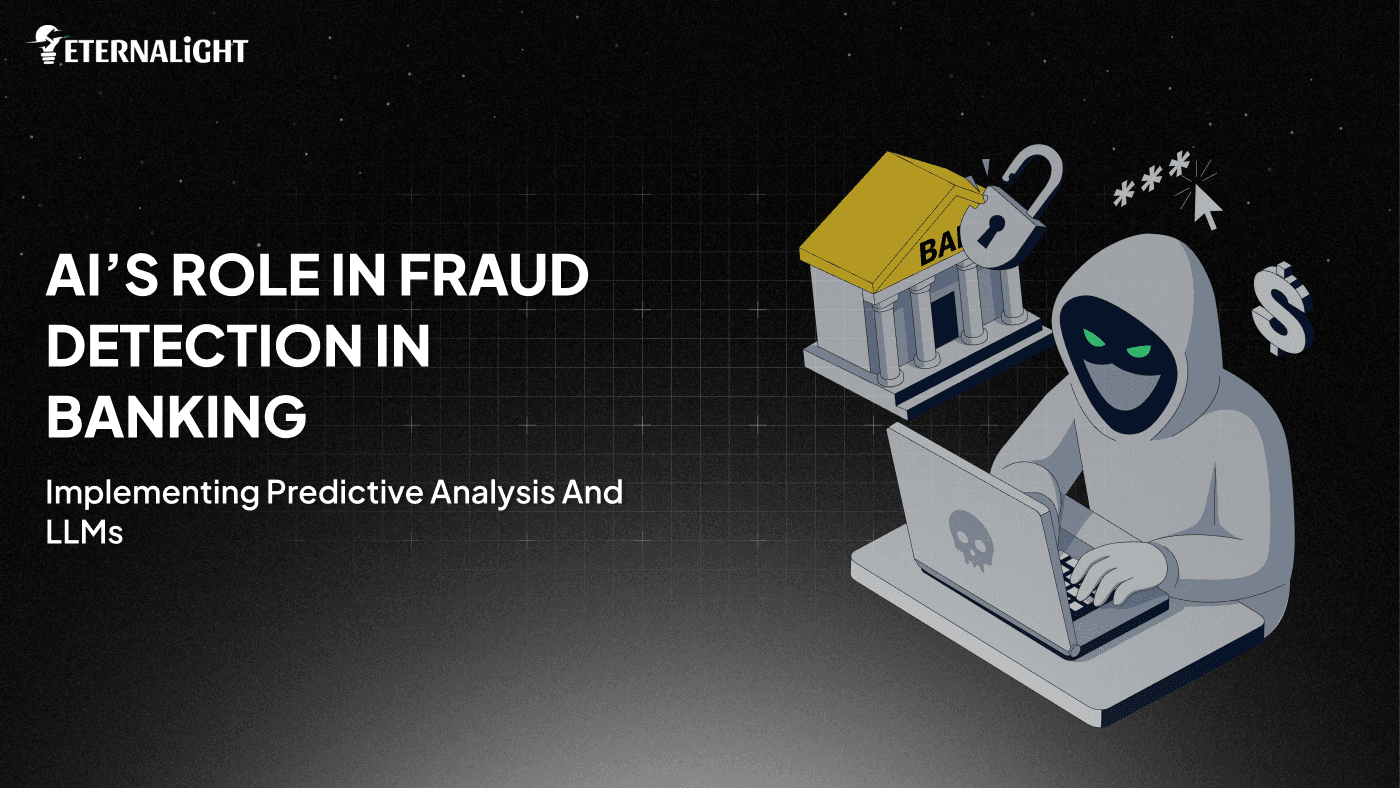
The way fraud and scam event stories are circulated every minute is alarming, underscoring the need to implement AI in fraud detection to mitigate risk in banking operations.
The way technology, which was evolving conventional safety measures and strategies, took a back seat and became outdated. To avoid draining banking resources and safeguard customers from fraudulent events, AI-based fraud detection techniques need to be prioritised.
This blog discusses the potential for fraud detection, its mechanisms, benefits, and restrictions, and what we can expect from leveraging AI in banking in the future.
My parents are afraid that if they use cards or UPI payment apps, they might lose money. That’s why they don’t apply for the netbanking and other AI-based banking features.
At the same time, the new generation prefers this much. Their fear is not bad.
Not all fraud comes from outsiders, internal banking staff can be involved too
What feels like convenience on the surface is a result of an industry-wide shift taking place behind the scenes. FinTech companies are replacing slow, manual workflows with intelligent systems that learn, adapt, and make real-time decisions.
A customer applies for a small loan on a Sunday afternoon. No bank official reviews their file manually, no long queues. No delays. An AI model checks their credit behaviour, verifies their identity through document scans, evaluates risk signals, and gives a decision in under two minutes.
Around 75% to 80% of global banking firms have optimized their operations and integrated resilience and reliability using Generative AI, chatbots, predictive analytics, etc.
Before we jump into the methods for fraud detection, it would be worthwhile to understand AI in Fraud Detection and its types.
Global Financial Report uncovered the insight that $485.6 billion in financial attacks by fraudsters have occurred to date.
Initially, the organization used rule-based systems, but these proved unsuitable for evolving cyber threats. If someone is using AI and genAI to launch fintech apps, hackers are also advanced; they have also adopted these technologies to erode security. Beyond conventional methods, fintech solutions must understand evolving trends and tactics to reduce financial losses through impactful actions.
You may have noticed that we have a limit on the number of logins per day. We often get frustrated that banks integrate to ensure customer safety. Sometimes unauthorized users try to claim accounts and steal financial information and credit/debit data.
As hackers' tactics evolved, they discovered new ways to connect with customers and access information, generally without OTP. It is hard to access accounts, yet they still try. Integration of 2-step verification and limiting the number of verification checks will help develop a risk-free, fault-tolerant customer experience.
Let's identify other key types of banking fraud that can be detected by integrating AI into the banking system.
It is one of the standard AI fraud-detection methods in BFSI, in which hackers attempt to log in from devices located in suspected locations. They first try to change the password to reduce the risk of unauthorized access to the account. It's better to protect accounts with two-factor authentication or biometric verification, such as facial or fingerprint recognition.
AI analyzes user profiles, their purchase behavior, location, and app usage from a particular area. These tools have access to an enormous amount of data.
Usually, debit and credit cards have spending or transaction limits. It exceeds the count limit, charges additional fees, and requires confirmation to proceed.
If the consecutive pattern flag is frequently set, then real-time blocking is a safer choice for now.
Also, predictive models can detect and keep the person informed about their banking transaction activities, confirming whether they are doing this, so that they can ignore them.
Some intruders use phishing by creating unauthorised or duplicate email IDs with slight variations in the organisation's name.
Add specific media or text content with links.
Generally, it happens during KYC registration, surveys, or when buying services like loans.
We often group joining page signup requests across social media by sending messages or emails.
These emails and messages contain viruses or malicious code, or keywords that can expose the system to high-risk scam events.
Gen AI and LLM systems can reduce the chances by identifying keywords and patterns, and flagging blocking or declining, highlighting that it's suspicious.
Although we briefly mentioned how AI detects specific types of fraud in the banking industry, let's talk about where banking services leverage AI.
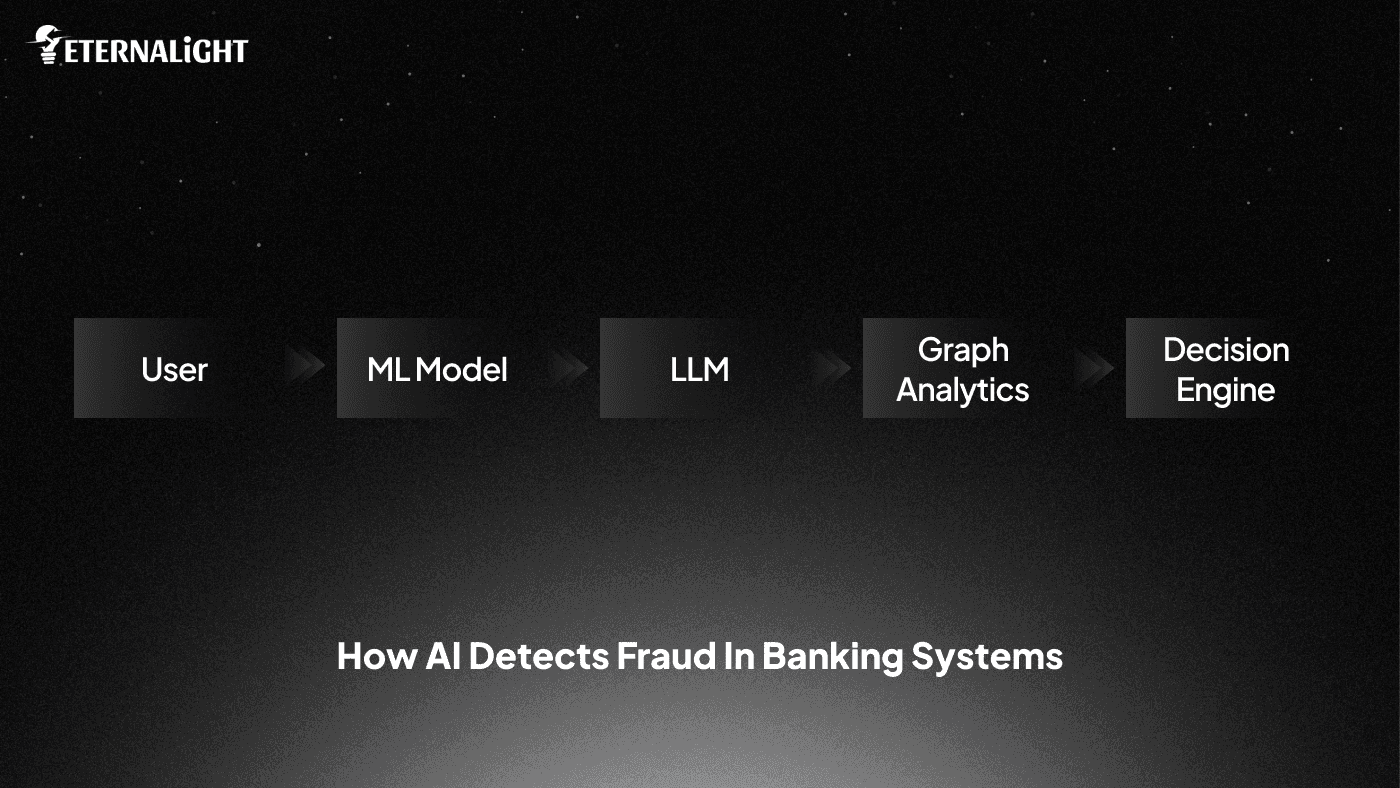
Imagine a fraudster trying to log into your account at midnight from any country.
Before you even receive an OTP, the power of predictive ML takes full charge, flags the attempt, graph analytics connects it to other suspicious devices, and the LLM scans recent emails/messages linked to your number.
How is that possible?
AI optimises workflows using predictive analytics, machine learning, and LLMs that store numerical and language-based data. These AI-enabled fraud detection systems are combined with role-based AI agents.
One is responsible for anomaly detection, another for inaccurate data, and the third for transaction disruption. It also combines computer vision, text analysis, and graph analytics to discover suspicious events.
Let’s discuss below one by one:
These are trained using historical datasets, customer behavioural patterns, previously reported spam, and blocked users.
For this, they assess the mechanisms of neural networks, decision trees, and patterns to detect the risks of navigating the right path.
It accesses the geographical information, time interval, and payment type and displays the potential fraud risk. It takes time to manually check records for different metrics, such as which device the user logged in from, which group they belong to, and their behaviour.
But they fall short in some places.
Most banking phishing attacks occur via text messages, often containing OTPs or links. Thus, to reduce such attacks and discover scam events, Encoder LLMs are integrated into the organization.
Data or emails that cannot be read are scanned by these models and presented in an understandable format, such as an email, a transcript, or logs that require immediate action. Flags when looking at suspicious or abnormal account access requests.
The combined mechanism of Predictive ML, Graph Analytics, and LLMs is worth the effort to combat existing fraudulent scenarios. All three are responsible for different tasks: anomaly detection, identifying hidden links across various sources and patterns, and verifying fraud related to the document.
It's a grouped arrangement, so in case one model is out of service, it is still possible to scan the risk.
As users, whatever we search for on the web is captured as our behaviour, interests, and geographical location. Furthermore, they capture data shared across many social and lifestyle platforms.
From there, capturing activity, payment histories, account balances, asset and liability positions, cash flows across open and external financial entities, interactions with chatbots, market trends, GDP growth, employment status, etc.
Banks have vast amounts of this data, including transaction history, user profiles, and records of their journeys to access specific services and products.
That serves as a metric for banking firms to make recommendations on loan eligibility, creditworthiness, future investment, such as retirement planning, and other services.
With the evolution of technologies such as cloud computing, deep learning, and AI models, it’s easier to predict and deliver helpful information.
It can engage customers for a long time, reduce the occurrence of faults and fraud, and enable hassle-free operations.
Every customer has different interests and spending habits; some have permanent government or private jobs, so they prefer to invest in financial products and services that best match their existing circumstances.
Predictive AI systems capture, process, and integrate the data from multiple sources in a scannable format and enable the customer privacy safety establishment to achieve transparency and resilience in routine transactions through alerts and automated monitoring tools.
Predictive AI in banking firms enables hyper-personalized marketing and cross-selling to encourage customers to initiate investment and insurance plans, and to offer the best credit and debit solutions, by analyzing their transactional historical data, both minor and significant, to deliver short- and long-term benefits.
These AI-enabled, hyper-personalized offerings build precision, which in turn fosters trust, loyalty, and brand positioning among customers.
AI/ML-powered banking tools can access and analyse large datasets and essential documents. If the customer wants to take a loan, these systems analyse their spending and cash flows, document verification, update credit score information, and build portfolios.
Avoids friction between customers and banks and enables rapid loan approval.
Avoids the risk that the customer is unable to pay the loan, cannot apply for or subscribe to any financial services products, or faces any complications.
To avoid the risk of regulatory compliance breaches and suspicious intruder activity, these Predictive AI systems in banking continuously discover the unique customer behaviors, activities, and other operational information.
It speeds up auditing, reporting, and the discovery of financial trails, rescuing anomalies, and reducing high financial risks.
These predictive systems proactively allocate resources and monitor complex operations, flagging suspicious activity.
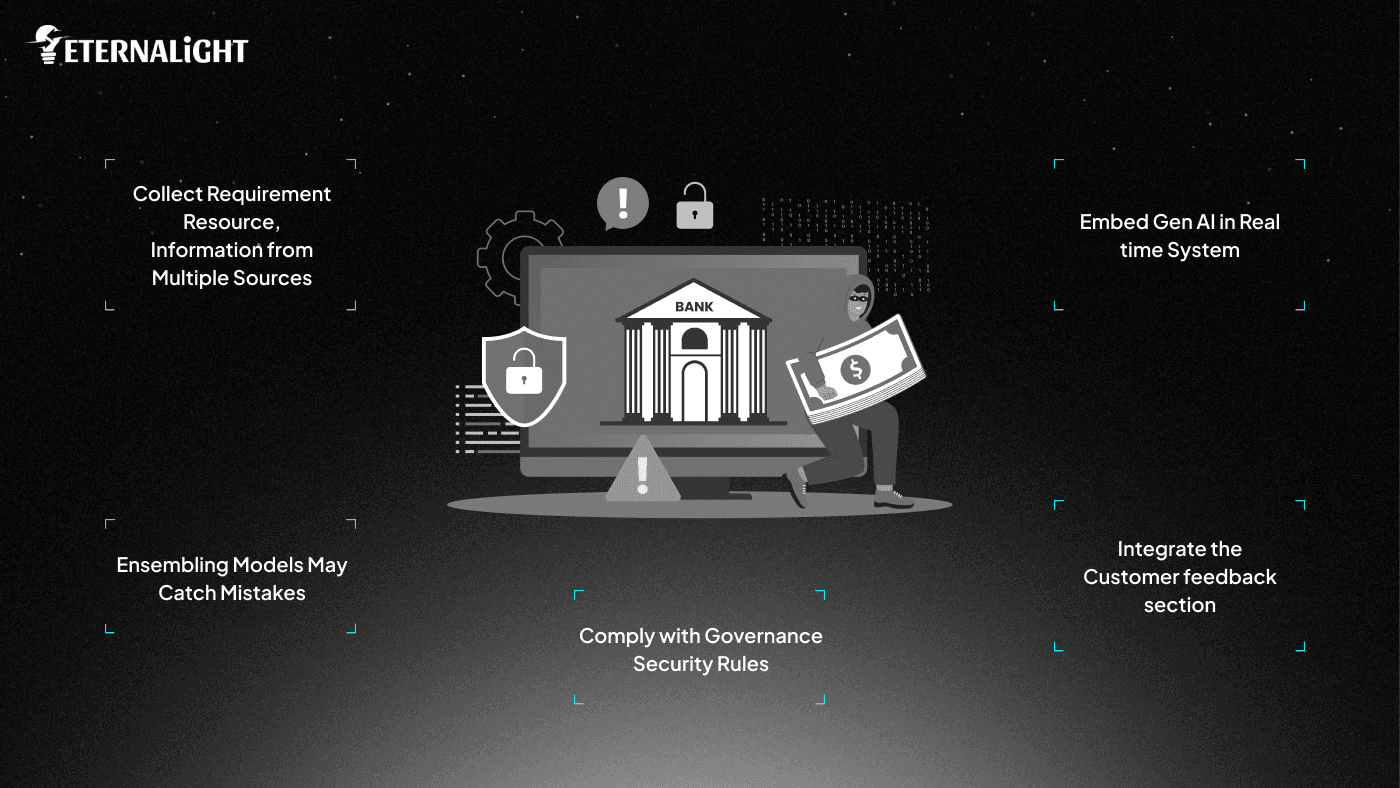
To build an AI fraud detection system for banking services, follow this step-by-step plan to ensure the AI solution delivers the most effective outcome.
To train AI solutions using supervised learning, collect requirements and information, and organize and optimize them in a scannable format. It includes everything: credit score, transaction history, profiles, and other financial assets. Label them to highlight past scams or legitimate ones for better clarity.
Instead of integrating only one model, try combining multiple models to detect all types of anomalies and threats, whether high-level or low-level; these multimodal layers will trace the patterns of fraudulent events.
To track every single minor and significant transaction, install AI fintech solutions with the existing banking system. Like users receive any call, they can block, spam, or report it. Based on the total count, the appropriate option was taken.
Likewise, transactions are under surveillance to enhance user safety and prevent disruptions. That can be separated by flagging the immediate review, trigger, or block option.
Fraud Detetction team is an essential block in any organization that reduces the likelihood of high fraudulent risk alerts and calls, and stores investigation results in models, allowing them to be trained without disruption.
An association of compliance authorities that takes responsibility for ensuring regulatory requirements are met without bias, prioritizing data privacy, is mandatory to integrate. Before launching the AI solutions in fintech, don’t forget to perform rigorous testing. Furthermore, keep the shadow mode on for the deployment phase.
Nowadays, when everything is digitalized, and the fintech industry is growing and evolving by the day, a bad habit is developing in all of us: forgetting credentials or getting cluttered with loan, insurance, or medical documents.
Such things raise concerns about the security of our personal assets and documents.
Fintech is our niche; therefore, we built an innovative platform to securely store critical information that doesn’t need to be exposed but should be accessible to authorized users. This platform is worth it for any type of document, including insurance, bank accounts, digital assets, and essential credentials. While we are incorporating our tech expertise, we have prioritized users’ data privacy and security.
Another thing is that an individual may sometimes be unavailable. We require their personal information immediately; thus, we have focused on building an intelligent digital legacy management platform that is robust, automated, and built on a modern tech stack, featuring SmartSync, which enables the secure analysis of assets, expenses, and other financial briefs.
In addition, this legacy system is enriched with bank-grade encryption, a zero-knowledge architecture, and 99.99% uptime, ensuring reliability and peace of mind.
It's wrap now!
Hackers or intruders are leveraging Generative AI to create fraudulent media files, voice commands, and speeches to carry out phishing attacks via text, email, or voice messages.
Thus, Fraud detection or scam discovery is a mandate to ensure reliability in any banking industry. With the use of LLM models and predictive analytics, it is easier to discover new and old patterns of threats.
Enabling humans at the centre of discussion forums enables navigating hurdles such as the dark web, phishing emails, and global fraud intelligence. Furthermore, fraud teams, systems, and the compliance department are identifying the loopholes and establishing transparency to avoid attacks from anonymous sources by imeplemnting AI in Fintech.

Ayushi Shrivastava
(Author)
Senior Content Writer
Contact us
Send us a message, and we'll promptly discuss your project with you.