We hardly go to the bank these days for our banking needs, be it transferring the amount to a different bank account, changing the debit card pin accessing the passbook details or statements, or applying for a loan or insurance, tracking expenses, subscriptions, SIP or FD; that's all possible with a simple tap on a fintech app.
For that, we don’t need to wait for physical entities' opening time or lunchtime, or visit in person in unfavorable weather; we just need a phone and the app installed on it. But sometimes users get frustrated with the app interface and willingly uninstall it or switch to a different bank account app that offers a better user experience and faster speed.
Building a fintech app isn’t the award-winning move, but aligning user expectations with a decent customer experience is the need of the hour. Users want a platform that satisfies all their needs, offers value-driven features, and provides robust support and scalability.
Here, in this blog, we cover the top trending features of a fintech app that a fintech app development company should prioritize in 2026.
Why Do Features Matter in Fintech Software?
You must have this thought in your mind: all banks and apps are the same. But that’s not true. Not all apps have the encryption, security, and operational efficiency needed to manage the massive volume of user data and transaction workflows.
Agentic AI, cloud computing, ML, and other technologies have emerged in the current landscape and will continue to flourish, so fintech app companies have the opportunity to incorporate these trends to make their applications more compliance-driven, intelligent, and performant.
It can be a wallet app, money transfer app, banking app, mutual fund stock exchange app, gold investment app, or anything else, so it needs strategic planning and a blueprint to develop the prototype and build a competitive app.
Below are the top features of fintech software that will be in demand in 2026.
Top Trending Features Every Fintech Software Should Include in 2026

Fintech apps differ from other domains, so software development companies build fintech software that addresses the specific needs of the finance domain to improve payment processing. They are using blockchain, AI/ML, LLM mechanisms, and industry-grade security & compliance standards to improve the user experience.
Let’s explore the trending features of fintech apps that dominate the industry and improve customer retention and optimize workflows without interruptions.
AI-driven Chatbots and Assistants for Automation
They are using AI in fintech as chatbots and agents to manage multi-step workflows more efficiently and securely, with less human intervention. Fintech companies build AI-powered chatbots and AI agents for credit scoring, expense planning, and mutual fund investment planning, with an intuitive, user-friendly interface with human-like intelligence.
Interactive Financial Dashboard
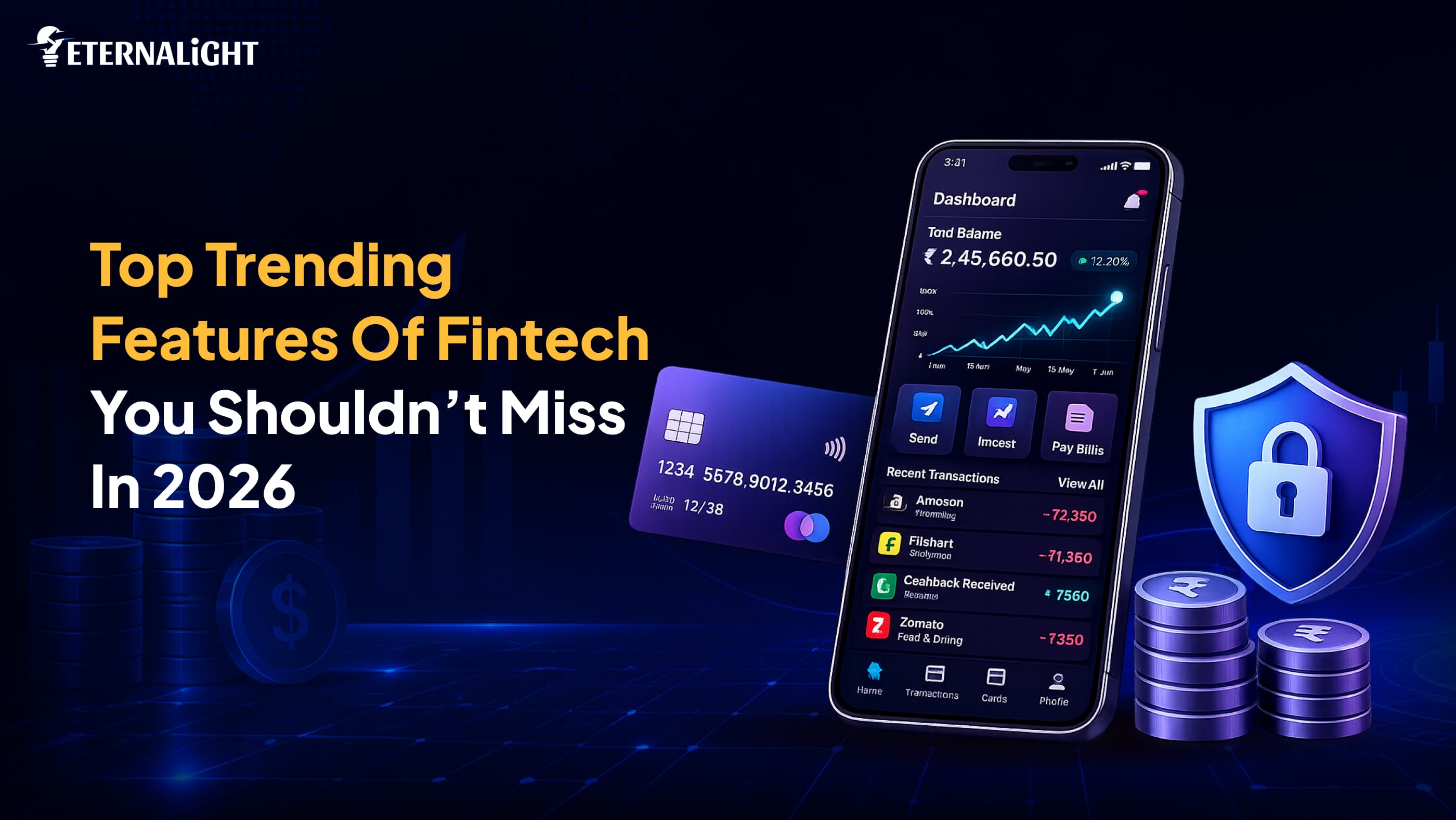
Customers want things to be done in 2-3 taps without any complex journeys. So designing the app with an interactive dashboard that brings all vital accessibility features together in one place would be convenient. It will help to track the latest activity, transactions, budget plan, etc.
Seamless Transactions with Multi-platform support
Some users are comfortable paying via UPI, whereas others are shopaholics who frequently shop across shopping sites and use credit and debit cards to get instant discounts, coins, or mobile wallet offers.
To enable seamless fund transfers and transactions, the fintech app must support multiple currencies and multiple payment methods for billing and subscriptions, applicable to cross-border users.
Cross-Platform Synchronisation
Users have both Android and iOS; both types of phones, it's difficult to develop the app separately for different user bases. Right now, Fitech app developers use a cross-platform tech stack to build the application with a single codebase and mobile-first design, which saves them from double effort and wasted hours. Also, if users switch from Android to iOS, they don’t face any difficulties.
Advanced Security with AI, Biometrics, and Blockchain
Using only a username and password was a traditional practice for securing accounts. Hackers are becoming more forward-thinking, so basic authentication will not work; they can bypass high-level security layers.
So, developers chose encryption methods, biometric & face detection mechanisms, and MFA to detect real-time threats.
Digital KYC & Identity Verification
Also, to make applications more secure, they are built with KYC verification and real-time document verification to prove identity.
Furthermore, adopting blockchain provides decentralization and immutability, enabling transparent, tamper-proof, and accurate transactions and minimizing the risk of cyber fraud and hacking.
Data Visualization and Spending Insights
Each icon conveys a different signal; using them with patterns and graphs enables better understanding and action. If people can’t understand text, they can remember things with elements and avoid risk. So fintech app development companies in india must prioritize this.
Real-time Alerts for Every Single Activity and Latest News
To create a loyal user base, the app must deliver a personalized experience by understanding users' preferences and needs.
If users forget to change their PIN, update their credentials, pay utility bills, recharge, or even claim rewards, the app must send an alert notification to the user via message, WhatsApp, or email so they can avoid any penalties.
As we know, scams and fraudulent activity are common, so informing users about hidden charges, payments, or other financial threats would be beneficial.
Instant Customer Support
Users don’t like to be in a queue or waitlist for simple query responses. If there’s any kind of delay, they must be informed. Thus, establishing a multichannel communication mode with an AI-powered chatbot or AI assistant, compliant boxes will help users to reach out and interact faster.
Implement Gamification for Adding Financial Gain
No matter how old you are, a child lives inside all of us. Adding game-like elements to fintech apps makes the app's features more interesting and encourages users to play games and earn rewards. They like to compete and complete financial challenges, which help them get a discount when making a purchase.
API & Third-party Integration
To manage payment transactions, real-time balance checks, investment, and cyber prevention, third-party integration is needed. It enables advanced-level processing for accounting, taxation, open banking workflows, and data exchange.
As a payment gateway is essential for accessing multiple bank accounts, a fintech development company can adopt a cloud-native architecture to improve efficiency, scalability, and multi-device support, enabling access from anywhere, at any time.
Embedded Finance for Better Customer Experience
No need to hop on multiple apps for shopping; SaaS companies are preparing apps that embed payment gateways, insurance, wallets, and buy-now-pay-later access. It elevates the user experience, enhances convenience, and eliminates transaction hassles.
Open Banking for Connected Financial Services
Enabling open banking for businesses through account aggregation, payment initiation for bank-to-bank and bank-to-fintech, for secure data transmission and data sharing. Enabling better control and privacy, amplifying interoperability and innovation at every tap with a more personalized experience.
Conclusion
Whatever we build in the fintech domain must be relevant to industry and end-user needs. They want security, speed, and stability at the forefront. We at Eternalight continue to explore new dimensions and solutions to revolutionize the fintech industry.
Partnering with the right fintech app development company will save you time and effort; they can identify features and trends and build future-ready, personalized, AI-powered fintech apps.

Ayushi Shrivastava
Senior Content Writer
Ayushi is a Content Strategist at Eternalight Infotech with 4 years of experience in transforming complex ideas into clear, engaging, and SEO optimized narratives. She specializes in crafting impactful content strategies that enhance brand visibility and drive meaningful engagement across digital platforms.
Related Blogs
 Software Development9 Mins
Why Choose Python for Fintech App Development?
Learn how Python helps fintech businesses build scalable, data-driven applications with powerful support for analytics, AI, APIs, and automation.
- Software Development8 Mins
Is It Time to Build Off the Self vs Custom Software for Your Business?
When should you build custom software? Learn the key signs, costs, limitations, and factors to consider before choosing custom software for your business.
- Software Development11 Mins
Website Security Checklist: What to Check Before It's Too Late
Worried about website security? Use this practical website security checklist to spot common risks and protect your website, data, and users.