All over the world, enterprises, startups, and large businesses are managing their work and operations through automation, including chatbots, AI tool assistants, and AI agents. The reason for using these technological instruments is the higher degree of efficiency and accuracy, and the minimum human intervention.
No need to waste hours on manual routine tasks when you can spend your valuable time and efforts on strategizing, value-driven avenues, and improving the productivity of your employees.
Large language models, NLP engines, and ML aspects altogether drive convenience across business operations. Here, this blog covers different AI agent use cases.
You must have heard about the chatbots that often appear on website or app interfaces that answer the user’s query and manage the issues automatically without any human intervention. All these chatbots and other AI-powered conversational tools operate on rule-based workflows and robotic processes that replace manual operations with AI.
Businesses have an enormous amount of data to collect, process, and analyze to meet user expectations and survive in the chaotic marketplace.
With the advent of AI agent use cases, businesses can tap into the edge of automation and make informed decisions, eliminating struggles.
What are AI agents in SME Automation?

AI agents are acting as armed forces across SMEs and enterprises to tackle complex workflows autonomously, without relying on humans. These AI agents not only accelerate speed but also act as business enablers, executing multi-step tasks to fulfill business goals without being limited by rules that can respond to only a few questions. It can learn, adapt, and respond by understanding context and situations. An AI app development company can apply the principles and techniques of LLMs, NLP, and machine learning to simplify cross-functional workflows.
Why are SMEs Adopting AI Agents in 2026?
AI agents have undoubtedly unlocked new avenues for growth that traditional chatbots failed to deliver. Modern-age AI-powered agents can access growing data, evolving trends, customer expectations, etc.
The investment in such custom AI solutions or an AI agent is a wise move for an enterprise to reduce the hustle of heavy manual workflows and boredom, and manage things strategically.
Regardless of the industry domain in which these AI agents are incorporated within their enterprise, they are well-suited to enable automation and real-time decision-making.
Top 10 AI Agent Use Cases Driving SME Automation in 2026
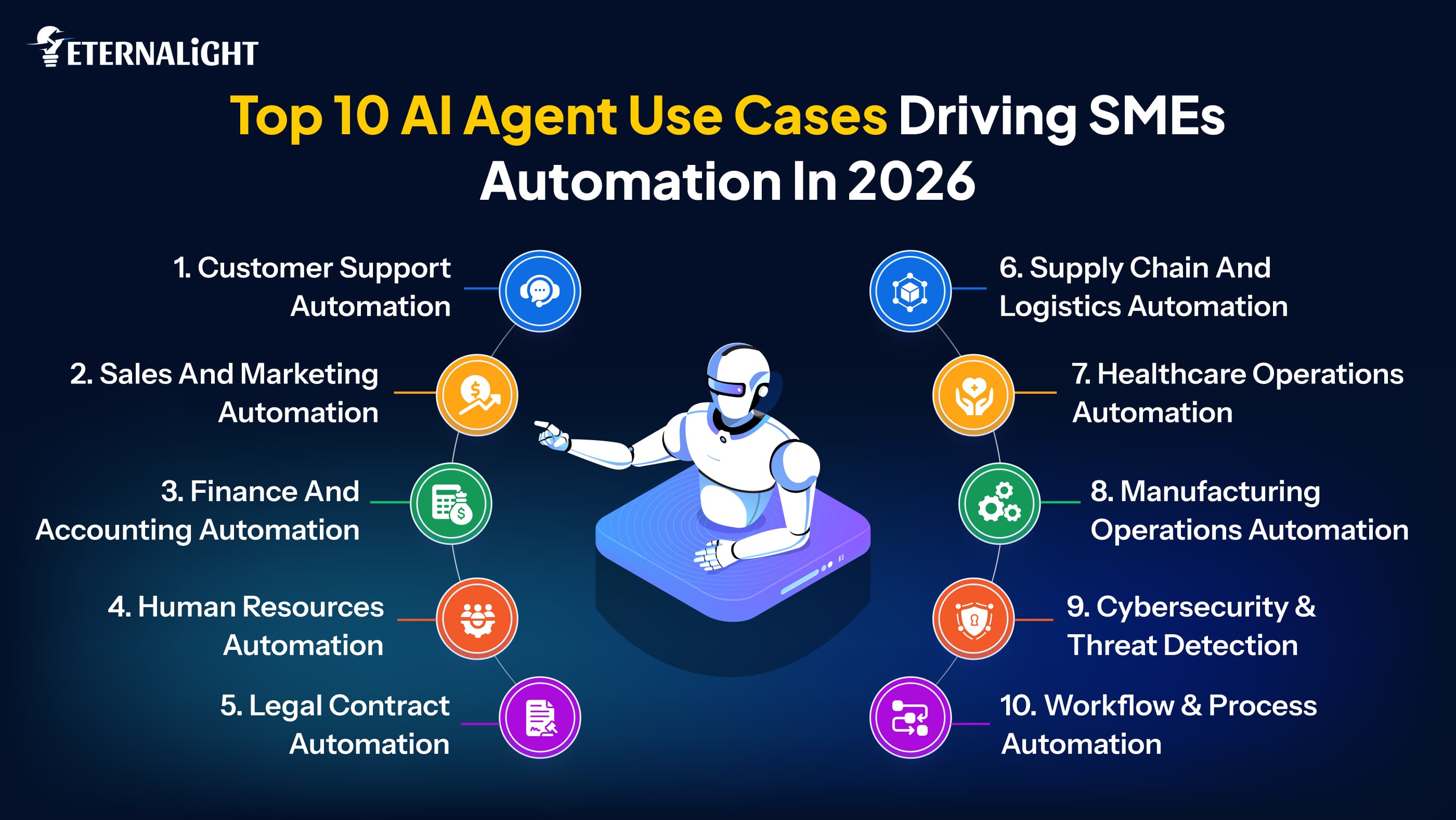
AI agents have undoubtedly driven massive transformation across many industries, simplifying organizational workflows, both internal and external, and managing customer-focused operations. Below, we outline how different types of AI agents influence every domain and decision.
Customer Support Automation
How difficult it would be to answer customers' queries at a time, from ordering items to refunds to other concerns; customer support has to deal with multiple requests; if it takes a little bit longer, customers get impatient.
Humans have limited time, energy, and capabilities, and having automated AI agents at the customer support desk operational costs, gets rescues, and optimizes the customer experience.
Have you ever visited a local shop where the owner manages orders and payments without any system or laptop? It takes time to prepare the bill and handle one customer when there's a long queue, and rushing would make it harder to manage the business. AI agents are driven by comfort, consistency, and efficiency, and they shorten time.
Sales and Marketing Automation
The department spends multiple hours planning, strategizing, and preparing the reports, sheets, and documents to analyze where the business is going. These reports are part of an intense table discussion to take future initiatives, analyzing performance and market falls and rises with top-notch interactions.
Integrating AI agents into the sales and marketing team helps nurture long-term business relationships, identify prospects for new deals, and automate time-consuming follow-ups as official business representatives on behalf of human resources.
With these AI agents, it becomes easier to track competitors' activities and moves, collecting data and insights in multiple formats from multiple sources, and producing structured reports aligned with user personas.
Finance & Accounting Automation
Spreadsheets alone don’t summarize finance and accounting; it's way more than that. The professionals prepare invoices, payroll, tax, expense approvals, compliance monitoring, R7R and more.
Humans have been doing it for several years, but having support from AI tools and agents reduces the workload and the risk of errors.
In large enterprises, we need to rely on advanced technological tools to eliminate risks, such as calculators and other compliance issues.
It elevates efficiency and accuracy across all financial and accounting workflows by synchronizing orders, transaction actions, and reporting.
AI agents can review the spreadsheet and organize it properly, helping to do forecasting and strategic budget planning. AI agents can also track the cash flow, identifying the mischievous patterns that can lead to additional expenses.
Human Resources Automation
When we think about the human resources department, it seems like they only organize fun events; however, HR is a significant pillar of any organization. They are responsible for hiring the right fit for the organization for the relevant role and designation.
However, from scrolling through profiles to screening, interviewing, and final onboarding, it takes days and multiple classes and emails.
AI agents have entered the HR department as a companion and a big-time savior, streamlining processes more efficiently. An AI agent can autonomously filter the best candidate profiles for interviews and reply to them via email.
If the candidate has any queries, these agents automatically respond without leaving them waiting.
In this fast-growing business world, it's tough to interact with candidates; it also heightens tension and burden, increasing chaos. Implementing AI agents will take over the load of the recruitment cycle, without wasting time on communication or administrative tasks, helping to engage the candidates and make the right choices.
Workflow And Process Automation
To drive an organization systematically without conflict, numerous employees work to complete a simple task. They are connected to each other and dependent on obtaining approvals for important actions and decisions.
If a person is absent, it's hard to process without their consent, leading to inefficiency, delays, and breaks in communication and connection.
If we set up the AI agent, it smooths communication flows and processes, intelligently orchestrates route approvals as needed, and helps prepare reports. Also, these AI agents adapt to evolving conditions, align with the context, and provide thoughtful responses.
Legal Contract Automation
Legal organizations connect with multiple clients and vendors daily and prepare contracts and legal documents. Before that, they need to collect important information for transactions, including personal details, ask about terms and conditions, and clarify expectations.
Doing everything manually isn't realistic, and it's also harder to review whether documents, contracts, or compliance requirements are fulfilled. As vendors and partners are involved, it's critical to invest time and verify for strategic decisions.
Legal teams set up the AI agents' environment to improve data extraction and analysis, summarizing, categorizing, and eliminating any misunderstandings and risks in the process.
Supply Chain and Logistics Automation
Nowadays, businesses are not running only from physical shops. Owners have social media channels and web app support where they can list products and services, share photos and videos, and integrate payments, with responsive, robust interfaces.
Businesses are not limiting their services to locals only; with the advent of AI-powered tools and agents, they can anticipate rising demand and plan their inventory accordingly. That enables them to maintain the supply chain and continue the logistics services.
Another great thing about these AI agents is that they can provide route recommendations that are better than those of conventional supply chain management systems. Businesses can avoid stockouts by better forecasting customer demand.
Healthcare Operations Automation
A hospital is a 24x7 job where multiple professionals are responsible for scheduling appointments, managing patient treatment histories, tracking future operations, billing, and other administrative tasks, as well as vehicle availability, medications, and blood bank viability.
Apart from patient-focused operational activities, healthcare professionals need to collaborate with their staff and senior experts to provide services and treatment, and to consult more efficiently, answering their queries.
Having AI agents in the healthcare industry is an innovative way to shift and share major responsibilities and improve the experience for both healthcare professionals and patients.
Manufacturing Operations Automation
How do we manufacture something?
Through machines and equipment. Yeah exactly. Suppose you receive a major order to complete, or are trying to complete, production, but the machinery suddenly fails. It will definitely be a panic encounter.
These things happen when you just keep neglecting the small glitches that lead to malfunction. It increases production costs and extends the project timeline, affecting quality.
What can we predict in advance to eliminate such potential unexpected mishaps? A
I agents can manage this autonomously, eliminating disruptions, optimizing production workflows to meet the delivery timeline, ensuring top-notch quality, and preventing mishaps through advanced, strategic resource planning.
Cybersecurity and Threat Detection
When discussing technology, we cannot overlook the rise of cyber threats, which are common today. As technology approaches diverse domains, establishing sophistication and frequency at higher note security levels has become a crucial factor.
AI agents' role is evident in fraud detection. They can diagnose vulnerabilities in the network layer, detect suspicious behavior, and help set up security alerts that can be triggered when potential cyber vulnerabilities are detected.
Relying solely on conventional security practices invites threats, whereas AI agents can detect them earlier.
Key Benefits of AI Agents for SMEs
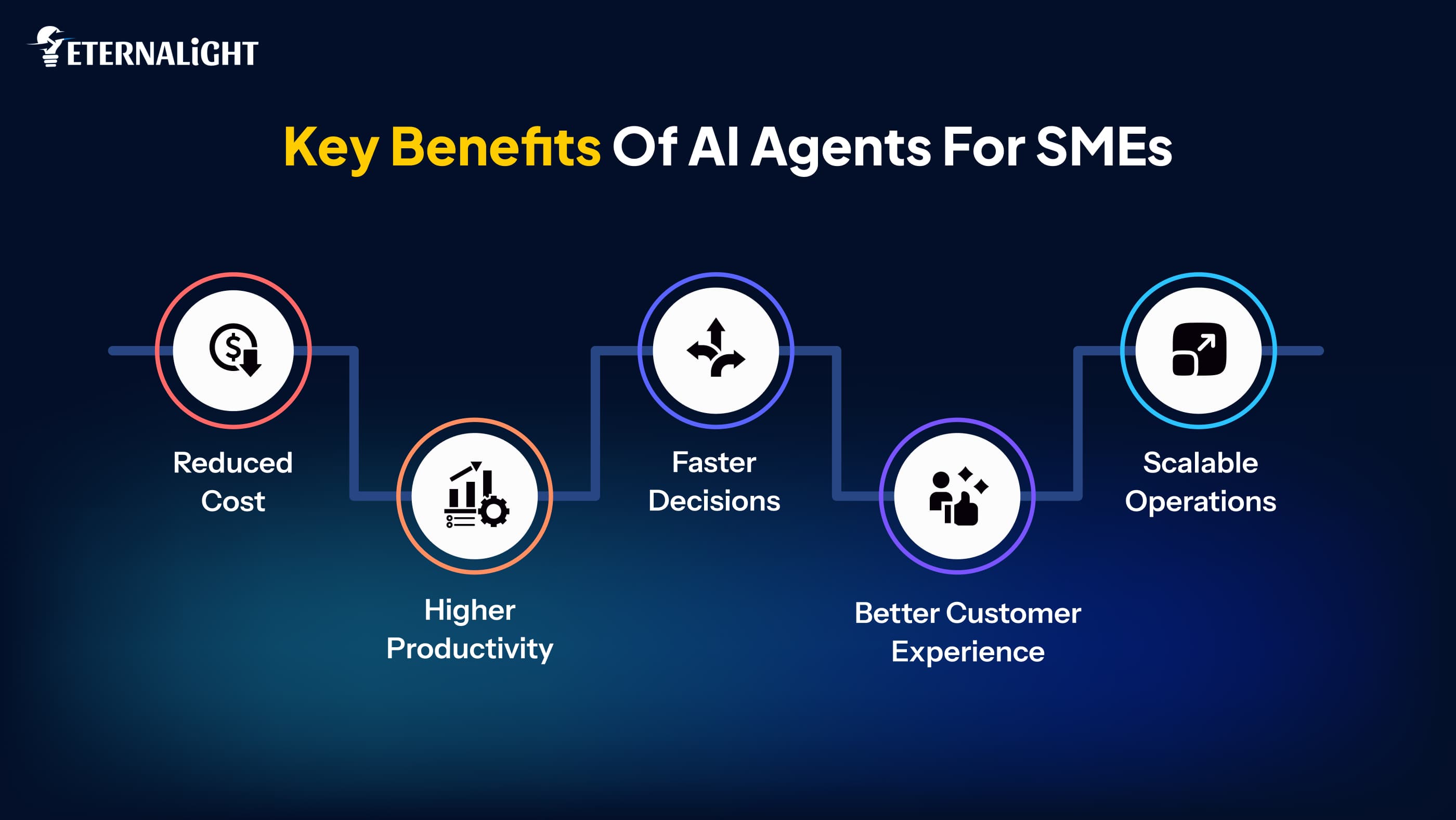
All the major industry sectors have adopted AI agents in their workplaces to tackle complex operations with ease.
Higher Productivity
Employees are free to focus on important tasks rather than routine tasks that consume time and effort and add pressure.
Reduced Cost
When human effort and time are reduced, labor and operational costs automatically decrease. Organizations can scale their businesses without worrying about expenses.
Faster Decisions
AI agents can access, retrieve, and analyze massive amounts of data, converting it into actionable insights to inform important decisions and structure future planning more effectively.
Scalable Smooth Operations
Fewer human errors increase the potential to win customer engagement in competitive business environments through structured reporting and analysis.
Better Customer Experience
AI agents access raw data and turn it into personalized responses to improve the customer experience.
Challenges of Implementing AI Agents
As AI agents drive efficiency and exclusivity to businesses, the implementation is more complicated and comes with challenges.
Planning plays an important role in AI agent integration with applications; neglecting strategy, blueprint, and governance will lead to critical issues.
If AI agents don’t comply with data security and privacy norms, sensitive data can be exposed publicly.
Many enterprises want to modernize their legacy systems by integrating AI to tackle challenging scenarios, and for this, an experienced team of AI-powered software developers is needed; beginner-stage developers are unlikely to do so.
AI agents leverage NLP, ML, and data pipelines, but they need the right strategy and techniques to teach these models and agents, with support from human intervention.
Sometimes, due to a lack of accuracy or reliability, responses and outputs may be affected and fail to align with the organization's values and objectives.
How Eternalight Infotech is Helping Enterprises and SMEs to Launch and Build AI Agents
At Eternalight Infotech, every product we build is aligned with the client's expectations and keeps pace with technological evolution. As businesses need something unique and tailored to their business to engage customers, we strive to deliver innovative solutions that automate tasks and operations through scalable architectural design. We build AI agents to manage customer support, enterprise workflows, and strategic work within a cloud-native architecture, delivering value-added, measurable, and outstanding impact.
Wrap Up
AI agents have driven a transition to modern agent business operations, expanding the capabilities of traditional chatbots. Now they have a sense of context and scenarios, can take informed, strategic, decision-driven initiatives, and align the business to perform better.
The business process automation use cases of AI agents we mentioned above reflect the changes resulting from their evolution. They not only reduce costs but also improve real-time interaction and provide a better experience. Now, in the middle of 2026, the industry is evolving with technological advancements and tools that empower businesses to scale their future endeavors. In the coming days, the storm will not take a back seat but will continue to flourish.

Ayushi Shrivastava
Senior Content Writer
Ayushi is a Content Strategist at Eternalight Infotech with 4 years of experience in transforming complex ideas into clear, engaging, and SEO optimized narratives. She specializes in crafting impactful content strategies that enhance brand visibility and drive meaningful engagement across digital platforms.
Related Blogs
- AI & ML10 Mins
AI Data Security Strategies: 8 Ways to Protect Data in AI Systems
Explore 8 AI data security strategies to protect sensitive data across prompts, AI models, RAG systems, APIs, access controls, storage, and outputs.
 AI & ML17 Mins
AI-Ready Data Architecture: A Complete Guide for Modern AI
Learn how AI-ready data architecture works, its key components, framework, how to build it, and how it supports generative AI, machine learning, and AI agents.
 AI & ML16 Mins
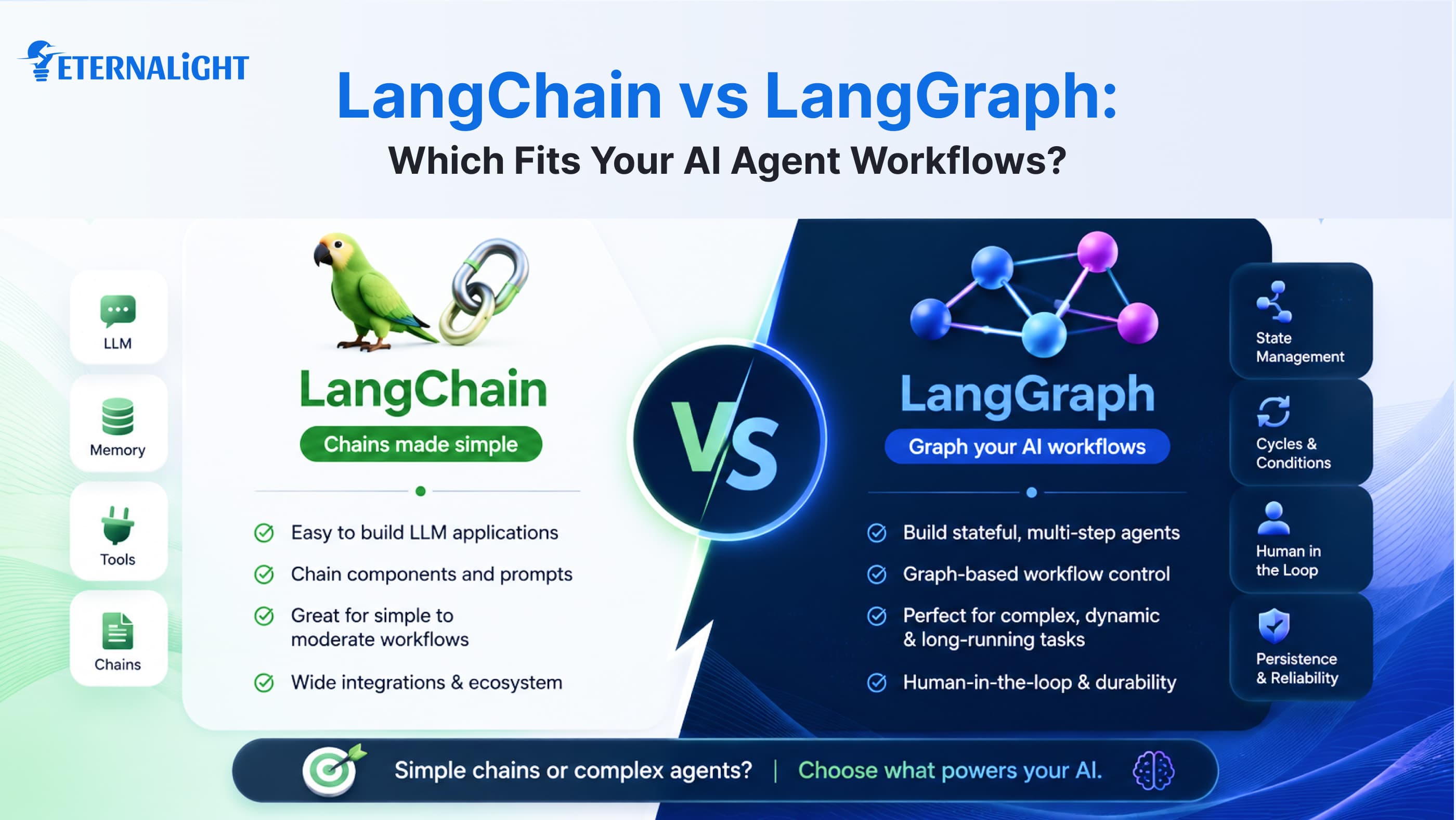
LangChain vs LangGraph: Which Fits Your AI Agent Workflows?
Compare LangChain vs LangGraph to understand their key differences, use cases, and how each framework fits modern AI agent workflows.