From software development to finance and other domains, people love swapping manual tasks and responsibilities for agentic AI, letting them hand off specific tasks to be done autonomously with minimal human involvement.
Each agent is assigned a different job to accomplish and keep the work moving. They can manage because the agents are well configured, with integrated models and integrations, and analyze workflow behavior patterns, data, memory logs, and context graph.
So if they need someone to check the order, confirm and verify the payment, verify an individual’s record stored in the database, or confirm the refund and return, the system can handle it efficiently.
Suddenly, the module gets updated, and changes appear; maybe the product doesn’t match the category or other details, incvoice/ billing format, or any other field is modified, then humans have to step in the action to figure it out until they reach a conventional way.
RPA handles manual actions with a clear set of instructions, but business dynamics evolve over time; as workflows change, we can’t predict every move, so agentic AI steps in to interpret the information, take the required actions, and adapt to change.
RPA is better and unique in its capabilities, but agentic AI makes more sense when there is uncertainty; sometimes they work together to handle unconventional situations.
What Are Agentic AI and RPA?
Whether it’s RPA or Agentic AI, both are infusing automation into manual workflows and transforming business operations, but it still causes confusion. Let’s understand them one by one:
Agentic AI
First, we want to clarify that AI agents and Agentic AI aren’t the same. An AI agent is designed to complete a multi-step workflow task, but sometimes one agent can’t manage complex organizational operations; when you arrange one or multiple AI agents to complete the final goal, that's agentic AI.
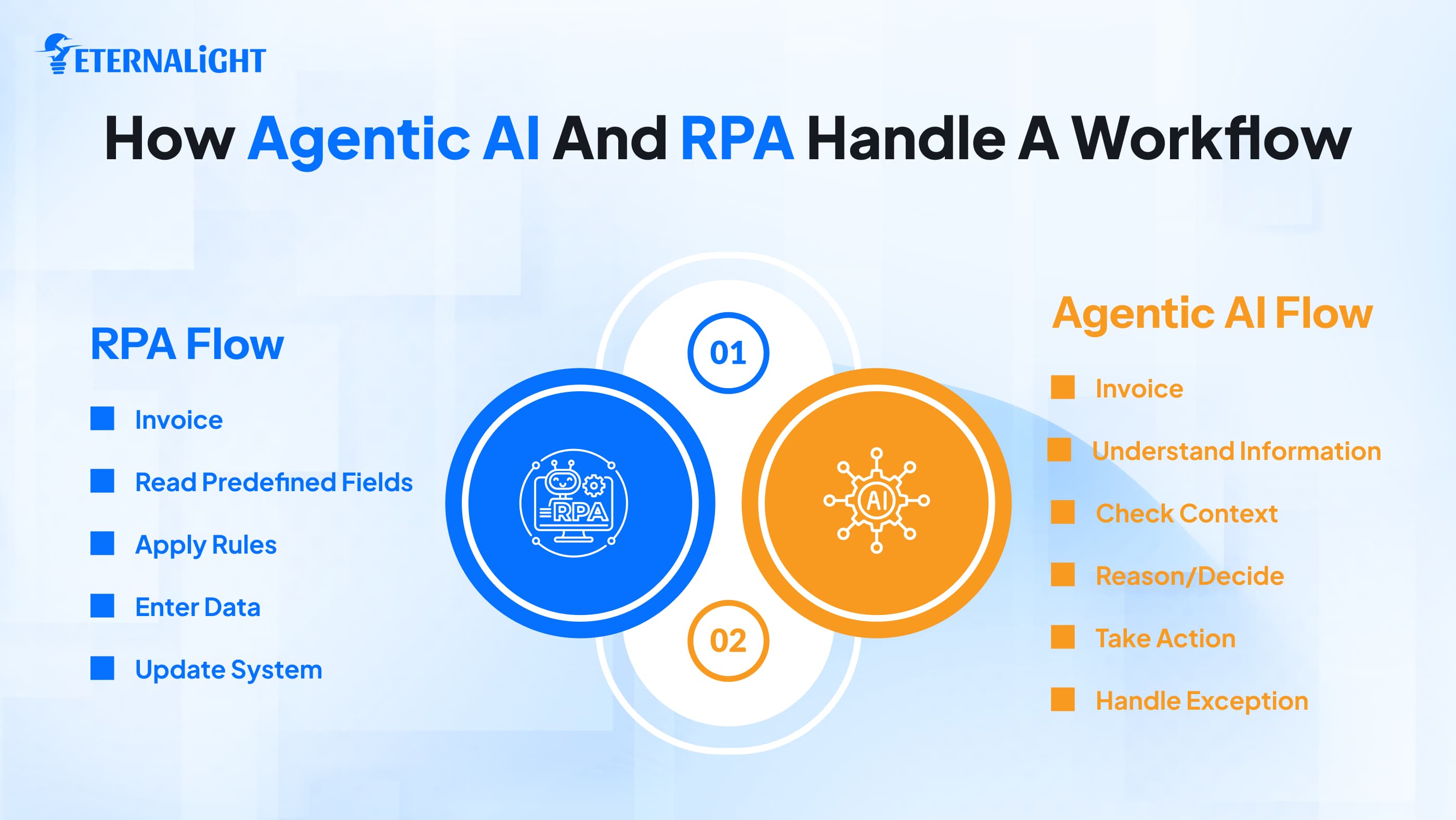
Here, AI agents can sync the workflow and manage the process independently, making decisions and accessing multiple tools as needed.
Collect or Percieve Information: they find the intent and information from connected tools, databases, sensors, and user-curated prompts
Reasoning: these agentic AI-driven systems are connected with LLMs to gather the information and prepare the sprint plan using RAG, an AI model, or a deployment environment
Execution: Agents perform the action, complying with protocols like MCP or A2A
Adapt: Taking the notes and knowledge from the user responses and feedback, and discovering successful attempts and failures by analyzing behavior and patterns
RPA or Robotic Process Automation
In RPA, software runs structured, rule-based queries and responds with answers that match the set rules. It does the human job and frees up time to focus on other core tasks that require human intervention. This software can interact like a human: research, fill in details, save information, and auto-transfer emails and files from legacy apps to modern apps. RPA can easily interact with a GUI.
So here's the catch: in an agentic AI arrangement, agents can autonomously decide the next step to achieve fixed goals, but in RPA the process and actions are predictable; the software acts only on pre-fed information or strict, protected rules.
RPA manages the task in three predictable steps:
Tracing: The bot records all the steps from logging in to the system to logging out, where people frequently navigate, and what they essentially extract
Process Implementation: Implement the rule logic and standards, complying with the conditions and analyzing the patterns and behaviors, such as after which query what will come next
Execution: All the moves are predefined by systems
Agentic AI vs RPA: Key Differences
RPA and Agentic AI are both powerful in their own ways for handling startup and enterprise tasks.
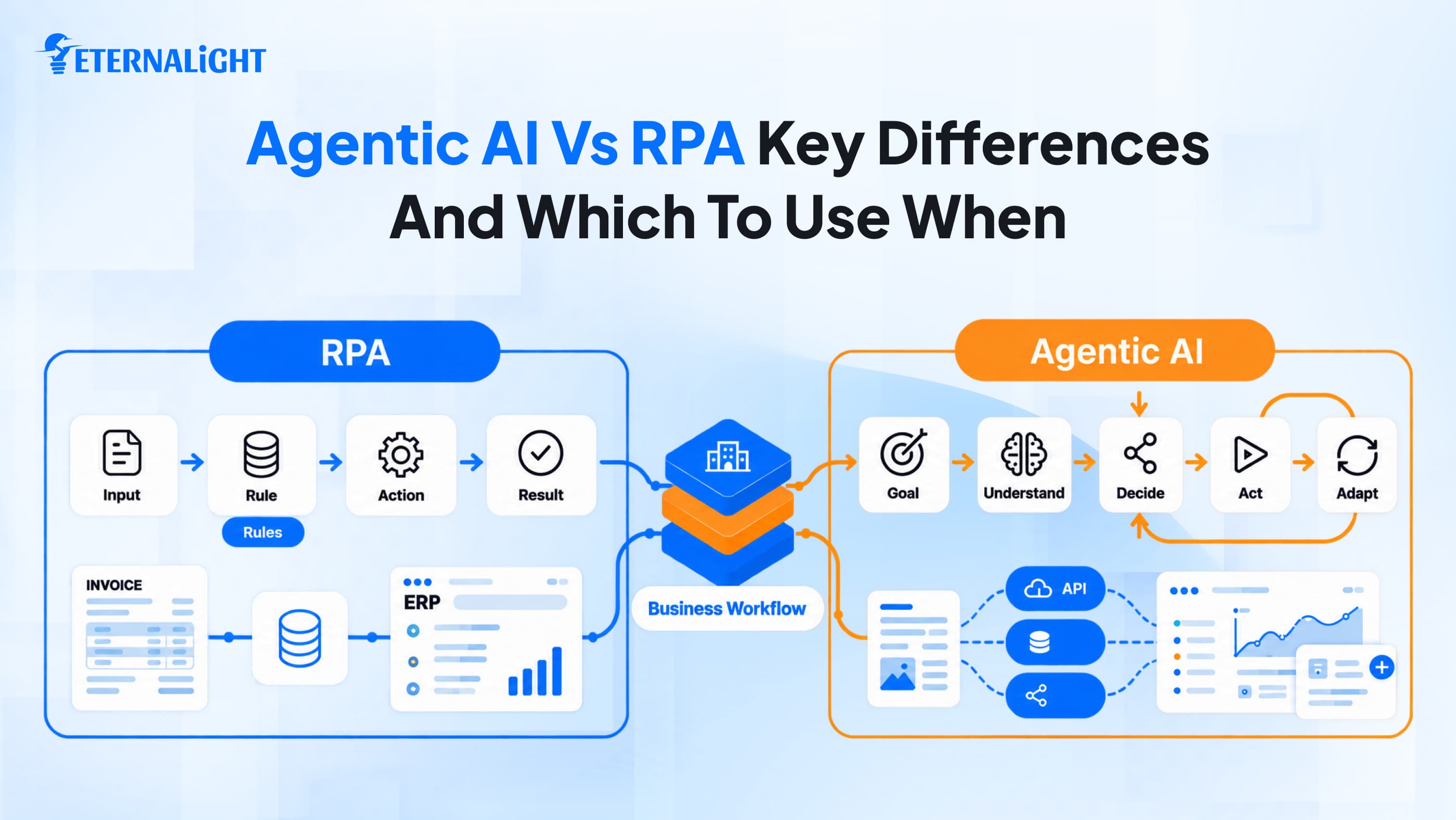
Suppose there is an ERP system connected to an accounting system where a bot tries to log in and process an invoice; there are multiple fields like vendor name, amount, and items in different document formats that automatically manage the user journey and confirm approval.
But if any format or field doesn’t match the structured format stored in the legacy system, it refuses to log in. Or the wrong entries get copy-pasted into the database, and it can’t be tracked until someone notices. The bot may act unpredictably or fail to enter the data.
In an agentic AI-driven system, a pre-defined goal is set to fill and process invoices. AI agents scan the invoice, identify field data types, map them to stored records and orders, and check when the order is placed or a record is inserted; they identify all nodes, edges, and cases to flag anything wrong or ambiguous and make decisions accordingly by entering the right variable values.
Agentic AI | RPA |
Flexible, adaptable to real-life incidents and context | Rigid to predefined queries and tasks |
Workflow is structured yet self-decisive | Structured and Rule-based Process |
Analyze, implement logic and standards, and doesn’t necessarily need APIs; integration is enough for the next move | Bots can execute with or without APIs and third-party tools |
Multiple agents heading towards the goal | It's a unified bot workflow |
When to Use RPA?
If the system handles inventory, banking, financial records, or revenue records, RPA can retrieve or scan order history and records even if an API is unavailable. Bots can efficiently compile records and variables across different process modes through the GUI.
They can partially manage the task, offloading human work; the bot can manage independently with rule-based arrangements and triggers; or, in hybrid mode, divide the work with key notes and edges.
When to Use Agentic AI?
Agentic AI fits better in dynamic scenarios where the situation evolves, is not static, and requires real-time decisions using tools. It requires discovering the issue, reviewing previous and ongoing steps, and responding accordingly. Frequently needs approval and is backed by compliance and governance.
Agentic AI and RPA: Can They Work Together?

Across every industry, companies’re adopting and relying on AI capabilities that drive speed, performance, and error-proof innovation. RPA and agentic AI have both been adopted to drive transformation, accuracy, and automation, and they share the goal of reducing operational chaos and human responsibilities. Both have conventional and unconventional strengths for managing specific tasks.
Using both together is like moving in parallel to achieve the single goal. We can divide their work by capability: RPA can handle high-volume, predictable, rule-based tasks, while Agentic AI can manage planning and strategic decision-making for future growth.
Can’t Decide: Which One to Choose Between Agentic AI and RPA?
Likewise, when choosing tools, software, or anything else, it depends on our requirements, what we want to achieve right now, and our priorities. Agentic AI and RPA both aim to drive automation and a lag-free experience.
If a project needs frequent analysis and reasoning, clear decision-making, reduced ambiguity to complete tasks, and the ability to turn accumulated facts into insightful outcomes, agentic AI takes the lead. If you also need to monitor logs and other activities for inspection and governance, agentic AI can help.
If a project or work involves repetitive moves, frequently asked problems with definite solutions, and high-volume tasks that need utmost consistency in a legacy system without any third-party APIs, RPA makes sense.
We can say RPA has a story around which the workflow situations are built, and tasks are performed with specific credentials, like a copy-paste exercise without the need for tracking regular sessions or governance needs. An RPA system uses pre-configured credentials for all task types.
Conclusion
The goal of driving automation is the same, but the approach differs. For rule-based tasks where every move is predictable and frequently executed, RPA works well.
On the other hand, Agentic AI fits well for complex multi-task workflow execution with advanced reasoning, decision-making, and action in different scenarios.
You can’t replace one with the other; assess your requirements first: the level of complexity and consistency you need, and the approach to syncing workflows.

Ayushi Shrivastava
Senior Content Writer
Ayushi is a Content Strategist at Eternalight Infotech with 4 years of experience in transforming complex ideas into clear, engaging, and SEO optimized narratives. She specializes in crafting impactful content strategies that enhance brand visibility and drive meaningful engagement across digital platforms.
Related Blogs
- AI & ML7 Mins
Best Prompt Engineering Techniques for AI Agent Systems
Explore prompt engineering techniques for different AI use cases, including structured prompts, zero-shot, few-shot, multimodal inputs, security, and testing.
- AI & ML10 Mins
AI Doesn't Forget. It Loses Context: How Context Graphs Can Help
Learn how context graphs help AI agents connect information, retain context, and make better decisions with AI memory tools and retrieval systems.
- AI & ML10 Mins
How to Test Generative AI Applications: A Practical Guide to Reliable AI Systems
Learn how to test generative AI applications for accuracy, hallucinations, performance, security, RAG workflows, and reliability.